
9 Results for "

presynaptic neurons

" in MedChemExpress (MCE) Product Catalog:
Products (9)

9 Results for "presynaptic neurons" in MCE Product Catalog:

Cat. No.: HY-B0590B
CAS No.: 1026016-83-0
Synonyms: (+)-TBZ; (3R,11bR)-TBZ; (3R,11bR)-Tetrabenazine
Target:  

Monoamine Transporter

Research Areas:  

Cancer

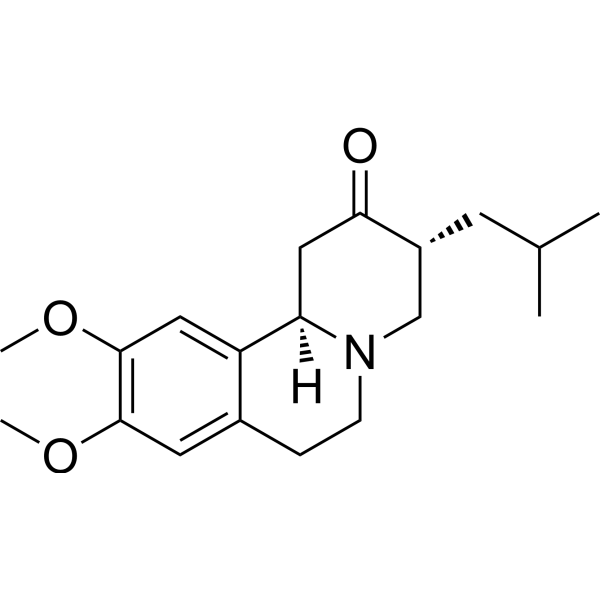
(+)-Tetrabenazine ((+)-TBZ) is the enantiomer of Tetrabenazine (HY-B0590) and is also a Vesicular Monoamine Transporter 2 (VMAT2) inhibitor with a rat Ki of 4.61 nM. (+)-Tetrabenazine inhibits monoamine uptake into granular vesicles of presynaptic neurons. (+)-Tetrabenazine is 3 times more active than (-)-Tetrabenazine. (+)-Tetrabenazine can be used for the research of Huntington's disease and hyperkinetic movement disorders (including chorea) .
loading...
    loading...
Cat. No.: HY-P3089A
Target:  

Potassium Channel

Research Areas:  

Others

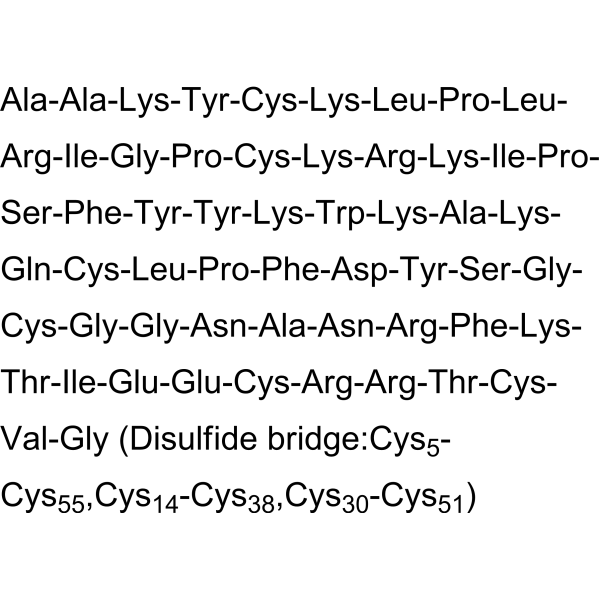
Dendrotoxin K TFA is a Kv1.1 channel blocker. Dendrotoxin K TFA determines glutamate release in CA3 neurons in a time-dependent manner through the control of the presynaptic spike waveform .
loading...
    loading...
Cat. No.: HY-141554
CAS No.: 3466-75-9
Purity:  99.23%
Synonyms: DHTBZ
Target:  

Monoamine Transporter

Research Areas:  

Neurological Disease

Dihydrotetrabenazine (DHTBZ) is the active metabolite of Tetrabenazine (HY-B0590). Dihydrotetrabenazine is the inhibitor for human vesicular monoamine transporter 2 (VMAT2), that reduces monoamine content in presynaptic neurons, and can be used in movement disorder research .
loading...
    loading...
Cat. No.: HY-P10979
CAS No.: 116786-35-7
Research Areas:  

Neurological Disease

Buccalin is a neuropeptide that colocalizes with small molecule cardioactive peptides in neuronal B15. When exogenously applied to the ARC neuromuscular junction, Buccalin reduces the amplitude of muscle contraction induced by motor neuron firing and acts only presynaptically. Buccalin has no effect on the rate of muscle relaxation and reduces motor neuron-induced ARC excitatory junction potentials without affecting contraction produced by direct acetylcholine action on the muscle .
loading...
    loading...
Cat. No.: HY-P3089
CAS No.: 119128-61-9
Target:  

Potassium Channel

Research Areas:  

Others

Dendrotoxin K is a Kv1.1 channel blocker. Dendrotoxin K determines glutamate release in CA3 neurons in a time-dependent manner through the control of the presynaptic spike waveform .
loading...
    loading...
Cat. No.: HY-113985
CAS No.: 59939-16-1
Synonyms: LD 3098
Cirazoline (LD 3098) is a doul agonist of Presynaptic imidazoline receptors (R(i-pre)) and α-adrenoceptor (R(α)). Cirazoline (30 μM) suppresses M current in SCG neurons cultured overnight .
loading...
    loading...
Cat. No.: HY-P2084
CAS No.: 149665-72-5
Target:  

Peptides

Research Areas:  

Neurological Disease

WWamide-1 is a neuropeptide, which can be isolated form Achatina fulica. WWamide-1 inhibits central neurons of snails, regulates the snail muscle contraction. WWamide-1 inhibits the contraction of anterior byssus retractor muscle (ABRM), enhances the contraction of the radular traction muscle, through effects on presynaptic and postsynaptic membrane of the muscle .
loading...
    loading...
Cat. No.: HY-183665
CAS No.: 76778-24-0
Target:  

Dopamine Receptor

Research Areas:  

Neurological Disease

GBR-13119 is a blood-brain barrier-permeable inhibitor of the presynaptic dopamine uptake system. GBR-13119 binds to dopamine uptake sites with high selectivity, without being affected by other neurotransmitter reuptake inhibitors. GBR-13119 exhibits a lipophilic systemic distribution profile with extremely low defluorination in rats, while it shows a differential characteristic of slow striatal washout in the brain of primates. GBR-13119 can serve as a PET tracer to achieve visualized imaging of the striatum in primates, and can reflect MPTP-induced dopaminergic neuron degeneration through reduced uptake. GBR-13119 can be widely applied to studies related to Parkinson's disease and dopaminergic neuron degeneration .
loading...
    loading...
Cat. No.: HY-L165
281 compounds

Dopamine receptor (DAR), widely distributed in the brain, plays a key role in regulating motor function, motivation, driving force and cognition. The role of DA is mediated by D1-type (D1, D5) and D2-type receptors (D2S, D2L, D3, D4), which are distributed in presynaptic, postsynaptic and extrasynaptic, projection neurons and interneurons. Each receptor has a different function. D1 and D5 receptors couple with G stimulation sites and activate Adenylyl cyclase. The activation of Adenylyl cyclase leads to the production of the second messenger cAMP, which leads to the production of protein kinase A (PKA), which leads to further transcription in the nucleus. D2 to D4 receptors are coupled to G inhibitory sites to inhibit adenylyl cyclase and activate potassium Ion channel. These receptors utilize phosphorylation cascades or direct membrane interactions to affect the functions of voltage-gated and neurotransmitter-gated channels, cytoplasmic enzymes, and transcription factors. Dopamine receptor plays an important role in daily life.

MCE designs a unique collection of 281 small molecules related to dopamine receptor. It is a good tool for screening drugs from nervous system disease.

