


14 Results for "

pulmonary vasoconstriction

" in MedChemExpress (MCE) Product Catalog:
Products (14)

14 Results for "pulmonary vasoconstriction" in MCE Product Catalog:

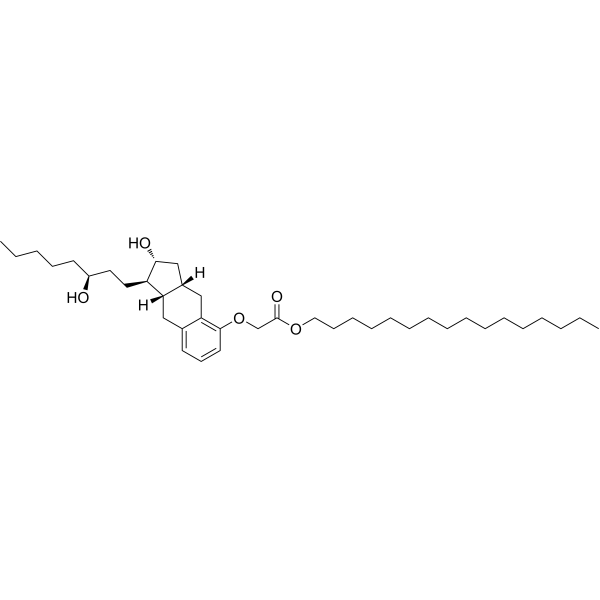
Cat. No.: HY-109163
CAS No.: 1706528-83-7
Purity:  99.62%
Synonyms: INS-1009
Treprostinil palmitil is a long-acting inhaled pulmonary vasodilator prodrug of Treprostinil (HY-100441), formulated in a lipid nanoparticle (LNP). Treprostinil palmitil can inhibit pulmonary vascular remodeling induced by Su/Hx challenge in rats. Treprostinil palmitil can induce cough. Treprostinil palmitil demonstrates a sustained presence in the lungs with reduced systemic exposure and prolonged inhibition of hypoxia-induced pulmonary vasoconstriction in vivo. Treprostinil palmitil can be studied in research for pulmonary arterial hypertension and interstitial lung disease .
loading...
    loading...
Cat. No.: HY-B1298
CAS No.: 61-16-5
Target:  

Adrenergic Receptor

Research Areas:  

Neurological Disease Endocrinology

Methoxamine hydrochloride is a selective alpha1-adrenergic receptor agonist. Methoxamine hydrochloride causes vasoconstriction and increased peripheral vascular resistance . Methoxamine hydrochloride significantly increased the overflow of ATP, ADP and AMP, but not adenosine, by a prazosin-sensitive mechanism in the rabbit pulmonary artery .
loading...
    loading...
Cat. No.: HY-B1298A
CAS No.: 390-28-3
Target:  

Adrenergic Receptor

Research Areas:  

Cardiovascular Disease

Methoxamine is a selective alpha1-adrenergic receptor agonist. Methoxamine causes vasoconstriction and increased peripheral vascular resistance . Methoxamine hydrochloride significantly increased the overflow of ATP, ADP and AMP, but not adenosine, by a prazosin-sensitive mechanism in the rabbit pulmonary artery .
loading...
    loading...
Cat. No.: HY-P1016B
Target:  

Endothelin Receptor

Research Areas:  

Cardiovascular Disease

BQ-3020 ammonium is a selective endothelin receptor (ETB receptor) agonist. BQ-3020 ammonium inhibits [ 125I] ET-1 binding to ETB receptors, with an IC50 value of 0.2 nM. BQ-3020 ammonium elicits vasoconstriction in the rabbit pulmonary artery. BQ-3020 ammonium makes relaxation of the pig urinary bladder neck and can be used for cardiovascular disease research . .
loading...
    loading...
Cat. No.: HY-105408A
CAS No.: 221246-12-4
Fandosentan potassium is a potent endothelin A receptor (ETAR) antagonist. Fandosentan potassium inhibits CYP2C9 and CYP3A4 activities with IC50 values of 39.6 and 21.6 μM, respectively. Fandosentan potassium reverses the hypoxic pulmonary vasoconstriction in the perinatal lamb. Fandosentan potassium can be used for pulmonary hypertension research [1][2].
loading...
    loading...
Cat. No.: HY-P1016
CAS No.: 143113-45-5
Target:  

Endothelin Receptor

Research Areas:  

Cardiovascular Disease

BQ-3020 is a selective endothelin receptor (ETB receptor) agonist that displaces [ 125I] ET-1 binding to ETB receptors, with an IC50 value of 0.2 nM. BQ-3020 elicits vasoconstriction in the rabbit pulmonary artery. BQ-3020 makes relaxation of the pig urinary bladder neck and can be used for cardiovascular disease research 1 2.
loading...
    loading...
Cat. No.: HY-134092
CAS No.: 131391-65-6
Synonyms: N-Methyl-LTC4
N-Methyl Leukotriene C4 (N-Methyl-LTC4) is a non-metabolizable LTC4 analog and a selective cysteinyl leukotriene receptor 2 (CysLT2) agonist, with an EC50 of 46.1 nM for mouse CysLT2 and an EC50 value of 122.3 nM for human CysLT2. N-Methyl Leukotriene C4 shows low potency against CysLT1. N-Methyl Leukotriene C4 activates human and mouse CysLT2 receptors, triggering calcium signaling, β-arrestin-2 binding to phosphorylated receptors, vascular leakage, hypotension, tachycardia, contraction of guinea pig ileum and trachea, mild bronchoconstriction, as well as hypertension associated with peripheral vasoconstriction. N-Methyl Leukotriene C4 can be used in research on asthma, rhinitis, sinusitis, cerebral inflammation and edema, pulmonary arterial hypertension, and cardiovascular diseases .
loading...
    loading...
Cat. No.: HY-B0130R
CAS No.: 82834-16-0
Synonyms: S-9490 (Standard)
Perindopril (Standard) is the analytical standard of Perindopril. This product is intended for research and analytical applications. Perindopril (S-9490) is an orally available, long-acting angiotensin-converting enzyme (ACE) inhibitor. Perindopril inhibits inflammatory cell influx and intimal thickening, preserving elastin on the inside of the aorta. Perindopril effectively inhibits experimental abdominal aortic aneurysm (AAA) formation in a rat model and reduces pulmonary vasoconstriction in rats with pulmonary hypertension .
loading...
    loading...
Cat. No.: HY-B0130S1
Synonyms: S-9490-d5
Perindopril-d5 (S-9490-d5) is deuterium labeled Perindopril. Perindopril (S-9490) is an orally available, long-acting angiotensin-converting enzyme (ACE) inhibitor. Perindopril inhibits inflammatory cell influx and intimal thickening, preserving elastin on the inside of the aorta. Perindopril effectively inhibits experimental abdominal aortic aneurysm (AAA) formation in a rat model and reduces pulmonary vasoconstriction in rats with pulmonary hypertension .
loading...
    loading...
Cat. No.: HY-132184S
CAS No.: 1881277-30-0
Synonyms: 5,6-EET-d11; (±)5,6-EpETrE-d11
5,6-Epoxyeicosatrienoic acid-d11 (5,6-EET-d11) is deuterium labeled 5,6-Epoxyeicosatrienoic acid. 5,6-Epoxyeicosatrienoic acid is one of the four major epoxyeicosatrienoic acid (EET) isomers metabolized from Arachidonic acid (HY-109590). 5,6-Epoxyeicosatrienoic acid induces peripheral vasodilation and lowers blood pressure by inhibiting T-type calcium channels (Cav3.2: IC50 = 0.54 μM). 5,6-Epoxyeicosatrienoic acid causes vasoconstriction in hypoxic pulmonary blood vessels via activating Rho kinase in a membrane depolarization-dependent manner. 5,6-Epoxyeicosatrienoic acid induces mechanical pain by activating TRPA1. 5,6-Epoxyeicosatrienoic acid can be used in studies related to hypoxic pulmonary vasoconstriction, mechanical hyperalgesia and hypertension.
loading...
    loading...
Cat. No.: HY-19078
CAS No.: 107332-47-8
Research Areas:  

Cardiovascular Disease

SQ-30741 is a thromboxane A2 receptor antagonist. SQ-30741 reduces vasoconstriction in a feline pulmonary vascular bed model. SQ-30741 increases relaxation of aortic endothelium and vascular smooth muscle in adult rats in a spontaneously hypertensive rat model. SQ-30741 can be used in research on cardiovascular diseases such as hypertension .
loading...
    loading...
Cat. No.: HY-182561
CAS No.: 155485-56-6
Target:  

Endothelin Receptor

Research Areas:  

Cardiovascular Disease

Cgs 27830 is an endothelin receptor antagonist with 20-fold higher selectivity for ET-A receptors over ET-B receptors. Cgs 27830 blocks activity of ET-A and ET-B receptors. Cgs 27830 does not alter basal vascular tone in the ovine fetal pulmonary circulation. Cgs 27830 prevents big-endothelin-1-induced pulmonary vasoconstriction in late gestation fetal lambs .
loading...
    loading...
Cat. No.: HY-W040167
CAS No.: 787582-98-3
Target:  

LPL Receptor

Research Areas:  

Cardiovascular Disease

VPC 23153 is a S1P4 receptor agonist and vasoconstrictor. VPC 23153 activates the S1P4 receptor, thereby triggering vasoconstriction. VPC 23153 induces pulmonary artery contraction. VPC 23153 can be used in studies related to pulmonary arterial hypertension .
loading...
    loading...
Cat. No.: HY-109163R
CAS No.: 1706528-83-7
Synonyms: INS-1009 (Standard)
Treprostinil palmitil (Standard) is the analytical standard of Treprostinil palmitil (HY-109163). This product is intended for research and analytical applications. Treprostinil palmitil is a long-acting inhaled pulmonary vasodilator prodrug of Treprostinil (HY-100441), formulated in a lipid nanoparticle (LNP). Treprostinil palmitil can inhibit pulmonary vascular remodeling induced by Su/Hx challenge in rats. Treprostinil palmitil can induce cough. Treprostinil palmitil demonstrates a sustained presence in the lungs with reduced systemic exposure and prolonged inhibition of hypoxia-induced pulmonary vasoconstriction in vivo. Treprostinil palmitil can be studied in research for pulmonary arterial hypertension and interstitial lung disease .
loading...
    loading...
  • 1

