



Treprostinil palmitil

Based on 1 Customer Validation
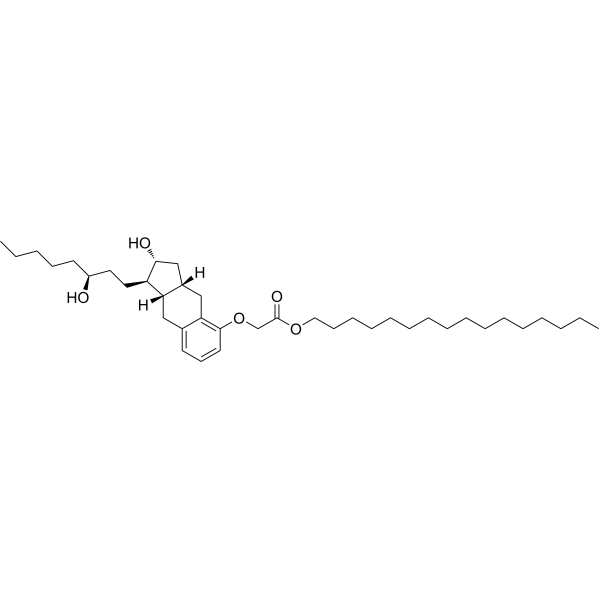
Treprostinil palmitil is a long-acting inhaled pulmonary vasodilator prodrug of Treprostinil (HY-100441), formulated in a lipid nanoparticle (LNP). Treprostinil palmitil can inhibit pulmonary vascular remodeling induced by Su/Hx challenge in rats. Treprostinil palmitil can induce cough. Treprostinil palmitil demonstrates a sustained presence in the lungs with reduced systemic exposure and prolonged inhibition of hypoxia-induced pulmonary vasoconstriction in vivo. Treprostinil palmitil can be studied in research for pulmonary arterial hypertension and interstitial lung disease.
For research use only. We do not sell to patients.
- Purity : 99.62%
- CAS No.: 1706528-83-7
- Formula: C39H66O5
- Molecular Weight:614.94
-
Storage:
4°C, sealed storage, away from moisture and light
* In solvent : -80°C, 6 months; -20°C, 1 month (sealed storage, away from moisture and light)

To place orders, for customer services and technical support, please contact: MedChemExpress USA
Tel: 609-228-6898 E-mail: [email protected] [email protected]


-
 Biological Activity
-
Chemical Information
-
Solvent & Solubility
- Protocols
- Purity & Documentation
- References
-
 Help & FAQs




Biological Activity
Description
IC50 & Target
|
DP |
In Vitro
Treprostinil palmitil (Compound TP) (10 nM-1 mM) produces partial relaxation of rat isolated pulmonary arteries[1].
MedChemExpress (MCE) has not independently confirmed the accuracy of these methods. They are for reference only.
In Vivo
Treprostinil palmitil (0.6-18 μg/kg, via TPIS, single dose) results in a dose-proportional increase in plasma Treprostinil (TRE) concentration in lungs of rats[1].
Treprostinil palmitil (4-14 μg/kg, via TPIS, single dose) inhibits the increase in right ventricular pulse pressure induced by hypoxia for up to 12 to 24 h in rats[1].
Treprostinil palmitil (4-11.6 μg/kg, via TPIS, single dose) produces a dose-response reduction of the increased PAP in sugen/hypoxia rat model[1].
Treprostinil palmitil (1-10 μg/kg, via TPIS, single dose) inhibits the influx of bronchoalveolar lavage inflammatory cells in Brown Norway rats sensitized to Ovalbumin (HY-W250978) antigen[1].
Treprostinil palmitil (59-117 μg/kg, via inhalation powder (TPIP), single dose) dose-dependently inhibits the increase in the mPAP and PVR and the reduction of CO that was induced by Su/Hx in SD rats[2].
MedChemExpress (MCE) has not independently confirmed the accuracy of these methods. They are for reference only.
-
Animal Model:Sugen/hypoxia rat model[1]
-
Dosage:4 and 11.6 μg/kg
-
Administration:Via nebulized inhaled suspension (TPIS), single dose
-
Result:Produced a dose-response reduction of the increased PAP.
Produced a significant reduction of the increased smooth muscle mass surrounding the pulmonary arteries.
Increased in the percentage of non-muscularized blood vessels and decreased the number of obliterated pulmonary blood vessels.
-
Animal Model:Adult male Sprague-Dawley rats challenged with Su/Hx[2]
-
Dosage:59 and 117 μg/kg
-
Administration:Via inhalation powder (TPIP), single dose
-
Result:Inhibited the increased wall thickness, muscularization, and obliteration of small-diameter pulmonary blood vessels.
Inhibits the increase in the mPAP and PVR and the reduction of CO that was induced by Su/Hx.
Slightly reduced the perivascular and interstitial fibrosis with 117 μg/kg.
Clinical Trial
| NCT Number | Sponsor | Condition | Start Date |
Phase

|
|---|---|---|---|---|
| NCT01329991 | 2011-05 | PHASE1 |


Chemical Information
-
CAS No. 1706528-83-7
-
Appearance Solid
-
Molecular Weight 614.94
-
Formula C39H66O5
-
Color Off-white to light yellow
-
SMILES
CCCCC[C@H](O)CC[C@@H]1[C@]2([H])[C@@](C[C@H]1O)([H])CC3=C(OCC(OCCCCCCCCCCCCCCCC)=O)C=CC=C3C2
-
Synonyms
INS-1009
-
Shipping
Room temperature in continental US; may vary elsewhere.
-
Storage
4°C, sealed storage, away from moisture and light
* In solvent : -80°C, 6 months; -20°C, 1 month (sealed storage, away from moisture and light)


Solvent & Solubility
In Vitro:
DMSO : 200 mg/mL (325.23 mM; Need ultrasonic; Hygroscopic DMSO has a significant impact on the solubility of product, please use newly opened DMSO)
Please refer to the solubility information to select the appropriate solvent. Once prepared, please aliquot and store the solution to prevent product inactivation from repeated freeze-thaw cycles.
Storage method and period of stock solution: -80°C, 6 months; -20°C, 1 month (sealed storage, away from moisture and light). When stored at -80°C, please use it within 6 months. When stored at -20°C, please use it within 1 month.
Please refer to the solubility information to select the appropriate solvent. Once prepared, please aliquot and store the solution to prevent product inactivation from repeated freeze-thaw cycles.
Storage method and period of stock solution: -80°C, 6 months; -20°C, 1 month (sealed storage, away from moisture and light). When stored at -80°C, please use it within 6 months. When stored at -20°C, please use it within 1 month.
Concentration (start) × Volume (start) = Concentration (final) × Volume (final)
In Vivo:
Select the appropriate dissolution method based on your experimental animal and administration route.
- For the following dissolution methods, please ensure to first prepare a clear stock solution using an In Vitro approach and then sequentially add co-solvents:
- To ensure reliable experimental results, the clarified stock solution can be appropriately stored based on storage conditions. As for the working solution for In Vivo experiments, it is recommended to prepare freshly and use it on the same day.
- The percentages shown for the solvents indicate their volumetric ratio in the final prepared solution. If precipitation or phase separation occurs during preparation, heat and/or sonication can be used to aid dissolution.
Add each solvent one by one: 10% DMSO 40% PEG300 5% Tween-80 45% Saline
Solubility: ≥ 9.09 mg/mL (14.78 mM); Clear solution
This protocol yields a clear solution of ≥ 9.09 mg/mL (saturation unknown).
Taking 1 mL working solution as an example, add 100 μL DMSO stock solution (90.9 mg/mL) to 400 μL PEG300, and mix evenly; then add 50 μL Tween-80 and mix evenly; then add 450 μL Saline to adjust the volume to 1 mL.
Preparation of Saline: Dissolve 0.9 g sodium chloride in ddH₂O and dilute to 100 mL to obtain a clear Saline solution.
Add each solvent one by one: 10% DMSO 90% (20% SBE-β-CD in Saline)
Solubility: 5 mg/mL (8.13 mM); Suspended solution; Need ultrasonic
This protocol yields a suspended solution of 5 mg/mL. Suspended solution can be used for oral and intraperitoneal injection.
Taking 1 mL working solution as an example, add 100 μL DMSO stock solution (50.0 mg/mL) to 900 μL 20% SBE-β-CD in Saline, and mix evenly.
Preparation of 20% SBE-β-CD in Saline (4°C, storage for one week): 2 g SBE-β-CD powder is dissolved in 10 mL Saline, completely dissolve until clear.
In Vivo Dissolution Calculator
Please enter the basic information of animal experiments:
-
-
-
-
Recommended: Prepare an additional quantity of animals to account for potential losses during experiments.
Please enter your animal formula composition:
-
%DMSO +
Recommended: Keep the proportion of DMSO in working solution below 2% if your animal is weak.
-
%+
-
+%Tween-80 + +
-
%Saline +
The co-solvents required include: DMSO, . All of co-solvents are available by MedChemExpress (MCE). , Tween 80. All of co-solvents are available by MedChemExpress (MCE).
Working solution concentration: 0.22 mg/mL
Method for preparing stock solution: mg drug dissolved in μL DMSO. Stock solution concentration: mg/mL. * In solvent : -80°C, 6 months; -20°C, 1 month (sealed storage, away from moisture and light)
1. Take μL DMSO stock solution;
2. Add μL .
μL , mix evenly;
3. Then add μL Tween 80, mix evenly;
4. Then add μL
Please ensure that the stock solution in the first step is dissolved to a clear state, and add co-solvents in sequence. You can use ultrasonic heating (ultrasonic cleaner, recommended frequency 20-40 kHz), vortexing, etc. to assist dissolution.


Purity & Documentation
-
Data Sheet (272 KB)
-
SDS (252 KB)
- English - EN (252 KB)
- Français - FR (252 KB)
- Deutsch - DE (252 KB)
- Norwegian - NO (252 KB)
- Español - ES (252 KB)
- Swedish - SV (252 KB)
- Italian - IT (252 KB)
- Korean - KR (252 KB)
- Portuguese - PT (252 KB)
-
Handling Instructions (2659 KB)
References
[1]. Chapman RW, Corboz MR, Malinin VS, Plaunt AJ, Konicek DM, Li Z, Perkins WR. An overview of the biology of a long-acting inhaled treprostinil prodrug. Pulm Pharmacol Ther. 2020 Dec;65:102002. [Content Brief]
[2]. Corboz, M. R., et al., (2022). Assessment of Inhaled Treprostinil Palmitil, Inhaled and Intravenous Treprostinil, and Oral Selexipag in a Sugen/Hypoxia Rat Model of Pulmonary Arterial Hypertension. The Journal of pharmacology and experimental therapeutics, 383(1), 103–116. [Content Brief]
[3]. Chapman, R. W., et al., (2021). Characterisation of cough evoked by inhaled treprostinil and treprostinil palmitil. ERJ open research, 7(1), 00592-2020. [Content Brief]
[4]. Plaunt, A. J., et al., (2021). Development and Characterization of Treprostinil Palmitil Inhalation Aerosol for the Investigational Treatment of Pulmonary Arterial Hypertension. International journal of molecular sciences, 22(2), 548. [Content Brief]


Complete Stock Solution Preparation Table
Please refer to the solubility information to select the appropriate solvent. Once prepared, please aliquot and store the solution to prevent product inactivation from repeated freeze-thaw cycles.
Storage method and period of stock solution: -80°C, 6 months; -20°C, 1 month (sealed storage, away from moisture and light). When stored at -80°C, please use it within 6 months. When stored at -20°C, please use it within 1 month.
| Optional Solvent | Concentration Solvent Mass | 1 mg | 5 mg | 10 mg | 25 mg |
|---|---|---|---|---|---|
| DMSO | 1 mM | 1.6262 mL | 8.1309 mL | 16.2617 mL | 40.6544 mL |
| 5 mM | 0.3252 mL | 1.6262 mL | 3.2523 mL | 8.1309 mL | |
| 10 mM | 0.1626 mL | 0.8131 mL | 1.6262 mL | 4.0654 mL | |
| 15 mM | 0.1084 mL | 0.5421 mL | 1.0841 mL | 2.7103 mL | |
| 20 mM | 0.0813 mL | 0.4065 mL | 0.8131 mL | 2.0327 mL | |
| 25 mM | 0.0650 mL | 0.3252 mL | 0.6505 mL | 1.6262 mL | |
| 30 mM | 0.0542 mL | 0.2710 mL | 0.5421 mL | 1.3551 mL | |
| 40 mM | 0.0407 mL | 0.2033 mL | 0.4065 mL | 1.0164 mL | |
| 50 mM | 0.0325 mL | 0.1626 mL | 0.3252 mL | 0.8131 mL | |
| 60 mM | 0.0271 mL | 0.1355 mL | 0.2710 mL | 0.6776 mL | |
| 80 mM | 0.0203 mL | 0.1016 mL | 0.2033 mL | 0.5082 mL | |
| 100 mM | 0.0163 mL | 0.0813 mL | 0.1626 mL | 0.4065 mL |


Treprostinil palmitil Related Classifications
HY-109163 Related Classifications
 Powered by Bioz