13 Results for "

rhizosphere

" in MedChemExpress (MCE) Product Catalog:
Products (13)

13 Results for "rhizosphere" in MCE Product Catalog:

1
1 Cited Publications
Cat. No.: HY-18569B
CAS No.: 87-51-4
Synonyms: IAA
3-Indoleacetic acid, suitable for plant cell culture (IAA), is a naturally occurring plant growth hormone that is widely present in plants, bacteria, and fungi. 3-Indoleacetic acid, suitable for plant cell culture, is a plant growth-promoting hormone that not only promotes plant growth but also protects bacteria from the toxic damage to cell membrane potential caused by other indole intermediate products (such as I3P) produced during their own metabolic processes. 3-Indoleacetic acid, suitable for plant cell culture, can be used in plant cell culture .
loading...
    loading...
Cat. No.: HY-W115721
CAS No.: 523-21-7
Synonyms: Sodium rhodizonate dibasic
Rhodizonic acid disodium (Sodium rhodizonate dibasic) is a transition metal-dependent pro-oxidant and lead detection agent that induces reactive oxygen species generation, DNA damage, and inhibits Aconitase activity. Rhodizonic acid disodium generates superoxide anion radicals in an iron (II)-dependent manner, leading to aconitase inactivation. Rhodizonic acid disodium also triggers hydroxyl radical-mediated DNA strand breaks and 8-OHdG formation via copper ion reduction. Rhodizonic acid disodium reacts with lead to form a scarlet precipitate, with the color intensity proportional to lead content, enabling qualitative or quantitative analysis of lead. Rhodizonic acid disodium can also be used for real-time visualization of the dynamic process of lead sequestration in the plant rhizosphere and evaluation of the effects of environmental factors such as soil type on the stability of lead-sequestering structures .
loading...
    loading...
Cat. No.: HY-W045071
CAS No.: 106983-28-2
Target:  

Bacterial

Research Areas:  

Infection

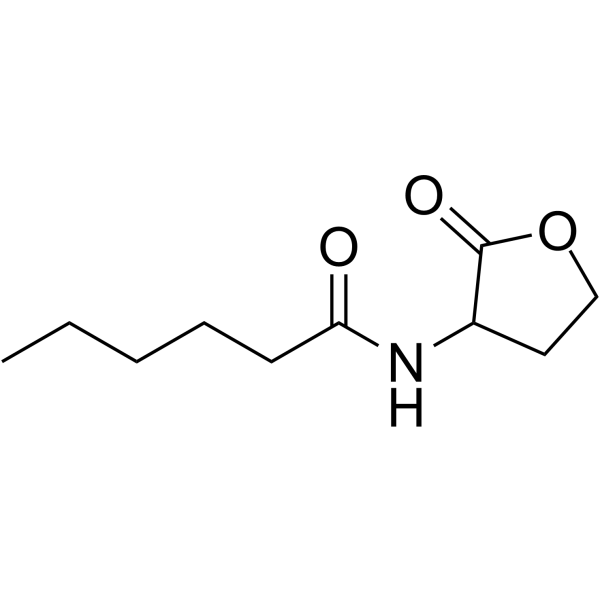
N-Hexanoyl-DL-homoserine lactone is a bacterial quorum sensing molecule produced in the rhizosphere. N-Hexanoyl-DL-homoserine lactone, a bacterial quorum sensing signal, induces transcriptional changes in Arabidopsis and may contribute to tuning plant growth to the microbial composition of the rhizosphere .
loading...
    loading...
Cat. No.: HY-Y1004
CAS No.: 112-30-1
Synonyms: Decyl alcohol
1-Decanol (Decyl alcohol) is a nematicidal agent derived from Houttuynia cordata, with an LC50 of 31.5 μg/mL against potato cyst nematodes (PCN). 1-decanol directly damages nematode surface structures, induces cellular apoptosis, and disrupts the oxidative stress regulation system, while also downregulating defense-related metabolic pathways in potato, thereby promoting the reallocation of metabolic resources from defense to growth. 1-Decanol can be used for the research of potato cyst nematode infestation .
loading...
    loading...
Cat. No.: HY-W015810
CAS No.: 617-94-7
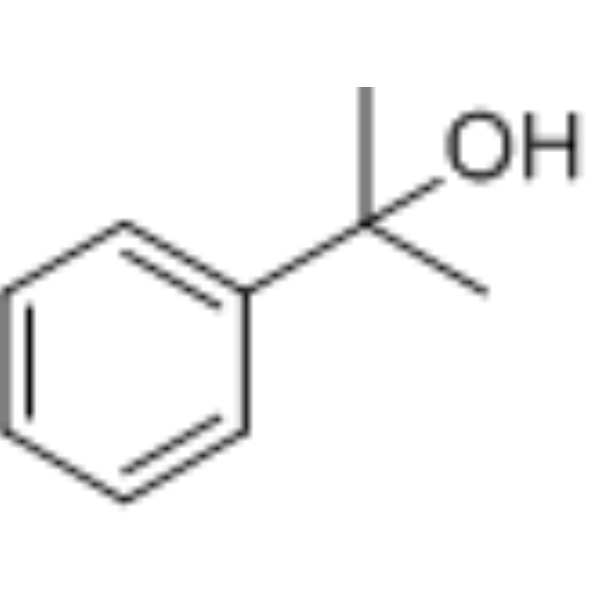
2-Phenyl-2-propanol is a volatile signaling compound released by rhizosphere microorganisms, and also a key product of the selective oxidation of cumene. 2-Phenyl-2-propanol alters primary root structure, regulates the expression of auxin and (±)-Jasmonic acid (HY-122464) responsive genes, and affects cell division. 2-Phenyl-2-propanol reduces the primary root length, lateral root number, lateral root density, and aboveground fresh weight of *Arabidopsis thaliana*. 2-Phenyl-2-propanol is commonly used in research related to cosmetics, pesticides, pharmaceuticals and other fields .
loading...
    loading...
Cat. No.: HY-W004297
CAS No.: 1454-84-8
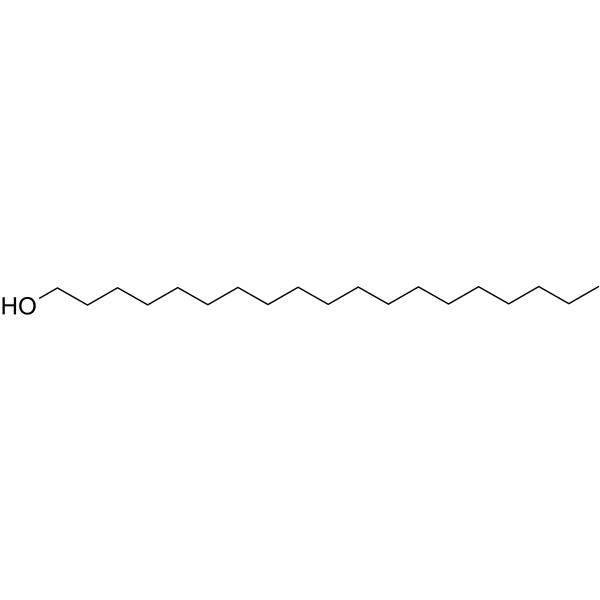
1-Nonadecanol is an endogenous metabolite that can be produced by Pantoea agglomerans from Medicago sativa rhizosphere, present in Neotinea ustulata scent and Heracleum thomsonii essential oil. 1-Nonadecanol exerts antimicrobial activity against Streptococcus pneumonia, Klebsiella, and S. aureus. 1-Nonadecanol can be used for the research of bacterial infections and pea aphid infestation .
loading...
    loading...
Cat. No.: HY-N13086
Target:  

Others

Peniviridiol A (compound4) is a viridin derivative that can be isolated from rhizosphere fungus Penicillium sp. SMU0102 .
loading...
    loading...
Cat. No.: HY-W971376
CAS No.: 21754-26-7
Target:  

Others

Cyclo(Ala-Tyr) is a cyclic dipeptide that can be isolated from the fermentation broth of the marine microorganism Bacillus marinus B-9987 isolated from the rhizosphere tissue of Suaeda salsa in the intertidal zone of Bohai Bay, China .
loading...
    loading...
Cat. No.: HY-N15117
CAS No.: 37331-24-1
Polymyxin P1 is a lipopeptide antibiotic belonging to the Polymyxin family, and it is a secondary metabolite produced by the rhizosphere bacterium Paenibacillus polymyxa M-1. Polymyxin P1 binds to bacterial outer membrane lipopolysaccharides, permeabilizes cell membranes, and induces dense protrusions on the cell surface of phytopathogenic Erwinia strains. Polymyxin P1 inhibits the growth of phytopathogenic Erwinia amylovora and E. carotovora. Polymyxin P1 can be used for the research of fire blight and soft rot .
loading...
    loading...
Cat. No.: HY-N15353
CAS No.: 51621-26-2
1-Palmitoyl-2-linoleoyl-sn-glycerol is a diacylglycerol (DAG)-type lipid signaling molecule found in the coralloid roots of Cycas revoluta, and serves as a major active component of the plant-secreted hormogonium-inducing factor (HIF). At a concentration of 1 nmol/disc (approximately 0.6 µg), 1-palmitoyl-2-linoleoyl-sn-glycerol can significantly induce the differentiation of filamentous aggregates of Nostoc into motile hormogonia, thereby promoting chemotaxis toward host roots and the establishment of symbiosis. This compound holds significant research and application potential in areas such as plant–microbe interactions, rhizosphere signaling pathways, and nitrogen-fixing symbiosis .
loading...
    loading...
Cat. No.: HY-W015810R
CAS No.: 617-94-7
2-Phenyl-2-propanol (Standard) is the analytical standard of 2-Phenyl-2-propanol (HY-W015810). This product is intended for research and analytical applications. 2-Phenyl-2-propanol is a volatile signaling compound released by rhizosphere microorganisms, and also a key product of the selective oxidation of cumene. 2-Phenyl-2-propanol alters primary root structure, regulates the expression of auxin and (±)-Jasmonic acid (HY-122464) responsive genes, and affects cell division. 2-Phenyl-2-propanol reduces the primary root length, lateral root number, lateral root density, and aboveground fresh weight of *Arabidopsis thaliana*. 2-Phenyl-2-propanol is commonly used in research related to cosmetics, pesticides, pharmaceuticals and other fields .
loading...
    loading...
Cat. No.: HY-N19229
CAS No.: 65718-85-6
Dihydrocitrinone is a polyketide secondary metabolite and the major urinary metabolite of citrinin, which can be isolated from Aspergillus strains derived from the rhizosphere soil of date palms. Dihydrocitrinone exerts independent toxic effects in renal cell cultures and zebrafish embryo models, enhances the toxic effects of Ochratoxin A through additive or synergistic actions, and increases the level of miR-731 in zebrafish embryos when acting in combination with Ochratoxin A .
loading...
    loading...
Cat. No.: HY-N15117A
Target:  

Antibiotic Bacterial

Research Areas:  

Infection

Polymyxin P1 TFA is a lipopeptide antibiotic belonging to the Polymyxin family, and it is a secondary metabolite produced by the rhizosphere bacterium Paenibacillus polymyxa M-1. Polymyxin P1 TFA binds to bacterial outer membrane lipopolysaccharides, permeabilizes cell membranes, and induces dense protrusions on the cell surface of phytopathogenic Erwinia strains. Polymyxin P1 TFA inhibits the growth of phytopathogenic Erwinia amylovora and E. carotovora. Polymyxin P1 TFA can be used for the research of fire blight and soft rot .
loading...
    loading...
  • 1

