
14 Results for "

vancomycin-resistant S. aureus

" in MedChemExpress (MCE) Product Catalog:
Products (14)

14 Results for "vancomycin-resistant S. aureus" in MCE Product Catalog:

Cat. No.: HY-P3078
CAS No.: 1402-82-0
Target:  

Bacterial Antibiotic

Research Areas:  

Infection

Amphomycin is a lipopeptide antibiotic that inhibits peptidoglycan synthesis and blocks cell wall development. Amphomycin exhibits potent antibacterial activities against methicillin-resistant S. aureus (MRSA), vancomycin-resistant enterococci (VRE), penicillin-gentamicin-erythromycin-resistant S. pneumonia, and linezolid-quinupristin-dalfopristin-resistant enterococci .
loading...
    loading...
Cat. No.: HY-A0279
CAS No.: 270076-60-3
Synonyms: Pristinamycine
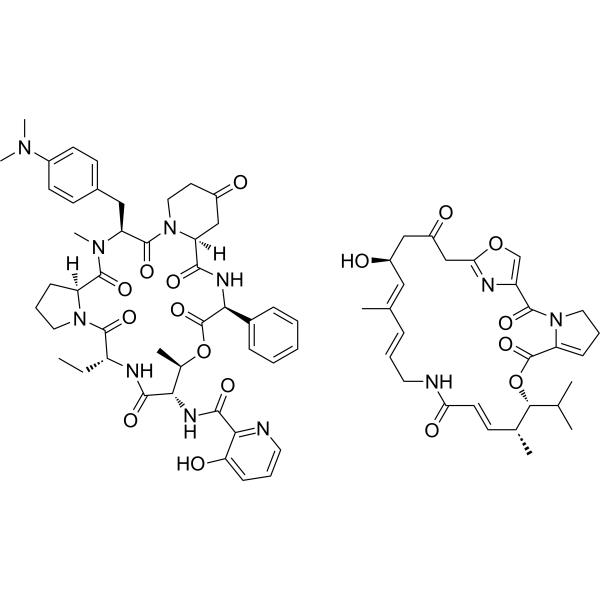
Pristinamycin, produced by Streptomyces pristinaespiralis, is an orally active streptogramin-like antibiotic consisting of two chemically unrelated components: Pristinamycin I (PI) and Pristinamycin II (PII). Pristinamycin is highly active against many antibiotic-resistant pathogens, particularly Gram-positive bacteria, including Methicillin-resistant Staphylococcus aureus (MRSA), Vancomycin-resistant S. aureus (VRSA) and Enterococcus faecium (VREF) .
loading...
    loading...
Cat. No.: HY-10393
CAS No.: 165800-04-4
Purity:  96.11%
Synonyms: PNU-100592
Target:  

Bacterial Antibiotic

Research Areas:  

Infection

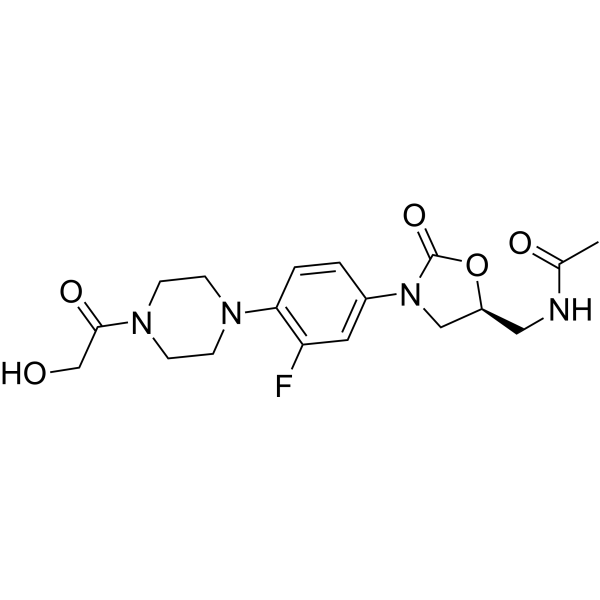
Eperezolid (PNU-100592) is an orally active protein synthesis inhibitor that targets the bacterial 50S ribosomal subunit. Eperezolid competitively binds to a specific site on the ribosomal 50S subunit (overlapping with the binding sites of chloramphenicol (HY-B0239) and lincomycin (HY-117660)) to inhibit the translation initiation stage and exert antibacterial activity. Eperezolid can induce host cell autophagy to enhance the clearance of intracellular mycobacteria, and its MIC90 for Staphylococcus aureus and Enterococcus is 1-4 μg/mL. Eperezolid is mainly used for antibacterial research on infections with Gram-positive bacteria such as methicillin-resistant (HY-121544) Staphylococci and vancomycin-resistant (HY-B0671) Enterococci, as well as infections with intracellular bacteria such as Mycobacterium tuberculosis .
loading...
    loading...
Cat. No.: HY-116863
CAS No.: 865285-47-8
Purity:  95.70%
Target:  

Bacterial

Research Areas:  

Infection

KKL-40 is a small molecule inhibitor that targets the trans-transcription process and is effective against methicillin-sensitive and -resistant Staphylococcus aureus (S. aureus) as well as other Gram-positive pathogens including vancomycin-resistant Enterococcus faecium, Bacillus subtilis, and Streptococcus pyogenes. KKL-40 synergizes with the human antimicrobial peptide LL-37 to inhibit S. aureus, but does not synergize with other antibiotics such as daptomycin, kanamycin, or erythromycin. Trans-transcription is an extreme form of recoding, and KKL-40 inhibits trans-transcription but is nontoxic to HeLa cells .
loading...
    loading...
Cat. No.: HY-W033728
CAS No.: 12080-32-9
Target:  

Bacterial

Research Areas:  

Infection

Platinum(COD)dichloride (Compound Pt1) is an Antibacterial agent. Platinum(COD)dichloride shows antibacterial activity against a panel of gram-positive bacteria including Vancomycin (HY-B0671) and Methicillin (HY-121544) resistant Staphylococcus aureus .
loading...
    loading...
Cat. No.: HY-174273
Target:  

Bacterial

Research Areas:  

Infection

Antibacterial agent 280 (Compound 7af) is an antibacterial agent targeting methicillin-resistant and vancomycin-resistant Staphylococcus aureus (MRSA, VRSA). Antibacterial agent 280 is promising for research of is promising for research of S. aureus infections .
loading...
    loading...
Cat. No.: HY-12770R
CAS No.: 14367-47-6
Synonyms: Mebeverine metabolite Mebeverine alcohol (Standard)
Research Areas:  

Neurological Disease

Mebeverine alcohol (Standard) is an analytical standard for Mebeverine alcohol. This product is intended for research and analytical applications. Eperezolid (PNU-100592) is an orally active protein synthesis inhibitor that targets the bacterial 50S ribosomal subunit. Eperezolid competitively binds to a specific site on the ribosomal 50S subunit (overlapping with the binding sites of Chloramphenicol (HY-B0239) and Lincomycin (HY-117660)) to inhibit the translation initiation stage and exert antibacterial activity. Eperezolid can induce host cell autophagy to enhance the clearance of intracellular mycobacteria, and its MIC90 for Staphylococcus aureus and Enterococcus is 1-4 μg/mL. Eperezolid is mainly used for antibacterial research on infections with Gram-positive bacteria such as methicillin-resistant (HY-121544) Staphylococci and vancomycin-resistant (HY-B0671) Enterococci, as well as infections with intracellular bacteria such as Mycobacterium tuberculosis .
loading...
    loading...
Cat. No.: HY-184679
CAS No.: 890179-59-6
Target:  

Antibiotic Bacterial

Research Areas:  

Infection

MCZ-038 is a thiourea antibiotic with bactericidal activity. MCZ-038 exerts its effects by interfering with the lipid organization or fluidity of bacterial cell membranes . MCZ-038 can be used in studies related to drug-resistant Staphylococcus aureus infections and Vancomycin (HY-B0671)-resistant Enterococcus faecium infections .
loading...
    loading...
Cat. No.: HY-N19290
CAS No.: 3040055-84-0
Glenthmycin E is an antibacterial agent found in Australian sheep pasture-derived Streptomyces sp. CMB-PB041. Glenthmycin E inhibits growth of multiple bacterial and exhibits no detectable cytotoxicity to eukaryotic cells including fungal and human carcinoma cells. Glenthmycin E can be used for the research of bacterial infections .
loading...
    loading...
Cat. No.: HY-N19135
CAS No.: 163768-82-9
Target:  

Bacterial

SB87-H is a Pestalone-type benzophenone compound that exists in the endophytic fungus Pestalotiopsis trachicarpicola SC-J551 and the lichen endophytic fungus Pestalotiopsis rhododendri LF-19-12. SB87-H exhibits cytotoxicity against cancer cells and epithelial cells, and possesses antibacterial activity against Staphylococcus aureus, methicillin-resistant Staphylococcus aureus, and vancomycin-sensitive Enterococcus faecium. SB87-H can be used in studies related to bacteria infections .
loading...
    loading...
Cat. No.: HY-P11659
Target:  

Antibiotic Bacterial

Research Areas:  

Infection

B26 peptoid is a ptoid antibiotic. B26 peptoid exhibits excellent broad-spectrum activity and high selectivity toward a panel of Gram-positive and Gram-negative bacterial strains. B26 peptoid disrupts bacterial membranes and has bactericidal activity. B26 peptoid shows low propensity for bacterial drug resistance. B26 peptoid can be used for the research of bacterial infection .
loading...
    loading...
Cat. No.: HY-182798
Research Areas:  

Infection

Antibacterial agent 337 is an antibacterial agent. Antibacterial agent 337 specifically interacts with PG in bacterial cell membranes, triggering membrane disruption, membrane depolarization, increased permeability, cytoplasmic leakage, ROS accumulation and rapid bacterial death. Antibacterial agent 337 inhibits biofilm formation and disrupts mature biofilms. Antibacterial agent 337 exhibits potent in vivo antibacterial efficacy in a mouse model of Staphylococcus aureus skin abscess. Antibacterial agent 337 can be used in studies of Gram-positive bacterial infections, including methicillin-resistant Staphylococcus aureus infections, vancomycin-resistant Enterococcus faecalis infections and bacterial biofilm infections .
loading...
    loading...
Cat. No.: HY-N19212
CAS No.: 3040055-59-9
Target:  

Bacterial

Glenthmycin A is a macrocyclic type II spiroketal polyketide antibacterial agent. Glenthmycin A inhibits the growth of Gram-positive pathogens. Glenthmycin A is applicable to the research of bacterial infections .
loading...
    loading...
Cat. No.: HY-187563
Research Areas:  

Infection

RNP-11 is a selective COX-2 inhibitor with an IC50 of 42.85 μg/mL against human COX-2, and also acts as a bactericide and anti-inflammatory agent. RNP-11 inhibits the production of pro-inflammatory cytokines (IL-6, TNF-α, IL-1β, disrupts bacterial cell membranes and induces bacterial cell death. RNP-11 exhibits activity against strains of Staphylococcus and Enterococcus, including Methicillin (HY-121544)-resistant Staphylococcus aureus and Vancomycin (HY-B0671)-resistant Enterococcus faecium. RNP-11 reduces the load of Staphylococcus aureus, exerting dual effects of pathogen clearance and inflammatory response alleviation in a mouse skin infection model,. RNP-11 can be used in research related to infections caused by Staphylococcus, Staphylococcus aureus and Enterococcus faecium .
loading...
    loading...
  • 1

