



Platinum(COD)dichloride

Based on 1 Customer Validation
Platinum(COD)dichloride (Compound Pt1) is an Antibacterial agent. Platinum(COD)dichloride shows antibacterial activity against a panel of gram-positive bacteria including Vancomycin (HY-B0671) and Methicillin (HY-121544) resistant Staphylococcus aureus.
For research use only. We do not sell to patients.
- CAS No.: 12080-32-9
- Formula: C8H12Cl2Pt
- Molecular Weight:374.17
-
Storage:
4°C, protect from light, stored under nitrogen
* In solvent : -80°C, 6 months; -20°C, 1 month (protect from light, stored under nitrogen)


To place orders, for customer services and technical support, please contact: MedChemExpress USA
Tel: 609-228-6898 E-mail: [email protected] [email protected]


-
 Biological Activity
-
Chemical Information
- Protocols
- Purity & Documentation
- References
-
 Help & FAQs


-
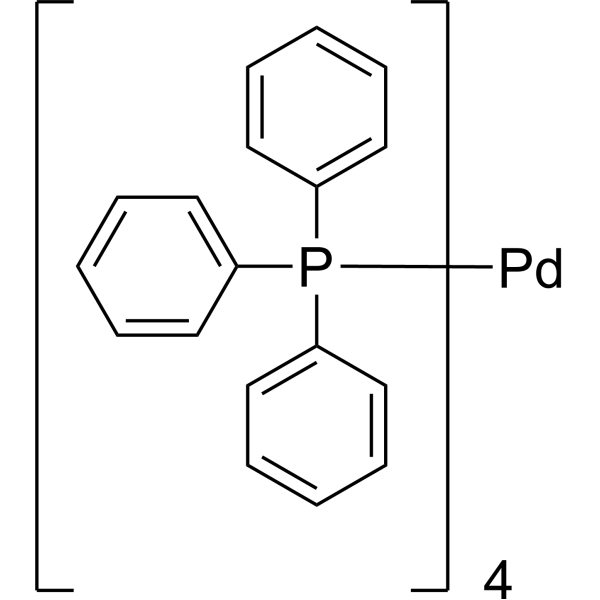
HY-Y1738
Tetrakis(triphenylphosphine)palladiumCatalyst -
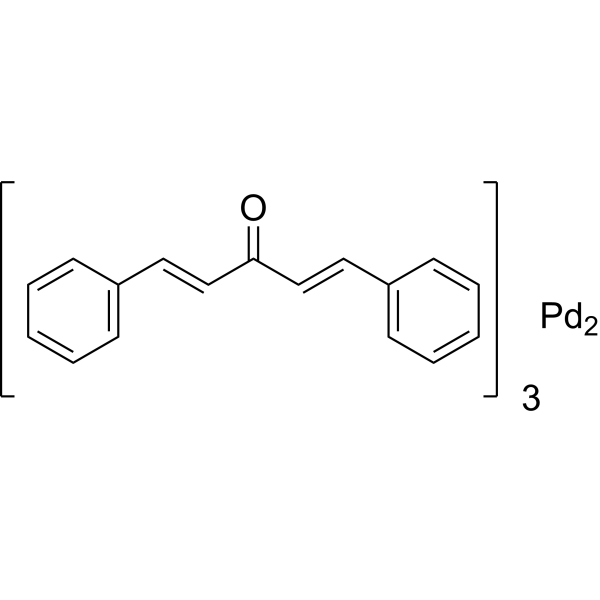
HY-W018864
Tris(dibenzylideneacetonyl)bis-palladiumCatalyst -
![[Rh(cod)Cl]2](https://file.medchemexpress.com/product_pic/hy-y1094.gif)
HY-Y1094
[Rh(cod)Cl]2Organometallic Rhodium (I) Dimer Precursor/Platelet Aggregation Inhibitor -
![[Rh(Cp-)Cl2]2](https://file.medchemexpress.com/product_pic/hy-w019734.gif)
HY-W019734
[Rh(Cp-)Cl2]2Biochemical Reagent -
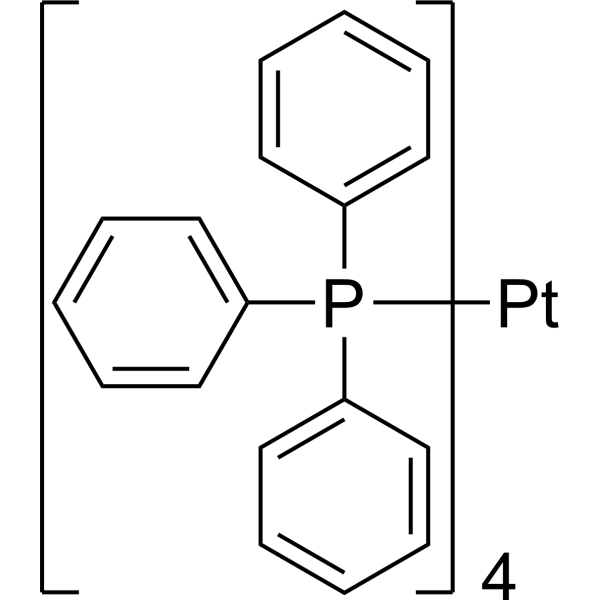
HY-W034985
Tetrakis(triphenylphosphine)platinumBiochemical Reagent -
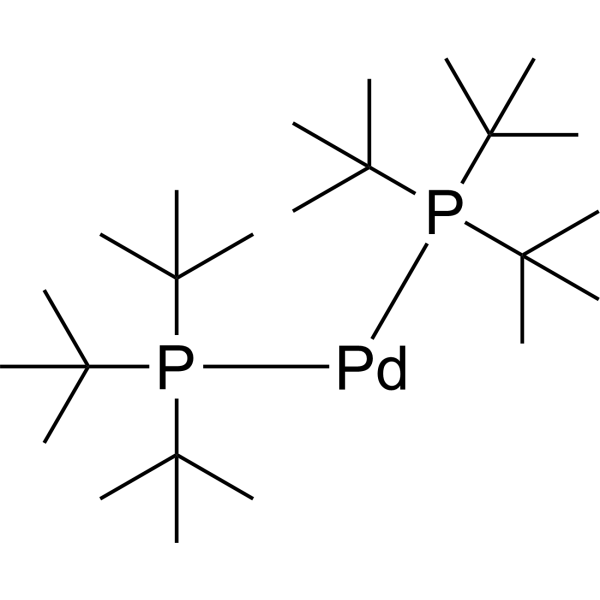
HY-W010772
Bis(tri-tert-butylphosphine)palladium(0)Biochemical Reagent -
![[Ir(cod)Cl]2](https://file.medchemexpress.com/product_pic/hy-w008260.gif)
HY-W008260
[Ir(cod)Cl]2Biochemical Reagent -
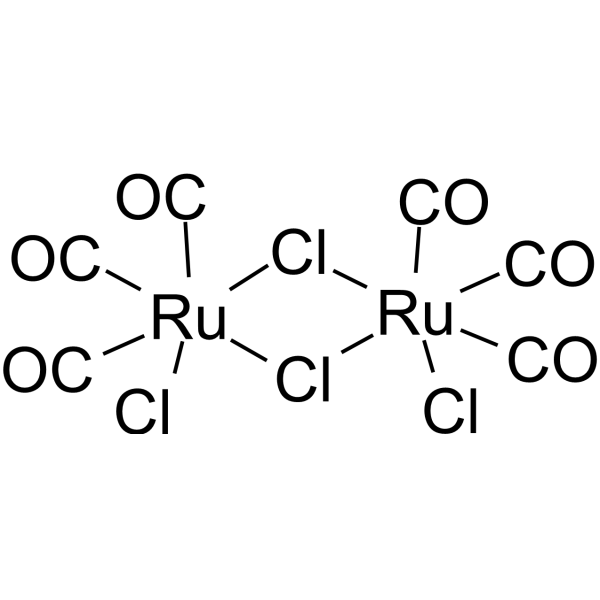
HY-W033577
Tricarbonyldichlororuthenium(II) dimerCO Donor -
HY-109521A
Manganese chloride tetrahydrate, molecular biology grade,≥99.0% (KT)Biochemical Assay Reagent


Biological Activity
Description
In Vitro
Platinum(COD)dichloride (Compound Pt1) displays broad antibacterial activity against Gram-positive bacteria including MRSA, GISA, and VRSA, with an MIC50 of 0.39 μM against S. aureus ATCC 43300 (MRSA)[1].
Platinum(COD)dichloride (Compound Pt1) (up to 100 μM) is non-cytotoxic to HEK-293 cells[1].
MedChemExpress (MCE) has not independently confirmed the accuracy of these methods. They are for reference only.
In Vivo


Chemical Information
-
CAS No. 12080-32-9
-
Appearance Solid
-
Molecular Weight 374.17
-
Formula C8H12Cl2Pt
-
SMILES
Cl[Pt]Cl.C1/C=C\CC/C=C\C1
-
Shipping
Room temperature in continental US; may vary elsewhere.
-
Storage
4°C, protect from light, stored under nitrogen
* In solvent : -80°C, 6 months; -20°C, 1 month (protect from light, stored under nitrogen)


Purity & Documentation
-
Data Sheet (270 KB)
-
SDS (252 KB)
- Français - FR (252 KB)
- Deutsch - DE (252 KB)
- Norwegian - NO (252 KB)
- Español - ES (252 KB)
- Swedish - SV (252 KB)
- Italian - IT (252 KB)
- Korean - KR (252 KB)
- Portuguese - PT (252 KB)
-
Handling Instructions (2659 KB)
References

Calculators
Concentration (start) × Volume (start) = Concentration (final) × Volume (final)


Platinum(COD)dichloride Related Classifications
HY-W033728 Related Classifications
 Powered by Bioz
Keywords
- Platinum(COD)dichloride
- 12080-32-9
- Bacterial
- glycopeptide intermediate Staphylococcus aureus
- human embryonic kidney cells
- Gram-positive bacteria
- methicillin-resistant Staphylococcus aureus
- HEK-293 cells
- vancomycin-resistant Staphylococcus aureus
- Galleria mellonella larvae
- vancomycin-resistant enterococcus
- S. aureus ATCC 43300
- human red blood cells
- Inhibitor
- inhibitor
- inhibit