



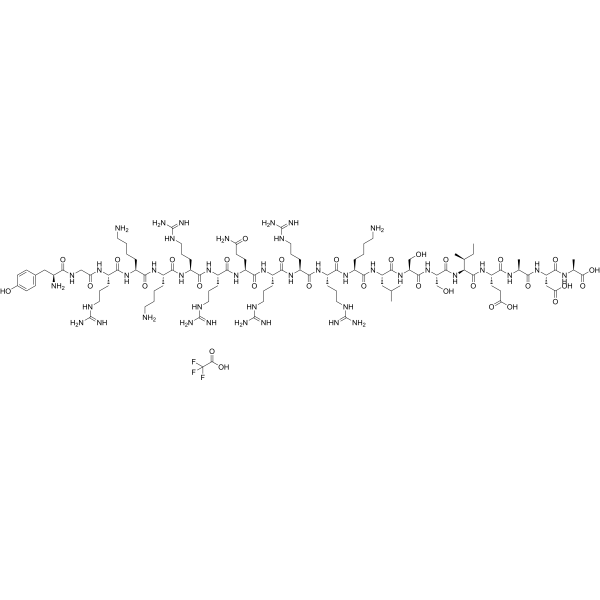
Tat-NR2Baa TFA
Tat-NR2BAA TFA is the control peptide of Tat-NR2B9c (HY-P0117), inactive. The sequence of Tat-NR2BAA TFA is similar to Tat-NR2B9c, but it has a double-point mutation in the COOH terminal tSXV motif, making it incapable of binding PSD-95. Tat-NR2B9c is a membrane-permeant peptide and disrupts PSD-95/NMDAR binding, correlate with uncoupling NR2B- and/or NR2A-type NMDARs from PSD-95.
For research use only. We do not sell to patients.
- Formula: C105H185F3N42O31
- Molecular Weight:2588.85
-
Storage:
Please store the product under the recommended conditions in the Certificate of Analysis.

To place orders, for customer services and technical support, please contact: MedChemExpress USA
Tel: 609-228-6898 E-mail: [email protected] [email protected]


-
 Biological Activity
-
Chemical Information
- Protocols
- Purity & Documentation
- References
-
 Help & FAQs


All iGluR Isoforms
More

Biological Activity
Description
IC50 & Target
|
NMDA Receptor |
In Vitro
Tat-NR2BAA TFA (125 ng; 20 mins) does not effects interactions between PSD-95 and NR2B subunits. In contrast, coimmunoprecipitation of PSD-95 with NR2B subunits is markedly decreased in rats pretreated with the disrupting peptide Tat-NR2B9c in lumbar dorsal horn tissue[1].Tat-NR2BAA TFA (125 ng or 1.25 μg; 20 minutes before collection of lumbar dorsal horn tissue) is the control group of Tat-NR2B9c. Tat-NR2B9c produces a significant and robust reduction of postdischarge, indicating the hyperexcitability of the cell.But Tat-NR2BAA TFA has no effects, even at a dose 100× greater than the active peptide Tat-NR2B9c (HY-P0117)[1].Tat-NR2BAA TFA (1 μM; pre-treatment 1 hour) is the control group in the Co-IP assay. Tat-NR2B9c (1 μM) disrupts NR2B/PSD95 interaction, and the coupling of NR2B to PSD-95 is more sensitive than NR2A/PSD95 to disruption in hippocampal neurons[2].
MedChemExpress (MCE) has not independently confirmed the accuracy of these methods. They are for reference only.


Chemical Information
-
Molecular Weight 2588.85
-
Formula C105H185F3N42O31
-
Sequence
Tyr-Gly-Arg-Lys-Lys-Arg-Arg-Gln-Arg-Arg-Arg-Lys-Leu-Ser-Ser-Ile-Glu-Ala-Asp-Ala
-
Sequence Shortening
YGRKKRRQRRRKLSSIEADA
-
Shipping
Room temperature in continental US; may vary elsewhere.
-
Storage
Please store the product under the recommended conditions in the Certificate of Analysis.


Purity & Documentation
References
[1]. Michelle Aarts, et al. Treatment of Ischemic Brain Damage by Perturbing NMDA Receptor- PSD-95 Protein Interactions. Science [Content Brief]
[2]. Jing Fan, et al. N-methyl-D-aspartate Receptor Subunit- And Neuronal-Type Dependence of Excitotoxic Signaling Through Post-Synaptic Density 9. J Neurochem. 2010 Nov;115(4):1045-56. [Content Brief]

Calculators
Concentration (start) × Volume (start) = Concentration (final) × Volume (final)


Tat-NR2Baa TFA Related Classifications
HY-P2307A Related Classifications
 Powered by Bioz