



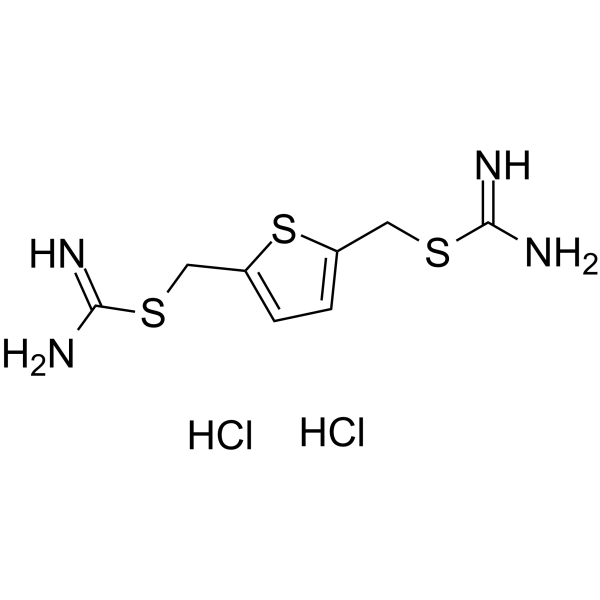
TPT-260 Dihydrochloride
Based on 2 publication(s) in Google Scholar
TPT-260 Dihydrochloride (NSC55712), a thiophene thiourea derivative, is a retromer complex stabilizer against thermal denaturation (Kd = ~5 µM). TPT-260 Dihydrochloride increases the levels of retromer proteins, shifts amyloid-precursor protein (APP) away from the endosome, and decreases the pathogenic processing of APP. TPT-260 Dihydrochloride inhibits TLR4 upregulation, IKKβ phosphorylation, NF-κB p65 nuclear translocation, and NLRP3 inflammasome formation. TPT-260 Dihydrochloride improves retromer-mediated cargo trafficking, reduces brain infarct area, and decreases amyloid plaque deposition. TPT-260 Dihydrochloride exhibits minimal cytotoxicity to primary microglia at tested concentrations. TPT-260 Dihydrochloride can be used for the research of inflammatory bowel disease, ischemic stroke and Alzheimer's disease.
For research use only. We do not sell to patients.
- Purity: 98.0%
- CAS No.: 2076-91-7
- Formula: C8H14Cl2N4S3
- Molecular Weight:333.32
-
Storage:
4°C, sealed storage, away from moisture
* In solvent : -80°C, 6 months; -20°C, 1 month (sealed storage, away from moisture)

To place orders, for customer services and technical support, please contact: MedChemExpress USA
Tel: 609-228-6898 E-mail: [email protected] [email protected]


-
 Biological Activity
-
Chemical Information
-
Solvent & Solubility
- Purity & Documentation
- References
-
 Help & FAQs


Publications Citing Use of MedChemExpress (MCE) TPT-260 Dihydrochloride
More

Biological Activity
Description
In Vitro
TPT-260 (10 μM) Dihydrochloride improves Occludin recycling and epithelial barrier function in Caco-2 cells but has no effect on VMP1-knockdown Caco-2 cells, indicating VMP1 is required for the Target Reagent's activity[1].
TPT-260 (5-20 μM) Dihydrochloride has no cytotoxic effect on primary mouse microglia, as measured by cell viability and LDH release assays[2].
TPT-260 (5-20 μM) Dihydrochloride protects primary mouse microglia from LPS (HY-D1056)/Nigericin (HY-127019)-induced cytotoxicity, as shown by restored cell viability and reduced LDH release[2].
TPT-260 (5-20 μM) Dihydrochloride inhibits LPS/Nigericin-induced inflammasome formation in primary mouse microglia, as measured by reduced ASC speck formation[2].
TPT-260 (5-20 μM) Dihydrochloride inhibits LPS/Nigericin-induced nuclear translocation of NF-κB p65 in primary mouse microglia, as measured by reduced nuclear p65 fluorescence intensity[2].
TPT-260 (5-20 μM) Dihydrochloride inhibits LPS (HY-D1056)/Nigericin (HY-127019)-induced upregulation of pro-inflammatory gene expression (Nlrp3, Tnfa, Il1b) in primary mouse microglia[2].
TPT-260 (5-20 μM) Dihydrochloride attenuates LPS/Nigericin-induced activation of the TLR4-IKKβ-NF-κB pathway in primary mouse microglia, as shown by reduced levels of pathway-related proteins and pro-inflammatory IL-1β[2].
TPT-260 (5 μM; 48 h) Dihydrochloride increases plasma membrane expression of NHE3 in Caco-2/bbe cells, raising surface NHE3 to 142.4% of control[3].
TPT-260 (5 μM; 48 h) Dihydrochloride increases levels of core retromer proteins VPS35 and VPS26 in Caco-2/bbe cells, and prevents the Cholera toxin (CT)-induced reduction in these retromer proteins when given either concurrently with CT or prior to CT exposure[3].
TPT-260 (5 μM; 48 h) Dihydrochloride increases plasma membrane expression of NHE3 in polarized Caco-2/bbe-HA-NHE3 cells, and reverses the CT-induced reduction in NHE3 surface expression when given either concurrently with CT or prior to CT exposure[3].
TPT-260 (5 μM; 48 h) Dihydrochloride partially reduces forskolin-induced fluid secretion in 3D human duodenal enteroids by stimulating NHE3-mediated fluid absorption[3].
TPT-260 Dihydrochloride (R55) binds to retromer complex with a Kd of ~5 μM[4].
TPT-260 Dihydrochloride (48 h) increases Vps35 levels with an EC50 of ~3.3 μM in primary hippocampal neurons[4].
TPT-260 Dihydrochloride (48 h) significantly reduces the levels of both endogenous Aβ40 and Aβ42 in hippocampal neurons[4].
TPT-260 Dihydrochloride inhibits Aβ levels with an IC50 of ~12 μM in hippocampal neurons[4].
TPT-260 Dihydrochloride significantly reduces the levels of both endogenous β-CTF and sAPPβ, and increases sAPPα levels in hippocampal neurons[4].
MedChemExpress (MCE) has not independently confirmed the accuracy of these methods. They are for reference only.
-
Cell Line:Caco-2/bbe cells
-
Concentration:5 μM
-
Incubation Time:48 h
-
Result:Increased amounts of VPS35 to 125% of control and VPS26 to 129% of control when used alone.
Prevented the CT-induced reduction in VPS35 and VPS26 levels, maintaining them at levels similar to untreated controls when given concurrently with CT or before CT.
In Vivo
MedChemExpress (MCE) has not independently confirmed the accuracy of these methods. They are for reference only.
-
Animal Model:C57BL/6 (2-month-old) bearing middle cerebral artery occlusion (MCAO) surgery[2]
-
Dosage:5 mg/kg
-
Administration:i.p.; single dose (24 hours prior to MCAO surgery)
-
Result:Significantly improved Bederson score (neurological function) in MCAO mice.
Significantly reduced brain infarct volume on the affected side.
Significantly suppressed brain tissue levels of pro-inflammatory factors IL-1β and TNF-α compared to untreated MCAO mice.


Chemical Information
-
CAS No. 2076-91-7
-
Appearance Solid
-
Molecular Weight 333.32
-
Formula C8H14Cl2N4S3
-
Color Light yellow to yellow
-
SMILES
NC(SCC1=CC=C(CSC(N)=N)S1)=N.Cl.Cl
-
Synonyms
NSC55712; TPU-260 Dihydrochloride
-
Shipping
Room temperature in continental US; may vary elsewhere.
-
Storage
4°C, sealed storage, away from moisture
* In solvent : -80°C, 6 months; -20°C, 1 month (sealed storage, away from moisture)


Publications (2)
-
Journal Impact Factor
-
Most Recent
-
-
J Inflamm Res
Therapeutic Potential of TPT-260 in Ischemic Stroke: An Investigation Into Its Anti-Inflammatory Effects and Impact on Microglial Activation. [Abstract]2025 Mar 1:18:3055-3066. PMID: 40046681


Solvent & Solubility
In Vitro:
DMSO : 100 mg/mL (300.01 mM; Need ultrasonic; Hygroscopic DMSO has a significant impact on the solubility of product, please use newly opened DMSO)
H2O : 33.33 mg/mL (99.99 mM; Need ultrasonic)
Please refer to the solubility information to select the appropriate solvent. Once prepared, please aliquot and store the solution to prevent product inactivation from repeated freeze-thaw cycles.
Storage method and period of stock solution: -80°C, 6 months; -20°C, 1 month (sealed storage, away from moisture). When stored at -80°C, please use it within 6 months. When stored at -20°C, please use it within 1 month.
* Note: If you choose water as the stock solution, please dilute it to the working solution, then filter and sterilize it with a 0.22 μm filter before use.
Please refer to the solubility information to select the appropriate solvent. Once prepared, please aliquot and store the solution to prevent product inactivation from repeated freeze-thaw cycles.
Storage method and period of stock solution: -80°C, 6 months; -20°C, 1 month (sealed storage, away from moisture). When stored at -80°C, please use it within 6 months. When stored at -20°C, please use it within 1 month.
* Note: If you choose water as the stock solution, please dilute it to the working solution, then filter and sterilize it with a 0.22 μm filter before use.
Concentration (start) × Volume (start) = Concentration (final) × Volume (final)
In Vivo:
Select the appropriate dissolution method based on your experimental animal and administration route.
- For the following dissolution methods, please ensure to first prepare a clear stock solution using an In Vitro approach and then sequentially add co-solvents:
- To ensure reliable experimental results, the clarified stock solution can be appropriately stored based on storage conditions. As for the working solution for In Vivo experiments, it is recommended to prepare freshly and use it on the same day.
- The percentages shown for the solvents indicate their volumetric ratio in the final prepared solution. If precipitation or phase separation occurs during preparation, heat and/or sonication can be used to aid dissolution.
Add each solvent one by one: 10% DMSO 40% PEG300 5% Tween-80 45% Saline
Solubility: ≥ 2.5 mg/mL (7.50 mM); Clear solution
This protocol yields a clear solution of ≥ 2.5 mg/mL (saturation unknown).
Taking 1 mL working solution as an example, add 100 μL DMSO stock solution (25.0 mg/mL) to 400 μL PEG300, and mix evenly; then add 50 μL Tween-80 and mix evenly; then add 450 μL Saline to adjust the volume to 1 mL.
Preparation of Saline: Dissolve 0.9 g sodium chloride in ddH₂O and dilute to 100 mL to obtain a clear Saline solution.
Add each solvent one by one: 10% DMSO 90% (20% SBE-β-CD in Saline)
Solubility: ≥ 2.5 mg/mL (7.50 mM); Clear solution
This protocol yields a clear solution of ≥ 2.5 mg/mL (saturation unknown).
Taking 1 mL working solution as an example, add 100 μL DMSO stock solution (25.0 mg/mL) to 900 μL 20% SBE-β-CD in Saline, and mix evenly.
Preparation of 20% SBE-β-CD in Saline (4°C, storage for one week): 2 g SBE-β-CD powder is dissolved in 10 mL Saline, completely dissolve until clear.
In Vivo Dissolution Calculator
Please enter the basic information of animal experiments:
-
-
-
-
Recommended: Prepare an additional quantity of animals to account for potential losses during experiments.
Working solution concentration: 0.22 mg/mL
This product has good water solubility, please refer to the measured solubility data in water/PBS/Saline for details.


Purity & Documentation
-
Data Sheet (290 KB)
-
SDS (476 KB)
- English - EN (476 KB)
- Français - FR (476 KB)
- Deutsch - DE (476 KB)
- Norwegian - NO (476 KB)
- Español - ES (476 KB)
- Swedish - SV (476 KB)
- Italian - IT (476 KB)
- Korean - KR (476 KB)
- Portuguese - PT (476 KB)
-
Handling Instructions (2659 KB)
References
[1]. Zhao J, et al. Loss of VMP1 Impairs Tight Junction Recycling and Aggravates Intestinal Barrier Dysfunction in Inflammatory Bowel Disease. Adv Sci (Weinh). Published online February 27, 2026. [Content Brief]
[2]. Qian J, et al. Therapeutic Potential of TPT-260 in Ischemic Stroke: An Investigation Into Its Anti-Inflammatory Effects and Impact on Microglial Activation. J Inflamm Res. 2025 Mar 1;18:3055-3066. [Content Brief]
[3]. Singh V, et al. Cholera toxin inhibits SNX27-retromer-mediated delivery of cargo proteins to the plasma membrane. J Cell Sci. 2018;131(16):jcs218610. Published 2018 Aug 17. [Content Brief]
[4]. Mecozzi VJ, et al. Pharmacological chaperones stabilize retromer to limit APP processing. Nat Chem Biol. 2014 Jun;10(6):443-9. [Content Brief]


Complete Stock Solution Preparation Table
Please refer to the solubility information to select the appropriate solvent. Once prepared, please aliquot and store the solution to prevent product inactivation from repeated freeze-thaw cycles.
Storage method and period of stock solution: -80°C, 6 months; -20°C, 1 month (sealed storage, away from moisture). When stored at -80°C, please use it within 6 months. When stored at -20°C, please use it within 1 month.
| Optional Solvent | Concentration Solvent Mass | 1 mg | 5 mg | 10 mg | 25 mg |
|---|---|---|---|---|---|
| H2O / DMSO | 1 mM | 3.0001 mL | 15.0006 mL | 30.0012 mL | 75.0030 mL |
| 5 mM | 0.6000 mL | 3.0001 mL | 6.0002 mL | 15.0006 mL | |
| 10 mM | 0.3000 mL | 1.5001 mL | 3.0001 mL | 7.5003 mL | |
| 15 mM | 0.2000 mL | 1.0000 mL | 2.0001 mL | 5.0002 mL | |
| 20 mM | 0.1500 mL | 0.7500 mL | 1.5001 mL | 3.7501 mL | |
| 25 mM | 0.1200 mL | 0.6000 mL | 1.2000 mL | 3.0001 mL | |
| 30 mM | 0.1000 mL | 0.5000 mL | 1.0000 mL | 2.5001 mL | |
| 40 mM | 0.0750 mL | 0.3750 mL | 0.7500 mL | 1.8751 mL | |
| 50 mM | 0.0600 mL | 0.3000 mL | 0.6000 mL | 1.5001 mL | |
| 60 mM | 0.0500 mL | 0.2500 mL | 0.5000 mL | 1.2500 mL | |
| 80 mM | 0.0375 mL | 0.1875 mL | 0.3750 mL | 0.9375 mL | |
| DMSO | 100 mM | 0.0300 mL | 0.1500 mL | 0.3000 mL | 0.7500 mL |
* Note: If you choose water as the stock solution, please dilute it to the working solution, then filter and sterilize it with a 0.22 μm filter before use.


TPT-260 Dihydrochloride Related Classifications
HY-13769A Related Classifications
 Powered by Bioz