



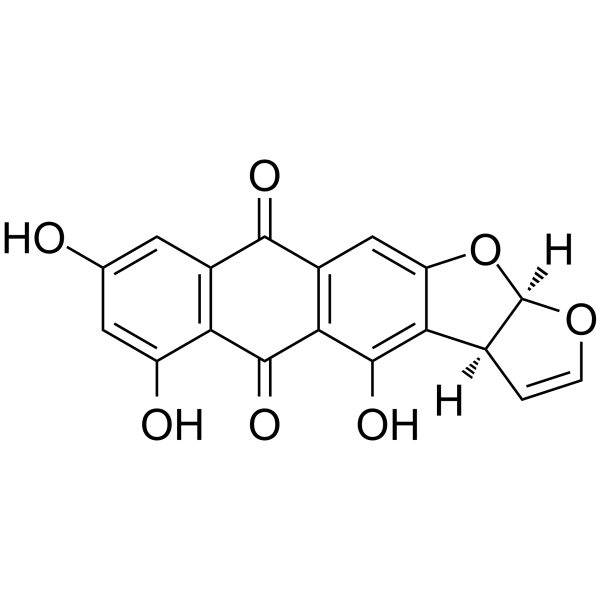
Versicolorin A
Versicolorin A is a biosynthetic precursor of Aflatoxin B1 (HY-N6615). Versicolorin A induces phosphorylation of p53. Versicolorin A activates the aryl hydrocarbon receptor AhR and significantly induces the expression of CYP1A1. Versicolorin A exerts genotoxic and cytotoxic effects. Versicolorin A enhances the genotoxicity of aflatoxin B1 in cells by promoting CYP450-mediated bioactivation of aflatoxin B1. Versicolorin A can be used in research related to colorectal cancer and hepatocellular carcinoma.
For research use only. We do not sell to patients.
- CAS No.: 6807-96-1
- Formula: C18H10O7
- Molecular Weight:338.27
-
Storage:
Please store the product under the recommended conditions in the Certificate of Analysis.

To place orders, for customer services and technical support, please contact: MedChemExpress USA
Tel: 609-228-6898 E-mail: [email protected] [email protected]


-
 Biological Activity
-
Chemical Information
- Protocols
- Purity & Documentation
- References
-
 Help & FAQs




Biological Activity
Description
IC50 & Target
[1]|
CYP1A1 |
In Vitro
Versicolorin A (0.1-30 μM; 24-48 h) exhibits cytotoxic activity similar to that of aflatoxin B1 in wild-type HepG2 cells. It induces significant concentration-dependent cytotoxicity after 48 h of incubation (with the strongest effect observed at 10 μM), whereas the cytotoxicity does not exceed the threshold of 20% after 24 h of incubation[2].
Versicolorin A (0.1-10 μM; 24 h) exhibits genotoxicity in wild-type HepG2 cells, induces concentration-dependent phosphorylation of H2AX, and has a lowest observed effect concentration (LOEC) of 10 μM after 24 h of incubation[2].
Versicolorin A (0.01-10 μM; 24 h) induces concentration-dependent p53 transcriptional activity in HepG2-p53 CALUX cells, with a lowest observed effect concentration (LOEC) of 1 μM after 24 h of incubation, and the peak induction level is comparable to that of aflatoxin B1[2].
Versicolorin A (1 μM; 24 h) increases the level of phosphorylated p53 (Ser15) in wild-type HepG2 cells, and this effect is observable after 24 hours of incubation, though it is not statistically significant[2].
Versicolorin A (0.001-10 μM; 4 h) activates the aryl hydrocarbon receptor in DRhuman CALUX cells, with an EC50 of 0.9 μM and an LOEC of 0.2 μM after 4 h of incubation. The maximum transcriptional activation level induced by it reaches 52% of that induced by 2,3,7,8-TCDD[2].
Incubation of wild-type HepG2 cells with Versicolorin A (1 μM; 24 h) for 24 h significantly induces a 2.4-fold increase in CYP1A1 mRNA transcription levels, but exerts no significant effect on the expression of CYP1A2 or CYP3A4[2].
Versicolorin A (1 μM) enhances the genotoxicity of aflatoxin B1 in wild-type HepG2 cells. The level of H2AX phosphorylation induced by the combined exposure for 24 h is significantly higher than that in the single-treatment groups, and this effect is particularly pronounced when the concentration of aflatoxin B1 is low (0.1 μM to 3 μM)[2].
MedChemExpress (MCE) has not independently confirmed the accuracy of these methods. They are for reference only.
-
Cell Line:wild-type HepG2 human liver hepatocellular carcinoma cells
-
Concentration:0.1-30 μM
-
Incubation Time:24 h; 48 h
-
Result:Caused no decrease in cell viability greater than the 20% threshold after 24 h of incubation.
Caused a dose-dependent decrease in cell viability after 48 h of incubation, with concentrations above 1 μM reducing viability and maximal cytotoxicity observed at 10 μM (viability reduced to ~35% compared to DMSO control).
Induced an unspecific increase in cell viability at 30 μM after 48 h.
-
Cell Line:wild-type HepG2 human liver hepatocellular carcinoma cells
-
Concentration:1 μM
-
Incubation Time:24 h
-
Result:Increased the relative abundance of phosphorylated p53 (Ser15) compared to DMSO control, though this increase was not statistically significant (p=0.1762).
Showed lower induction than that caused by 1 μM aflatoxin B1.
-
Cell Line:wild-type HepG2 human liver hepatocellular carcinoma cells
-
Concentration:1 μM
-
Incubation Time:24 h
-
Result:Significantly induced CYP1A1 mRNA expression by 2.4-fold relative to DMSO control.
Caused no significant induction of CYP1A2 or CYP3A4 mRNA.


Chemical Information
-
CAS No. 6807-96-1
-
Molecular Weight 338.27
-
Formula C18H10O7
-
SMILES
O=C(C1=C2C=C(O)C=C1O)C3=C(C=C4O[C@](OC=C5)([H])[C@]5([H])C4=C3O)C2=O
-
Structure Classification
-
Initial Source
Aspergillus parasiticus
-
Shipping
Room temperature in continental US; may vary elsewhere.
-
Storage
Please store the product under the recommended conditions in the Certificate of Analysis.


Purity & Documentation
References
[1]. Gauthier T, et al. Versicolorin A, a precursor in aflatoxins biosynthesis, is a food contaminant toxic for human intestinal cells. Environ Int. 2020;137:105568. [Content Brief]
[2]. Budin C, et al. Versicolorin A enhances the genotoxicity of aflatoxin B1 in human liver cells by inducing the transactivation of the Ah-receptor. Food Chem Toxicol. 2021;153:112258. [Content Brief]

Calculators
Concentration (start) × Volume (start) = Concentration (final) × Volume (final)


Versicolorin A Related Classifications
HY-129247 Related Classifications
 Powered by Bioz