



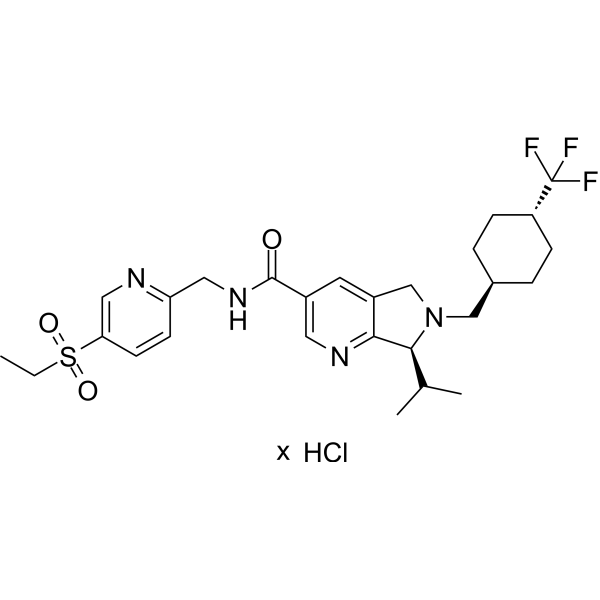
Vimirogant hydrochloride
Based on 1 publication(s) in Google Scholar
Vimirogant hydrochloride (VTP-43742 hydrochloride) is a potent, selective, and orally active RORγt inhibitor with a Ki of 3.5 nM for binding to RORγt. VTP-43742 blocks Th17 cell differentiation and reduces IL-17A production by inhibiting RORγt-mediated transcriptional activity, thereby suppressing the RORγt/Th17/IL-17 inflammatory axis. VTP-43742 can be used for research on autoimmune diseases and inflammation-related diseases.
For research use only. We do not sell to patients.
- Purity : 98.39%
- CAS No.: 1802678-42-7
- Formula: C27H35F3N4O3S.xHCl
-
Storage:
4°C, sealed storage, away from moisture
* In solvent : -80°C, 6 months; -20°C, 1 month (sealed storage, away from moisture)

To place orders, for customer services and technical support, please contact: MedChemExpress USA
Tel: 609-228-6898 E-mail: [email protected] [email protected]


-
 Biological Activity
-
Chemical Information
-
Solvent & Solubility
- Protocols
- Purity & Documentation
- References
-
 Help & FAQs


Publications Citing Use of MedChemExpress (MCE) Vimirogant hydrochloride
More

Biological Activity
Description
IC50 & Target
[3]|
RORγt 3.5 nM (Ki) |
In Vitro
Vimirogant (VTP-43742 hydrochloride) hydrochloride binds with high affinity to RORγt, with a Ki of 3.5 nM, and exhibits >1000-fold selectivity over RORα and RORβ[3].
Vimirogant hydrochloride inhibits Th17 differentiation and IL-17A secretion in mouse splenocytes with an IC50 of 57 nM, without affecting Th1, Th2, or Treg cell differentiation[3].
Vimirogant hydrochloride inhibits IL-17A secretion in activated hPBMCs with an IC50 of 18 nM[3].
Vimirogant hydrochloride inhibits IL-17A secretion in whole blood from healthy and psoriasis donors with an IC50 of 192 nM[3].
MedChemExpress (MCE) has not independently confirmed the accuracy of these methods. They are for reference only. Further protocols information, click here.
In Vivo
Vimirogant (prophylactic administration; 11 days) hydrochloride dose-dependently inhibits CD4+IL-17+IFNγ− and CD4+IL-17+IFNγ+ T cells in the spleen and draining lymph nodes of MOG35-55/CFA-immunized EAE mice; Th17-derived cytokines are specifically suppressed following ex vivo restimulation of splenocytes from treated mice with MOG35-55[4].
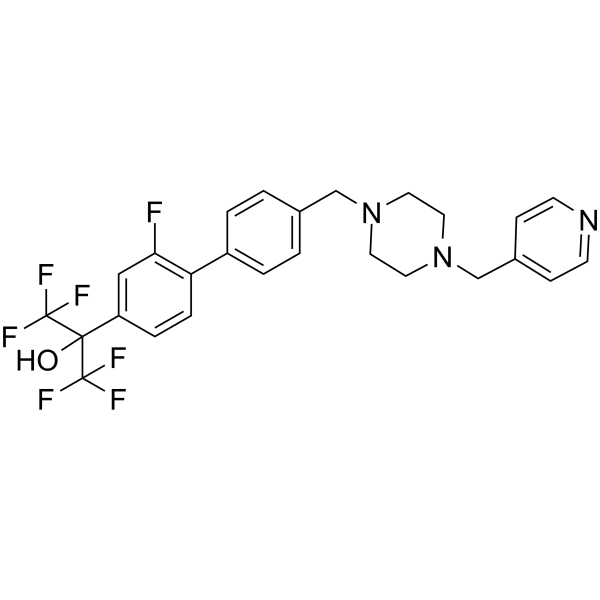
Vimirogant (high dose; prophylactic administration) hydrochloride completely suppresses EAE clinical scores in the chronic EAE study, with a greater degree of inhibition than MM17F3; it also suppresses Th17-related markers in the spinal cord and reduces demyelination and inflammatory cell infiltration[4].
Vimirogant (30 μg/kg; p.o.; 7 days) hydrochloride reduces M1 macrophage polarization in the colonic mucosa of DSS-induced colitis mice and alleviates colitis-associated inflammatory injury; the main text states that IL-17a expression remains unchanged under this condition[5].
Vimirogant (30 μg/kg; p.o.; 7 days; combined with SYD 2.50 g/kg) hydrochloride inhibits colonic mucosal inflammatory injury more strongly than SYD alone in DSS-induced colitis mice[5].
MedChemExpress (MCE) has not independently confirmed the accuracy of these methods. They are for reference only.
-
Animal Model:C57BL/6N mice (male, 6-8 weeks old, 20 g, SPF grade)[5]
-
Dosage:30 μg/kg
-
Administration:i.g.; daily; 7 days
-
Result:Considerably decreased M1 macrophage polarization in the colonic mucosa.
Produced milder colonic inflammatory lesions and lower sensitivity to DSS-induced colitis.
Did not alter IL-17a expression according to the article text.


Chemical Information
-
CAS No. 1802678-42-7
-
Appearance Solid
-
Formula C27H35F3N4O3S.xHCl
-
Color Light yellow to yellow
-
SMILES
O=C(C1=CN=C([C@H](C(C)C)N(C[C@H]2CC[C@H](C(F)(F)F)CC2)C3)C3=C1)NCC4=NC=C(S(=O)(CC)=O)C=C4.Cl.[x]
-
Synonyms
VTP-43742 hydrochloride
-
Shipping
Room temperature in continental US; may vary elsewhere.
-
Storage
4°C, sealed storage, away from moisture
* In solvent : -80°C, 6 months; -20°C, 1 month (sealed storage, away from moisture)


Publications (1)
-
Journal Impact Factor
-
Most Recent
-
J Ethnopharmacol
Shaoyao decoction alleviates DSS-induced colitis by inhibiting IL-17a-mediated polarization of M1 macrophages. [Abstract]2025 Jan 30;337(Pt 3):118941. PMID: 39427735


Solvent & Solubility
In Vitro:
DMSO : 125 mg/mL (Need ultrasonic; Hygroscopic DMSO has a significant impact on the solubility of product, please use newly opened DMSO)
Ethanol : 50 mg/mL (Need ultrasonic)
In Vivo:
Select the appropriate dissolution method based on your experimental animal and administration route.
- For the following dissolution methods, please ensure to first prepare a clear stock solution using an In Vitro approach and then sequentially add co-solvents:
- To ensure reliable experimental results, the clarified stock solution can be appropriately stored based on storage conditions. As for the working solution for In Vivo experiments, it is recommended to prepare freshly and use it on the same day.
- The percentages shown for the solvents indicate their volumetric ratio in the final prepared solution. If precipitation or phase separation occurs during preparation, heat and/or sonication can be used to aid dissolution.
Add each solvent one by one: 10% DMSO 40% PEG300 5% Tween-80 45% Saline
Solubility: ≥ 6.25 mg/mL; Clear solution
This protocol yields a clear solution of ≥ 6.25 mg/mL (saturation unknown).
Taking 1 mL working solution as an example, add 100 μL DMSO stock solution (62.5 mg/mL) to 400 μL PEG300, and mix evenly; then add 50 μL Tween-80 and mix evenly; then add 450 μL Saline to adjust the volume to 1 mL.
Preparation of Saline: Dissolve 0.9 g sodium chloride in ddH₂O and dilute to 100 mL to obtain a clear Saline solution.
Add each solvent one by one: 10% DMSO 90% (20% SBE-β-CD in Saline)
Solubility: ≥ 6.25 mg/mL; Clear solution
This protocol yields a clear solution of ≥ 6.25 mg/mL (saturation unknown).
Taking 1 mL working solution as an example, add 100 μL DMSO stock solution (62.5 mg/mL) to 900 μL 20% SBE-β-CD in Saline, and mix evenly.
Preparation of 20% SBE-β-CD in Saline (4°C, storage for one week): 2 g SBE-β-CD powder is dissolved in 10 mL Saline, completely dissolve until clear.
Add each solvent one by one: 10% EtOH 40% PEG300 5% Tween-80 45% Saline
Solubility: ≥ 2.5 mg/mL; Clear solution
This protocol yields a clear solution of ≥ 2.5 mg/mL (saturation unknown).
Taking 1 mL working solution as an example, add 100 μL EtOH stock solution (25.0 mg/mL) to 400 μL PEG300, and mix evenly; then add 50 μL Tween-80 and mix evenly; then add 450 μL Saline to adjust the volume to 1 mL.
Preparation of Saline: Dissolve 0.9 g sodium chloride in ddH₂O and dilute to 100 mL to obtain a clear Saline solution.
Add each solvent one by one: 10% EtOH 90% (20% SBE-β-CD in Saline)
Solubility: ≥ 2.5 mg/mL; Clear solution
This protocol yields a clear solution of ≥ 2.5 mg/mL (saturation unknown).
Taking 1 mL working solution as an example, add 100 μL EtOH stock solution (25.0 mg/mL) to 900 μL 20% SBE-β-CD in Saline, and mix evenly.
Preparation of 20% SBE-β-CD in Saline (4°C, storage for one week): 2 g SBE-β-CD powder is dissolved in 10 mL Saline, completely dissolve until clear.
Add each solvent one by one: 10% EtOH 90% Corn Oil
Solubility: ≥ 2.5 mg/mL; Clear solution
This protocol yields a clear solution of ≥ 2.5 mg/mL (saturation unknown). If the continuous dosing period exceeds half a month, please choose this protocol carefully.
Taking 1 mL working solution as an example, add 100 μL EtOH stock solution (25.0 mg/mL) to 900 μL Corn oil, and mix evenly.
In Vivo Dissolution Calculator
Please enter the basic information of animal experiments:
-
-
-
-
Recommended: Prepare an additional quantity of animals to account for potential losses during experiments.
Please enter your animal formula composition:
-
%DMSO +
Recommended: Keep the proportion of DMSO in working solution below 2% if your animal is weak.
-
%+
-
+%Tween-80 + +
-
%Saline +
The co-solvents required include: DMSO, . All of co-solvents are available by MedChemExpress (MCE). , Tween 80. All of co-solvents are available by MedChemExpress (MCE).
Working solution concentration: 0.22 mg/mL
Method for preparing stock solution: mg drug dissolved in μL DMSO. Stock solution concentration: mg/mL. * In solvent : -80°C, 6 months; -20°C, 1 month (sealed storage, away from moisture)
1. Take μL DMSO stock solution;
2. Add μL .
μL , mix evenly;
3. Then add μL Tween 80, mix evenly;
4. Then add μL
Please ensure that the stock solution in the first step is dissolved to a clear state, and add co-solvents in sequence. You can use ultrasonic heating (ultrasonic cleaner, recommended frequency 20-40 kHz), vortexing, etc. to assist dissolution.

Protocols
-
Dual Luciferin reporter gene assay
Luciferin reporter gene assay is a reporting system to detect the activity of Firefly Luciferase using luciferin as a substrate, which is often used in the research of miRNA target gene verification and promoter transcriptive activity regulation. Dual luciferase usually refers to Firefly luciferase and Renilla luciferase.
-
Naïve CD4+ T-cell subset differentiation/polarization
Naïve CD4+ T-cell subset differentiation/polarization is an in vitro assay in which purified naïve CD4+ T cells are activated through TCR and CD28 costimulation and cultured with defined cytokines and neutralizing antibodies to generate Th0, Th1, Th2, Th17, or induced Treg-like populations. Differentiation is detected by subset-associated cytokines and transcription factors: IFN-γ/T-bet for Th1, IL-4/GATA3 for Th2, IL-17A/RORγt for Th17, and Foxp3 for induced Treg cells. The assay readout is usually generated by intracellular cytokine staining after restimulation, transcription-factor staining by flow cytometry, ELISA of secreted cytokines, or gene-expression analysis. The result reflects cytokine-directed lineage commitment or polarization rather than antigen-specific immune protection by itself.
-
Research Protocol for Inflammation-related Diseases
The NLRP3 inflammasome is a cytosolic innate immune signaling platform that integrates priming signals and danger-signal activation to promote caspase-1 activation, maturation of IL-1β and IL-18, and gasdermin D-mediated pyroptotic cell death. The core experimental logic is to determine whether inflammatory disease phenotypes are driven by increased NLRP3 expression, ASC-containing inflammasome assembly, caspase-1 cleavage, GSDMD cleavage, and extracellular release of IL-1β/IL-18 rather than by nonspecific cell injury alone. The pathway is strongly linked to inflammation-related disease phenotypes because monosodium urate crystals activate NALP3/NLRP3 inflammasome signaling in gout-like crystal inflammation, cholesterol crystals activate NLRP3 inflammasomes in atherogenesis models, and DSS-induced intestinal inflammation has been reported to involve NLRP3 inflammasome activity. However, experimental colitis studies also show context-dependent protective effects of NLRP3 inflammasome co
-
iPSC cell differentiation
Induced pluripotent stem cells (iPSCs) are a type of cell that has similar properties to embryonic stem cells through somatic cell reprogramming.


Purity & Documentation
-
Data Sheet (286 KB)
-
SDS (252 KB)
- English - EN (252 KB)
- Français - FR (252 KB)
- Deutsch - DE (252 KB)
- Norwegian - NO (252 KB)
- Español - ES (252 KB)
- Swedish - SV (252 KB)
- Italian - IT (252 KB)
- Korean - KR (252 KB)
- Portuguese - PT (252 KB)
-
Handling Instructions (2659 KB)
References
[2]. Gege C, et al. RORγt inhibitors as potential back-ups for the phase II candidate VTP-43742 from Vitae Pharmaceuticals: patent evaluation of WO2016061160 and US20160122345. Expert opinion on therapeutic patents. 2017 Jan;27(1):1-8. [Content Brief]
[5]. Wang S, et al. Shaoyao decoction alleviates DSS-induced colitis by inhibiting IL-17a-mediated polarization of M1 macrophages. Journal of ethnopharmacology. 2025 Jan 30;337(Pt 3):118941. [Content Brief]

Calculators
Concentration (start) × Volume (start) = Concentration (final) × Volume (final)


Vimirogant hydrochloride Related Classifications
HY-103637A Related Classifications
 Powered by Bioz