



SULT1
STAT1 is a latent transcription factor within the JAK-STAT signaling pathway, originally defined through cellular responses to interferons[1]. Mechanistically, STAT1 connects interferon and cytokine receptor activation to rapid gene-expression programs that regulate host defense, immune signaling, and disease biology[1][2]. In human immunity, inherited STAT1 defects define autosomal recessive complete deficiency, autosomal recessive partial deficiency, autosomal dominant deficiency, and autosomal dominant gain-of-function disease[2]. Disease models show that loss-of-function STAT1 variants impair IFN-γ- and IFN-α/β-mediated immunity, whereas gain-of-function variants enhance STAT1-dependent responses and impair IL-17 immunity in chronic mucocutaneous candidiasis[2][3]. Compared with the full-length STAT1α isoform, STAT1β lacks the C-terminal transactivation domain but is not simply dominant negative in vivo[4]. Isoform-specific mouse models show that STAT1α and STAT1β have largely redundant IFN-α/β- and IFN-λ-dependent antiviral activity, while STAT1β remains transcriptionally active after IFN-γ stimulation[4]. In esophageal squamous cell carcinoma models, STAT1β interacts with STAT1α, decreases STAT1α proteasomal degradation, and increases STAT1 DNA binding and transcriptional activity[5]. Therefore, STAT1 research should distinguish total STAT1 from STAT1α and STAT1β when designing interferon signaling, infection, immunity, or tumor biology studies[4][5].
Verweise:
- [1]. Philips RL, et al. The JAK-STAT pathway at 30: Much learned, much more to do. Cell. 2022 Oct 13;185(21):3857-3876. [Content Brief]
- [2]. Boisson-Dupuis S, et al. Inborn errors of human STAT1: allelic heterogeneity governs the diversity of immunological and infectious phenotypes. Curr Opin Immunol. 2012 Aug;24(4):364-78. [Content Brief]
- [3]. Liu L, et al. Gain-of-function human STAT1 mutations impair IL-17 immunity and underlie chronic mucocutaneous candidiasis. J Exp Med. 2011 Aug 1;208(8):1635-48. [Content Brief]
- [4]. Semper C, et al. STAT1β is not dominant negative and is capable of contributing to gamma interferon-dependent innate immunity. Mol Cell Biol. 2014 Jun;34(12):2235-48. [Content Brief]
- [5]. Zhang Y, et al. STAT1β enhances STAT1 function by protecting STAT1α from degradation in esophageal squamous cell carcinoma. Cell Death Dis. 2017 Oct 5;8(10):e3077. [Content Brief]
All Product Categories
-
SULT1 Verwandte Produkte (1)
Verwandte Produkte (1)

-
(Rac)-Metanephrine hydrochloride
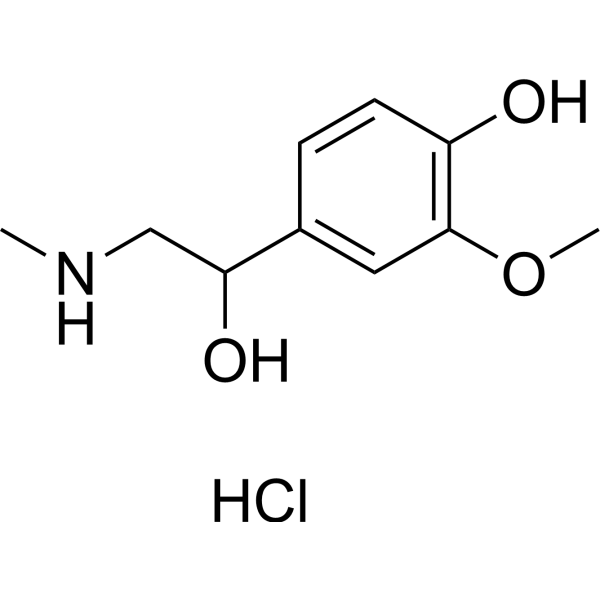 0 Images(Rac)-Metanephrine hydrochloride is a metabolite of epinephrine and a substrate of the sulfotransferase SULT1A3. (Rac)-Metanephrine hydrochloride undergoes sulfonation at its p-hydroxyl group via a reaction catalyzed by SULT1A3. (Rac)-Metanephrine hydrochloride is an isomer of Metanephrine (HY-113299) hydrochloride, and it is applicable to the research of pheochromocytoma.



