



HY-15401
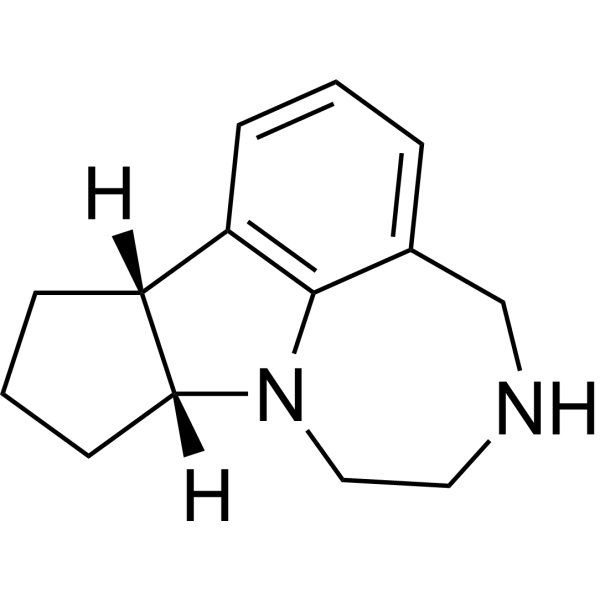
WAY 163909 is an orally active, blood-brain barrier permeable 5-HT2C receptor-selective agonist. WAY 163909 exhibits an EC50 of 8 nM and a Ki of 10.5 nM for h5-HT2C. Instead of triggering apoptosis, WAY 163909 induces anorectic, antipsychotic-like, antidepressant-like, anti-aggressive and anti-compulsive effects. WAY 163909 alleviates ketamine-induced hypothermia, but impairs sexual function at high doses. With rapid antidepressant-like properties, WAY 163909 can be used in research related to obesity, schizophrenia, depression, obsessive-compulsive disorder, and anesthesia-induced hypothermia.
For research use only. We do not sell to patients.
- CAS No.: 428868-32-0
- Formula: C14H18N2
- Molecular Weight:214.31
-
Storage:
Please store the product under the recommended conditions in the Certificate of Analysis.

To place orders, for customer services and technical support, please contact: MedChemExpress USA
Tel: 609-228-6898 E-mail: [email protected] [email protected]


-
 Biological Activity
-
Chemical Information
- Protocols
- Purity & Documentation
- References
-
 Help & FAQs


All 5-HT Receptor Isoforms
More

Biological Activity
Description
IC50 & Target
[2]|
5-HT2C Receptor 8 nM (EC50) |
In Vitro
WAY 163909 (1-10 μM) has high metabolic clearance in dogs, moderate clearance in rats and monkeys, and low clearance in human liver microsomes, with no meaningful metabolism by small intestinal microsomes across tested species[1].
WAY 163909 (1-10 μM) results significant depletion of in incubations with cDNA-expressed CYP2D6 but not other tested CYP isoforms[1].
WAY 163909 is not mutagenic in the Ames assay and does not induce chromosomal aberrations in human peripheral blood lymphocytes[1].
MedChemExpress (MCE) has not independently confirmed the accuracy of these methods. They are for reference only. Further protocols information, click here.
In Vivo
WAY 163909 (0.1-30 mg/kg; i.p., p.o., s.c.; once daily; 21 days) exhibits atypical antipsychotic-like activity in rodent models, with selective effects on mesolimbic dopamine pathways and no extrapyramidal side effect liability up to 30 mg/kg i.p[1].
WAY 163909 (10 mg/kg; i.p.; three time points: 15 min post-pretest, 5 h pre-test, 1 h pre-test) reduces immobility and increases swimming behavior in SD rats in the forced swim test, mirroring the profile of SSRIs[2].
WAY 163909 (0.33-3.0 mg/kg; s.c.; single dose 30 min pre-test) selectively reduces aggressive behavior in resident rats in the resident-intruder model, with an ID50 of 0.33 mg/kg s.c[2].
WAY 163909 (10 mg/kg; i.p.; daily; 14 days) reduces noncontact penile erections in male SD rats, indicating sexual dysfunction liability at doses higher than those needed for antidepressant-like effects[2].
WAY 163909 (0.3-3 mg/kg; i.p.; single injection; 15 minutes pre-ketamine) pretreatment at 1 mg/kg and 3 mg/kg significantly attenuates ketamine-induced hypothermia in male Swiss-Webster mice via activation of 5-HT2C receptors, with the 1 mg/kg dose being the most effective[3].
MedChemExpress (MCE) has not independently confirmed the accuracy of these methods. They are for reference only.


Chemical Information
-
CAS No. 428868-32-0
-
Molecular Weight 214.31
-
Formula C14H18N2
-
SMILES
[H][C@@]12[C@@](N3CCNCC4=CC=CC2=C43)([H])CCC1
-
Shipping
Room temperature in continental US; may vary elsewhere.
-
Storage
Please store the product under the recommended conditions in the Certificate of Analysis.

Protocols
-
Detection of Apoptosis
Apoptosis, also called programmed cell death, is generally characterized by distinct morphological characteristics.
-
TUNEL staining for apoptotic DNA fragmentation
TUNEL staining detects DNA strand breaks by using terminal deoxynucleotidyl transferase to add labeled nucleotides to exposed 3′-OH DNA termini, generating either microscopic staining in fixed cells or tissue sections, or fluorescence/cytometric signal in cell suspensions. TUNEL positivity reflects DNA fragmentation but should not be interpreted alone as definitive apoptosis, because TUNEL can also label necrotic, autolytic, mechanically damaged, or DNA-repair-associated DNA breaks.
-
Annexin V plus membrane-impermeant dye apoptosis staining
Annexin V-based apoptosis assays rely on the detection of phosphatidylserine (PS) externalization from the inner leaflet of the plasma membrane to the outer leaflet, an early biochemical hallmark of apoptosis. Fluorescently labeled Annexin V binds PS in a calcium-dependent manner, enabling identification of early apoptotic cells by flow cytometry or fluorescence microscopy. When combined with a membrane-impermeant DNA-binding dye (e. g. , propidium iodide), this approach allows discrimination between viable (Annexin V−/dye−), early apoptotic (Annexin V+/dye−), and late apoptotic or necrotic (Annexin V+/dye+) cell populations by assessing membrane integrity and PS exposure.
-
Apoptosis Solutions
Apoptosis is a regulated, generally non-lytic cell-death pathway that removes unwanted, damaged, infected, or abnormal cells through coordinated morphological changes, caspase activation, DNA fragmentation, and membrane remodeling. The intrinsic apoptosis pathway is controlled mainly by mitochondrial outer membrane permeabilization, BCL-2 family proteins, cytochrome c release, apoptosome formation, caspase-9 activation, and downstream executioner caspase-3/7 activation. The extrinsic apoptosis pathway is initiated by death receptors such as Fas, TNFR, and TRAIL receptors, which recruit adaptor proteins and activate caspase-8 before engaging executioner caspases or mitochondrial amplification through BID cleavage. Apoptosis is linked to many phenotypes, including cancer cell killing, tissue homeostasis, immune regulation, neurodegeneration, infection response, and treatment-induced cytotoxicity; unresolved questions include how apoptosis interacts with necroptosis, pyroptosis, ferroptos
-
Research Protocol for Metabolic Diseases
AMP-activated protein kinase, AMPK, is a conserved cellular energy sensor that responds to reduced cellular energy status and coordinates metabolism by increasing ATP-generating catabolic pathways while suppressing ATP-consuming anabolic processes. In metabolic disease research, the AMPK pathway is experimentally relevant because it regulates hepatic lipid synthesis, fatty acid oxidation, glucose production, skeletal-muscle glucose disposal, mTORC1-linked biosynthesis, autophagy, mitochondrial homeostasis, and whole-body energy balance. The central pathway logic is that energy stress, metformin, exercise-like stimulation, or direct AMPK activators increase AMPKα Thr172 phosphorylation and downstream substrate phosphorylation, including ACC and RAPTOR. Phosphorylation of ACC suppresses lipogenesis and supports fatty acid oxidation, whereas phosphorylation of RAPTOR suppresses mTORC1 signaling and links cellular energy status to growth and protein synthesis control. The pathway is linked


Purity & Documentation
References
[1]. Dunlop J, et al. Pharmacological profile of the 5-HT(2C) receptor agonist WAY-163909; therapeutic potential in multiple indications. CNS Drug Rev. 2006;12(3-4):167-177. [Content Brief]
[2]. Rosenzweig-Lipson S, et al. Antidepressant-like effects of the novel, selective, 5-HT2C receptor agonist WAY-163909 in rodents. Psychopharmacology (Berl). 2007;192(2):159-170. [Content Brief]

Calculators
Concentration (start) × Volume (start) = Concentration (final) × Volume (final)


HY-15401 Related Classifications
HY-15401 Related Classifications
 Powered by Bioz