



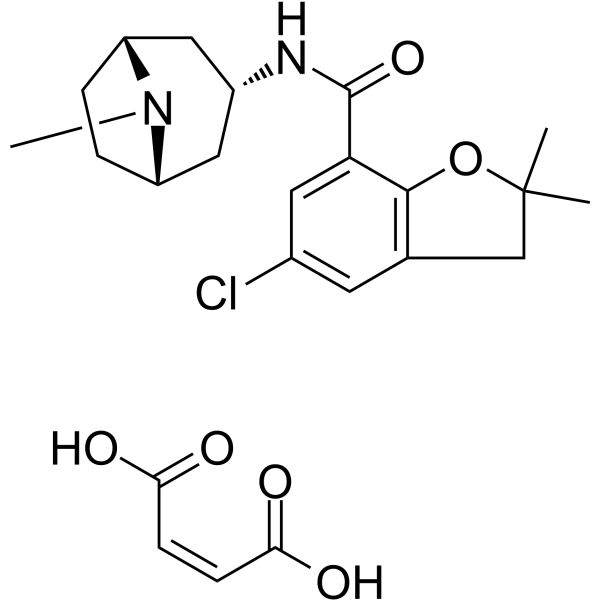
Zatosetron maleate
Zatosetron maleate is a potent and selective 5HT3 receptor antagonist.
Para uso exclusivo en investigación. No vendemos a pacientes.
- No. CAS: 123482-23-5
- Fòrmula: C23H29ClN2O6
- Peso molecular:464.94
-
Almacenamiento:
Please store the product under the recommended conditions in the Certificate of Analysis.

To place orders, for customer services and technical support, please contact: MedChemExpress USA
Tel: 609-228-6898 E-mail: [email protected] [email protected]


-
 Actividad biológica
-
Chemical Information
- Protocolo
- Pureza y Documentación
- Referencias
-
 Help & FAQs


Ver todos los productos específicos de isoformas 5-HT Receptor
More

Actividad biológica
Descripciòn
IC50 & Target
|
5-HT3 Receptor |
In Vivo
MedChemExpress (MCE) has not independently confirmed the accuracy of these methods. They are for reference only.


Chemical Information
-
No. CAS 123482-23-5
-
Peso molecular 464.94
-
Fòrmula C23H29ClN2O6
-
SMILES
O=C(O)/C=C\C(O)=O.O=C(C1=CC(Cl)=CC2=C1OC(C)(C)C2)N[C@H]3C[C@@H](CC4)N(C)[C@@H]4C3
-
Synonyms
LY 277359 maleate
-
Envío
Room temperature in continental US; may vary elsewhere.
-
Almacenamiento
Please store the product under the recommended conditions in the Certificate of Analysis.

Protocolo
Animal Administration[2]
Male rats are used and Zatosetron maleate (Zatosetron) is prepared as an aqueous solution. Acutely treated animals receive i.p. injections of Zatosetron maleate or saline 2 h before electrophysiological recordings; Chronically treated animals receive injections (i.p.) of Zatosetron maleate or saline once daily for 21 days, and receive their last injection 2 h before electrophysiological recordings. After completion of nine tracks, some animals are administered either apomorphine HCI (0.14 or 0.01 mg/kg i.v.) or haloperidol (0.1 mg/kg i.v.) and the number of dopamine cells is then counted in three additional tracks[2].
MedChemExpress (MCE) has not independently confirmed the accuracy of these methods. They are for reference only.


Pureza y Documentación
Referencias
[1]. Robertson DW, et al. Zatosetron, a potent, selective, and long-acting 5HT3 receptor antagonist: synthesis and structure-activity relationships. J Med Chem. 1992 Jan 24;35(2):310-9. [Content Brief]
[2]. Rasmussen K, et al. The 5-HT3 receptor antagonist zatosetron decreases the number of spontaneously active A10 dopamine neurons. Eur J Pharmacol. 1991 Nov 19; 205 (1):113-6. [Content Brief]

Calculators
Concentration (start) × Volume (start) = Concentration (final) × Volume (final)


Zatosetron maleate Related Classifications
HY-U00234 Related Classifications
 Powered by Bioz