



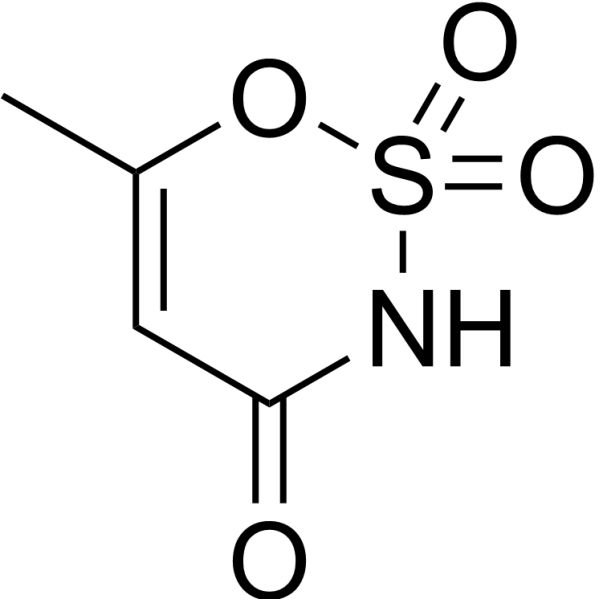
Acesulfame

Based on 1 Customer Validation
Acesulfame is a synthetic sweetener. Long-term use of Acesulfame can affect cognitive function. Acesulfame potassium can suppress autophagic degradation of PD-L1 in RIL-175 and SK-Hep1 cells through the ERK1/2-mTORC1-ULK1 pathway, which may be related to immune evasion in cancer cells. Acesulfame can be used in research on neurological diseases, metabolic disorders, cancer, and immune evasion.
Nos produits utilisent uniquement pour la recherche. Nous ne vendons pas aux patients.
- Pureté : 98.0%
- CAS No.: 33665-90-6
- Formule: C4H5NO4S
- Masse moléculaire:163.15
-
Stockage:Powder -20°C, 3 years ; In solvent -80°C, 6 months , -20°C, 1 month

To place orders, for customer services and technical support, please contact: MedChemExpress USA
Tel: 609-228-6898 E-mail: [email protected] [email protected]


-
 Activité biologique
-
Chemical Information
-
Solvant et solubilité
- Protocole
- Pureté et documentation
- Références
-
 Help & FAQs




Activité biologique
Description
In Vitro
Acesulfame (1 mM, 24 hours) upregulates PD-L1 protein levels in RIL-175 and SK-Hep1 cells[2].
Acesulfame (1 mM, 24 hours) increases granzyme B production in RIL-175 and SK-Hep1 cells co-cultured with T cells[2].
Acesulfame (1 mM, 24 hours) activates ERK1/2-mTORC1-ULK1 pathway to suppress autophagic degradation of PD-L1 in RIL-175 and SK-Hep1 cells[2].
.
Acesulfame (5-25 mM, 24 hours) inhibites mitochondrial metabolism in SH-SY5Y cells[4].
Acesulfame (5-25 mM, 24 hours) inhibites ATP production in cells and reduced phosphorylation of neuroprotective proteins, impaires energy metabolism and neuroprotective functions in SH-SY5Y cells[4].
MedChemExpress (MCE) has not independently confirmed the accuracy of these methods. They are for reference only. Further protocols information, click here.
-
Cell Line:RIL-175 (mouse hepatocellular carcinoma), SK-Hep1 (human hepatocellular carcinoma)
-
Concentration:1 mM
-
Incubation Time:24 hours
-
Result:Significantly increased PD-L1 protein levels.
-
Cell Line:SH-SY5Y (neuroblastoma cells)
-
Concentration:5-25 mM
-
Incubation Time:24 hours
-
Result:Reduced the extracellular acidification rate (ECAR) in SH-SY5Y cells.
In Vivo
Acesulfame (12.5 mM, administered via drinking water for 40 weeks) affects the neurometabolic functions in C57BL/6J mice[4].
MedChemExpress (MCE) has not independently confirmed the accuracy of these methods. They are for reference only.
-
Animal Model:CD-1 mice (male and female)[3]
-
Dosage:37.5 mg/kg
-
Administration:Oral gavage (p.o.), once daily for 4 weeks
-
Result:Increased body weight in male CD-1 mice.
Significantly altered the gut microbiome composition in both male and female mice.
-
Animal Model:C57BL/6J mice[3]
-
Dosage:12.5 mM
-
Administration:Administered via drinking water, once daily for 40 weeks
-
Result:Significant increase in fasting blood glucose and insulin levels in treated mice, without altering insulin sensitivity.


Chemical Information
-
CAS No. 33665-90-6
-
Appearance Solid
-
Masse moléculaire 163.15
-
Formule C4H5NO4S
-
Color White to off-white
-
SMILES
O=C1C=C(C)OS(=O)(N1)=O
-
Livraison
Room temperature in continental US; may vary elsewhere.
-
Stockage
Powder -20°C 3 years In solvent -80°C 6 months -20°C 1 month


Solvant et solubilité
In Vitro:
DMSO : 100 mg/mL (612.93 mM; Need ultrasonic; Hygroscopic DMSO has a significant impact on the solubility of product, please use newly opened DMSO)
Please refer to the solubility information to select the appropriate solvent. Once prepared, please aliquot and store the solution to prevent product inactivation from repeated freeze-thaw cycles.
Storage method and period of stock solution: -80°C, 6 months; -20°C, 1 month. When stored at -80°C, please use it within 6 months. When stored at -20°C, please use it within 1 month.
Please refer to the solubility information to select the appropriate solvent. Once prepared, please aliquot and store the solution to prevent product inactivation from repeated freeze-thaw cycles.
Storage method and period of stock solution: -80°C, 6 months; -20°C, 1 month. When stored at -80°C, please use it within 6 months. When stored at -20°C, please use it within 1 month.
Concentration (start) × Volume (start) = Concentration (final) × Volume (final)
In Vivo:
Select the appropriate dissolution method based on your experimental animal and administration route.
- For the following dissolution methods, please ensure to first prepare a clear stock solution using an In Vitro approach and then sequentially add co-solvents:
- To ensure reliable experimental results, the clarified stock solution can be appropriately stored based on storage conditions. As for the working solution for In Vivo experiments, it is recommended to prepare freshly and use it on the same day.
- The percentages shown for the solvents indicate their volumetric ratio in the final prepared solution. If precipitation or phase separation occurs during preparation, heat and/or sonication can be used to aid dissolution.
Add each solvent one by one: 10% DMSO 40% PEG300 5% Tween-80 45% Saline
Solubility: ≥ 5 mg/mL (30.65 mM); Clear solution
This protocol yields a clear solution of ≥ 5 mg/mL (saturation unknown).
Taking 1 mL working solution as an example, add 100 μL DMSO stock solution (50.0 mg/mL) to 400 μL PEG300, and mix evenly; then add 50 μL Tween-80 and mix evenly; then add 450 μL Saline to adjust the volume to 1 mL.
Preparation of Saline: Dissolve 0.9 g sodium chloride in ddH₂O and dilute to 100 mL to obtain a clear Saline solution.
Add each solvent one by one: 10% DMSO 90% (20% SBE-β-CD in Saline)
Solubility: ≥ 5 mg/mL (30.65 mM); Clear solution
This protocol yields a clear solution of ≥ 5 mg/mL (saturation unknown).
Taking 1 mL working solution as an example, add 100 μL DMSO stock solution (50.0 mg/mL) to 900 μL 20% SBE-β-CD in Saline, and mix evenly.
Preparation of 20% SBE-β-CD in Saline (4°C, storage for one week): 2 g SBE-β-CD powder is dissolved in 10 mL Saline, completely dissolve until clear.
In Vivo Dissolution Calculator
Please enter the basic information of animal experiments:
-
-
-
-
Recommended: Prepare an additional quantity of animals to account for potential losses during experiments.
Please enter your animal formula composition:
-
%DMSO +
Recommended: Keep the proportion of DMSO in working solution below 2% if your animal is weak.
-
%+
-
+%Tween-80 + +
-
%Saline +
The co-solvents required include: DMSO, . All of co-solvents are available by MedChemExpress (MCE). , Tween 80. All of co-solvents are available by MedChemExpress (MCE).
Working solution concentration: 0.22 mg/mL
Method for preparing stock solution: mg drug dissolved in μL DMSO. Stock solution concentration: mg/mL.
1. Take μL DMSO stock solution;
2. Add μL .
μL , mix evenly;
3. Then add μL Tween 80, mix evenly;
4. Then add μL
Please ensure that the stock solution in the first step is dissolved to a clear state, and add co-solvents in sequence. You can use ultrasonic heating (ultrasonic cleaner, recommended frequency 20-40 kHz), vortexing, etc. to assist dissolution.

Protocole
-
Protocol for Water Maze
The Morris Water Maze is a rodent spatial learning and memory assay in which a mouse or rat swims in opaque water to find an escape platform; in the hidden-platform version, the animal cannot see the platform and must use distal extra-maze cues to learn its fixed spatial location. The assay primarily measures hippocampus-dependent spatial learning during acquisition trials and spatial reference memory during probe trials after platform removal; readouts include escape latency, swim path length, swim speed, quadrant occupancy, platform-site crossings, and proximity to the former platform location.
-
Autophagy
Autophagy is a process in which eukaryotic cells use lysosomes to degrade their own cytoplasmic proteins and damaged organelles under the regulation of autophagy related gene (Atg). Microtubule-associated proteins light chain 3 (LC3) is recognized as autophagy marker, which transfers from cytoplasmic LC3 (LC3-I) to membrane type (LC3-II). LC3-II/I ratio could be detected by Western Blot and fluorescence microscopy.


Pureté et documentation
-
Fiche technique (281 KB)
-
SDS (252 KB)
- English - EN (252 KB)
- Français - FR (252 KB)
- Deutsch - DE (252 KB)
- Norwegian - NO (252 KB)
- Español - ES (252 KB)
- Swedish - SV (252 KB)
- Italian - IT (252 KB)
- Korean - KR (252 KB)
- Portuguese - PT (252 KB)
-
Instruction de manipulation (2659 KB)
Références
[1]. Cong WN, et al. Long-term artificial sweetener acesulfame potassium treatment alters neurometabolic functions in C57BL/6J mice. PLoS One. 2013 Aug 7;8(8):e70257. [Content Brief]
[2]. Kim DH, et al. Acesulfame potassium upregulates PD-L1 in HCC cells by attenuating autophagic degradation. Biochem Biophys Res Commun. 2024 Jun 4;711:149921. [Content Brief]
[3]. Bian X, et al. The artificial sweetener acesulfame potassium affects the gut microbiome and body weight gain in CD-1 mice. PLoS One. 2017 Jun 8;12(6):e0178426. [Content Brief]


Complete Stock Solution Preparation Table
Please refer to the solubility information to select the appropriate solvent. Once prepared, please aliquot and store the solution to prevent product inactivation from repeated freeze-thaw cycles.
Storage method and period of stock solution: -80°C, 6 months; -20°C, 1 month. When stored at -80°C, please use it within 6 months. When stored at -20°C, please use it within 1 month.
| Optional Solvent | Concentration Solvent Mass | 1 mg | 5 mg | 10 mg | 25 mg |
|---|---|---|---|---|---|
| DMSO | 1 mM | 6.1293 mL | 30.6466 mL | 61.2933 mL | 153.2332 mL |
| 5 mM | 1.2259 mL | 6.1293 mL | 12.2587 mL | 30.6466 mL | |
| 10 mM | 0.6129 mL | 3.0647 mL | 6.1293 mL | 15.3233 mL | |
| 15 mM | 0.4086 mL | 2.0431 mL | 4.0862 mL | 10.2155 mL | |
| 20 mM | 0.3065 mL | 1.5323 mL | 3.0647 mL | 7.6617 mL | |
| 25 mM | 0.2452 mL | 1.2259 mL | 2.4517 mL | 6.1293 mL | |
| 30 mM | 0.2043 mL | 1.0216 mL | 2.0431 mL | 5.1078 mL | |
| 40 mM | 0.1532 mL | 0.7662 mL | 1.5323 mL | 3.8308 mL | |
| 50 mM | 0.1226 mL | 0.6129 mL | 1.2259 mL | 3.0647 mL | |
| 60 mM | 0.1022 mL | 0.5108 mL | 1.0216 mL | 2.5539 mL | |
| 80 mM | 0.0766 mL | 0.3831 mL | 0.7662 mL | 1.9154 mL | |
| 100 mM | 0.0613 mL | 0.3065 mL | 0.6129 mL | 1.5323 mL |


Acesulfame Related Classifications
HY-W550739 Related Classifications
 Powered by Bioz