



Bopindolol
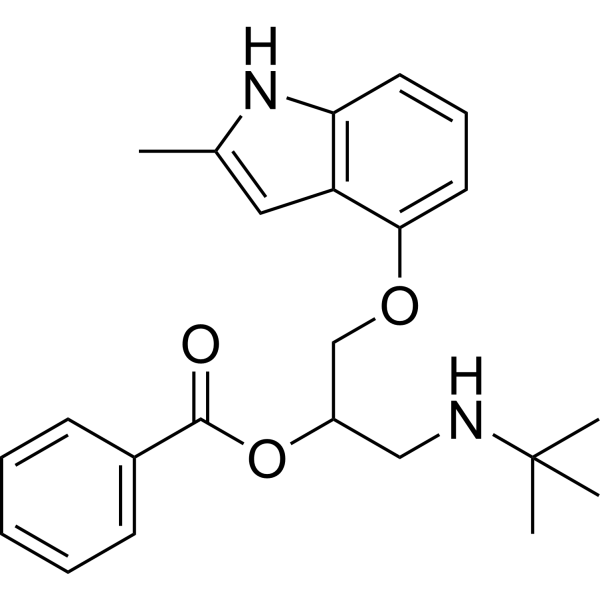
Bopindolol ((±)-Bopindolol) is an orally active antagonist of β-adrenoceptors (ARs) with partial agonist activity. Bopindolol is non-selective for β1- and β2-ARs and has low affinity for β3-AR subtype. Bopindolol has intrinsic sympathomimetic as well as membrane stabilizing actions, inhibits renin secretion, and interacts with 5-HT receptors. Bopindolol is a proagent of Pindolol (HY-B0982). Bopindolol can be used for essential and renovascular hypertension research.
For research use only. We do not sell to patients.
- CAS No.: 62658-63-3
- Formula: C23H28N2O3
- Molecular Weight:380.48
-
Storage:
Please store the product under the recommended conditions in the Certificate of Analysis.

To place orders, for customer services and technical support, please contact: MedChemExpress USA
Tel: 609-228-6898 E-mail: [email protected] [email protected]


-
 Biological Activity
-
Chemical Information
- Protocols
- Purity & Documentation
- References
-
 Help & FAQs




Biological Activity
Description
IC50 & Target
[1]|
β2 adrenoceptor |
Beta-1 adrenergic receptor |
Beta-3 adrenergic receptor |
In Vivo
MedChemExpress (MCE) has not independently confirmed the accuracy of these methods. They are for reference only.
-
Animal Model:Male Wistar rats (260-300 g)[2]
-
Dosage:0.3, 1 and 3 mg/kg
-
Administration:IP; single dosage
-
Result:Produced dose dependent decreases in diastolic blood pressure, and the decrease of about 8 mmHg at 3 mg/kg.
Decreased the heart rate in a dose-dependent manner.


Chemical Information
-
CAS No. 62658-63-3
-
Molecular Weight 380.48
-
Formula C23H28N2O3
-
SMILES
CC(N1)=CC2=C1C=CC=C2OCC(OC(C3=CC=CC=C3)=O)CNC(C)(C)C
-
Synonyms
(±)-Bopindolol
-
Shipping
Room temperature in continental US; may vary elsewhere.
-
Storage
Please store the product under the recommended conditions in the Certificate of Analysis.


Purity & Documentation
References
[1]. Harron DW, et al. Bopindolol. A review of its pharmacodynamic and pharmacokinetic properties and therapeutic efficacy. Drugs. 1991 Jan;41(1):130-49. [Content Brief]
[2]. H Tanaka, et al. Hypotensive effect of bopindolol in pithed rats. Gen Pharmacol. 1993 Mar;24(2):373-5. [Content Brief]
[3]. Y Hosohata, et al. Bopindolol is a slowly dissociating beta 1-adrenoceptor antagonist when compared to other beta-blockers. Biol Pharm Bull. 1995 Aug;18(8):1066-71. [Content Brief]
[4]. Nagatomo T, et al. Bopindolol: pharmacological basis and clinical implications. Cardiovasc Drug Rev. 2001 Spring;19(1):9-24. [Content Brief]

Calculators
Concentration (start) × Volume (start) = Concentration (final) × Volume (final)


Bopindolol Related Classifications
HY-B1562 Related Classifications
 Powered by Bioz