



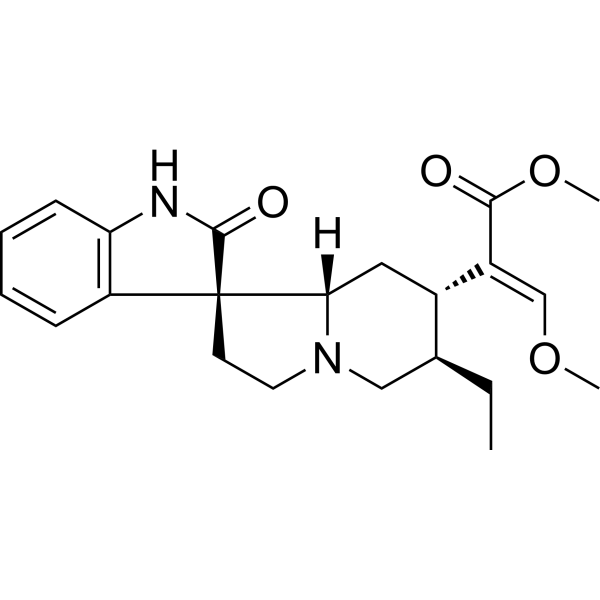
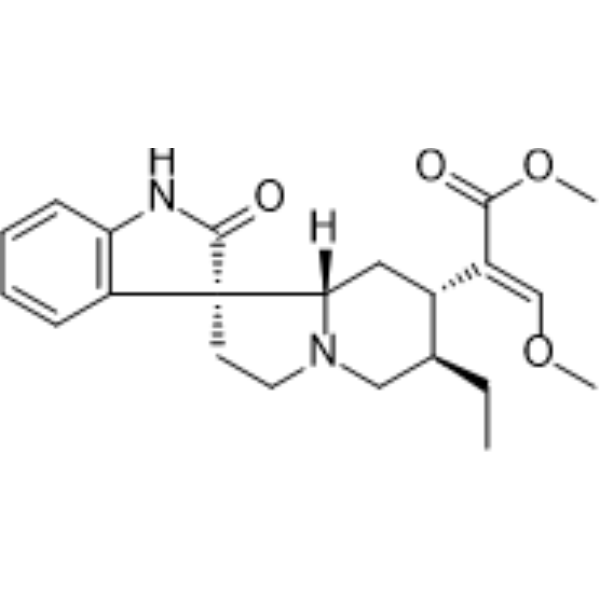
Isorhynchophylline
Based on 2 publication(s) in Google Scholar
Isorhynchophylline is an alkaloid isolated from Crocus sativus with anticancer, antihypertensive, anti-inflammatory, and neuroprotective properties. Isorhynchophylline can be applied to cardiovascular and neurological disorders, and cancer studies.
Nur für Forschungszwecke. Wir verkaufen nicht an Patienten.
- Reinheit: 99.82%
- CAS. Nr.: 6859-01-4
- Formel: C22H28N2O4
- Molecular Weight:384.47
-
Speicherung:Powder -20°C, 3 years , 4°C, 2 years ; In solvent -80°C, 2 years , -20°C, 1 year

To place orders, for customer services and technical support, please contact: MedChemExpress USA
Tel: 609-228-6898 E-mail: [email protected] [email protected]


-
 Biologische Aktivität
-
Chemical Information
-
Lösungsmittel & Löslichkeit
- Reinheit & Dokumentation
- Verweise
-
 Help & FAQs


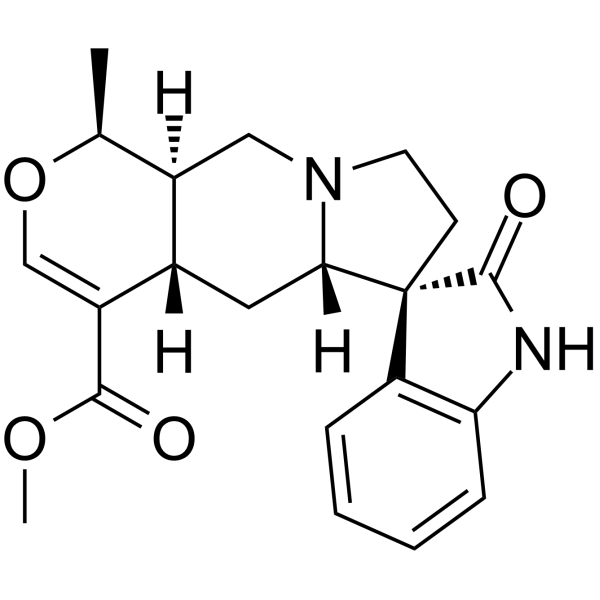

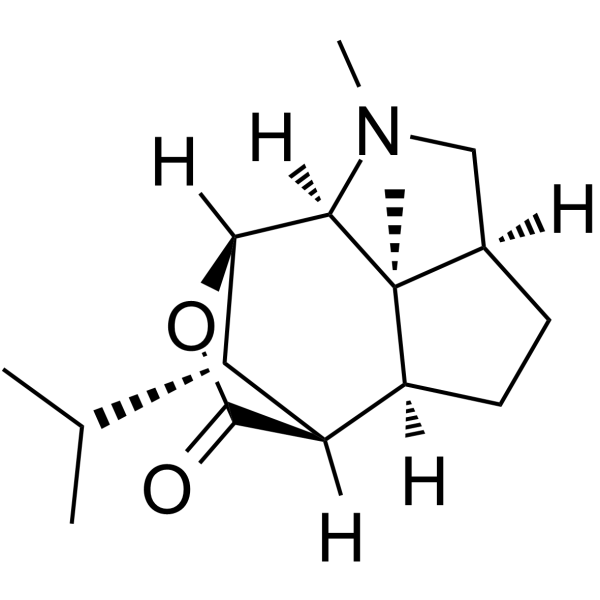

Publications Citing Use of MedChemExpress (MCE) Isorhynchophylline
More

Biologische Aktivität
|
Cell Line

|
Type | Value | Description | References |
|---|---|---|---|---|
| HL-60 | IC50 |
>40 μM
Compound: 6
|
Cytotoxicity against human HL60 cells after 48 hrs by MTT assay
Cytotoxicity against human HL60 cells after 48 hrs by MTT assay
|
[PMID: 21070010] |
| Microglia | IC50 |
19 μM
Compound: 6
|
Inhibition of LPS-stimulated NO release in rat cortical microglial cells assessed as nitrite accumulation after 48 hrs
Inhibition of LPS-stimulated NO release in rat cortical microglial cells assessed as nitrite accumulation after 48 hrs
|
[PMID: 18588343] |
| SW480 | IC50 |
>40 μM
Compound: 6
|
Cytotoxicity against human SW480 cells after 48 hrs by MTT assay
Cytotoxicity against human SW480 cells after 48 hrs by MTT assay
|
[PMID: 21070010] |
Isorhynchophylline (0.0625-40 µM, 48 h) shows cytotoxicity against human HL60 cells and SW480 cells (MTT assay), with IC50s greater than 40 μM[1].
Isorhynchophylline (3-15 µg/mL, 48 h) inhibits LPS-stimulated NO release in rat cortical microglial cells assessed as nitrite accumulation[2].
Isorhynchophylline (0.1-10.0 μM, 24 h) effectively inhibits angiotensin II-induced proliferation in rat vascular smooth muscle cells, at least in part, due to increased NO production and regulation of the cell cycle[3].
Isorhynchophylline (0-300 μM, 48 h) exerts anticancer and anti-metastatic effects through regulation of multiple signaling cascades (abatement of phospho-p38, etc.) in hepatocellular carcinoma cells [4].
Isorhynchophylline (1-50 μM, 2 h) protects PC12 cells against Beta-Amyloid-induced apoptosis via PI3K/Akt signaling pathway[5].
Isorhynchophylline (1-80 μM, 24 h) attenuates proliferation and migration of synovial fibroblasts via the FOXC1/β-catenin axis[6].
Isorhynchophylline (5-200 μM, 48 h) alleviates cartilage degeneration in osteoarthritis by activating autophagy in chondrocytes[7].
Isorhynchophylline (30 μM, 24 h) relieves ferroptosis-induced nerve damage after intracerebral hemorrhage via miR-122-5p/TP53/SLC7A11 pathway in hippocampal HT-22 cells[8].
MedChemExpress (MCE) has not independently confirmed the accuracy of these methods. They are for reference only.
-
Cell Line:Rat vascular smooth muscle cells treated with Ang II (1.0 μM)
-
Concentration:0.1, 1, 10 μM
-
Incubation Time:24 h
-
Result:Attenuated Ang II-induced cell proliferation in a concentration-dependent manner.
Abolished Ang-II induced VMSC proliferation at the highest concentration (10 μM).
-
Cell Line:Rat vascular smooth muscle cells treated with Ang II (1.0 μM)
-
Concentration:0.1, 1, 10 μM
-
Incubation Time:24 h
-
Result:Significantly decreased the percentage of cells in S and G2/M phases, and increased the percentage of cells in G0/G1 phase (1.0 μM and 10.0 μM).
-
Cell Line:Rat vascular smooth muscle cells treated with Ang II (1.0 μM)
-
Concentration:0.1, 1, 10 μM
-
Incubation Time:24 h
-
Result:Suppressed the overexpression of c-fos mRNA in a concentration-dependent manner.
Decreased the over-expression of OPN and PCNA mRNA at 1.0 μM and 10.0 μM.
Isorhynchophylline (50 μM, the first day of every week from the 5th to the 8th week after surgery) alleviates osteoarthritis in rat osteoarthritis models, with decreasing OARSI score and the reduction of joint space[7].
Isorhynchophylline (10-40 mg/kg, i.g., 7 days) exerts antidepressant-like effects in mice at least in part by inhibiting monoamine oxidase[10].
Isorhynchophylline (20-40 mg/kg, i.g., daily, 8 weeks) alleviates learning and memory impairments induced by aluminum chloride in mice[11].
Isorhynchophylline (20 mg/kg, i.p., 14 or 42 days) alleviates silicon-dioxide-induced lung injury in mice, with reducing inflammatory responses and fibrosis[12].
MedChemExpress (MCE) has not independently confirmed the accuracy of these methods. They are for reference only.
-
Animal Model:D-galactose-induced cognitive deficits (Ten-week-old male ICR mice received a daily subcutaneous injection of D-gal at a dose of 100 mg/kg for 8 weeks)[9]
-
Dosage:20, 40 mg/kg
-
Administration:Given intragastrically (i.g.), daily, 8 weeks
-
Result:Shortened the mean latency to find the platform at the 4th day (20 mg/kg).
Led to a significant increase in the number of target crossings (40 mg/kg).
Attenuated oxidative stress (enhanced the level of GSH, attenuated MDA).
Decreased the production of NO and the mRNA expression of iNOS in the brain (40 mg/kg).
Decreased the production of PGE2 and the mRNA expression of COX-2 (40 mg/kg).
Suppressed the protein level of p-IκBα (40 mg/kg).


Chemical Information
-
CAS. Nr. 6859-01-4
-
Appearance Solid
-
Molecular Weight 384.47
-
Formel C22H28N2O4
-
Color White to off-white
-
SMILES
O=C(NC1=C2C=CC=C1)[C@@]32[C@@](C[C@H](/C(C(OC)=O)=C\OC)[C@@H](CC)C4)([H])N4CC3
-
Structure Classification
-
Initial Source
-
Versand
Room temperature in continental US; may vary elsewhere.
-
Speicherung
Powder -20°C 3 years 4°C 2 years In solvent -80°C 2 years -20°C 1 year


Publications (2)
-
Journal Impact Factor
-
Most Recent
-
Int J Biol Macromol
Isorhynchophylline-loaded silk sericin/gelatin methacrylate crosslinked hydrogel: A synergistic platform for accelerated wound healing. [Abstract]2025 Dec;334(Pt 2):148943. PMID: 41224043 -
Sci Rep
Exploring the molecular mechanisms of subarachnoid hemorrhage and potential therapeutic targets: insights from bioinformatics and drug prediction. [Abstract]2025 Apr 15;15(1):12861. PMID: 40229542


Lösungsmittel & Löslichkeit
DMSO : 100 mg/mL (260.10 mM; Need ultrasonic; Hygroscopic DMSO has a significant impact on the solubility of product, please use newly opened DMSO)
Please refer to the solubility information to select the appropriate solvent. Once prepared, please aliquot and store the solution to prevent product inactivation from repeated freeze-thaw cycles.
Storage method and period of stock solution: -80°C, 2 years; -20°C, 1 year. When stored at -80°C, please use it within 2 years. When stored at -20°C, please use it within 1 year.
Please refer to the solubility information to select the appropriate solvent. Once prepared, please aliquot and store the solution to prevent product inactivation from repeated freeze-thaw cycles.
Storage method and period of stock solution: -80°C, 2 years; -20°C, 1 year. When stored at -80°C, please use it within 2 years. When stored at -20°C, please use it within 1 year.
Konzentration (Stammlösung) × Volumen (Stammlösung) = Konzentration (Ziellösung) × Volumen (Ziellösung)
Select the appropriate dissolution method based on your experimental animal and administration route.
- For the following dissolution methods, please ensure to first prepare a clear stock solution using an In Vitro approach and then sequentially add co-solvents:
- To ensure reliable experimental results, the clarified stock solution can be appropriately stored based on storage conditions. As for the working solution for In Vivo experiments, it is recommended to prepare freshly and use it on the same day.
- The percentages shown for the solvents indicate their volumetric ratio in the final prepared solution. If precipitation or phase separation occurs during preparation, heat and/or sonication can be used to aid dissolution.
Add each solvent one by one: 10% DMSO 40% PEG300 5% Tween-80 45% Saline
Solubility: ≥ 2.5 mg/mL (6.50 mM); Clear solution
This protocol yields a clear solution of ≥ 2.5 mg/mL (saturation unknown).
Taking 1 mL working solution as an example, add 100 μL DMSO stock solution (25.0 mg/mL) to 400 μL PEG300, and mix evenly; then add 50 μL Tween-80 and mix evenly; then add 450 μL Saline to adjust the volume to 1 mL.
Preparation of Saline: Dissolve 0.9 g sodium chloride in ddH₂O and dilute to 100 mL to obtain a clear Saline solution.
Please enter the basic information of animal experiments:
-
-
-
-
Recommended: Prepare an additional quantity of animals to account for potential losses during experiments.
Please enter your animal formula composition:
-
%DMSO +
Recommended: Keep the proportion of DMSO in working solution below 2% if your animal is weak.
-
%+
-
+%Tween-80 + +
-
%Saline +
The co-solvents required include: DMSO, . All of co-solvents are available by MedChemExpress (MCE). , Tween 80. All of co-solvents are available by MedChemExpress (MCE).
Working solution concentration: 0.22 mg/mL
Method for preparing stock solution: mg drug dissolved in μL DMSO. Stock solution concentration: mg/mL.
1. Take μL DMSO stock solution;
2. Add μL .
μL , mix evenly;
3. Then add μL Tween 80, mix evenly;
4. Then add μL
Please ensure that the stock solution in the first step is dissolved to a clear state, and add co-solvents in sequence. You can use ultrasonic heating (ultrasonic cleaner, recommended frequency 20-40 kHz), vortexing, etc. to assist dissolution.


Reinheit & Dokumentation
-
Data Sheet (286 KB)
-
SDS (419 KB)
- English - EN (419 KB)
- Français - FR (419 KB)
- Deutsch - DE (419 KB)
- Norwegian - NO (419 KB)
- Español - ES (419 KB)
- Swedish - SV (419 KB)
- Italian - IT (419 KB)
- Korean - KR (419 KB)
- Portuguese - PT (419 KB)
-
Handling Instructions (2659 KB)
Verweise
[1]. Wang K, et al. Macrophyllionium and macrophyllines A and B, oxindole alkaloids from Uncaria macrophylla. J Nat Prod. 2011 Jan 28;74(1):12-5. [Content Brief]
[2]. Yuan D, et al. Alkaloids from the leaves of Uncaria rhynchophylla and their inhibitory activity on NO production in lipopolysaccharide-activated microglia. J Nat Prod. 2008 Jul;71(7):1271-4. [Content Brief]
[3]. Zhang F, et al. Effects of isorhynchophylline on angiotensin II-induced proliferation in rat vascular smooth muscle cells. J Pharm Pharmacol. 2008 Dec;60(12):1673-8. [Content Brief]
[4]. Lee H, et al. Isorhynchophylline, a Potent Plant Alkaloid, Induces Apoptotic and Anti-Metastatic Effects in Human Hepatocellular Carcinoma Cells through the Modulation of Diverse Cell Signaling Cascades. Int J Mol Sci. 2017 May 19;18(5):1095. [Content Brief]
[5]. Xian YF, et al. Isorhynchophylline Protects PC12 Cells Against Beta-Amyloid-Induced Apoptosis via PI3K/Akt Signaling Pathway. Evid Based Complement Alternat Med. 2013;2013:163057. [Content Brief]
[6]. Wu Y, et al. Isorhynchophylline attenuates proliferation and migration of synovial fibroblasts via the FOXC1/β-catenin axis. Autoimmunity. 2023 Dec;56(1):2289868. [Content Brief]
[7]. Jiang J, et al. Isorhynchophylline alleviates cartilage degeneration in osteoarthritis by activating autophagy of chondrocytes. J Orthop Surg Res. 2023 Mar 2;18(1):154. [Content Brief]
[8]. Zhao H, et al. Isorhynchophylline Relieves Ferroptosis-Induced Nerve Damage after Intracerebral Hemorrhage Via miR-122-5p/TP53/SLC7A11 Pathway. Neurochem Res. 2021 Aug;46(8):1981-1994. [Content Brief]
[9]. Xian YF, et al. Isorhynchophylline improves learning and memory impairments induced by D-galactose in mice. Neurochem Int. 2014 Oct;76:42-9. [Content Brief]
[10]. Xian YF, et al. Antidepressant-Like Effect of Isorhynchophylline in Mice. Neurochem Res. 2017 Feb;42(2):678-685. [Content Brief]
[11]. Li HQ, et al. Isorhynchophylline alleviates learning and memory impairments induced by aluminum chloride in mice. Chin Med. 2018 Jun 14;13:29. [Content Brief]
[12]. Qiu M, et al. Protective effects of isorhynchophylline against silicon-dioxide-induced lung injury in mice. Artif Cells Nanomed Biotechnol. 2020 Dec;48(1):1125-1134. [Content Brief]
[13]. Guo H, et al. Isorhynchophylline protects against pulmonary arterial hypertension and suppresses PASMCs proliferation. Biochem Biophys Res Commun. 2014 Jul 18;450(1):729-34. [Content Brief]


Complete Stock Solution Preparation Table
Please refer to the solubility information to select the appropriate solvent. Once prepared, please aliquot and store the solution to prevent product inactivation from repeated freeze-thaw cycles.
Storage method and period of stock solution: -80°C, 2 years; -20°C, 1 year. When stored at -80°C, please use it within 2 years. When stored at -20°C, please use it within 1 year.
| Optional Solvent | Concentration Solvent Mass | 1 mg | 5 mg | 10 mg | 25 mg |
|---|---|---|---|---|---|
| DMSO | 1 mM | 2.6010 mL | 13.0049 mL | 26.0098 mL | 65.0246 mL |
| 5 mM | 0.5202 mL | 2.6010 mL | 5.2020 mL | 13.0049 mL | |
| 10 mM | 0.2601 mL | 1.3005 mL | 2.6010 mL | 6.5025 mL | |
| 15 mM | 0.1734 mL | 0.8670 mL | 1.7340 mL | 4.3350 mL | |
| 20 mM | 0.1300 mL | 0.6502 mL | 1.3005 mL | 3.2512 mL | |
| 25 mM | 0.1040 mL | 0.5202 mL | 1.0404 mL | 2.6010 mL | |
| 30 mM | 0.0867 mL | 0.4335 mL | 0.8670 mL | 2.1675 mL | |
| 40 mM | 0.0650 mL | 0.3251 mL | 0.6502 mL | 1.6256 mL | |
| 50 mM | 0.0520 mL | 0.2601 mL | 0.5202 mL | 1.3005 mL | |
| 60 mM | 0.0433 mL | 0.2167 mL | 0.4335 mL | 1.0837 mL | |
| 80 mM | 0.0325 mL | 0.1626 mL | 0.3251 mL | 0.8128 mL | |
| 100 mM | 0.0260 mL | 0.1300 mL | 0.2601 mL | 0.6502 mL |


Isorhynchophylline Related Classifications
HY-N0766 Related Classifications
 Powered by Bioz