



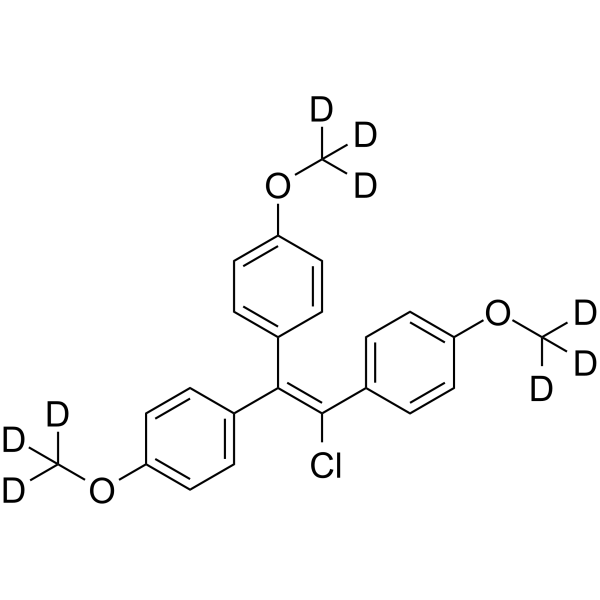
Chlorotrianisene-d9
Chlorotrianisene-d9 is the deuterium labeled Chlorotrianisene. Chlorotrianisene is a long-acting non-steroidal estrogen and an orally active estrogen receptor modulator. Chlorotrianisene exhibits antiestrogenic activity. Chlorotrianisene potently inhibits the enzyme COX-1 and inhibits platelet aggregation in whole blood.
Nos produits utilisent uniquement pour la recherche. Nous ne vendons pas aux patients.
- CAS No.: 1276197-26-2
- Formule: C23H12D9ClO3
- Masse moléculaire:389.92
-
Stockage:
Please store the product under the recommended conditions in the Certificate of Analysis.

To place orders, for customer services and technical support, please contact: MedChemExpress USA
Tel: 609-228-6898 E-mail: [email protected] [email protected]


-
 Activité biologique
-
Chemical Information
- Protocole
- Pureté et documentation
- Références
-
 Help & FAQs




Activité biologique
Description
In Vitro
Stable heavy isotopes of hydrogen, carbon, and other elements have been incorporated into drug molecules, largely as tracers for quantitation during the drug development process. Deuteration has gained attention because of its potential to affect the pharmacokinetic and metabolic profiles of drugs[1].
MedChemExpress (MCE) has not independently confirmed the accuracy of these methods. They are for reference only. Further protocols information, click here.
Application
1. This compound can be used as a tracer
2. This compound can be used as an internal standard for quantitative analysis by NMR, GC-MS, or LC-MS.


Chemical Information
-
CAS No. 1276197-26-2
-
Unlabeled CAS 569-57-3
-
Masse moléculaire 389.92
-
Formule C23H12D9ClO3
-
SMILES
Cl/C(C1=CC=C(C=C1)OC([2H])([2H])[2H])=C(C2=CC=C(C=C2)OC([2H])([2H])[2H])\C3=CC=C(C=C3)OC([2H])([2H])[2H]
-
Livraison
Room temperature in continental US; may vary elsewhere.
-
Stockage
Please store the product under the recommended conditions in the Certificate of Analysis.

Protocole
-
Research Protocol for Endocrine Diseases
Endocrine diseases often arise from disrupted hormone production, hormone signaling, or target-tissue responsiveness; for diabetes-focused endocrine disease models, insulin signaling regulates glucose uptake, hepatic glucose output, lipid metabolism, and β-cell compensation. Type 2 diabetes develops through interacting defects in insulin resistance, β-cell dysfunction, adipose inflammation, hepatic glucose overproduction, altered incretin signaling, and ectopic lipid metabolism. A major unresolved question is whether endocrine dysfunction is driven primarily by target-tissue insulin resistance, intrinsic β-cell failure, immune/inflammatory stress, or combined multi-organ failure that differs by disease stage.


Pureté et documentation
Références
[1]. Russak EM, et al. Impact of Deuterium Substitution on the Pharmacokinetics of Pharmaceuticals. Ann Pharmacother. 2019;53(2):211-216. [Content Brief]
[2]. Ruenitz PC, et al. Estrogenic tamoxifen derivatives: categorization of intrinsic estrogenicity in MCF-7 cells. J Steroid Biochem Mol Biol. 1997 Nov-Dec;63(4-6):203-9. [Content Brief]
[3]. Lounkine E, et al. Large-scale prediction and testing of drug activity on side-effect targets. Nature. 2012 Jun 10;486(7403):361-7. [Content Brief]
[4]. Kupfer D, et al. Inactivation of the uterine estrogen receptor binding of estradiol during P-450 catalyzed metabolism of chlorotrianisene (TACE). Speculation that TACE antiestrogenic activity involves covalent binding to the estrogen receptor. FEBS Lett. 1990 Feb 12;261(1):59-62. [Content Brief]

Calculators
Concentration (start) × Volume (start) = Concentration (final) × Volume (final)


Chlorotrianisene-d9 Related Classifications
HY-B2158S Related Classifications
 Powered by Bioz