



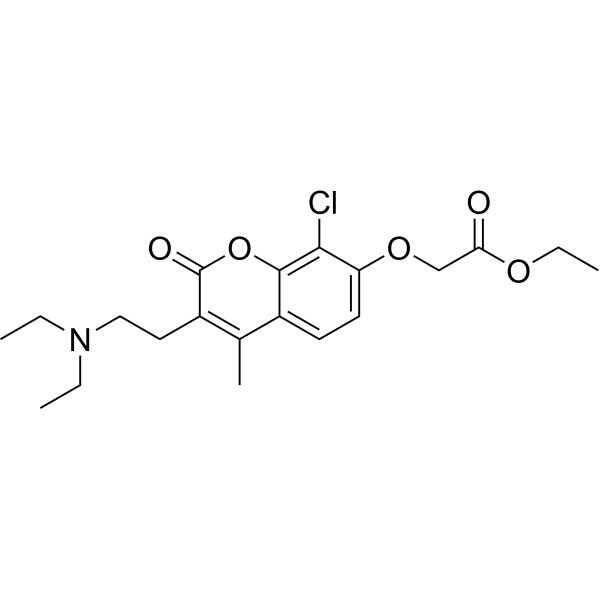
Cloricromen
Cloricromen (Cloricromene) is an orally active platelet inhibitor. Cloricromen inhibits thromboxane B2 release, β-thromboglobulin, and thrombus formation. Cloricromen inhibits LPS (HY-D1056)-induced NF-κB activation, oxidative activity, and TNF-α expression. Cloricromen exhibits protective activity in animal models of shock and peripheral ischaemia. Cloricromen can be used for the research of myocardial ischaemia/reperfusion injury, and ischaemic cerebrovascular disease.
Nur für Forschungszwecke. Wir verkaufen nicht an Patienten.
- CAS. Nr.: 68206-94-0
- Formel: C20H26ClNO5
- Molecular Weight:395.88
-
Speicherung:
Please store the product under the recommended conditions in the Certificate of Analysis.

To place orders, for customer services and technical support, please contact: MedChemExpress USA
Tel: 609-228-6898 E-mail: [email protected] [email protected]


-
 Biologische Aktivität
-
Chemical Information
- Protokoll
- Reinheit & Dokumentation
- Verweise
-
 Help & FAQs


Alle TNF Receptor Isoform-spezifische Produkte anzeigen
More

Biologische Aktivität
Beschreibung
In Vitro
Cloricromen (1-50 μM; 10 min pre-incubation before 24 h LPS exposure) potently inhibits lipopolysaccharide-induced TNF-α release in rat alveolar macrophages with an IC50 of 5.9 μM, without inducing cytotoxicity[3].
Cloricromen (10 μM; 10 min pre-incubation before 2 h LPS exposure) inhibits LPS-induced TNF-α mRNA expression in rat alveolar macrophages, indicating a pre-transcriptional mechanism of action[3].
Cloricromen (1-50 μM; 10 min pre-incubation before 15 min LPS exposure) LPS-induced NF-κB activation in a dose-dependent manner in rat alveolar macrophages by targeting activation, not direct DNA binding[3].
Cloricromen (10 μM; 10 min pre-incubation before 5 min LPS exposure) has only a slight effect on lipopolysaccharide-induced PKC-βII translocation in rat alveolar macrophages[3].
Cloricromen (10 μM; 10 min pre-incubation before LPS exposure) significantly inhibits lipopolysaccharide-induced cellular oxidative activity in rat alveolar macrophages[3].
MedChemExpress (MCE) has not independently confirmed the accuracy of these methods. They are for reference only.
-
Cell Line:rat alveolar macrophages
-
Concentration:10 μM
-
Incubation Time:10 min pre-incubation before 2 h LPS exposure
-
Result:Inhibited LPS-induced TNF-α mRNA expression by ~60%.
In Vivo
Cloricromene protects against LPS-induced endotoxic shock in male Sprague-Dawley rats by inhibiting TNF-α production, improving survival, and reversing associated hemodynamic and hematological abnormalities[3].
Cloricromene reduces myocardial infarct size in male Sprague-Dawley rats subjected to ischemia-reperfusion injury[3].
Cloricromene (0.25-0.50 mg/kg; i.v.; continuous infusion; up to 70 minutes) reduces myocardial ischemia-reperfusion injury in rabbits[4].
MedChemExpress (MCE) has not independently confirmed the accuracy of these methods. They are for reference only.
-
Animal Model:New Zealand white rabbits (male, 2-3 kg, myocardial ischaemia-reperfusion model via 1 hour left coronary artery occlusion followed by 2 hours reperfusion)[1]
-
Dosage:30; 300 μg/kg/min
-
Administration:i.v.; continuous infusion; from 15 minutes pre-occlusion through 2-hour reperfusion
-
Result:Reduced infarct size to 40.8% of the area at risk.
Significantly reduced myeloperoxidase activity in infarcted myocardial tissue.
Showed no attenuation of occlusion-induced ST-segment elevation.
Detected no inhibition of ex vivo platelet aggregation induced by ADP or collagen.
Caused no significant changes in mean arterial blood pressure, pressure-rate index, left ventricular systolic pressure, or heart rate relative to controls.
Significantly reduced myeloperoxidase activity in infarcted myocardial tissue.
Significantly reduced occlusion-induced ST-segment elevation to 0.08 mV at 20 minutes post-occlusion and returned to basal levels by 1 hour post-occlusion.
Inhibited ex vivo platelet aggregation, with collagen-induced aggregation reduced to 57% at end of occlusion and 13% after 2-hour reperfusion, and ADP-induced aggregation reduced to 74% at end of occlusion and 53% after 2-hour reperfusion.
Caused a slight, non-significant decrease in mean arterial blood pressure, a significant decrease in left ventricular systolic pressure at end of occlusion, and a significant increase in heart rate at end of reperfusion, with no change in pressure-rate index.
-
Animal Model:New Zealand white rabbits (pathogen-free, 2.5-3.5 kg)[4]
-
Dosage:3.6 μg/kg/min; 7.1 μg/kg/min (for transient ST elevations); total 0.25-0.50 mg/kg
-
Administration:i.v.; continuous infusion; up to 70 minutes
-
Result:Reversed transient ST-segment elevations in 3 out of 4 affected rabbits.
Showed no significant difference in chemiluminescence between anterior and posterior ventricular walls.
Achieved an anterior/posterior wall chemiluminescence ratio of 0.95.
Resulted in an overall myocardial-cell injury score of 1.4.
Preserved myocyte subcellular architecture with only mild or moderate mitochondrial edema.
Maintained well-preserved capillary structure with occasional mild/moderate endothelial luminal protrusions.
Observed focal subendocardial necrosis in 3 out of 10 treated rabbits.
Prevented reperfusion arrhythmias.


Chemical Information
-
CAS. Nr. 68206-94-0
-
Molecular Weight 395.88
-
Formel C20H26ClNO5
-
SMILES
O=C(COC1=CC=C(C(C)=C2CCN(CC)CC)C(OC2=O)=C1Cl)OCC
-
Synonyms
Cloricromene; AD6
-
Versand
Room temperature in continental US; may vary elsewhere.
-
Speicherung
Please store the product under the recommended conditions in the Certificate of Analysis.


Reinheit & Dokumentation
Verweise
[1]. Orefice G, et al. No effect of cloricromen on some coagulation parameters in patients with ischaemic cerebrovascular disease. J Int Med Res. 1994 Sep-Oct;22(5):287-91. [Content Brief]
[2]. Lidbury PS, et al. Dissociation of the anti-ischaemic effects of cloricromene from its anti-platelet activity. Br J Pharmacol. 1993 Sep;110(1):275-80. [Content Brief]
[3]. Corsini E, et al. Cloricromene, a semi-synthetic coumarin derivative, inhibits tumor necrosis factor-alpha production at a pre-transcriptional level. Eur J Pharmacol. 2001 Apr 27;418(3):231-7. [Content Brief]
[4]. Milei J, et al. Effects of cloricromene on ischemia-reperfusion myocardial damage in the rabbit. Cardiology. 1992;81(2-3):89-99. [Content Brief]

Calculators
Konzentration (Stammlösung) × Volumen (Stammlösung) = Konzentration (Ziellösung) × Volumen (Ziellösung)


Cloricromen Related Classifications
HY-116678 Related Classifications
 Powered by Bioz