



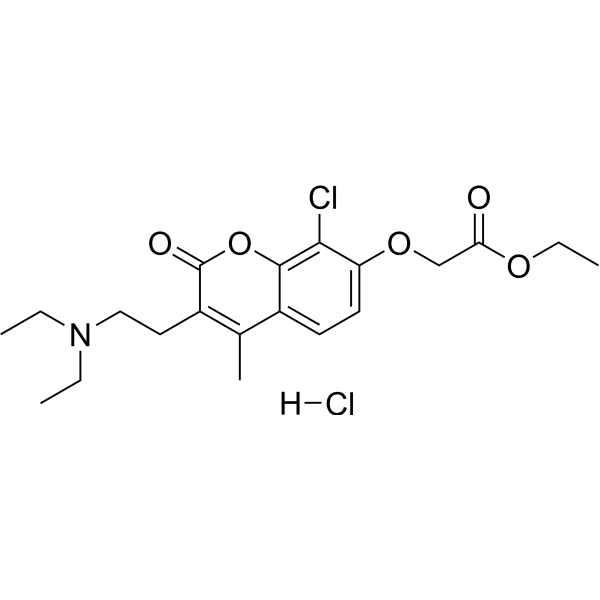
Cloricromen hydrochloride

Based on 1 Customer Validation
Cloricromen (Cloricromene) hydrochloride is an orally active platelet inhibitor. Cloricromen hydrochloride inhibits thromboxane B2 release, β-thromboglobulin, and thrombus formation. Cloricromen hydrochloride inhibits LPS (HY-D1056)-induced NF-κB activation, oxidative activity, and TNF-α expression. Cloricromen hydrochloride exhibits protective activity in animal models of shock and peripheral ischaemia. Cloricromen hydrochloride can be used for the research of myocardial ischaemia/reperfusion injury, and ischaemic cerebrovascular disease.
For research use only. We do not sell to patients.
- Purity : 99.82%
- CAS No.: 74697-28-2
- Formula: C20H27Cl2NO5
- Molecular Weight:432.34
-
Storage:Powder -20°C, 3 years , 4°C, 2 years ; In solvent -80°C, 6 months , -20°C, 1 month

To place orders, for customer services and technical support, please contact: MedChemExpress USA
Tel: 609-228-6898 E-mail: [email protected] [email protected]


-
 Biological Activity
-
Chemical Information
-
Solvent & Solubility
- Protocols
- Purity & Documentation
- References
-
 Help & FAQs




Biological Activity
Description
In Vitro
Cloricromen (1-50 μM; 10 min pre-incubation before 24 h LPS exposure) hydrochloride potently inhibits lipopolysaccharide-induced TNF-α release in rat alveolar macrophages with an IC50 of 5.9 μM, without inducing cytotoxicity[3].
Cloricromen (10 μM; 10 min pre-incubation before 2 h LPS exposure) hydrochloride inhibits LPS-induced TNF-α mRNA expression in rat alveolar macrophages, indicating a pre-transcriptional mechanism of action[3].
Cloricromen (1-50 μM; 10 min pre-incubation before 15 min LPS exposure) inhibits LPS-induced NF-κB activation in a dose-dependent manner in rat alveolar macrophages by targeting activation, not direct DNA binding[3].
Cloricromen (10 μM; 10 min pre-incubation before 5 min LPS exposure) hydrochloride has only a slight effect on lipopolysaccharide-induced PKC-βII translocation in rat alveolar macrophages[3].
Cloricromen (10 μM; 10 min pre-incubation before LPS exposure) hydrochloride significantly inhibits lipopolysaccharide-induced cellular oxidative activity in rat alveolar macrophages[3].
MedChemExpress (MCE) has not independently confirmed the accuracy of these methods. They are for reference only. Further protocols information, click here.
-
Cell Line:rat alveolar macrophages
-
Concentration:10 μM
-
Incubation Time:10 min pre-incubation before 2 h LPS exposure
-
Result:Inhibited LPS-induced TNF-α mRNA expression by ~60%.
In Vivo
Cloricromene hydrochloride protects against LPS-induced endotoxic shock in male Sprague-Dawley rats by inhibiting TNF-α production, improving survival, and reversing associated hemodynamic and hematological abnormalities[3].
Cloricromene hydrochloride reduces myocardial infarct size in male Sprague-Dawley rats subjected to ischemia-reperfusion injury[3].
Cloricromene (0.25-0.50 mg/kg; i.v.; continuous infusion; up to 70 minutes) hydrochloride reduces myocardial ischemia-reperfusion injury in rabbits[4].
MedChemExpress (MCE) has not independently confirmed the accuracy of these methods. They are for reference only.
-
Animal Model:New Zealand white rabbits (male, 2-3 kg, myocardial ischaemia-reperfusion model via 1 hour left coronary artery occlusion followed by 2 hours reperfusion)[1]
-
Dosage:30; 300 μg/kg/min
-
Administration:i.v.; continuous infusion; from 15 minutes pre-occlusion through 2-hour reperfusion
-
Result:Reduced infarct size to 40.8% of the area at risk.
Significantly reduced myeloperoxidase activity in infarcted myocardial tissue.
Showed no attenuation of occlusion-induced ST-segment elevation.
Detected no inhibition of ex vivo platelet aggregation induced by ADP or collagen.
Caused no significant changes in mean arterial blood pressure, pressure-rate index, left ventricular systolic pressure, or heart rate relative to controls.
Significantly reduced myeloperoxidase activity in infarcted myocardial tissue.
Significantly reduced occlusion-induced ST-segment elevation to 0.08 mV at 20 minutes post-occlusion and returned to basal levels by 1 hour post-occlusion.
Inhibited ex vivo platelet aggregation, with collagen-induced aggregation reduced to 57% at end of occlusion and 13% after 2-hour reperfusion, and ADP-induced aggregation reduced to 74% at end of occlusion and 53% after 2-hour reperfusion.
Caused a slight, non-significant decrease in mean arterial blood pressure, a significant decrease in left ventricular systolic pressure at end of occlusion, and a significant increase in heart rate at end of reperfusion, with no change in pressure-rate index.
-
Animal Model:New Zealand white rabbits (pathogen-free, 2.5-3.5 kg)[4]
-
Dosage:3.6 μg/kg/min; 7.1 μg/kg/min (for transient ST elevations); total 0.25-0.50 mg/kg
-
Administration:i.v.; continuous infusion; up to 70 minutes
-
Result:Reversed transient ST-segment elevations in 3 out of 4 affected rabbits.
Showed no significant difference in chemiluminescence between anterior and posterior ventricular walls.
Achieved an anterior/posterior wall chemiluminescence ratio of 0.95.
Resulted in an overall myocardial-cell injury score of 1.4.
Preserved myocyte subcellular architecture with only mild or moderate mitochondrial edema.
Maintained well-preserved capillary structure with occasional mild/moderate endothelial luminal protrusions.
Observed focal subendocardial necrosis in 3 out of 10 treated rabbits.
Prevented reperfusion arrhythmias.


Chemical Information
-
CAS No. 74697-28-2
-
Appearance Solid
-
Molecular Weight 432.34
-
Formula C20H27Cl2NO5
-
Color White to off-white
-
SMILES
O=C(COC1=CC=C(C(C)=C2CCN(CC)CC)C(OC2=O)=C1Cl)OCC.[H]Cl
-
Synonyms
Cloricromene hydrochloride; AD6 hydrochloride
-
Shipping
Room temperature in continental US; may vary elsewhere.
-
Storage
Powder -20°C 3 years 4°C 2 years In solvent -80°C 6 months -20°C 1 month


Solvent & Solubility
In Vitro:
DMSO : 100 mg/mL (231.30 mM; Need ultrasonic; Hygroscopic DMSO has a significant impact on the solubility of product, please use newly opened DMSO)
Please refer to the solubility information to select the appropriate solvent. Once prepared, please aliquot and store the solution to prevent product inactivation from repeated freeze-thaw cycles.
Storage method and period of stock solution: -80°C, 6 months; -20°C, 1 month. When stored at -80°C, please use it within 6 months. When stored at -20°C, please use it within 1 month.
Please refer to the solubility information to select the appropriate solvent. Once prepared, please aliquot and store the solution to prevent product inactivation from repeated freeze-thaw cycles.
Storage method and period of stock solution: -80°C, 6 months; -20°C, 1 month. When stored at -80°C, please use it within 6 months. When stored at -20°C, please use it within 1 month.
Concentration (start) × Volume (start) = Concentration (final) × Volume (final)
In Vivo:
Select the appropriate dissolution method based on your experimental animal and administration route.
- For the following dissolution methods, please ensure to first prepare a clear stock solution using an In Vitro approach and then sequentially add co-solvents:
- To ensure reliable experimental results, the clarified stock solution can be appropriately stored based on storage conditions. As for the working solution for In Vivo experiments, it is recommended to prepare freshly and use it on the same day.
- The percentages shown for the solvents indicate their volumetric ratio in the final prepared solution. If precipitation or phase separation occurs during preparation, heat and/or sonication can be used to aid dissolution.
Add each solvent one by one: 10% DMSO 40% PEG300 5% Tween-80 45% Saline
Solubility: 2.5 mg/mL (5.78 mM); Clear solution; Need ultrasonic
This protocol yields a clear solution of 2.5 mg/mL.
Taking 1 mL working solution as an example, add 100 μL DMSO stock solution (25.0 mg/mL) to 400 μL PEG300, and mix evenly; then add 50 μL Tween-80 and mix evenly; then add 450 μL Saline to adjust the volume to 1 mL.
Preparation of Saline: Dissolve 0.9 g sodium chloride in ddH₂O and dilute to 100 mL to obtain a clear Saline solution.
Add each solvent one by one: 10% DMSO 90% (20% SBE-β-CD in Saline)
Solubility: 2.5 mg/mL (5.78 mM); Clear solution; Need ultrasonic
This protocol yields a clear solution of 2.5 mg/mL.
Taking 1 mL working solution as an example, add 100 μL DMSO stock solution (25.0 mg/mL) to 900 μL 20% SBE-β-CD in Saline, and mix evenly.
Preparation of 20% SBE-β-CD in Saline (4°C, storage for one week): 2 g SBE-β-CD powder is dissolved in 10 mL Saline, completely dissolve until clear.
In Vivo Dissolution Calculator
Please enter the basic information of animal experiments:
-
-
-
-
Recommended: Prepare an additional quantity of animals to account for potential losses during experiments.
Please enter your animal formula composition:
-
%DMSO +
Recommended: Keep the proportion of DMSO in working solution below 2% if your animal is weak.
-
%+
-
+%Tween-80 + +
-
%Saline +
The co-solvents required include: DMSO, . All of co-solvents are available by MedChemExpress (MCE). , Tween 80. All of co-solvents are available by MedChemExpress (MCE).
Working solution concentration: 0.22 mg/mL
Method for preparing stock solution: mg drug dissolved in μL DMSO. Stock solution concentration: mg/mL.
1. Take μL DMSO stock solution;
2. Add μL .
μL , mix evenly;
3. Then add μL Tween 80, mix evenly;
4. Then add μL
Please ensure that the stock solution in the first step is dissolved to a clear state, and add co-solvents in sequence. You can use ultrasonic heating (ultrasonic cleaner, recommended frequency 20-40 kHz), vortexing, etc. to assist dissolution.

Protocols
-
RNA extraction experimental
By lysing cells, releasing RNA, and removing impurities such as proteins and DNA, high-purity RNA products are finally obtained. The commonly used traditional method is the guanidine isothiocyanate/phenol/chloroform method (Trizol), which is suitable for a variety of animal materials including animal tissues, microorganisms, cultured cells, etc., and most plant materials.
-
Research Protocol for Inflammation-related Diseases
The NLRP3 inflammasome is a cytosolic innate immune signaling platform that integrates priming signals and danger-signal activation to promote caspase-1 activation, maturation of IL-1β and IL-18, and gasdermin D-mediated pyroptotic cell death. The core experimental logic is to determine whether inflammatory disease phenotypes are driven by increased NLRP3 expression, ASC-containing inflammasome assembly, caspase-1 cleavage, GSDMD cleavage, and extracellular release of IL-1β/IL-18 rather than by nonspecific cell injury alone. The pathway is strongly linked to inflammation-related disease phenotypes because monosodium urate crystals activate NALP3/NLRP3 inflammasome signaling in gout-like crystal inflammation, cholesterol crystals activate NLRP3 inflammasomes in atherogenesis models, and DSS-induced intestinal inflammation has been reported to involve NLRP3 inflammasome activity. However, experimental colitis studies also show context-dependent protective effects of NLRP3 inflammasome co


Purity & Documentation
-
Data Sheet (277 KB)
-
SDS (251 KB)
- English - EN (251 KB)
- Français - FR (251 KB)
- Deutsch - DE (251 KB)
- Norwegian - NO (251 KB)
- Español - ES (251 KB)
- Swedish - SV (251 KB)
- Italian - IT (251 KB)
- Korean - KR (251 KB)
- Portuguese - PT (251 KB)
-
Handling Instructions (2659 KB)
References
[1]. Lidbury PS, et al. Dissociation of the anti-ischaemic effects of cloricromene from its anti-platelet activity. Br J Pharmacol. 1993 Sep;110(1):275-80. [Content Brief]
[2]. Orefice G, et al. No effect of cloricromen on some coagulation parameters in patients with ischaemic cerebrovascular disease. J Int Med Res. 1994 Sep-Oct;22(5):287-91. [Content Brief]
[3]. Corsini E, et al. Cloricromene, a semi-synthetic coumarin derivative, inhibits tumor necrosis factor-alpha production at a pre-transcriptional level. Eur J Pharmacol. 2001 Apr 27;418(3):231-7. [Content Brief]
[4]. Milei J, et al. Effects of cloricromene on ischemia-reperfusion myocardial damage in the rabbit. Cardiology. 1992;81(2-3):89-99. [Content Brief]


Complete Stock Solution Preparation Table
Please refer to the solubility information to select the appropriate solvent. Once prepared, please aliquot and store the solution to prevent product inactivation from repeated freeze-thaw cycles.
Storage method and period of stock solution: -80°C, 6 months; -20°C, 1 month. When stored at -80°C, please use it within 6 months. When stored at -20°C, please use it within 1 month.
| Optional Solvent | Concentration Solvent Mass | 1 mg | 5 mg | 10 mg | 25 mg |
|---|---|---|---|---|---|
| DMSO | 1 mM | 2.3130 mL | 11.5650 mL | 23.1299 mL | 57.8249 mL |
| 5 mM | 0.4626 mL | 2.3130 mL | 4.6260 mL | 11.5650 mL | |
| 10 mM | 0.2313 mL | 1.1565 mL | 2.3130 mL | 5.7825 mL | |
| 15 mM | 0.1542 mL | 0.7710 mL | 1.5420 mL | 3.8550 mL | |
| 20 mM | 0.1156 mL | 0.5782 mL | 1.1565 mL | 2.8912 mL | |
| 25 mM | 0.0925 mL | 0.4626 mL | 0.9252 mL | 2.3130 mL | |
| 30 mM | 0.0771 mL | 0.3855 mL | 0.7710 mL | 1.9275 mL | |
| 40 mM | 0.0578 mL | 0.2891 mL | 0.5782 mL | 1.4456 mL | |
| 50 mM | 0.0463 mL | 0.2313 mL | 0.4626 mL | 1.1565 mL | |
| 60 mM | 0.0385 mL | 0.1927 mL | 0.3855 mL | 0.9637 mL | |
| 80 mM | 0.0289 mL | 0.1446 mL | 0.2891 mL | 0.7228 mL | |
| 100 mM | 0.0231 mL | 0.1156 mL | 0.2313 mL | 0.5782 mL |


Cloricromen hydrochloride Related Classifications
HY-116678A Related Classifications
 Powered by Bioz