



ERK-CLIPTAC
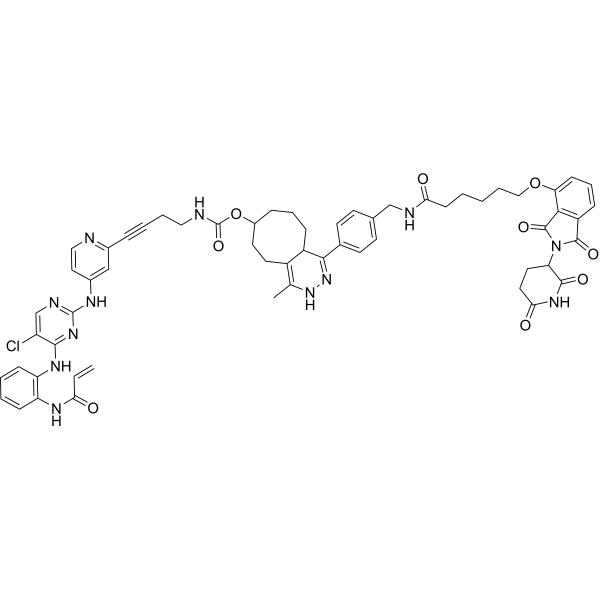
ERK-CLIPTAC is a ERK CLIPTAC (click chemistry-synthesized proteolysis-targeting chimera) degrader. ERK-CLIPTAC forms intracellularly via click chemistry from ERK1/2-IN-14 (HY-175578) and Tz-thalidomide (HY-101460). The formed ERK-CLIPTAC recruits the E3 ubiquitin ligase CRBN to ERK1/2, thereby inducing ubiquitination and subsequent degradation of ERK1/2. Due to its lack of cell permeability, ERK-CLIPTAC cannot induce ERK1/2 degradation in cells. ERK-CLIPTAC can be used in research related to melanoma and colorectal cancer.
(Pink: Target protein ligand; Blue: Cereblon ligand (HY-101460); Black: linker).
For research use only. We do not sell to patients.
- CAS No.: 2087490-46-6
- Formula: C60H61ClN12O9
- Molecular Weight:1129.65
-
Storage:
Please store the product under the recommended conditions in the Certificate of Analysis.

To place orders, for customer services and technical support, please contact: MedChemExpress USA
Tel: 609-228-6898 E-mail: [email protected] [email protected]


-
 Biological Activity
-
Chemical Information
- Protocols
- Purity & Documentation
- References
-
 Help & FAQs


All PROTACs Isoforms
More

Biological Activity
Description
IC50 & Target
[1]|
ERK1 |
ERK2 |
Cereblon |
In Vitro
ERK-CLIPTAC (0.1-10 μM; 18 h) lacks cell permeability and does not induce ERK1/2 degradation in A375 cells, confirming that functional ERK-CLIPTAC must form intracellularly from its precursors to elicit degradation[1].
MedChemExpress (MCE) has not independently confirmed the accuracy of these methods. They are for reference only.
-
Cell Line:A375 cells (BRAFV600E mutant melanoma cells)
-
Concentration:Preformed ERK-CLIPTAC at 0.1-10 μM
-
Incubation Time:18 h
-
Result:Showed no degradation of ERK1/2 across all tested concentrations of preformed ERK-CLIPTAC.


Chemical Information
-
CAS No. 2087490-46-6
-
Molecular Weight 1129.65
-
Formula C60H61ClN12O9
-
SMILES
O=C(NCCC#CC1=NC=CC(NC2=NC=C(C(NC3=C(NC(C=C)=O)C=CC=C3)=N2)Cl)=C1)OC4CCC5=C(C)NN=C(C5CCC4)C6=CC=C(CNC(CCCCCOC7=CC=CC(C(N8C9C(NC(CC9)=O)=O)=O)=C7C8=O)=O)C=C6
-
Shipping
Room temperature in continental US; may vary elsewhere.
-
Storage
Please store the product under the recommended conditions in the Certificate of Analysis.


Purity & Documentation
References

Calculators
Concentration (start) × Volume (start) = Concentration (final) × Volume (final)


ERK-CLIPTAC Related Classifications
HY-153735 Related Classifications
 Powered by Bioz