



HSP90-IN-18
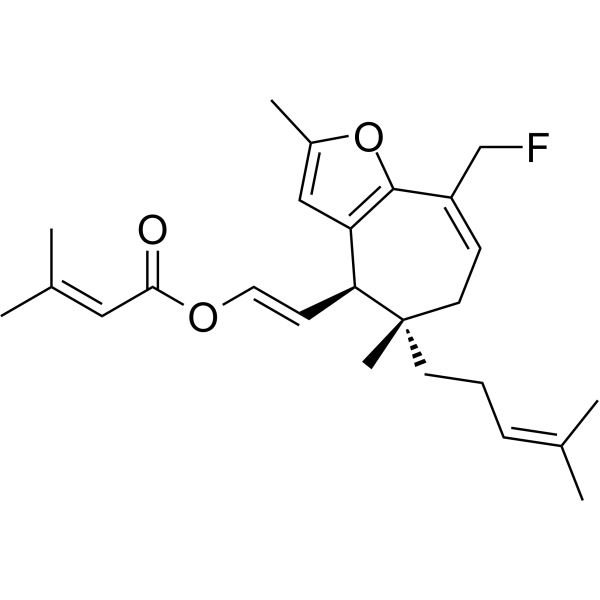
HSP90-IN-18 is an effective heat shock protein 90 (Hsp90) inhibitor. HSP90-IN-18 has effective Hsp90 inhibitory activity with an IC50 value of 0.39 μM. HSP90-IN-18 can be used for the research of viral infection, neurodegenerative disease, and inflammation.
Nur für Forschungszwecke. Wir verkaufen nicht an Patienten.
- CAS. Nr.: 2927442-45-1
- Formel: C25H33FO3
- Molecular Weight:400.53
-
Speicherung:
Please store the product under the recommended conditions in the Certificate of Analysis.

To place orders, for customer services and technical support, please contact: MedChemExpress USA
Tel: 609-228-6898 E-mail: [email protected] [email protected]


-
 Biologische Aktivität
-
Chemical Information
- Protokoll
- Reinheit & Dokumentation
- Verweise
-
 Help & FAQs




Biologische Aktivität
Beschreibung
IC50 & Target
IC50: 0.39 μM (Hsp90); 17.65 μM (MCF-7); 20.03 μM (SW480); >40 μM (A549); 3.69 μM (HL60); 11.92 μM (SMMC-7721)[1]
Cellular Effect
|
Cell Line

|
Type | Value | Description | References |
|---|---|---|---|---|
| A549 | IC50 |
>40 μM
Compound: 29
|
Antiproliferative activity against human A549 cells assessed as reduction in cell viability incubated for 48 hrs by MTT assay
Antiproliferative activity against human A549 cells assessed as reduction in cell viability incubated for 48 hrs by MTT assay
|
[PMID: 36274275] |
| HL-60 | IC50 |
3.69 μM
Compound: 29
|
Antiproliferative activity against human HL-60 cells assessed as reduction in cell viability incubated for 48 hrs by MTT assay
Antiproliferative activity against human HL-60 cells assessed as reduction in cell viability incubated for 48 hrs by MTT assay
|
[PMID: 36274275] |
| MCF7 | IC50 |
17.65 μM
Compound: 29
|
Antiproliferative activity against human MCF7 cells assessed as reduction in cell viability incubated for 48 hrs by MTT assay
Antiproliferative activity against human MCF7 cells assessed as reduction in cell viability incubated for 48 hrs by MTT assay
|
[PMID: 36274275] |
| SMMC-7721 | IC50 |
11.92 μM
Compound: 29
|
Antiproliferative activity against human SMMC-7721 cells assessed as reduction in cell viability incubated for 48 hrs by MTT assay
Antiproliferative activity against human SMMC-7721 cells assessed as reduction in cell viability incubated for 48 hrs by MTT assay
|
[PMID: 36274275] |
| SW480 | IC50 |
20.03 μM
Compound: 29
|
Antiproliferative activity against human SW480 cells assessed as reduction in cell viability incubated for 48 hrs by MTT assay
Antiproliferative activity against human SW480 cells assessed as reduction in cell viability incubated for 48 hrs by MTT assay
|
[PMID: 36274275] |
In Vitro
HSP90-IN-18 has effective Hsp90 inhibitory activity with an IC50 value of 0.39 μM[1].
HSP90-IN-18 (40, 8, 1.6, 0.32, 0.064 μM; 48 h) has antiproliferative activity against MCF-7, SW480, A549, HL60 and SMMC-7721 with IC50 values of 17.65 μM, 20.03 μM, >40 μM, 3.69 μM and 11.92 μM, respectively[1].
HSP90-IN-18 (0, 1, 5, 10, 20 μM; 12-16 h) promotes HL-60 cell apoptosis by mitochondrial-mediated apoptosis pathway[1].
MedChemExpress (MCE) has not independently confirmed the accuracy of these methods. They are for reference only. Further protocols information, click here.
-
Cell Line:HL-60, A549, SMMC7721, MCF-7 and SW480 cell lines
-
Concentration:40, 8, 1.6, 0.32, 0.064 μM
-
Incubation Time:48 h
-
Result:Showed much better anti-proliferation activities in five cancer cell lines, especially against human leukocyte cell line.
-
Cell Line:HL-60 cells
-
Concentration:0, 1, 5, 10, 20 μM
-
Incubation Time:12-16 h
-
Result:Promoted the apoptosis of HL-60 cells.
-
Cell Line:HL-60 cells
-
Concentration:0, 1, 5, 10 μM
-
Incubation Time:24 h
-
Result:Showed the expression of Bcl2 was significantly reduced, while Bax was increased.
In Vivo
MedChemExpress (MCE) has not independently confirmed the accuracy of these methods. They are for reference only.
-
Animal Model:Kunming Mice (female; 18–20g)[1]
-
Dosage:100 mg/kg
-
Administration:Intraperitoneal administration for 14 days
-
Result:Showed normal behavior and feeding habits without any signs of toxicity and demonstrated low acute toxicity (LD50 > 500 mg/kg).


Chemical Information
-
CAS. Nr. 2927442-45-1
-
Molecular Weight 400.53
-
Formel C25H33FO3
-
SMILES
C/C(C)=C\CC[C@]1(CC=C(C2=C([C@@H]1/C=C/OC(/C=C(C)/C)=O)C=C(O2)C)CF)C
-
Versand
Room temperature in continental US; may vary elsewhere.
-
Speicherung
Please store the product under the recommended conditions in the Certificate of Analysis.

Protokoll
-
Research Protocol for Infectious Diseases
Infectious-disease experiments test how pathogens interact with host barriers, innate immune receptors, inflammatory signaling, pathogen replication, and tissue injury; pattern-recognition receptors such as TLRs, RIG-I-like receptors, NOD-like receptors, and inflammasomes detect microbial molecules and activate NF-κB, interferon, and cytokine responses. The central hypothesis is that infection severity reflects the balance between pathogen burden and host response: protective inflammation restricts pathogen growth, whereas excessive or mislocalized inflammation contributes to tissue damage and disease phenotype. Unresolved questions include which host pathways are protective versus pathogenic, why some infection models fail to translate to human disease, and which combined readouts best predict clinically relevant infection outcomes.
-
Cell Cytotoxicity Assay
Cytotoxicity assays are usually based on the assessment of cell membrane damage, which can also be indirectly detected by measuring cell viability. Detection methods include MTT assay, CKK-8 assay, LDH assay and ATP assay, etc.
-
Research Protocol for Inflammation-related Diseases
The NLRP3 inflammasome is a cytosolic innate immune signaling platform that integrates priming signals and danger-signal activation to promote caspase-1 activation, maturation of IL-1β and IL-18, and gasdermin D-mediated pyroptotic cell death. The core experimental logic is to determine whether inflammatory disease phenotypes are driven by increased NLRP3 expression, ASC-containing inflammasome assembly, caspase-1 cleavage, GSDMD cleavage, and extracellular release of IL-1β/IL-18 rather than by nonspecific cell injury alone. The pathway is strongly linked to inflammation-related disease phenotypes because monosodium urate crystals activate NALP3/NLRP3 inflammasome signaling in gout-like crystal inflammation, cholesterol crystals activate NLRP3 inflammasomes in atherogenesis models, and DSS-induced intestinal inflammation has been reported to involve NLRP3 inflammasome activity. However, experimental colitis studies also show context-dependent protective effects of NLRP3 inflammasome co
-
Research Protocol for Neurological Diseases
PINK1/Parkin-mediated mitophagy pathway is a mitochondrial quality-control signaling axis in which mitochondrial depolarization stabilizes PINK1 on damaged mitochondria, activates Parkin recruitment and E3 ubiquitin ligase activity, promotes ubiquitination of outer mitochondrial membrane proteins, recruits selective autophagy adaptors, and drives lysosomal degradation of damaged mitochondria. In neurological disease research, this pathway is experimentally important because neurons, especially dopaminergic neurons, are highly dependent on mitochondrial integrity, and defective mitochondrial turnover can lead to mitochondrial dysfunction, oxidative stress, impaired neuronal survival, α-synuclein accumulation, and neuroinflammatory damage-associated signals. The genetic disease link is strongest in Parkinson’s disease because mutations in PRKN/parkin cause autosomal recessive juvenile parkinsonism, mutations in PINK1 cause hereditary early-onset Parkinson’s disease, and Drosophila studie


Reinheit & Dokumentation
Verweise

Calculators
Konzentration (Stammlösung) × Volumen (Stammlösung) = Konzentration (Ziellösung) × Volumen (Ziellösung)


HSP90-IN-18 Related Classifications
HY-152027 Related Classifications
 Powered by Bioz