



ICRF-196
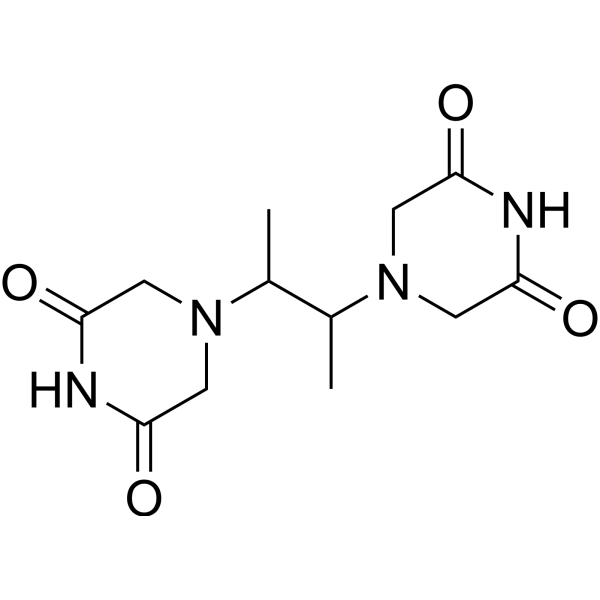
ICRF-196 is an racemic mixture of the (S,S)- and (R,R)-isomers of ICRF-193 (HY-118590). ICRF-193 is a DNA Topoisomerase II inhibitor. ICRF-193 can inhibit DNA syntheses and induces apoptosis. ICRF-193 exhibits anti-cancer and anti-inflammation effects. ICRF-193 shows cardioprotective effect against anthracycline toxicity to cardiomyocytes. ICRF-193 can be used for the researches of cancer, infection, inflammation and cardiovascular disease, such as acute promyelocytic leukemia.
For research use only. We do not sell to patients.
- CAS No.: 21416-68-2
- Formula: C12H18N4O4
- Molecular Weight:282.30
-
Storage:
Please store the product under the recommended conditions in the Certificate of Analysis.

To place orders, for customer services and technical support, please contact: MedChemExpress USA
Tel: 609-228-6898 E-mail: [email protected] [email protected]


-
 Biological Activity
-
Chemical Information
- Protocols
- Purity & Documentation
- References
-
 Help & FAQs




Biological Activity
Description
IC50 & Target
[1]|
Topoisomerase II |
In Vitro
ICRF-193 (10-100 μM, 2 h) induces mitotic defects in fission yeast cells expressing histone H2A-RFP, α-tubulin Atb2-GFP and spindle pole body protein Sid4-GFP[1].
ICRF-193 (100 μM. 2 h) inhibits its own induced snapped spindles and induces unequal chromosome segregation and unequal chromosome segregation in fission yeast cells[1].
ICRF-193 (100 μM, 4 h) alters nuclear morphology and DNA content in cdc11-123 fission yeast mutant[1].
ICRF-193 (100 μM, 8 h) reduces cell viability in wild-type fission yeast[1].
ICRF-193 (5 days) inhibits the growth of human acute promyelocytic leukemia (APL) cell lines (NB4, HT-93) and other myeloid leukemia cell lines (HL-60, U937) with IC50 of 0.21-0.26 μM[2].
ICRF-193 (0.1-0.2 μM, 5 days) induces granulocytic differentiation of NB4, HT-93, HL-60, and U937 cells[2].
ICRF-193 (0.2 μM, 48 h) significantly downregulates the level of PML-RAR fusion protein and upregulates p21 and RARβ levels in NB4 cells[2].
ICRF-193 (10 μM) inhibits cells arrested at the quiescent (G0) phase reentry into the S phase and inhibits DNA syntheses in murine spleen cells[3].
ICRF-193 (150 nM, 72 h) inhibits LPS (HY-D1056)-induced IL-1β secretion in human macrophage[4].
ICRF-193 decreases DNA fragmentation induced by Etoposide (HY-13629) and induces apoptosis in murine thymocytes[6].
MedChemExpress (MCE) has not independently confirmed the accuracy of these methods. They are for reference only.


Chemical Information
-
CAS No. 21416-68-2
-
Molecular Weight 282.30
-
Formula C12H18N4O4
-
SMILES
CC(N(C1)CC(NC1=O)=O)C(N(C2)CC(NC2=O)=O)C
-
Shipping
Room temperature in continental US; may vary elsewhere.
-
Storage
Please store the product under the recommended conditions in the Certificate of Analysis.


Purity & Documentation
References
[1]. Nakazawa N, et al. ICRF-193, an anticancer topoisomerase II inhibitor, induces arched telophase spindles that snap, leading to a ploidy increase in fission yeast. Genes Cells. 2016 Sep;21(9):978-93. [Content Brief]
[2]. Niitsu N, et al. The catalytic DNA topoisomerase II inhibitor ICRF-193 and all-trans retinoic acid cooperatively induce granulocytic differentiation of acute promyelocytic leukemia cells: candidate drugs for chemo-differentiation therapy against acute promyelocytic leukemia. Exp Hematol. 2002 Nov;30(11):1273-82. [Content Brief]
[3]. Hossain MS, et al. ICRF-193, a catalytic inhibitor of DNA topoisomerase II, inhibits re-entry into the cell division cycle from quiescent state in mammalian cells. Genes Cells. 2002 Mar;7(3):285-94 [Content Brief]
[4]. Brindle A, et al. The Bisdioxopiperazine ICRF-193 Attenuates LPS-induced IL-1β Secretion by Macrophages. Inflammation. 2024 Feb;47(1):84-98. [Content Brief]
[5]. Jirkovská A, et al. Structure-Activity Relationship Study of Dexrazoxane Analogues Reveals ICRF-193 as the Most Potent Bisdioxopiperazine against Anthracycline Toxicity to Cardiomyocytes Due to Its Strong Topoisomerase IIβ Interactions. J Med Chem. 2021 Apr 8;64(7):3997-4019. [Content Brief]
[6]. Tanimoto C, et al. ICRF-193 modifies etoposide-induced apoptosis in thymocytes. Acta Med Okayama. 1995 Dec;49(6):281-6. [Content Brief]

Calculators
Concentration (start) × Volume (start) = Concentration (final) × Volume (final)


ICRF-196 Related Classifications
HY-118590A Related Classifications
 Powered by Bioz