



IMP-2373

Based on 1 Customer Validation
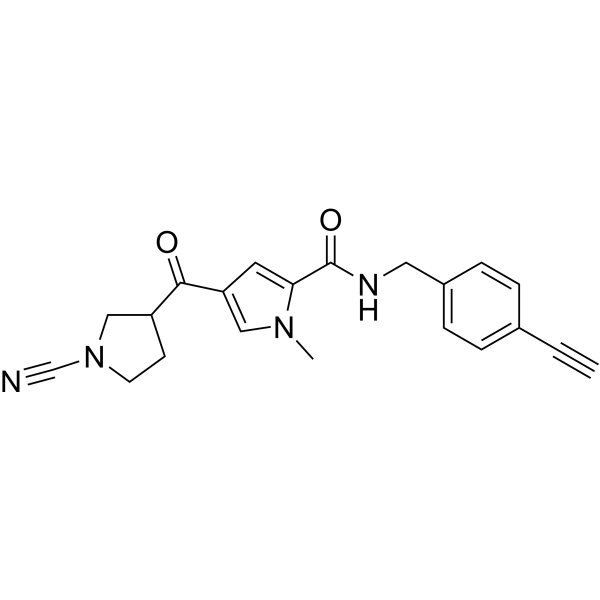
IMP-2373 is a low-toxicity activity-based probe targeting covalent pan-deubiquitinase (DUB), which modulates and monitors DUB activity via covalent binding to the catalytic cysteine and active site of DUB. IMP-2373 enables real-time tracking of dynamic intracellular DUB activity in physiologically relevant living cell systems, and quantitative analysis of activity changes induced by pharmacological inhibition or MYC dysregulation. IMP-2373 can be used for research on related diseases such as B-cell lymphoma.
연구목적의 판매만을 진행합니다. 환자를 대상으로 한 판매는 하지 않습니다.
- Purity : 99.58%
- 화학식: C21H20N4O2
- 분자량:360.41
-
보관:
4°C, protect from light
* In solvent : -80°C, 6 months; -20°C, 1 month (protect from light)

To place orders, for customer services and technical support, please contact: MedChemExpress USA
Tel: 609-228-6898 E-mail: [email protected] [email protected]


-
 Biological Activity
-
Chemical Information
-
용액&용해도
- 순도&문서
- References
-
 Help & FAQs




Biological Activity
제품 설명
In Vitro
IMP-2373 (8 h; 24 h) shows no cytotoxicity against T47D, U2OS and U87-MG cells after 8 h of treatment, and exhibits only extremely low cytotoxicity after 24 h of treatment, with EC50 values all higher than 60 μM in these three cell lines[1].
IMP-2373 (10 μM; 1 h) is a competitive probe that selectively and efficiently detects the target engagement of intracellular active DUB inhibitors, including the UCHL1 inhibitor IMP-1711-S and the USP30 inhibitor FT385, in U87-MG and T47D cells[1].
IMP-2373 (25 μM; 1 h) captures the activity of 38 deubiquitinases in P493-6 B-cell lymphoma cells, and reveals that dysregulation of oncogenic MYC drives global downregulation of DUB activity, which is independent of DUB abundance. Meanwhile, the activities of UCHL3, USP7, USP47, USP10 and ATXN3 are selectively upregulated in low-MYC cells[1].
IMP-2373 exhibits extremely low off-target cytotoxicity: no reduction in cell viability is observed after treatment with >100 μM for 8 h in T47D and U2OS cells; no reduction in cell viability is detected either after treatment with 95.4 μM for 8 h in U87-MG cells; additionally, the 24 h EC50 values range from 8.9 μM (U87-MG) to 86.5 μM (T47D)[2].
IMP-2373 (10 μM; 1 h) acts as a competitive probe for the quantitative detection of intracellular target engagement corresponding to selective DUB inhibitors (UCHL1 and USP30 inhibitors) in U87-MG and T47D cells, respectively[2].
Analysis of DUB activity changes in P493-6 B cell lymphoma cells treated with IMP-2373 (25 μM; 1 h) shows that global DUB activity is lower in high MYC cells, while UCHL3, USP7, USP47, USP10 and ATXN3 exhibit significantly higher activity relative to their abundance in low MYC cells[2].
MedChemExpress (MCE) has not independently confirmed the accuracy of these methods. They are for reference only.
-
Cell Line:HEK293T cells overexpressing FLAG-tagged wild-type (UCHL1, USP30, USP7, OTUB1) and active site Cys-to-Ser mutant DUBs
-
Concentration:0, 10, 25 μM
-
Incubation Time:1 h
-
Result:Selectively engaged the catalytic cysteine of wild-type UCHL1, USP30, USP7, and OTUB1.
Showed no engagement with the corresponding active site Cys-to-Ser mutant DUBs.
-
Cell Line:T47D breast cancer cells, U2OS osteosarcoma cells, U87-MG glioblastoma cells
-
Concentration:>100 μM; 95.4 μM; 86.5 μM; 60.4 μM; 8.9 μM
-
Incubation Time:8 h (T47D/U2OS/U87-MG); 24 h (T47D/U2OS/U87-MG)
-
Result:Did not affect cell viability after 8 h treatment at concentrations >100 μM in T47D and U2OS cells, and at 95.4 μM in U87-MG cells.
Showed minimal cytotoxicity after 24 h treatment, with EC50 values of 86.5 μM (T47D), 60.4 μM (U2OS), and 8.9 μM (U87-MG).


Chemical Information
-
Appearance Solid
-
분자량 360.41
-
화학식 C21H20N4O2
-
Color White to off-white
-
SMILES
C#CC1=CC=C(CNC(C2=CC(C(C3CN(C#N)CC3)=O)=CN2C)=O)C=C1
-
선적
Room temperature in continental US; may vary elsewhere.
-
보관
4°C, protect from light
* In solvent : -80°C, 6 months; -20°C, 1 month (protect from light)


용액&용해도
In Vitro:
DMSO : 100 mg/mL (277.46 mM; Need ultrasonic; Hygroscopic DMSO has a significant impact on the solubility of product, please use newly opened DMSO)
Please refer to the solubility information to select the appropriate solvent. Once prepared, please aliquot and store the solution to prevent product inactivation from repeated freeze-thaw cycles.
Storage method and period of stock solution: -80°C, 6 months; -20°C, 1 month (protect from light). When stored at -80°C, please use it within 6 months. When stored at -20°C, please use it within 1 month.
Please refer to the solubility information to select the appropriate solvent. Once prepared, please aliquot and store the solution to prevent product inactivation from repeated freeze-thaw cycles.
Storage method and period of stock solution: -80°C, 6 months; -20°C, 1 month (protect from light). When stored at -80°C, please use it within 6 months. When stored at -20°C, please use it within 1 month.
Concentration (start) × Volume (start) = Concentration (final) × Volume (final)


순도&문서
-
Data Sheet (273 KB)
-
SDS (251 KB)
- English - EN (251 KB)
- Français - FR (251 KB)
- Deutsch - DE (251 KB)
- Norwegian - NO (251 KB)
- Español - ES (251 KB)
- Swedish - SV (251 KB)
- Italian - IT (251 KB)
- Korean - KR (251 KB)
- Portuguese - PT (251 KB)
-
Handling Instructions (2659 KB)
References


Complete Stock Solution Preparation Table
Please refer to the solubility information to select the appropriate solvent. Once prepared, please aliquot and store the solution to prevent product inactivation from repeated freeze-thaw cycles.
Storage method and period of stock solution: -80°C, 6 months; -20°C, 1 month (protect from light). When stored at -80°C, please use it within 6 months. When stored at -20°C, please use it within 1 month.
| Optional Solvent | Concentration Solvent Mass | 1 mg | 5 mg | 10 mg | 25 mg |
|---|---|---|---|---|---|
| DMSO | 1 mM | 2.7746 mL | 13.8731 mL | 27.7462 mL | 69.3654 mL |
| 5 mM | 0.5549 mL | 2.7746 mL | 5.5492 mL | 13.8731 mL | |
| 10 mM | 0.2775 mL | 1.3873 mL | 2.7746 mL | 6.9365 mL | |
| 15 mM | 0.1850 mL | 0.9249 mL | 1.8497 mL | 4.6244 mL | |
| 20 mM | 0.1387 mL | 0.6937 mL | 1.3873 mL | 3.4683 mL | |
| 25 mM | 0.1110 mL | 0.5549 mL | 1.1098 mL | 2.7746 mL | |
| 30 mM | 0.0925 mL | 0.4624 mL | 0.9249 mL | 2.3122 mL | |
| 40 mM | 0.0694 mL | 0.3468 mL | 0.6937 mL | 1.7341 mL | |
| 50 mM | 0.0555 mL | 0.2775 mL | 0.5549 mL | 1.3873 mL | |
| 60 mM | 0.0462 mL | 0.2312 mL | 0.4624 mL | 1.1561 mL | |
| 80 mM | 0.0347 mL | 0.1734 mL | 0.3468 mL | 0.8671 mL | |
| 100 mM | 0.0277 mL | 0.1387 mL | 0.2775 mL | 0.6937 mL |


IMP-2373 Related Classifications
HY-D2188 Related Classifications
 Powered by Bioz