



NP3-253

Based on 1 Customer Validation
NP3-253 is an orally active and brain-penetranted NLRP3 inflammasome inhibitor. NP3-253 functions as a molecular glue that prevents NACHT-subdomain rearrangements, locking NLRP3 in an inactive conformation. NP3-253 inhibits production of pro-inflammatory cytokines IL-1β and IL-18. NP3-253 can be used for the research of inflammation and neurological disease, suah as peritonitis.
For research use only. We do not sell to patients.
- Purity : 99.78%
- CAS No.: 2557349-50-3
- Formula: C19H23F3N4O
- Molecular Weight:380.41
-
Storage:
4°C, protect from light
* In solvent : -80°C, 6 months; -20°C, 1 month (protect from light)


To place orders, for customer services and technical support, please contact: MedChemExpress USA
Tel: 609-228-6898 E-mail: [email protected] [email protected]


-
 Biological Activity
-
Chemical Information
-
Solvent & Solubility
- Protocols
- Purity & Documentation
- References
-
 Help & FAQs


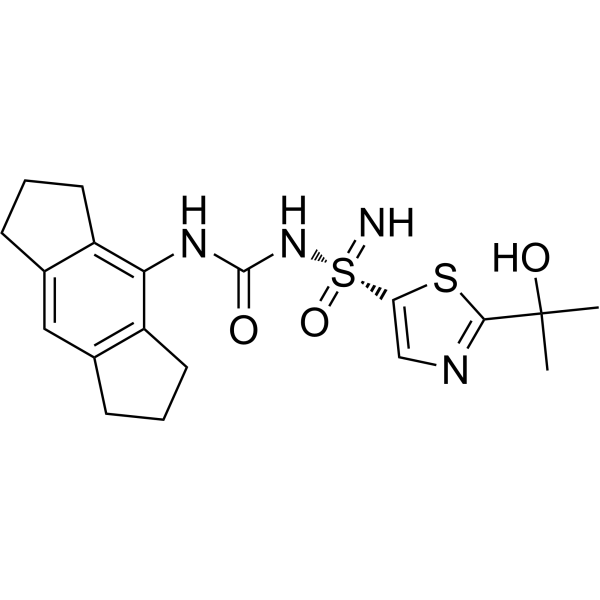
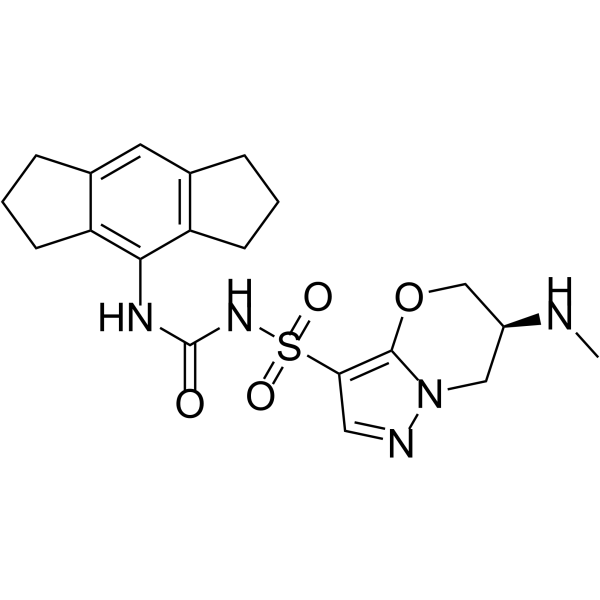


Biological Activity
Description
IC50 & Target
[1]|
NLRP3 inflammasome |
IL-1β |
IL-18 |
In Vitro
NP3-253 potently inhibits NLRP3-mediated IL-1β secretion in PMA (HY-18739)-differentiated THP-1 cells with an IC50 of 0.5 ± 0.1 nM, and does not inhibit NF-κB-mediated TNF-α secretion[1].
NP3-253 potently inhibits NLRP3-mediated IL-1β secretion in human whole blood with an IC50 of 7 ± 2 nM[1].
NP3-253 does not inhibit NLRC4 inflammasome-mediated IL-1β secretion in NLRC4-overexpressing THP-1 cells at concentrations up to >33 μM, demonstrating inflammasome selectivity[1].
NP3-253 (10 μM; 2 h) has a low efflux ratio of 2.5 in MDCK-MDR1 cells, indicating it is not a strong substrate for human P-glycoprotein[1].
NP3-253 (0.5-25 μM; 10-15 min) does not inhibit human CYP3A4 or CYP2C9 at concentrations up to >25 μM, but potently inhibits CYP2D6 with an IC50 of <0.5 μM[1].
NP3-253 inhibits hERG channel binding with an IC50 of 6.49 μM, suggesting a potential cardiac liability[1].
NP3-253 shows high selectivity across a panel of 29 off-target enzymes, receptors, and ion channels tested up to 10 μM, with only weak binding to muscarinic receptor M2 (IC50 = 9.9 μM) and serotonin transporter 5HTT (IC50 = 3.8 μM)[1].
MedChemExpress (MCE) has not independently confirmed the accuracy of these methods. They are for reference only.
In Vivo
NP3-253 (10 mg/kg; p.o.; single dose 22 hours prior to LPS priming) fully inhibits LPS-induced IL-1β production in mouse peritonitis[1].
NP3-253 (20 mg/kg; p.o.; single dose 1 hour prior to LPS injection) completely inhibits LPS-induced IL-18 production in mouse plasma[1].
NP3-253 (0.02-2 mg/kg; p.o.; single dose 1 hour prior to second LPS injection) inhibits LPS-induced IL-1β production in mouse CSF and serum in a dose-dependent manner, with 96.5% inhibition in CSF at 2 mg/kg, and reduces downstream Ccl20 gene expression in brain tissue without affecting Il1b gene expression[1].
MedChemExpress (MCE) has not independently confirmed the accuracy of these methods. They are for reference only.
-
Animal Model:Peritonitis C57BL/6JRj (female, 8-12 weeks old)[1]
-
Dosage:0.0083, 0.05, 0.3, 2, 3 mg/kg
-
Administration:P.o.; single dose 3 hours prior to LPS priming
-
Result:Achieved 99.4% inhibition of IL-1β in peritoneal washout fluid, with a terminal blood concentration of 0.597 ± 0.029 μM and a terminal brain concentration of 0.676 ± 0.074 μM (3 mg/kg).
Achieved 99.6 ± 0.2% inhibition of IL-1β in peritoneal washout fluid, with a serum blood concentration of 0.479 ± 0.074 μM and a brain concentration of 0.564 ± 0.1 μM (2 mg/kg).
Achieved 98.3 ± 1.9% inhibition of IL-1β in peritoneal washout fluid, with a serum blood concentration of 0.076 ± 0.011 μM and a brain concentration of 0.087 ± 0.015 μM (0.3 mg/kg).
Achieved 43.9 ± 22.4% inhibition of IL-1β in peritoneal washout fluid, with a serum blood concentration of 0.011 ± 0.001 μM and a brain concentration of 0.013 ± 0.001 μM (0.05 mg/kg).
Achieved 16.0 ± 30.0% inhibition of IL-1β in peritoneal washout fluid, with a serum blood concentration of 0.002 ± 0.0001 μM and a brain concentration of 0.0002 ± 0.0003 μM (0.0083 mg/kg).


Chemical Information
-
CAS No. 2557349-50-3
-
Appearance Solid
-
Molecular Weight 380.41
-
Formula C19H23F3N4O
-
Color Off-white to light brown
-
SMILES
CC1=CC(C(F)(F)F)=CC(O)=C1C2=NN=C(N[C@@H]3CCCN(CC)C3)C=C2
-
Shipping
Room temperature in continental US; may vary elsewhere.
-
Storage
4°C, protect from light
* In solvent : -80°C, 6 months; -20°C, 1 month (protect from light)


Solvent & Solubility
In Vitro:
DMSO : 100 mg/mL (262.87 mM; Need ultrasonic; Hygroscopic DMSO has a significant impact on the solubility of product, please use newly opened DMSO)
Please refer to the solubility information to select the appropriate solvent. Once prepared, please aliquot and store the solution to prevent product inactivation from repeated freeze-thaw cycles.
Storage method and period of stock solution: -80°C, 6 months; -20°C, 1 month (protect from light). When stored at -80°C, please use it within 6 months. When stored at -20°C, please use it within 1 month.
Please refer to the solubility information to select the appropriate solvent. Once prepared, please aliquot and store the solution to prevent product inactivation from repeated freeze-thaw cycles.
Storage method and period of stock solution: -80°C, 6 months; -20°C, 1 month (protect from light). When stored at -80°C, please use it within 6 months. When stored at -20°C, please use it within 1 month.
Concentration (start) × Volume (start) = Concentration (final) × Volume (final)
In Vivo:
Select the appropriate dissolution method based on your experimental animal and administration route.
- For the following dissolution methods, please ensure to first prepare a clear stock solution using an In Vitro approach and then sequentially add co-solvents:
- To ensure reliable experimental results, the clarified stock solution can be appropriately stored based on storage conditions. As for the working solution for In Vivo experiments, it is recommended to prepare freshly and use it on the same day.
- The percentages shown for the solvents indicate their volumetric ratio in the final prepared solution. If precipitation or phase separation occurs during preparation, heat and/or sonication can be used to aid dissolution.
Add each solvent one by one: 10% DMSO 40% PEG300 5% Tween-80 45% Saline
Solubility: ≥ 5 mg/mL (13.14 mM); Clear solution
This protocol yields a clear solution of ≥ 5 mg/mL (saturation unknown).
Taking 1 mL working solution as an example, add 100 μL DMSO stock solution (50.0 mg/mL) to 400 μL PEG300, and mix evenly; then add 50 μL Tween-80 and mix evenly; then add 450 μL Saline to adjust the volume to 1 mL.
Preparation of Saline: Dissolve 0.9 g sodium chloride in ddH₂O and dilute to 100 mL to obtain a clear Saline solution.
Add each solvent one by one: 10% DMSO 90% (20% SBE-β-CD in Saline)
Solubility: ≥ 5 mg/mL (13.14 mM); Clear solution
This protocol yields a clear solution of ≥ 5 mg/mL (saturation unknown).
Taking 1 mL working solution as an example, add 100 μL DMSO stock solution (50.0 mg/mL) to 900 μL 20% SBE-β-CD in Saline, and mix evenly.
Preparation of 20% SBE-β-CD in Saline (4°C, storage for one week): 2 g SBE-β-CD powder is dissolved in 10 mL Saline, completely dissolve until clear.
In Vivo Dissolution Calculator
Please enter the basic information of animal experiments:
-
-
-
-
Recommended: Prepare an additional quantity of animals to account for potential losses during experiments.
Please enter your animal formula composition:
-
%DMSO +
Recommended: Keep the proportion of DMSO in working solution below 2% if your animal is weak.
-
%+
-
+%Tween-80 + +
-
%Saline +
The co-solvents required include: DMSO, . All of co-solvents are available by MedChemExpress (MCE). , Tween 80. All of co-solvents are available by MedChemExpress (MCE).
Working solution concentration: 0.22 mg/mL
Method for preparing stock solution: mg drug dissolved in μL DMSO. Stock solution concentration: mg/mL. * In solvent : -80°C, 6 months; -20°C, 1 month (protect from light)
1. Take μL DMSO stock solution;
2. Add μL .
μL , mix evenly;
3. Then add μL Tween 80, mix evenly;
4. Then add μL
Please ensure that the stock solution in the first step is dissolved to a clear state, and add co-solvents in sequence. You can use ultrasonic heating (ultrasonic cleaner, recommended frequency 20-40 kHz), vortexing, etc. to assist dissolution.


Purity & Documentation
-
Data Sheet (285 KB)
-
SDS (251 KB)
- English - EN (251 KB)
- Français - FR (251 KB)
- Deutsch - DE (251 KB)
- Norwegian - NO (251 KB)
- Español - ES (251 KB)
- Swedish - SV (251 KB)
- Italian - IT (251 KB)
- Korean - KR (251 KB)
- Portuguese - PT (251 KB)
-
Handling Instructions (2659 KB)
References


Complete Stock Solution Preparation Table
Please refer to the solubility information to select the appropriate solvent. Once prepared, please aliquot and store the solution to prevent product inactivation from repeated freeze-thaw cycles.
Storage method and period of stock solution: -80°C, 6 months; -20°C, 1 month (protect from light). When stored at -80°C, please use it within 6 months. When stored at -20°C, please use it within 1 month.
| Optional Solvent | Concentration Solvent Mass | 1 mg | 5 mg | 10 mg | 25 mg |
|---|---|---|---|---|---|
| DMSO | 1 mM | 2.6287 mL | 13.1437 mL | 26.2874 mL | 65.7186 mL |
| 5 mM | 0.5257 mL | 2.6287 mL | 5.2575 mL | 13.1437 mL | |
| 10 mM | 0.2629 mL | 1.3144 mL | 2.6287 mL | 6.5719 mL | |
| 15 mM | 0.1752 mL | 0.8762 mL | 1.7525 mL | 4.3812 mL | |
| 20 mM | 0.1314 mL | 0.6572 mL | 1.3144 mL | 3.2859 mL | |
| 25 mM | 0.1051 mL | 0.5257 mL | 1.0515 mL | 2.6287 mL | |
| 30 mM | 0.0876 mL | 0.4381 mL | 0.8762 mL | 2.1906 mL | |
| 40 mM | 0.0657 mL | 0.3286 mL | 0.6572 mL | 1.6430 mL | |
| 50 mM | 0.0526 mL | 0.2629 mL | 0.5257 mL | 1.3144 mL | |
| 60 mM | 0.0438 mL | 0.2191 mL | 0.4381 mL | 1.0953 mL | |
| 80 mM | 0.0329 mL | 0.1643 mL | 0.3286 mL | 0.8215 mL | |
| 100 mM | 0.0263 mL | 0.1314 mL | 0.2629 mL | 0.6572 mL |


NP3-253 Related Classifications
HY-169996 Related Classifications
 Powered by Bioz