



PROTAC EGFR degrader 3

Based on 1 Customer Validation
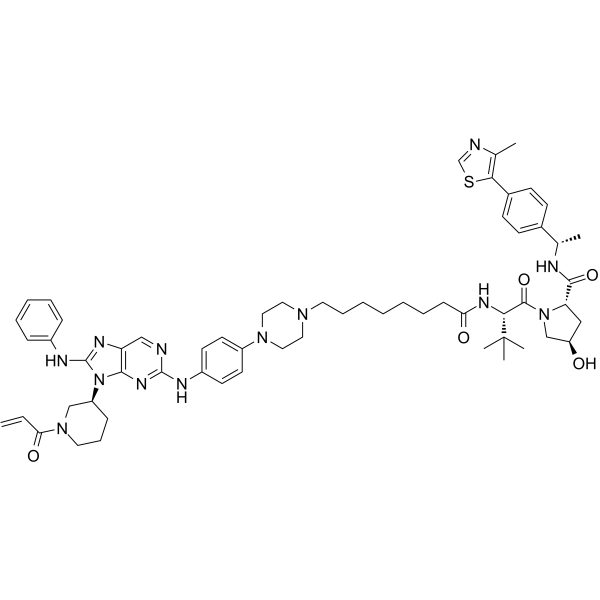
PROTAC EGFR degrader 3 is a selective EGFR mutant PROTAC degrader with activity against EGFRL858R/T790M and EGFRdel19, with DC50 values of 1.56 nM and 0.49 nM, respectively. PROTAC EGFR degrader 3 induces degradation via formation of a ternary complex with VHL, ubiquitination, and lysosomal processing. PROTAC EGFR degrader 3 inhibits tumor cell proliferation. PROTAC EGFR degrader 3 can be used for the research of non-small cell lung cancer.
(Pink: EGFR ligand (HY-150905); Blue: VHL ligand (HY-112078); Black: linker).
For research use only. We do not sell to patients.
- Purity : 97.39%
- CAS No.: 2768472-28-0
- Formula: C60H77N13O5S
- Molecular Weight:1092.40
-
Storage:
4°C, protect from light, stored under nitrogen
* In solvent : -80°C, 6 months; -20°C, 1 month (protect from light, stored under nitrogen)

To place orders, for customer services and technical support, please contact: MedChemExpress USA
Tel: 609-228-6898 E-mail: [email protected] [email protected]


-
 Biological Activity
-
Chemical Information
-
Solvent & Solubility
- Purity & Documentation
- References
-
 Help & FAQs




Biological Activity
Description
Cellular Effect
|
Cell Line

|
Type | Value | Description | References |
|---|---|---|---|---|
| A-431 | IC50 |
>10000 nM
Compound: CP17
|
Antiproliferative activity against human A-431 cells expressing EGFR wildtype assessed as inhibition of cell proliferation incubated for 72 hrs by MTT assay
Antiproliferative activity against human A-431 cells expressing EGFR wildtype assessed as inhibition of cell proliferation incubated for 72 hrs by MTT assay
|
[PMID: 35254067] |
| BaF3 | IC50 |
481 nM
Compound: CP17
|
Antiproliferative activity against mouse BaF3 cells expressing EGFR deletion19/T790M/C797S mutant assessed as reduction on cell growth incubated for 72 hrs by MTT assay
Antiproliferative activity against mouse BaF3 cells expressing EGFR deletion19/T790M/C797S mutant assessed as reduction on cell growth incubated for 72 hrs by MTT assay
|
[PMID: 35254067] |
| BaF3 | IC50 |
669 nM
Compound: CP17
|
Antiproliferative activity against mouse BaF3 cells expressing EGFR L858R/T790M/C797S mutant assessed as reduction on cell growth incubated for 72 hrs by MTT assay
Antiproliferative activity against mouse BaF3 cells expressing EGFR L858R/T790M/C797S mutant assessed as reduction on cell growth incubated for 72 hrs by MTT assay
|
[PMID: 35254067] |
| HCC827 | IC50 |
1.6 nM
Compound: CP17
|
Antiproliferative activity against human HCC827 cells expressing EGFR deletion19 mutant assessed as inhibition of cell proliferation incubated for 72 hrs by MTT assay
Antiproliferative activity against human HCC827 cells expressing EGFR deletion19 mutant assessed as inhibition of cell proliferation incubated for 72 hrs by MTT assay
|
[PMID: 35254067] |
| HCC827 | IC50 |
1.6 nM
Compound: CP17
|
Antiproliferative activity against human HCC827 cells expressing EGFR L858R/T790M mutant assessed as inhibition of cell proliferation incubated for 72 hrs by MTT assay
Antiproliferative activity against human HCC827 cells expressing EGFR L858R/T790M mutant assessed as inhibition of cell proliferation incubated for 72 hrs by MTT assay
|
[PMID: 35254067] |
| NCI-H1975 | IC50 |
32 nM
Compound: CP17
|
Antiproliferative activity against human NCI-H1975 cells expressing EGFR L858R/T790M mutant assessed as inhibition of cell proliferation incubated for 72 hrs by MTT assay
Antiproliferative activity against human NCI-H1975 cells expressing EGFR L858R/T790M mutant assessed as inhibition of cell proliferation incubated for 72 hrs by MTT assay
|
[PMID: 35254067] |
| NCI-H1975 | IC50 |
>10000 nM
Compound: CP17
|
Antiproliferative activity against human NCI-H1975 cells expressing EGFR L858R/T790M/C797S mutant assessed as reduction on cell growth incubated for 72 hrs by MTT assay
Antiproliferative activity against human NCI-H1975 cells expressing EGFR L858R/T790M/C797S mutant assessed as reduction on cell growth incubated for 72 hrs by MTT assay
|
[PMID: 35254067] |
| PC-9 | IC50 |
>10000 nM
Compound: CP17
|
Antiproliferative activity against human PC-9 cells expressing EGFR deletion19/T790M/C797S mutant assessed as reduction on cell growth growth incubated for 72 hrs by MTT assay
Antiproliferative activity against human PC-9 cells expressing EGFR deletion19/T790M/C797S mutant assessed as reduction on cell growth growth incubated for 72 hrs by MTT assay
|
[PMID: 35254067] |
In Vitro
PROTAC EGFR degrader 3 (compound CP17) (72 h) potently inhibits the proliferation of H1975 (EGFRL858R/T790M) and HCC827 (EGFRdel19) cells, with IC50 values of 32 nM and 1.60 nM, respectively, but shows weak activity against cells harboring EGFR triple mutants and wild-type EGFR[1].
PROTAC EGFR degrader 3 (1-1000 nM, H1975 cells; 0.3-30 nM, HCC827 cells; 10 days) potently inhibits colony formation of H1975 (EGFRL858R/T790M) and HCC827 (EGFRdel19) cells at concentrations as low as 30 nM and 1 nM, respectively[1].
PROTAC EGFR degrader 3 (0.3-1000 nM; 2-72 h) potently and selectively degrades EGFRL858R/T790M (DC50 = 1.56 nM) in H1975 cells and EGFRdel19 (DC50 = 0.49 nM) in HCC827 cells, with the maximum degradation effect achieved after 48 h of treatment[1].
PROTAC EGFR degrader 3 (0.3-1000 nM, H1975 cells; 0.3-30 nM, HCC827 cells; 24 h) effectively blocks the EGFR signaling pathway in H1975 (EGFRL858R/T790M) and HCC827 (EGFRdel19) cells by inhibiting the phosphorylation of EGFR, AKT and ERK1/2[1].
PROTAC EGFR degrader 3 (30 nM; 24 h, then analyzed at 12, 24, 48 h post-washout) exerts more durable degradation of EGFRdel19 in HCC827 cells than of EGFRL858R/T790M in H1975 cells; at 48 h post-washout, the expression level of EGFRdel19 remains reduced, while that of EGFRL858R/T790M is restored[1].
PROTAC EGFR degrader 3 (30 nM; with pre-treatment inhibitors) induces the degradation of EGFRL858R/T790M in H1975 cells. This process depends on the formation of a ternary complex involving EGFR and VHL, as well as ubiquitination, and is associated with the lysosomal pathway but not the proteasomal pathway[1].
MedChemExpress (MCE) has not independently confirmed the accuracy of these methods. They are for reference only.
-
Cell Line:H1975 cells (EGFRL858R/T790M), HCC827 cells (EGFRdel19)
-
Concentration:1, 10, 30, 100, 1000 nM (H1975 cells); 0.3, 1, 3, 10, 30 nM (HCC827 cells)
-
Incubation Time:10 days
-
Result:Significantly reduced colony formation rate in a dose-dependent manner for both cell lines.
Reduced H1975 and HCC827 colony formation rate.
-
Cell Line:H1975 cells (EGFRL858R/T790M), HCC827 cells (EGFRdel19), A431 cells (EGFRWT), HCT116 cells, HeLa cells, MCF-7 cells, HepG2 cells
-
Concentration:10, 100 nM (H1975 cells, 24 h)
3, 30 nM (HCC827 cells, 24 h)
0.3, 1, 3, 10, 30, 100, 300, 1000 nM (H1975 cells, 48 h)
0.3, 1, 3, 10, 30, 100, 300 nM (HCC827 cells, 24 h)
30 nM (H1975 cells, time-course)
10, 30, 100, 300, 1000 nM (A431 cells, 24 h)
100, 1000 nM (HCT116, HeLa, MCF-7, HepG2 cells, 24 h) -
Incubation Time:2, 4, 8, 12, 24, 36, 48, 72 h (H1975 cells, time-course)
24 h (H1975, HCC827, A431, HCT116, HeLa, MCF-7, HepG2 cells)
48 h (H1975, HCC827 cells) -
Result:Induced 51% degradation of EGFRL858R/T790M at 10 nM and 77% degradation at 100 nM in H1975 cells after 24 h.
Induced 70% degradation of EGFRdel19 at 3 nM and 74% degradation at 30 nM in HCC827 cells after 24 h.
Achieved a DC50 of 1.56 nM for EGFRL858R/T790M degradation in H1975 cells, with a maximum degradation rate of 86% after 48 h.
Achieved a DC50 of 0.49 nM for EGFRdel19 degradation in HCC827 cells, with a maximum degradation rate of 82%.
Caused significant degradation of EGFRL858R/T790M after 8 h of treatment with 30 nM CP17, peaking at 48 h.
Did not induce significant degradation of EGFRWT in A431 cells at concentrations up to 1000 nM.
Induced minimal degradation in HCT116, HeLa, and HepG2 cells at 1000 nM, with no effect in MCF-7 cells.
-
Cell Line:H1975 cells (EGFRL858R/T790M), HCC827 cells (EGFRdel19)
-
Concentration:0.3, 1, 10, 100, 1000 nM (H1975 cells)
0.3, 1, 3, 10, 30 nM (HCC827 cells) -
Incubation Time:24 h
-
Result:Significantly reduced levels of phosphorylated EGFR, AKT, and ERK1/2 in both cell lines, while leaving phosphorylated B-RAF levels unchanged.
Caused significant inhibition in H1975 cells at 100 nM.
Caused significant inhibition in HCC827 cells at 3 nM.
-
Cell Line:H1975 cells (EGFRL858R/T790M), HCC827 cells (EGFRdel19)
-
Concentration:30 nM
-
Incubation Time:24 h, then analyzed at 12, 24, 48 h post-washout
-
Result:Caused EGFRL858R/T790M and phosphorylated EGFRL858R/T790M levels to significantly recover 48 h after washout.
Left EGFRdel19 and phosphorylated EGFRdel19 levels reduced even 48 h after washout.


Chemical Information
-
CAS No. 2768472-28-0
-
Appearance Solid
-
Molecular Weight 1092.40
-
Formula C60H77N13O5S
-
Color Off-white to light yellow
-
SMILES
C=CC(N1CCC[C@@H](C1)N2C3=C(N=C2NC4=CC=CC=C4)C=NC(NC5=CC=C(C=C5)N6CCN(CC6)CCCCCCCC(N[C@H](C(N7[C@@H](C[C@H](C7)O)C(N[C@H](C8=CC=C(C=C8)C9=C(N=CS9)C)C)=O)=O)C(C)(C)C)=O)=N3)=O
-
Shipping
Room temperature in continental US; may vary elsewhere.
-
Storage
4°C, protect from light, stored under nitrogen
* In solvent : -80°C, 6 months; -20°C, 1 month (protect from light, stored under nitrogen)


Solvent & Solubility
In Vitro:
DMSO : 100 mg/mL (91.54 mM; Need ultrasonic; Hygroscopic DMSO has a significant impact on the solubility of product, please use newly opened DMSO)
Please refer to the solubility information to select the appropriate solvent. Once prepared, please aliquot and store the solution to prevent product inactivation from repeated freeze-thaw cycles.
Storage method and period of stock solution: -80°C, 6 months; -20°C, 1 month (protect from light, stored under nitrogen). When stored at -80°C, please use it within 6 months. When stored at -20°C, please use it within 1 month.
Please refer to the solubility information to select the appropriate solvent. Once prepared, please aliquot and store the solution to prevent product inactivation from repeated freeze-thaw cycles.
Storage method and period of stock solution: -80°C, 6 months; -20°C, 1 month (protect from light, stored under nitrogen). When stored at -80°C, please use it within 6 months. When stored at -20°C, please use it within 1 month.
Concentration (start) × Volume (start) = Concentration (final) × Volume (final)
In Vivo:
Select the appropriate dissolution method based on your experimental animal and administration route.
- For the following dissolution methods, please ensure to first prepare a clear stock solution using an In Vitro approach and then sequentially add co-solvents:
- To ensure reliable experimental results, the clarified stock solution can be appropriately stored based on storage conditions. As for the working solution for In Vivo experiments, it is recommended to prepare freshly and use it on the same day.
- The percentages shown for the solvents indicate their volumetric ratio in the final prepared solution. If precipitation or phase separation occurs during preparation, heat and/or sonication can be used to aid dissolution.
Add each solvent one by one: 10% DMSO 40% PEG300 5% Tween-80 45% Saline
Solubility: ≥ 2.5 mg/mL (2.29 mM); Clear solution
This protocol yields a clear solution of ≥ 2.5 mg/mL (saturation unknown).
Taking 1 mL working solution as an example, add 100 μL DMSO stock solution (25.0 mg/mL) to 400 μL PEG300, and mix evenly; then add 50 μL Tween-80 and mix evenly; then add 450 μL Saline to adjust the volume to 1 mL.
Preparation of Saline: Dissolve 0.9 g sodium chloride in ddH₂O and dilute to 100 mL to obtain a clear Saline solution.
In Vivo Dissolution Calculator
Please enter the basic information of animal experiments:
-
-
-
-
Recommended: Prepare an additional quantity of animals to account for potential losses during experiments.
Please enter your animal formula composition:
-
%DMSO +
Recommended: Keep the proportion of DMSO in working solution below 2% if your animal is weak.
-
%+
-
+%Tween-80 + +
-
%Saline +
The co-solvents required include: DMSO, . All of co-solvents are available by MedChemExpress (MCE). , Tween 80. All of co-solvents are available by MedChemExpress (MCE).
Working solution concentration: 0.22 mg/mL
Method for preparing stock solution: mg drug dissolved in μL DMSO. Stock solution concentration: mg/mL. * In solvent : -80°C, 6 months; -20°C, 1 month (protect from light, stored under nitrogen)
1. Take μL DMSO stock solution;
2. Add μL .
μL , mix evenly;
3. Then add μL Tween 80, mix evenly;
4. Then add μL
Please ensure that the stock solution in the first step is dissolved to a clear state, and add co-solvents in sequence. You can use ultrasonic heating (ultrasonic cleaner, recommended frequency 20-40 kHz), vortexing, etc. to assist dissolution.


Purity & Documentation
-
Data Sheet (277 KB)
-
SDS (252 KB)
- English - EN (252 KB)
- Français - FR (252 KB)
- Deutsch - DE (252 KB)
- Norwegian - NO (252 KB)
- Español - ES (252 KB)
- Swedish - SV (252 KB)
- Italian - IT (252 KB)
- Korean - KR (252 KB)
- Portuguese - PT (252 KB)
-
Handling Instructions (2659 KB)
References


Complete Stock Solution Preparation Table
Please refer to the solubility information to select the appropriate solvent. Once prepared, please aliquot and store the solution to prevent product inactivation from repeated freeze-thaw cycles.
Storage method and period of stock solution: -80°C, 6 months; -20°C, 1 month (protect from light, stored under nitrogen). When stored at -80°C, please use it within 6 months. When stored at -20°C, please use it within 1 month.
| Optional Solvent | Concentration Solvent Mass | 1 mg | 5 mg | 10 mg | 25 mg |
|---|---|---|---|---|---|
| DMSO | 1 mM | 0.9154 mL | 4.5771 mL | 9.1542 mL | 22.8854 mL |
| 5 mM | 0.1831 mL | 0.9154 mL | 1.8308 mL | 4.5771 mL | |
| 10 mM | 0.0915 mL | 0.4577 mL | 0.9154 mL | 2.2885 mL | |
| 15 mM | 0.0610 mL | 0.3051 mL | 0.6103 mL | 1.5257 mL | |
| 20 mM | 0.0458 mL | 0.2289 mL | 0.4577 mL | 1.1443 mL | |
| 25 mM | 0.0366 mL | 0.1831 mL | 0.3662 mL | 0.9154 mL | |
| 30 mM | 0.0305 mL | 0.1526 mL | 0.3051 mL | 0.7628 mL | |
| 40 mM | 0.0229 mL | 0.1144 mL | 0.2289 mL | 0.5721 mL | |
| 50 mM | 0.0183 mL | 0.0915 mL | 0.1831 mL | 0.4577 mL | |
| 60 mM | 0.0153 mL | 0.0763 mL | 0.1526 mL | 0.3814 mL | |
| 80 mM | 0.0114 mL | 0.0572 mL | 0.1144 mL | 0.2861 mL |


PROTAC EGFR degrader 3 Related Classifications
HY-144605 Related Classifications
 Powered by Bioz