



IL-15 Protein, Human
Based on 4 publication(s) in Google Scholar
IL-15 Protein, Human modulates immune cells of both the innate and adaptive immune systems, induces the production of chemokines and cytokines, stimulates the proliferation of natural killer cells, T-cells and B-cells. IL-15 Protein, Human triggers both pro-inflammatory and protective immune responses. IL-15 Protein, Human is the recombinant human-derived IL-15 Protein, expressed by E. coli.
- Species: Human
- Source: E. coli
-
Storage:Stored at -20°C for 2 years from date of receipt. After reconstitution, it is stable at 4°C for 1 week or -20°C for longer (with carrier protein). It is recommended to freeze aliquots at -20°C or -80°C for extended storage.


To place orders, for customer services and technical support, please contact: MedChemExpress USA
Tel: 609-228-6898 E-mail: [email protected] [email protected]


-
 Biological Activity
-
Technical Parameters
-
Product Properties
- Documentation
- References
- Help & FAQs


-

HY-P7045
IL-7 Protein, Human -
HY-P7037
IL-2 Protein, Human -
HY-P70591
IL-18 Protein, Human -
HY-P7038
IL-21 Protein, Human -
HY-P7032
IL-12 Protein, Human (HEK293) -
HY-P7025
IFN-gamma Protein, Human -
HY-P70445
IL-4 Protein, Human -
HY-P70755
IL-7 Protein, Human (HEK293, His) -
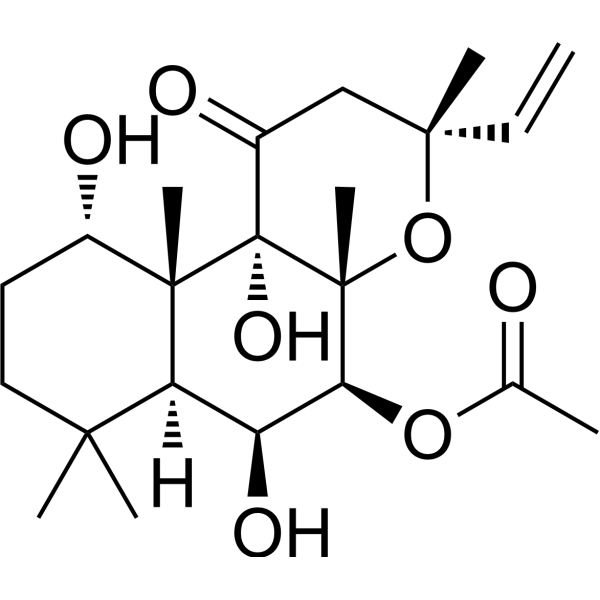
HY-15371
Forskolin -
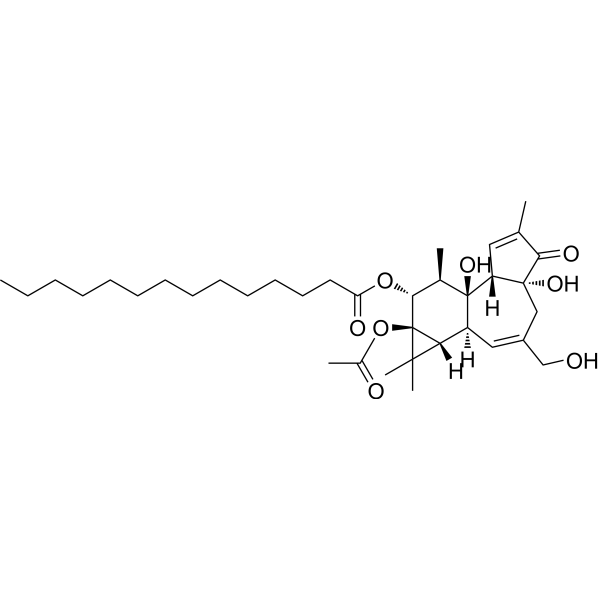
HY-18739
Phorbol 12-myristate 13-acetate -
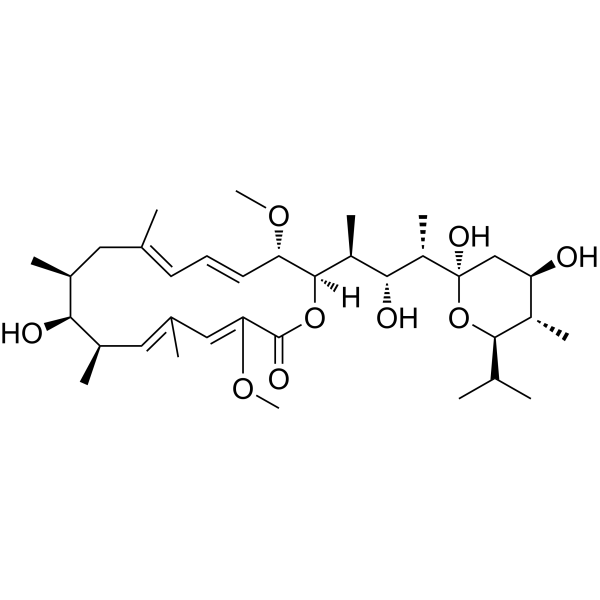
HY-100558
Bafilomycin A1 -
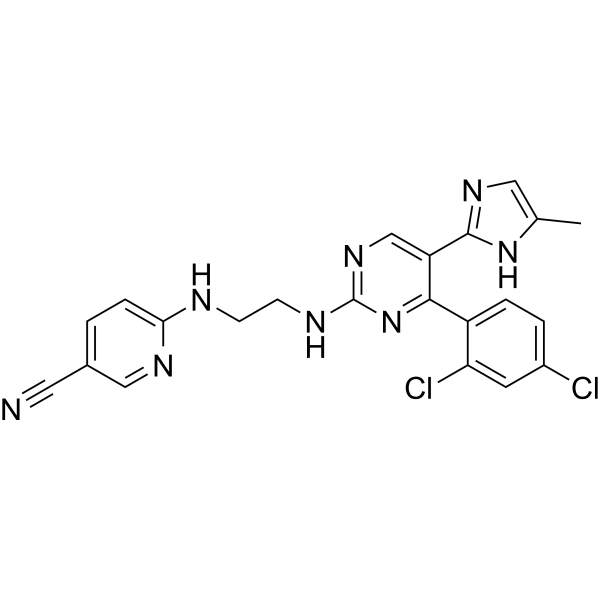
HY-10182
Laduviglusib


Biological Activity
Description
IL-15 Protein, Human modulates immune cells of both the innate and adaptive immune systems, induces the production of chemokines and cytokines, stimulates the proliferation of natural killer cells, T-cells and B-cells. IL-15 Protein, Human triggers both pro-inflammatory and protective immune responses. IL-15 Protein, Human is the recombinant human-derived IL-15 Protein, expressed by E. coli.
Background
Interleukin 15 is a cytokine that shares many biological properties with IL-2, including T, B and NK cell-stimulatory activities. Interleukin-15 has significant potential in cancer immunotherapy as an activator of antitumor CD8 T and natural killer (NK) cells[1]. Interleukin-15 (IL-15) is a pleiotropic cytokine and a member of the four α-helix bundle family of cytokines which include IL-2, IL-4, IL-7, IL-9, IL-15 and IL-21. IL-15 exhibits a broad biological activity and induces the differentiation and proliferation of T, B and natural killer (NK) cells. As a potent pro-inflammatory cytokine, IL-15 plays an important and complex role in autoimmune disease and inflammation. IL-15 plays a pivotal role in some hematological malignancies and presents anti-tumor effects. The direct administration of IL-15 has shown anti-tumor effects in several preclinical mouse tumor models[2].
In Vitro
IL-15 Protein (Human, 100 ng/mL, 8 days) increases myotube thickness, nuclear fusion index and myonuclei number in primary human myoblasts, promotes the expression of myogenesis-related genes myomaker, MYOD and MYOG[3].
IL-15 Protein (Human, 10-500 ng/mL, 12-24 h) induces the expression of chemokines (such as MIP-1α, MIP-1β and RANTES) and their receptors (such as CCR1, CCR4, CCR5, etc.) in peripheral blood T lymphocytes. IL-15 Protein promotes the entry and replication of mononuclear tropic HIV in T lymphocytes[4].
In Vivo
IL-15 Protein (10-50 µg/kg/day, iv, once daily for 12 days) exhibits immunostimulatory property, exhibits toxicity that leads to neutropenia in rhesus macaques. IL-15 Protein causes adverse reactions such as loss of appetite, diarrhea and vomiting with a high dose of 50 µg/kg/day[5].
Verified Bioactivity
1. The ED50 is <0.5 ng/mL as measured by CTLL-2 cells, corresponding to a specific activity of >2 × 10⁶ units/mg.
2.The ED50 is ≤2 ng/mL, as measured in a cell proliferation assay using MO7e human megakaryocytic leukemic cells.
MCE Validation Data
-
Purity - SDS-PAGE
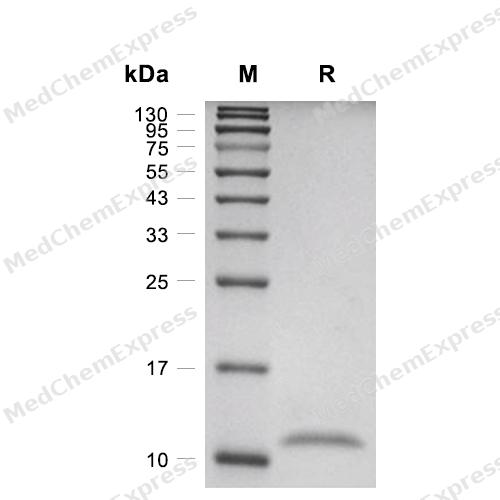
Purity - SDS-PAGE
-
Bioactivity - Cell-Based Assay
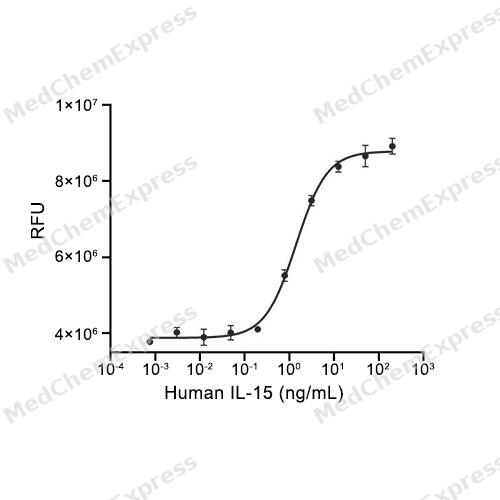
Bioactivity - Cell-Based Assay


Publications (4)
-
Journal Impact Factor
-
Most Recent
-
Cancer Biol Med
Neoepitope BTLAP267L-specific TCR-T cell immunotherapy unlocks precision treatment for hepatocellular carcinoma. [Abstract]2025 Apr 9:j.issn.2095-3941.2024.0434. PMID: 40205806 -
Int J Mol Sci
Single-Cell Sequencing Reveals the Heterogeneity of Hepatic Natural Killer Cells and Identifies the Cytotoxic Natural Killer Subset in Schistosomiasis Mice. [Abstract]2025 Mar 30;26(7):3211. PMID: 40244063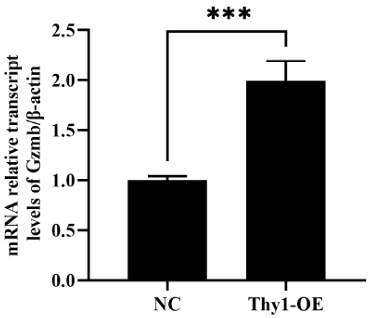
IL-15 Protein, Human purchased from MedChemExpress. Usage Cited in: Int J Mol Sci. 2025 Mar 30;26(7):3211. [Abstract]
IL-15 (50 ng/mL; 24 h). Changes in Gzmb mRNA expression levels in NC and Thy1-OE NK92 cells after stimulation with IL-12, IL-15 and IL-18 for 24 hours.
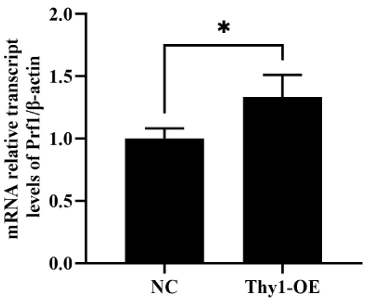
IL-15 Protein, Human purchased from MedChemExpress. Usage Cited in: Int J Mol Sci. 2025 Mar 30;26(7):3211. [Abstract]
IL-15 (50 ng/mL; 24 h). Changes in Prf1 mRNA expression levels in NC and Thy1-OE NK92 cells after stimulation with IL-12, IL-15 and IL-18 for 24 hours.
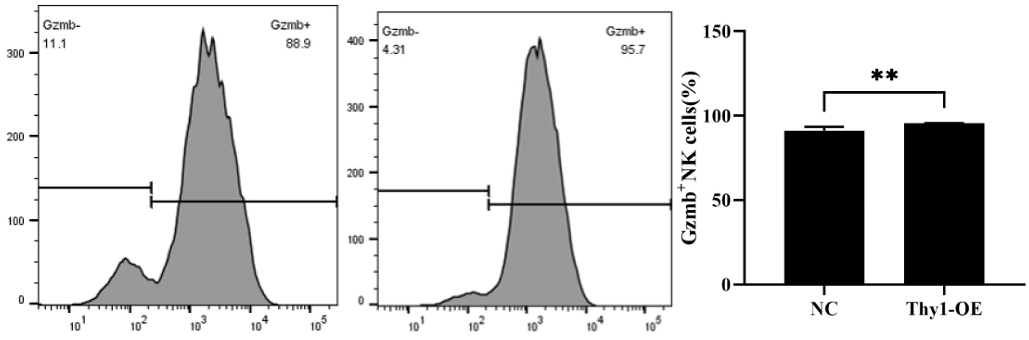
IL-15 Protein, Human purchased from MedChemExpress. Usage Cited in: Int J Mol Sci. 2025 Mar 30;26(7):3211. [Abstract]
IL-15 (50 ng/mL; 48 h). Changes in Gzmb protein expression levels in NC and Thy1-OE NK92 cells after stimulation with IL-12, IL-15 and IL-18 for 48 hours.
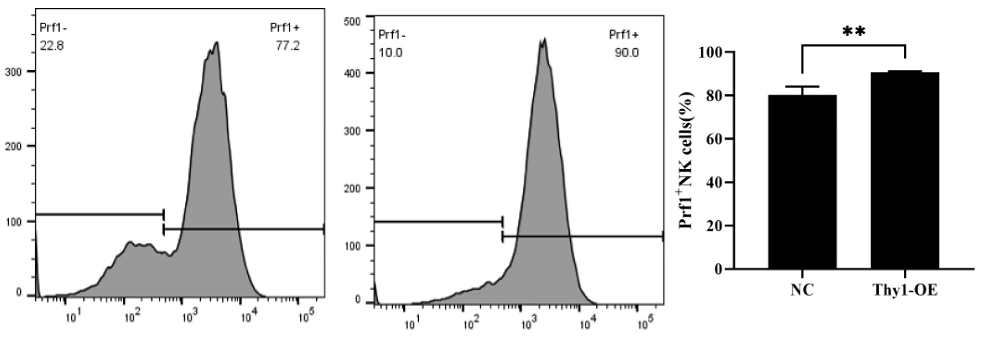
IL-15 Protein, Human purchased from MedChemExpress. Usage Cited in: Int J Mol Sci. 2025 Mar 30;26(7):3211. [Abstract]
IL-15 (50 ng/mL; 48 h). Changes in Prf1 protein expression levels in NC and Thy1-OE NK92 cells after stimulation with IL-12, IL-15 and IL-18 for 48 hours.
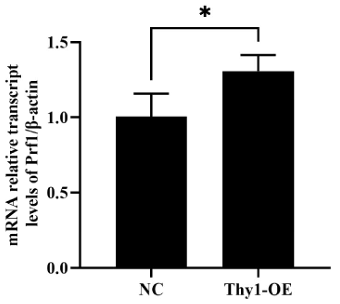
IL-15 Protein, Human purchased from MedChemExpress. Usage Cited in: Int J Mol Sci. 2025 Mar 30;26(7):3211. [Abstract]
IL-15 (50 ng/mL; 48 h). Changes in Prf1 mRNA expression levels in NC and Thy1-OE NK92 cells after stimulation with IL-12, IL-15 and IL-18 for 48 hours.
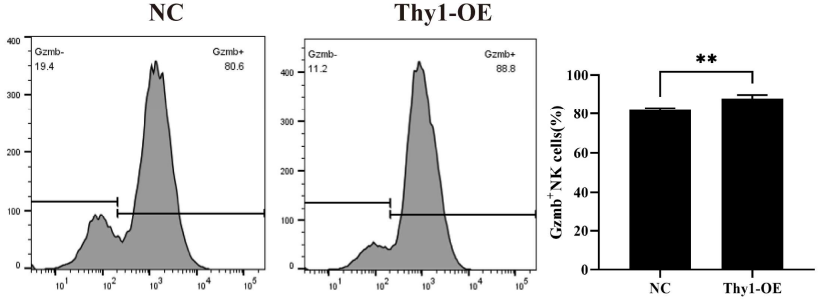
IL-15 Protein, Human purchased from MedChemExpress. Usage Cited in: Int J Mol Sci. 2025 Mar 30;26(7):3211. [Abstract]
Changes in Gzmb protein expression levels in NC and Thy1-OE NK92 cells after stimulation with IL-12 (50 ng/mL), IL-15 (50 ng/mL), and IL-18 (100 ng/mL) for 24 hours.
-
FASEB J
EI24 alleviates renal interstitial fibrosis through inhibition of epithelial-mesenchymal transition and fibroblast activation. [Abstract]2021 Jan;35(1):e21239. PMID: 33368642 -
bioRxiv
2025 Oct 1:2025.09.29.679095. PMID: 41256549


Technical Parameters
-
Species Human
-
Source E. coli
-
Tag Tag Free
-
Accession
P40933-1 (N49-S162)
-
Molecular Construction
-
N-term
-
IL-15 (N49-S162)
Accession # P40933-1 -
C-term
-
-
Protein Length
Full Length of Isoform-1
-
Synonyms
IL15; Interleukin-15; Interleukin 15; MGC9721; IL-15
-
AA Sequence
NWVNVISDLKKIEDLIQSMHIDATLYTESDVHPSCKVTAMKCFLLELQVISLESGDASIHDTVENLIILANNSLSSNGNVTESGCKECEELEEKNIKEFLQSFVHIVQMFINTS
-
Predicted Molecular Mass
12.8 kDa
-
Molecular Weight
Approximately 13 kDa, based on SDS-PAGE under reducing conditions.
-
Purity
≥ 95%, as determined by reducing SDS-PAGE.


Product Properties
Lyophilized powder
1.Lyophilized from a 0.22 μm filtered solution of PBS.
2.Lyophilized from a 0.22 μm filtered solution of PBS, pH 7.4, 8% trehalose.
Please refer to the lot-specific COA for specific buffer information.
<1 EU/μg, determined by LAL method.
It is not recommended to reconstitute to a concentration less than 100 μg/mL in ddH2O. For long term storage it is recommended to add a carrier protein (0.1% BSA, 5% HSA, 10% FBS or 5% Trehalose).
Stored at -20°C for 2 years from date of receipt. After reconstitution, it is stable at 4°C for 1 week or -20°C for longer (with carrier protein). It is recommended to freeze aliquots at -20°C or -80°C for extended storage.
Room temperature in continental US; may vary elsewhere.


Documentation
-
Data Sheet (263 KB)
-
SDS (251 KB)
- English - EN (251 KB)
- Français - FR (251 KB)
- Deutsch - DE (251 KB)
- Norwegian - NO (251 KB)
- Español - ES (251 KB)
- Swedish - SV (251 KB)
- Italian - IT (251 KB)
- Korean - KR (251 KB)
- Portuguese - PT (251 KB)
-
Handling Instructions (2659 KB)


References
[1]. Conlon KC, et al. Redistribution, hyperproliferation, activation of natural killer cells and CD8 T cells, and cytokine production during first-in-human clinical trial of recombinant human interleukin-15 in patients with cancer. J Clin Oncol. 2015 Jan 1;33(1):74-82. [Content Brief]
[2]. Sun W, et al. High level expression and purification of active recombinant human interleukin-15 in Pichiapastoris. J Immunol Methods. 2016 Jan;428:50-7. [Content Brief]
[3]. O'Leary MF, et al., IL-15 promotes human myogenesis and mitigates the detrimental effects of TNFα on myotube development. Sci Rep. 2017 Oct 11;7(1):12997. [Content Brief]
[5]. Waldmann TA, et al., Safety (toxicity), pharmacokinetics, immunogenicity, and impact on elements of the normal immune system of recombinant human IL-15 in rhesus macaques. Blood. 2011 May 5;117(18):4787-95. [Content Brief]

Calculators
Concentration (start) × Volume (start) = Concentration (final) × Volume (final)


 Powered by Bioz

