



IL-2 Protein, Human
Based on 24 publication(s) in Google Scholar
IL-2 Protein, Human activates STAT, PI3K and MAPK pathways. IL-2 Protein, Human increases NK-cell cytolytic activity as a T-cell growth factor. IL-2 Protein, Human regulates the proliferation of activated B-cells and regulatory T-cells. IL-2 Protein, Human is the recombinant human-derived IL-2 Protein, expressed by E. coli.
- Species: Human
- Source: E. coli
-
Storage:Stored at -20°C for 2 years from date of receipt. After reconstitution, it is stable at 4°C for 1 week or -20°C for longer (with carrier protein). It is recommended to freeze aliquots at -20°C or -80°C for extended storage.


To place orders, for customer services and technical support, please contact: MedChemExpress USA
Tel: 609-228-6898 E-mail: [email protected] [email protected]


-
 Biological Activity
-
Technical Parameters
-
Product Properties
- Documentation
- References
- Help & FAQs


-

HY-P7034
IL-15 Protein, Human -
HY-P7077
IL-2 Protein, Mouse -
HY-P70445
IL-4 Protein, Human -
HY-P7045
IL-7 Protein, Human -
HY-P7025
IFN-gamma Protein, Human -
HY-P7044
IL-6 Protein, Human -
HY-P70543
TGF beta 1/TGFB1 Protein, Human (HEK293) -

HY-K0353
Human CD3/CD28 T Cell Activation Magnetic Beads -
HY-P7032
IL-12 Protein, Human (HEK293) -
HY-P7058
TNF-alpha/TNFSF2 Protein, Human -
HY-P7028
IL-1 beta Protein, Human -
HY-P7085
M-CSF Protein, Mouse


Biological Activity
Description
IL-2 Protein, Human activates STAT, PI3K and MAPK pathways. IL-2 Protein, Human increases NK-cell cytolytic activity as a T-cell growth factor. IL-2 Protein, Human regulates the proliferation of activated B-cells and regulatory T-cells. IL-2 Protein, Human is the recombinant human-derived IL-2 Protein, expressed by E. coli.
Background
Recombinant human interleukin-2 (IL-2) expressed as Escherichia coli is isolated as insoluble aggregates of protein (inclusion bodies) after cell breakage. Interleukin 2 (IL-2), a cytokine secreted by activated T cells, promotes the differentiation and proliferation of lymphoid cells as well as enhances the cell-mediated immune response to infections. Therefore IL-2 has been used as an adjunctive immunotherapeutic agent to control some infectious diseases, such as leishmaniasis, leprosy, and HIV infection[1].
In Vitro
IL-2 Protein (Human, 500 U/mL, 42 hours-5 days) induces cytotoxic activity in mouse splenocytes and human peripheral blood lymphocytes, which exhibits a killing effect on tumor cells[2].
Verified Bioactivity
1. The ED50 as determined by the dose-dependant stimulation of the proliferation of CTLL-2 was found to be < 0.1 ng/ml, corresponding to a specific activity of > 1.0 × 10⁷ IU/mg.
2. Measured in a cell proliferation assay using CTLL-2 mouse cytotoxic T cells.The ED50 for this effect is <3.0 ng/mL.
MCE Validation Data
-
Purity - SDS-PAGE
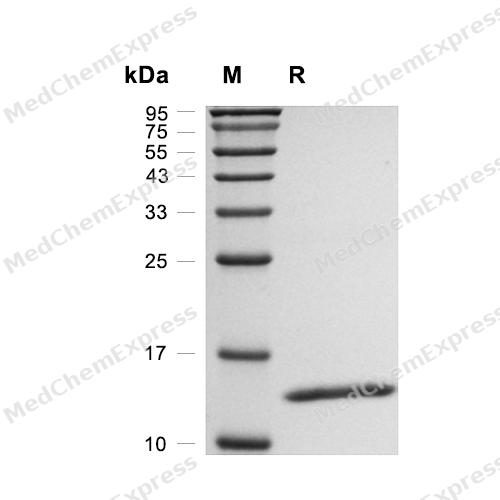
Purity - SDS-PAGE
-
Bioactivity - Cell-Based Assay
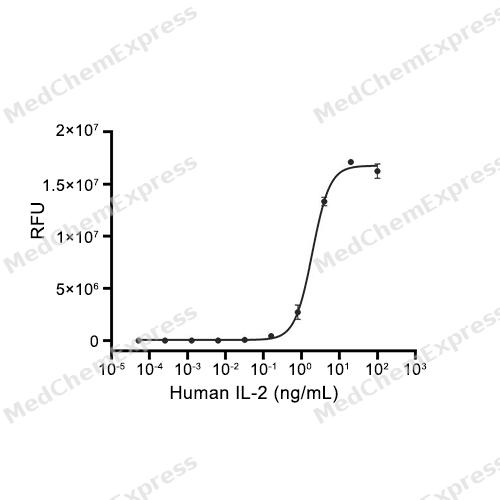
Bioactivity - Cell-Based Assay


Publications (24)
-
Journal Impact Factor
-
Most Recent
-
J Hematol Oncol
Engineering a controllable and reversible switch for CAR-based cellular immunotherapies via a genetic code expansion system. [Abstract]2024 Dec 18;17(1):122. PMID: 39696585 -
Cell
Cancer SLC6A6-mediated taurine uptake transactivates immune checkpoint genes and induces exhaustion in CD8+ T cells. [Abstract]2024 Apr 25;187(9):2288-2304.e27. PMID: 38565142 -
Cell Mol Immunol
USP21 drives immune evasion in colorectal cancer via deubiquitination and stabilization of β-catenin. [Abstract]2026 Jun;23(6):701-718. PMID: 42091690 -
Cancer Res
2026 Feb 24. PMID: 41734377 -
Adv Sci (Weinh)
Chronic ER Stress Triggers Cell-Surface Chaperones as the Therapeutic Targets of CAR Cells in Acute Myeloid Leukemia. [Abstract]2025 Oct 23:e11573. PMID: 41126722 -
-
Cell Death Dis
Cancer-associated fibroblasts (CAFs) derived from MFAP2 promote CRC proliferation and metastasis while suppressing CD8+ T cell-mediated antitumor immunity. [Abstract]2026 Jan 30;17(1):159. PMID: 41617683 -
Cancer Lett
2026 May 28:646:218386. PMID: 41791643 -
J Immunother Cancer
CD146+ CAFs mediate immunosuppression in gastric cancer via COL4A1: potential therapeutic targets. [Abstract]2025 Dec 21;13(12):e013577. PMID: 41423274 -
Cell Commun Signal
NK cell immunopotentiators-loaded nanoliposomes enhance ADCC effect for targeted therapy against HER2-positive breast cancer. [Abstract]2025 Feb 22;23(1):106. PMID: 39987140 -
Leukemia
GNAS knockout potentiates HDAC3 inhibition through viral mimicry-related interferon responses in lymphoma. [Abstract]2024 Oct;38(10):2210-2224. PMID: 39117798 -
Int J Biol Macromol
Oncostatin M promotes immune escape, invasion, and metastasis of pancreatic cancer by upregulating PD-L1 via the PI3K/AKT pathway. [Abstract]2026 May:363:152179. PMID: 42034135 -
Clin Transl Med
HBx hijacks the miR-19a-3p/BAMBI/TGF-β1 axis to impair the anti-tumour activity of CD4+ T cells in diffuse large B-cell lymphoma. [Abstract]2026 Jan;16(1):e70578. PMID: 41492119 -
Cancer Immunol Res
FAM135B Deficiency Inhibits Cytotoxic T-Cell Activity in Triple-negative Breast Cancer by Blocking the IFI16-dependent STING Pathway. [Abstract]2025 Nov 11. PMID: 41218197 -
Cancer Immunol Res
CXCL10 recruitment of γδ T cells into the hypoxic bone marrow environment leads to IL-17 expression and multiple myeloma progression. [Abstract]2023 Oct 4;11(10):1384-1399. PMID: 37586075 -
Cancer Immunol Immunother
Dual-modality imaging enables longitudinal biodistribution profiling of intracerebroventricular CAR-T therapy in orthotopic glioma. [Abstract]2026 May 2;75(5):160. PMID: 42068336 -
Cancer Immunol Immunother
The transcription factor FOXA1 upregulates PYCR1-mediated autophagy to suppress antitumor immunity in lung adenocarcinoma. [Abstract]2025 Aug 23;74(9):290. PMID: 40848149 -
Cancer
Impact of tocilizumab on anti-CD19 chimeric antigen receptor T-cell therapy in B-cell acute lymphoblastic leukemia. [Abstract]2024 Aug 1;130(15):2660-2669. PMID: 38578977 -
Cancers (Basel)
2020 Mar 16;12(3):702. PMID: 32188095 -
Funct Integr Genomics
ALOX15 exerts tumor-suppressive role in head and neck squamous cell carcinoma via ERK pathway. [Abstract]2026 Mar 13;26(1):64. PMID: 41820595 -
Toxicol Appl Pharmacol
Schisandrin B induces HepG2 cells pyroptosis by activating NK cells mediated anti-tumor immunity. [Abstract]2023 Aug 1:472:116574. PMID: 37271225 -
Tissue Cell
ONECUT1 activates PSAT1 to facilitate PD-L1 expression and mediate immune evasion of lung squamous cell carcinoma. [Abstract]2026 Feb:98:103091. PMID: 40907151 -
bioRxiv
2025 Oct 1:2025.09.29.679095. PMID: 41256549 -


Technical Parameters
-
Species Human
-
Source E. coli
-
Tag Tag Free
-
Accession
P60568 (A21-T153)
-
Molecular Construction
-
N-term
-
IL-2 (A21-T153)
Accession # P60568 -
C-term
-
-
Protein Length
Full Length of Mature Protein
-
Synonyms
IL2; T Cell Growth Factor; Interleukin 2; Aldesleukin; IL-2; Involved In Regulation Of T-Cell Clonal Expansion; TCGF; T-Cell Growth Factor; Interleukin-2; Lymphokine
-
AA Sequence
APTSSSTKKTQLQLEHLLLDLQMILNGINNYKNPKLTRMLTFKFYMPKKATELKHLQCLEEELKPLEEVLNLAQSKNFHLRPRDLISNINVIVLELKGSETTFMCEYADETATIVEFLNRWITFCQSIISTLT
-
Predicted Molecular Mass
16.9 kDa
-
Molecular Weight
Approximately 14-16 kDa, based on SDS-PAGE under reducing conditions, due to the glycosylation.
-
Purity
≥ 95%, as determined by reducing SDS-PAGE.


Product Properties
Lyophilized powder
1.Lyophilized from a 0.22 μm filtered solution of 10 mM sodium citrate, pH 4.0.
2.Lyophilized from a 0.22 μm filtered solution of 10 mM sodium citrate, pH 4.0, 8% trehalose.
Please refer to the lot-specific COA for specific buffer information.
<1 EU/μg, determined by LAL method.
It is not recommended to reconstitute to a concentration less than 100 μg/mL in ddH2O. For long term storage it is recommended to add a carrier protein (0.1% BSA, 5% HSA, 10% FBS or 5% Trehalose).
Stored at -20°C for 2 years from date of receipt. After reconstitution, it is stable at 4°C for 1 week or -20°C for longer (with carrier protein). It is recommended to freeze aliquots at -20°C or -80°C for extended storage.
Room temperature in continental US; may vary elsewhere.


Documentation
-
Data Sheet (262 KB)
-
SDS (252 KB)
- English - EN (252 KB)
- Français - FR (252 KB)
- Deutsch - DE (252 KB)
- Norwegian - NO (252 KB)
- Español - ES (252 KB)
- Swedish - SV (252 KB)
- Italian - IT (252 KB)
- Korean - KR (252 KB)
- Portuguese - PT (252 KB)
-
Handling Instructions (2659 KB)


References
[1]. Zhang R, et al. Therapeutic effects of recombinant human interleukin 2 as adjunctive immunotherapy against tuberculosis: A systematic review and meta-analysis. PLoS One. 2018 Jul 19;13(7):e0201025. [Content Brief]
[2]. Devos R, et al., Induction of cytolytic cells by pure recombinant human interleukin 2. Eur J Immunol. 1984 Nov;14(11):1057-60. [Content Brief]

Calculators
Concentration (start) × Volume (start) = Concentration (final) × Volume (final)


 Powered by Bioz

