



IL-2 Protein, Mouse
Based on 31 publication(s) in Google Scholar
IL-2 protein is mainly produced by activated CD4-positive helper T cells and plays an important role in immune response and tolerance. Binding to IL-2R induces downstream signaling through JAK1 and JAK3 phosphorylation, thereby activating various pathways, including STAT, PI3K, and MAPK. IL-2 Protein, Mouse is the recombinant mouse-derived IL-2 protein, expressed by E. coli.
- Species: Mouse
- Source: E. coli
-
Storage:Stored at -20°C for 2 years from date of receipt. After reconstitution, it is stable at 4°C for 1 week or -20°C for longer (with carrier protein). It is recommended to freeze aliquots at -20°C or -80°C for extended storage.


To place orders, for customer services and technical support, please contact: MedChemExpress USA
Tel: 609-228-6898 E-mail: [email protected] [email protected]


-
 Biological Activity
-
Technical Parameters
-
Product Properties
- Documentation
- References
- Help & FAQs


-

HY-P7117
TGF beta 1/TGFB1 Protein, Mouse/Rat (HEK293, Tag Free) -
HY-P73226
IL-7 Protein, Mouse -
HY-P7037
IL-2 Protein, Human -
HY-P7071
IFN-gamma Protein, Mouse -
HY-P7080
IL-4 Protein, Mouse (CHO) -
HY-P7063
IL-6 Protein, Mouse -
HY-P700193AF
Animal-Free IL-15 Protein, Mouse (His) -
HY-P7361
GM-CSF Protein, Mouse -
HY-18739
Phorbol 12-myristate 13-acetatePKC Activator -
HY-P7085
M-CSF Protein, Mouse -

HY-K0354
Mouse CD3/CD28 T Cell Activation Magnetic Beads -
HY-P78719
IL-15 Protein, Mouse (HEK293, Fc)


Biological Activity
Description
IL-2 protein is mainly produced by activated CD4-positive helper T cells and plays an important role in immune response and tolerance. Binding to IL-2R induces downstream signaling through JAK1 and JAK3 phosphorylation, thereby activating various pathways, including STAT, PI3K, and MAPK. IL-2 Protein, Mouse is the recombinant mouse-derived IL-2 protein, expressed by E. coli.
Background
Interleukin-2 (IL-2) is a multi-faceted cytokine, known for promoting proliferation, survival, and cell death depending on the cell type and state. For example, IL-2 facilitates cell death only in activated T cells when antigen and IL-2 are abundant. The availability of IL-2 clearly impacts this process. IL-2 is retained in blood vessels by heparan sulfate, and that biologically active IL-2 is released from vessel tissue by heparanase. The morphologic changes and rapid cell death induced by dimeric IL-2 imply that cell death is mediated by disruption of membrane permeability and subsequent necrosis. IL-2 has a direct and unexpectedly broad influence on cellular homeostatic mechanisms in both immune and non-immune systems[1].
In Vivo
IL-2 Protein, Mouse (1 μg/kg, ip, once daily for 5 days) increases the frequency and function of regulatory T cells (Tregs), improves the survival rate of mice in transplantation model[2].
IL-2 Protein, Mouse (5 μg/kg, ip, once daily for 5 days) ameliorates the pulmonary edema and neutrophil aggregation, increases the level of anti-inflammatory cytokine IL-10 in mouse transfusion-related acute lung injury model[3].
Verified Bioactivity
1.Measured in a cell proliferation assay using CTLL-2 Cells. The ED50 for this effect is ≤0.5117 ng/mL, corresponding to a specific activity is ≥1.954×10⁶ units/mg.
2.Measured in a cell proliferation assay using CTLL 2 mouse cytotoxic T cells.The specific activity of Recombinant Mouse IL-2 is ≥1×10⁶ IU/mg.
MCE Validation Data
-
Purity - SDS-PAGE
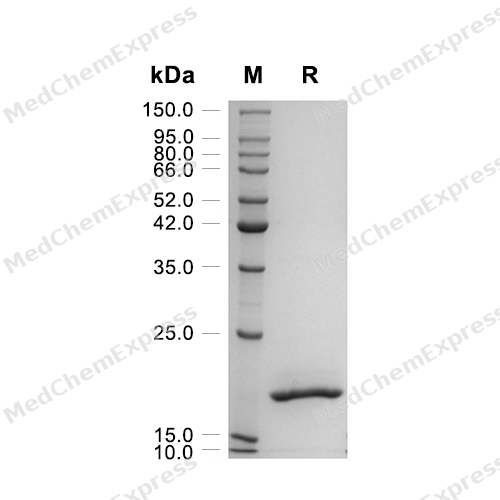
Purity - SDS-PAGE
-
Bioactivity - Cell-Based Assay
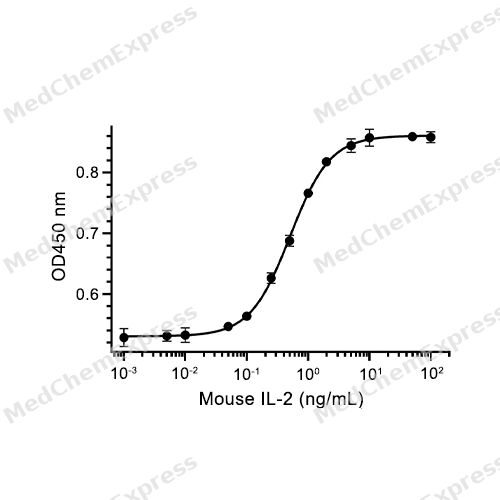
Bioactivity - Cell-Based Assay


Publications (31)
-
Journal Impact Factor
-
Most Recent
-
Cancer Commun (Lond)
Radiotherapy-resistant prostate cancer cells escape immune checkpoint blockade through the senescence-related ataxia telangiectasia and Rad3-related protein. [Abstract]2025 Mar;45(3):218-244. PMID: 39698847 -
Autophagy
KDM4A-induced tumor senescence enhances the efficacy of immunotherapy by inhibiting AGT-PHB1 axis-mediated mitophagy in colorectal cancer. [Abstract]2025 Sep 9:1-22. PMID: 40923240 -
Nat Commun
Engineered exosome nanovesicles for delivery of antibodies to treat inflammatory bowel disease. [Abstract]2026 Feb 13;17(1):2737. PMID: 41688436 -
Nat Commun
Targeting ALDH16A1 mediated thioredoxin lysosomal degradation to enhance ferroptosis susceptibility in SMARCA4-deficient NSCLC. [Abstract]2025 Sep 2;16(1):8181. PMID: 40897711 -
Nat Commun
Engineering micro oxygen factories to slow tumour progression via hyperoxic microenvironments. [Abstract]2022 Aug 2;13(1):4495. PMID: 35918337 -
J Adv Res
Single-cell and spatial transcriptome profiling identifies cellular heterogeneity and immunosuppressive tumor microenvironment in inflammatory breast cancer. [Abstract]2025 Jun 1:S2090-1232(25)00382-0. PMID: 40460936 -
Trends Biotechnol
Synthetic M13 phage engagers expand CAR-T cell antigen recognition to overcome tumor heterogeneity. [Abstract]2026 Mar 28:S0167-7799(26)00047-8. PMID: 41904099 -
J Nanobiotechnology
Dual depletion of myeloid-derived suppressor cells and tumor cells with self-assembled gemcitabine-celecoxib nano-twin drug for cancer chemoimmunotherapy. [Abstract]2024 Jun 8;22(1):319. PMID: 38849938 -
Adv Sci (Weinh)
UBE2O Drives Immune Evasion and Radioimmunotherapy Resistance in Lung Cancer by Degrading CDKL1 to Induce PD-L1 Transcription. [Abstract]2026 Jun 22:e76223. PMID: 42325185 -
Cell Rep Med
Augment proteasome inhibitor efficacy activates CD8+ T cell-mediated antitumor immunity in breast cancer. [Abstract]2025 Jul 15;6(7):102211. PMID: 40609539 -
Research (Wash D C)
Ultrasensitive In Vivo Imaging of Adoptive Immune Cell Distribution and Expansion Using Second Near-Infrared Conjugated Oligoelectrolyte Probes. [Abstract]2026 Jun 26:9:1342. PMID: 42369837 -
Int J Biol Sci
Procyanidin Suppresses Tumor Growth by Activating the B-Cell MAPK Pathway through Remodulation of the Gut Microbiota and Metabolites in Hepatocellular Carcinoma. [Abstract]2026 Jan 1;22(1):161-177. PMID: 41362739 -
J Immunother Cancer
METTL3 promotes an immunosuppressive microenvironment in bladder cancer via m6A-dependent CXCL5/CCL5 regulation. [Abstract]2025 Apr 15;13(4):e011108. PMID: 40234090 -
J Immunother Cancer
Targeting KDM4C enhances CD8+ T cell mediated antitumor immunity by activating chemokine CXCL10 transcription in lung cancer. [Abstract]2022 Feb;10(2):e003716. PMID: 35121645 -
NPJ Precis Oncol
Bifidobacterium boosts anti-PD-1 effectiveness through JAK pathway in hepatocellular carcinoma. [Abstract]2025 Jul 23;9(1):251. PMID: 40702094 -
Aging Cell
2025 Feb;24(2):e14391. PMID: 39473192 -
-
Biochem Pharmacol
NEDD4 like E3 ubiquitin protein ligase-mediated ubiquitination and degradation of dipeptidyl peptidase 4 restrains Th2-linked inflammation in allergic rhinitis. [Abstract]2026 Apr 9;250(Pt 1):117960. PMID: 41966487 -
Biochem Pharmacol
SPSB1 inhibition induces cancer immune evasion by modulating the KLF6/PD-L1 axis in non-small cell lung cancer cells. [Abstract]2026 Apr 27:118017. PMID: 42055144 -
RSC Adv
2023 Mar 13;13(11):7656-7663. PMID: 36923299 -
Cell Biol Toxicol
SENP3 mediated DeSUMOylation of macrophage derived CCL17 accelerates atherosclerosis via regulation of Treg. [Abstract]2025 Nov 21;41(1):151. PMID: 41266856 -
Cell Biol Toxicol
KMT2D/ZNF460-induced COL9A1-mediated extracellular matrix stiffness maintains the cancer stem cell pool to promote colorectal cancer progression. [Abstract]2025 Jul 1;41(1):111. PMID: 40591048 -
Int Immunopharmacol
Targeting SPP1+ macrophages via the SPP1-CD44 axis reveals a key mechanism of immune suppression and tumor progression in ovarian cancer. [Abstract]2025 Jul 28:160:114906. PMID: 40446696 -
Mol Cell Biochem
RNF125 promotes CD8 T cell-mediated anticancer immunity and suppresses the malignant phenotype of cervical cancer. [Abstract]2026 Mar 13. PMID: 41824200 -
Cytotherapy
NLRC5 knockdown in CD4+CD25+ Treg cells attenuates cardiac allograft rejection through enhanced immunosuppressive function. [Abstract]2025 Dec;27(12):1419-1426. PMID: 41085514 -
FASEB J
Complanatuside A ameliorates 2,4,6-trinitrobenzene sulfonic acid-induced colitis in mice by regulating the Th17/Treg balance via the JAK2/STAT3 signaling pathway. [Abstract]2024 May 31;38(10):e23667. PMID: 38742812 -
Br J Haematol
The mechanism of EZH2/H3K27me3 downregulating CXCL10 to affect CD8+ T cell exhaustion to participate in the transformation from myelodysplastic syndrome to acute myeloid leukaemia. [Abstract]2025 Apr 9. PMID: 40201935 -
Tissue Cell
Oral glutamine inhibits tumor growth of gastric cancer bearing mice by improving immune function and activating apoptosis pathway. [Abstract]2021 Aug:71:101508. PMID: 33609891 -
-
Heliyon
Low-dose IL-2 treatment confers anti-inflammatory effect against subarachnoid hemorrhage in mice. [Abstract]2024 Apr 23;10(9):e30013. PMID: 38742061 -


Technical Parameters
-
Species Mouse
-
Source E. coli
-
Tag Tag Free
-
Accession
P04351 (A21-Q169)
-
Molecular Construction
-
N-term
-
IL-2 (A21-Q169)
Accession # P04351 -
C-term
-
-
Protein Length
Full Length of Mature Protein
-
Synonyms
IL2; T Cell Growth Factor; Interleukin 2; Aldesleukin; IL-2; Involved In Regulation Of T-Cell Clonal Expansion; TCGF; T-Cell Growth Factor; Interleukin-2; Lymphokine
-
AA Sequence
APTSSSTSSSTAEAQQQQQQQQQQQQHLEQLLMDLQELLSRMENYRNLKLPRMLTFKFYLPKQATELKDLQCLEDELGPLRHVLDLTQSKSFQLEDAENFISNIRVTVVKLKGSDNTFECQFDDESATVVDFLRRWIAFCQSIISTSPQ
-
Predicted Molecular Mass
17.4 kDa
-
Molecular Weight
Approximately 17 kDa, based on SDS-PAGE under reducing conditions.
-
Purity
≥ 95%, as determined by reducing SDS-PAGE.


Product Properties
Lyophilized powder
1.Lyophilized from a 0.22 μm filtered solution of 20 mM sodium citrate, 0.02% Tween 80, pH 3.0.
2.Lyophilized from a 0.22 μm filtered solution of 20 mM sodium citrate, 0.02% Tween 80, 4% mannitol, pH 3.0.
3.Lyophilized from a 0.22 μm filtered solution of PBS, pH 7.4.
4.Lyophilized from a 0.22 μm filtered solution of 20 mM sodium citrate, 0.2% Tween 80, pH 3.0.
5.Lyophilized from a 0.22 μm filtered solution of 20 mM PB, 150 mM NaCl, pH 7.4.
6.Lyophilized from a 0.22 μm filtered solution of 10 mM Sodium Citrate, pH 4.0.
Please refer to the lot-specific COA for specific buffer information.
<1 EU/μg, determined by LAL method.
It is not recommended to reconstitute to a concentration less than 100 μg/mL in ddH2O. For long term storage it is recommended to add a carrier protein (0.1% BSA, 5% HSA, 10% FBS or 5% Trehalose).
Stored at -20°C for 2 years from date of receipt. After reconstitution, it is stable at 4°C for 1 week or -20°C for longer (with carrier protein). It is recommended to freeze aliquots at -20°C or -80°C for extended storage.
Room temperature in continental US; may vary elsewhere.


Documentation
-
Data Sheet (263 KB)
-
SDS (252 KB)
- English - EN (252 KB)
- Français - FR (252 KB)
- Deutsch - DE (252 KB)
- Norwegian - NO (252 KB)
- Español - ES (252 KB)
- Swedish - SV (252 KB)
- Italian - IT (252 KB)
- Korean - KR (252 KB)
- Portuguese - PT (252 KB)
-
Handling Instructions (2659 KB)


References
[1]. Wrenshall LE, et al. Identification of a cytotoxic form of dimeric interleukin-2 in murine tissues. PLoS One. 2014 Jul 14;9(7):e102191. [Content Brief]
[2]. Tahvildari M, et al., Low-Dose IL-2 Therapy in Transplantation, Autoimmunity, and Inflammatory Diseases. J Immunol. 2019 Dec 1;203(11):2749-2755. [Content Brief]
[3]. He R, et al., Preventing murine transfusion-related acute lung injury by expansion of CD4+ CD25+ FoxP3+ Tregs using IL-2/anti-IL-2 complexes. Transfusion. 2019 Feb;59(2):534-544. [Content Brief]

Calculators
Concentration (start) × Volume (start) = Concentration (final) × Volume (final)


 Powered by Bioz

