



IL-1 beta Protein, Human (solution)
Based on 1 publication(s) in Google Scholar
IL-1 beta protein is a potent proinflammatory cytokine that plays multiple roles in immune responses. It induces inflammatory events including prostaglandin synthesis, neutrophil activation, and cytokine production. IL-1 beta Protein, Human (solution) is the recombinant human-derived IL-1 beta protein, expressed by E. coli , with tag free.
- Species: Human
- Source: E. coli
-
Storage:Stored at -80°C for 1 year from date of receipt. It is stable at -20°C for 3 months after opening. It is recommended to freeze aliquots at -80°C for extended storage. Avoid repeated freeze-thaw cycles.


To place orders, for customer services and technical support, please contact: MedChemExpress USA
Tel: 609-228-6898 E-mail: [email protected] [email protected]


-
 Biological Activity
-
Technical Parameters
-
Product Properties
- Documentation
- Help & FAQs




Biological Activity
Description
IL-1 beta protein is a potent proinflammatory cytokine that plays multiple roles in immune responses. It induces inflammatory events including prostaglandin synthesis, neutrophil activation, and cytokine production. IL-1 beta Protein, Human (solution) is the recombinant human-derived IL-1 beta protein, expressed by E. coli , with tag free.
Background
IL-1 beta Protein stands as a potent pro-inflammatory cytokine, recognized for its diverse roles in orchestrating immune responses. Originally identified as a major endogenous pyrogen, IL-1 beta induces a cascade of inflammatory events, including prostaglandin synthesis, neutrophil influx and activation, T-cell and B-cell activation, cytokine production, as well as fibroblast proliferation and collagen production. It plays a pivotal role in immune cell differentiation, promoting Th17 differentiation of T-cells and synergizing with IL-12 to induce IFNG synthesis from T-helper 1 (Th1) cells. Additionally, IL-1 beta contributes to angiogenesis by inducing VEGF production, working synergistically with TNF and IL-6. Notably, it plays a key role in transducing inflammation downstream of pyroptosis, being specifically released into the extracellular milieu through the gasdermin-D (GSDMD) pore. In the context of microbial infection, IL-1 beta acts as a sensor of S. pyogenes infection in the skin, undergoing cleavage and activation by the pyogenes SpeB protease, leading to an inflammatory response that curtails bacterial growth during invasive skin infection. However, the cleavage of IL-1 beta by SpeB has a dual role, promoting streptococcal infection of the nasopharynx by disrupting colonization resistance mediated by the microbiota.
Verified Bioactivity
Measured by its ability to induce NF-kB signaling in 293-IL1 Res cells. The ED50 for this effect is 20-100 pg/mL.
MCE Validation Data
-
Purity - SDS-PAGE
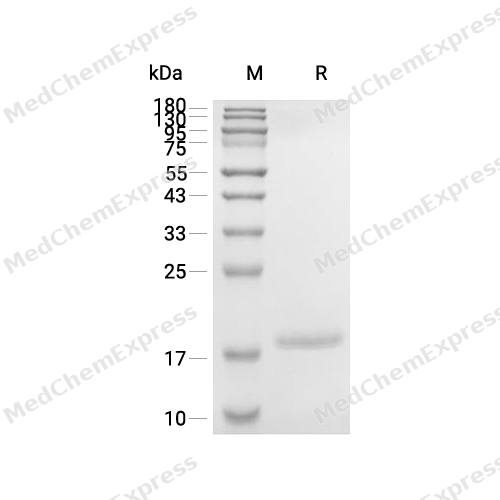
Purity - SDS-PAGE


Publications (1)
-
Journal Impact Factor
-
Most Recent
-
J Cell Mol Med
Modified Qianghuo Shengshi Decoction Ameliorates Osteoarthritis via Inhibiting PI3K/Akt Pathway-Related Ferroptosis. [Abstract]2025 Jul;29(13):e70691. PMID: 40586853


Technical Parameters
-
Species Human
-
Source E. coli
-
Tag Tag Free
-
Accession
P01584 (A117-S269)
-
Molecular Construction
-
N-term
-
IL-1β (A117-S269)
Accession # P01584 -
C-term
-
-
Protein Length
Full Length of Mature Protein
-
Synonyms
IL1B; IL-1B; Interleukin 1 Beta; Multifunctional Fusion Protein; IL1F2; Pro-Interleukin-1-Beta; Interleukin-1 Beta; Preinterleukin 1 Beta; IL1-BETA; Interleukin 1beta; IL-1 Beta; IL1beta; Catabolin; IL-1
-
AA Sequence
APVRSLNCTLRDSQQKSLVMSGPYELKALHLQGQDMEQQVVFSMSFVQGEESNDKIPVALGLKEKNLYLSCVLKDDKPTLQLESVDPKNYPKKKMEKRFVFNKIEINNKLEFESAQFPNWYISTSQAENMPVFLGGTKGGQDITDFTMQFVSS
-
Predicted Molecular Mass
17.5 kDa
-
Molecular Weight
Approximately 17 kDa, based on SDS-PAGE under reducing conditions.
-
Purity
≥ 95%, as determined by reducing SDS-PAGE.


Product Properties
Solution
Supplied as a 0.22 μm filtered solution of 20 mM Tris-HCl, 150 mM NaCl, pH 7.5.
Note: For SPR assay, please replace the buffer. Primary amine components (e.g., Tris, imidazole) can affect protein-coupled chips.
<1 EU/μg, determined by LAL method.
Stored at -80°C for 1 year from date of receipt. It is stable at -20°C for 3 months after opening. It is recommended to freeze aliquots at -80°C for extended storage. Avoid repeated freeze-thaw cycles.
Shipping with dry ice.


Documentation
-
Data Sheet (236 KB)
-
SDS (252 KB)
- English - EN (252 KB)
- Français - FR (252 KB)
- Deutsch - DE (252 KB)
- Norwegian - NO (252 KB)
- Español - ES (252 KB)
- Swedish - SV (252 KB)
- Italian - IT (252 KB)
- Korean - KR (252 KB)
- Portuguese - PT (252 KB)
-
Handling Instructions (2659 KB)

Calculators
Concentration (start) × Volume (start) = Concentration (final) × Volume (final)


 Powered by Bioz

