



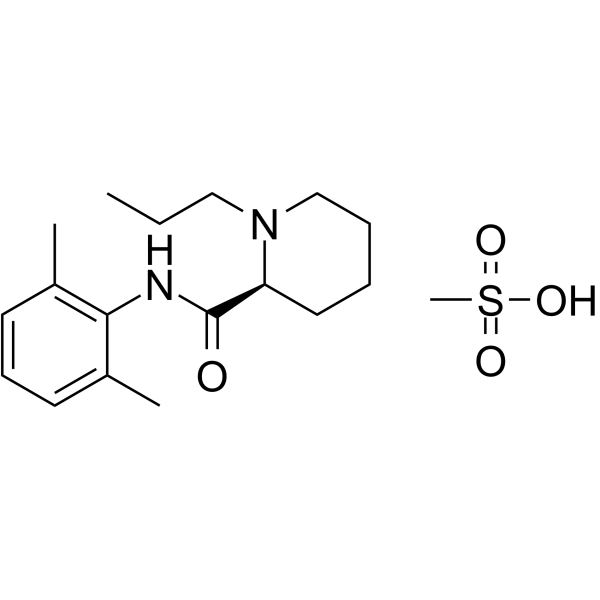
Ropivacaine mesylate
Based on 8 publication(s) in Google Scholar
Ropivacaine mesylate is a long-acting amide local anaesthetic agent for a spinal block and effectively blocks neuropathic pain. Ropivacaine blocks impulse conduction via reversible inhibition of sodium ion influx in nerve fibressup. Ropivacaine is also an inhibitor of K2P (two-pore domain potassium channel) TREK-1 with an IC50 of 402.7 μM in COS-7 cell's membrane.
For research use only. We do not sell to patients.
- Purity : 99.51%
- CAS No.: 854056-07-8
- Formula: C18H30N2O4S
- Molecular Weight:370.51
-
Storage:
4°C, sealed storage, away from moisture
* In solvent : -80°C, 6 months; -20°C, 1 month (sealed storage, away from moisture)

To place orders, for customer services and technical support, please contact: MedChemExpress USA
Tel: 609-228-6898 E-mail: [email protected] [email protected]


-
 Biological Activity
-
Chemical Information
-
Solvent & Solubility
- Purity & Documentation
- References
-
 Help & FAQs


Publications Citing Use of MedChemExpress (MCE) Ropivacaine mesylate
More- J Exp Clin Cancer Res. 2024 Mar 25;43(1):90. [Abstract]
- Stem Cell Res Ther. 2021 Feb 4;12(1):107. [Abstract]
- Int Immunopharmacol. 2026 May 14:182:116838. [Abstract]
- Int J Neuropsychopharmacol. 2025 Oct 1;28(10):pyaf066. [Abstract]
- Eur Spine J. 2022 Nov;31(11):2960-2971. [Abstract]
- BMC Pregnancy Childbirth. 2025 Jun 2;25(1):646. [Abstract]
- In Vitro Cell Dev Biol Anim. 2024 Oct;60(9):1109-1120. [Abstract]
- J Toxicol Sci. 2023;48(3):139-148. [Abstract]


Biological Activity
Description
IC50 & Target
IC50: sodium ion influx[1]IC50: 402.7 μM (TREK-1 in COS-7 cell's membrane)[3]
In Vivo
Ropivacaine mesylate inhibits pressure-induced increases in filtration coefficient (Kf) without affecting pulmonary artery pressure (Ppa), pulmonary capillary pressures (Ppc), and zonal characteristics (ZC)[2].
Ropivacaine mesylate prevents pressure-induced lung edema and associated hyperpermeability as evidence by maintaining PaO2, lung wet-to-dry ratio and plasma volume in levels similar to sham rats[2].
Ropivacaine mesylate inhibits pressure-induced NO production as evidenced by decreased lung nitro-tyrosine content when compared to hypertensive lungs[2].
MedChemExpress (MCE) has not independently confirmed the accuracy of these methods. They are for reference only.
-
Animal Model:Adult Sprague-Dawley rats (300-400g)[2]
-
Dosage:1 μM
-
Administration:Infusion (added to the perfusate reservoir)
-
Result:Attenuated pressure-dependent increases in filtration coefficient (Kf).


Chemical Information
-
CAS No. 854056-07-8
-
Appearance Solid
-
Molecular Weight 370.51
-
Formula C18H30N2O4S
-
Color White to off-white
-
SMILES
O=C([C@H]1N(CCC)CCCC1)NC2=C(C)C=CC=C2C.CS(=O)(O)=O
-
Shipping
Room temperature in continental US; may vary elsewhere.
-
Storage
4°C, sealed storage, away from moisture
* In solvent : -80°C, 6 months; -20°C, 1 month (sealed storage, away from moisture)


Publications (8)
-
Journal Impact Factor
-
Most Recent
-
J Exp Clin Cancer Res
2024 Mar 25;43(1):90. PMID: 38523299 -
Stem Cell Res Ther
Local anesthetics impair the growth and self-renewal of glioblastoma stem cells by inhibiting ZDHHC15-mediated GP130 palmitoylation. [Abstract]2021 Feb 4;12(1):107. PMID: 33541421 -
Int Immunopharmacol
Exploring the mechanism of ropivacaine in alleviating neuropathic pain via the mTOR-PKM2/STAT3-H4K12 lactylation axis. [Abstract]2026 May 14:182:116838. PMID: 42134294 -
Int J Neuropsychopharmacol
Mechanism of the AMPK/SIRT1 pathway in gut dysbiosis-mediated postoperative cognitive dysfunction in aged mice. [Abstract]2025 Oct 1;28(10):pyaf066. PMID: 41031618 -
Eur Spine J
Effect of species, concentration and volume of local anesthetics on intervertebral disk degeneration in rats with discoblock. [Abstract]2022 Nov;31(11):2960-2971. PMID: 36152221 -
BMC Pregnancy Childbirth
KCNK2-mediated regulation of MMP-2/9 by PlGF influences uterine artery function in pregnancy-induced hypertension. [Abstract]2025 Jun 2;25(1):646. PMID: 40457264 -
In Vitro Cell Dev Biol Anim
Inhibition of FOXO3 ameliorates ropivacaine-induced nerve cell damage through the miR-126-5p/TRAF6 axis. [Abstract]2024 Oct;60(9):1109-1120. PMID: 39227495 -
J Toxicol Sci
Dexmedetomidine protects against Ropivacaine-induced neuronal pyroptosis via the Nrf2/HO-1 pathway. [Abstract]2023;48(3):139-148. PMID: 36858639


Solvent & Solubility
In Vitro:
H2O : 250 mg/mL (674.75 mM; Need ultrasonic)
Please refer to the solubility information to select the appropriate solvent. Once prepared, please aliquot and store the solution to prevent product inactivation from repeated freeze-thaw cycles.
Storage method and period of stock solution: -80°C, 6 months; -20°C, 1 month (sealed storage, away from moisture). When stored at -80°C, please use it within 6 months. When stored at -20°C, please use it within 1 month.
* Note: If you choose water as the stock solution, please dilute it to the working solution, then filter and sterilize it with a 0.22 μm filter before use.
Please refer to the solubility information to select the appropriate solvent. Once prepared, please aliquot and store the solution to prevent product inactivation from repeated freeze-thaw cycles.
Storage method and period of stock solution: -80°C, 6 months; -20°C, 1 month (sealed storage, away from moisture). When stored at -80°C, please use it within 6 months. When stored at -20°C, please use it within 1 month.
* Note: If you choose water as the stock solution, please dilute it to the working solution, then filter and sterilize it with a 0.22 μm filter before use.
Concentration (start) × Volume (start) = Concentration (final) × Volume (final)


Purity & Documentation
-
Data Sheet (274 KB)
-
SDS (394 KB)
- English - EN (394 KB)
- Français - FR (394 KB)
- Deutsch - DE (394 KB)
- Norwegian - NO (394 KB)
- Español - ES (394 KB)
- Swedish - SV (394 KB)
- Italian - IT (394 KB)
- Korean - KR (394 KB)
- Portuguese - PT (394 KB)
-
Handling Instructions (2659 KB)
References
[1]. Li TF, et al. Epidural sustained release ropivacaine prolongs anti-allodynia and anti-hyperalgesia in developing and established neuropathic pain. PLoS One. 2015 Jan 24;10(1):e0117321. [Content Brief]
[2]. Milan Patel, et al. Ropivacaine Inhibits Pressure-Induced Lung Endothelial Hyperpermeability in Models of Acute Hypertension. Life Sci. 2019 Apr 1;222:22-28. [Content Brief]
[3]. Dene Simpson, et al. Ropivacaine: a review of its use in regional anaesthesia and acute pain management. Drugs. 2005;65(18):2675-717. [Content Brief]
[4]. Hye Won Shin, et al. The inhibitory effects of bupivacaine, levobupivacaine, and ropivacaine on K2P (two-pore domain potassium) channel TREK-1. J Anesth. 2014 Feb;28(1):81-6. [Content Brief]


Complete Stock Solution Preparation Table
Please refer to the solubility information to select the appropriate solvent. Once prepared, please aliquot and store the solution to prevent product inactivation from repeated freeze-thaw cycles.
Storage method and period of stock solution: -80°C, 6 months; -20°C, 1 month (sealed storage, away from moisture). When stored at -80°C, please use it within 6 months. When stored at -20°C, please use it within 1 month.
| Optional Solvent | Concentration Solvent Mass | 1 mg | 5 mg | 10 mg | 25 mg |
|---|---|---|---|---|---|
| H2O | 1 mM | 2.6990 mL | 13.4949 mL | 26.9898 mL | 67.4746 mL |
| 5 mM | 0.5398 mL | 2.6990 mL | 5.3980 mL | 13.4949 mL | |
| 10 mM | 0.2699 mL | 1.3495 mL | 2.6990 mL | 6.7475 mL | |
| 15 mM | 0.1799 mL | 0.8997 mL | 1.7993 mL | 4.4983 mL | |
| 20 mM | 0.1349 mL | 0.6747 mL | 1.3495 mL | 3.3737 mL | |
| 25 mM | 0.1080 mL | 0.5398 mL | 1.0796 mL | 2.6990 mL | |
| 30 mM | 0.0900 mL | 0.4498 mL | 0.8997 mL | 2.2492 mL | |
| 40 mM | 0.0675 mL | 0.3374 mL | 0.6747 mL | 1.6869 mL | |
| 50 mM | 0.0540 mL | 0.2699 mL | 0.5398 mL | 1.3495 mL | |
| 60 mM | 0.0450 mL | 0.2249 mL | 0.4498 mL | 1.1246 mL | |
| 80 mM | 0.0337 mL | 0.1687 mL | 0.3374 mL | 0.8434 mL | |
| 100 mM | 0.0270 mL | 0.1349 mL | 0.2699 mL | 0.6747 mL |
* Note: If you choose water as the stock solution, please dilute it to the working solution, then filter and sterilize it with a 0.22 μm filter before use.


Ropivacaine mesylate Related Classifications
HY-B0563C Related Classifications
 Powered by Bioz