



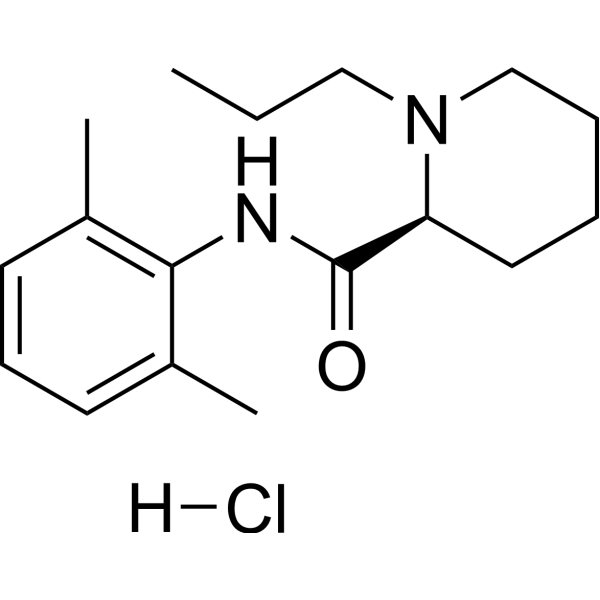
Ropivacaine hydrochloride
Based on 8 publication(s) in Google Scholar
Ropivacaine hydrochloride is a potent sodium channel blocker and blocks impulse conduction via reversible inhibition of sodium ion influx in nerve fibrese. Ropivacaine is also an inhibitor of K2P (two-pore domain potassium channel) TREK-1 with an IC50 of 402.7 μM in COS-7 cell's membrane. Ropivacaine is widely used for neuropathic pain management in vivo.
For research use only. We do not sell to patients.
- Purity : 99.49%
- CAS No.: 98717-15-8
- Formula: C17H27ClN2O
- Molecular Weight:310.86
-
Storage:
4°C, sealed storage, away from moisture
* In solvent : -80°C, 6 months; -20°C, 1 month (sealed storage, away from moisture)

To place orders, for customer services and technical support, please contact: MedChemExpress USA
Tel: 609-228-6898 E-mail: [email protected] [email protected]


-
 Biological Activity
-
Chemical Information
-
Solvent & Solubility
- Purity & Documentation
- References
-
 Help & FAQs


Publications Citing Use of MedChemExpress (MCE) Ropivacaine hydrochloride
More- J Exp Clin Cancer Res. 2024 Mar 25;43(1):90. [Abstract]
- Stem Cell Res Ther. 2021 Feb 4;12(1):107. [Abstract]
- Int Immunopharmacol. 2026 May 14:182:116838. [Abstract]
- Int J Neuropsychopharmacol. 2025 Oct 1;28(10):pyaf066. [Abstract]
- Eur Spine J. 2022 Nov;31(11):2960-2971. [Abstract]
- BMC Pregnancy Childbirth. 2025 Jun 2;25(1):646. [Abstract]
- In Vitro Cell Dev Biol Anim. 2024 Oct;60(9):1109-1120. [Abstract]
- J Toxicol Sci. 2023;48(3):139-148. [Abstract]


Biological Activity
Description
IC50 & Target
IC50: sodium ion influx[1]IC50: 402.7 μM (TREK-1 in COS-7 cell's membrane)[3]
In Vivo
Ropivacaine hydrochloride inhibits pressure-induced increases in filtration coefficient (Kf) without affecting pulmonary artery pressure (Ppa), pulmonary capillary pressures (Ppc), and zonal characteristics (ZC)[2].
Ropivacaine hydrochloride prevents pressure-induced lung edema and associated hyperpermeability as evidence by maintaining PaO2, lung wet-to-dry ratio and plasma volume in levels similar to sham rats[2].
Ropivacaine hydrochloride inhibits pressure-induced NO production as evidenced by decreased lung nitro-tyrosine content when compared to hypertensive lungs[2].
MedChemExpress (MCE) has not independently confirmed the accuracy of these methods. They are for reference only.
-
Animal Model:Adult Sprague-Dawley rats (300–400g)[2]
-
Dosage:1 μM
-
Administration:Infusion (added to the perfusate reservoir)
-
Result:Attenuated pressure-dependent increases in filtration coefficient (Kf).
Clinical Trial
| NCT Number | Sponsor | Condition | Start Date |
Phase

|
|---|---|---|---|---|
| NCT01329991 | Plexxikon| | 2011-05 | PHASE1 |


Chemical Information
-
CAS No. 98717-15-8
-
Appearance Solid
-
Molecular Weight 310.86
-
Formula C17H27ClN2O
-
Color White to off-white
-
SMILES
[H]Cl.O=C([C@H]1N(CCC)CCCC1)NC2=C(C)C=CC=C2C
-
Shipping
Room temperature in continental US; may vary elsewhere.
-
Storage
4°C, sealed storage, away from moisture
* In solvent : -80°C, 6 months; -20°C, 1 month (sealed storage, away from moisture)


Publications (8)
-
Journal Impact Factor
-
Most Recent
-
J Exp Clin Cancer Res
2024 Mar 25;43(1):90. PMID: 38523299 -
Stem Cell Res Ther
Local anesthetics impair the growth and self-renewal of glioblastoma stem cells by inhibiting ZDHHC15-mediated GP130 palmitoylation. [Abstract]2021 Feb 4;12(1):107. PMID: 33541421 -
Int Immunopharmacol
Exploring the mechanism of ropivacaine in alleviating neuropathic pain via the mTOR-PKM2/STAT3-H4K12 lactylation axis. [Abstract]2026 May 14:182:116838. PMID: 42134294 -
Int J Neuropsychopharmacol
Mechanism of the AMPK/SIRT1 pathway in gut dysbiosis-mediated postoperative cognitive dysfunction in aged mice. [Abstract]2025 Oct 1;28(10):pyaf066. PMID: 41031618 -
Eur Spine J
Effect of species, concentration and volume of local anesthetics on intervertebral disk degeneration in rats with discoblock. [Abstract]2022 Nov;31(11):2960-2971. PMID: 36152221 -
BMC Pregnancy Childbirth
KCNK2-mediated regulation of MMP-2/9 by PlGF influences uterine artery function in pregnancy-induced hypertension. [Abstract]2025 Jun 2;25(1):646. PMID: 40457264 -
In Vitro Cell Dev Biol Anim
Inhibition of FOXO3 ameliorates ropivacaine-induced nerve cell damage through the miR-126-5p/TRAF6 axis. [Abstract]2024 Oct;60(9):1109-1120. PMID: 39227495 -
J Toxicol Sci
Dexmedetomidine protects against Ropivacaine-induced neuronal pyroptosis via the Nrf2/HO-1 pathway. [Abstract]2023;48(3):139-148. PMID: 36858639


Solvent & Solubility
In Vitro:
DMSO : 10 mg/mL (32.17 mM; Need ultrasonic; Hygroscopic DMSO has a significant impact on the solubility of product, please use newly opened DMSO)
H2O : 10 mg/mL (32.17 mM; Need ultrasonic)
Please refer to the solubility information to select the appropriate solvent. Once prepared, please aliquot and store the solution to prevent product inactivation from repeated freeze-thaw cycles.
Storage method and period of stock solution: -80°C, 6 months; -20°C, 1 month (sealed storage, away from moisture). When stored at -80°C, please use it within 6 months. When stored at -20°C, please use it within 1 month.
* Note: If you choose water as the stock solution, please dilute it to the working solution, then filter and sterilize it with a 0.22 μm filter before use.
Please refer to the solubility information to select the appropriate solvent. Once prepared, please aliquot and store the solution to prevent product inactivation from repeated freeze-thaw cycles.
Storage method and period of stock solution: -80°C, 6 months; -20°C, 1 month (sealed storage, away from moisture). When stored at -80°C, please use it within 6 months. When stored at -20°C, please use it within 1 month.
* Note: If you choose water as the stock solution, please dilute it to the working solution, then filter and sterilize it with a 0.22 μm filter before use.
Concentration (start) × Volume (start) = Concentration (final) × Volume (final)
In Vivo:
Select the appropriate dissolution method based on your experimental animal and administration route.
- For the following dissolution methods, please ensure to first prepare a clear stock solution using an In Vitro approach and then sequentially add co-solvents:
- To ensure reliable experimental results, the clarified stock solution can be appropriately stored based on storage conditions. As for the working solution for In Vivo experiments, it is recommended to prepare freshly and use it on the same day.
- The percentages shown for the solvents indicate their volumetric ratio in the final prepared solution. If precipitation or phase separation occurs during preparation, heat and/or sonication can be used to aid dissolution.
Add each solvent one by one: 10% DMSO 40% PEG300 5% Tween-80 45% Saline
Solubility: ≥ 1 mg/mL (3.22 mM); Clear solution
This protocol yields a clear solution of ≥ 1 mg/mL (saturation unknown).
Taking 1 mL working solution as an example, add 100 μL DMSO stock solution (10.0 mg/mL) to 400 μL PEG300, and mix evenly; then add 50 μL Tween-80 and mix evenly; then add 450 μL Saline to adjust the volume to 1 mL.
Preparation of Saline: Dissolve 0.9 g sodium chloride in ddH₂O and dilute to 100 mL to obtain a clear Saline solution.
Add each solvent one by one: 10% DMSO 90% (20% SBE-β-CD in Saline)
Solubility: ≥ 1 mg/mL (3.22 mM); Clear solution
This protocol yields a clear solution of ≥ 1 mg/mL (saturation unknown).
Taking 1 mL working solution as an example, add 100 μL DMSO stock solution (10.0 mg/mL) to 900 μL 20% SBE-β-CD in Saline, and mix evenly.
Preparation of 20% SBE-β-CD in Saline (4°C, storage for one week): 2 g SBE-β-CD powder is dissolved in 10 mL Saline, completely dissolve until clear.
In Vivo Dissolution Calculator
Please enter the basic information of animal experiments:
-
-
-
-
Recommended: Prepare an additional quantity of animals to account for potential losses during experiments.
Please enter your animal formula composition:
-
%DMSO +
Recommended: Keep the proportion of DMSO in working solution below 2% if your animal is weak.
-
%+
-
+%Tween-80 + +
-
%Saline +
The co-solvents required include: DMSO, . All of co-solvents are available by MedChemExpress (MCE). , Tween 80. All of co-solvents are available by MedChemExpress (MCE).
Working solution concentration: 0.22 mg/mL
Method for preparing stock solution: mg drug dissolved in μL DMSO. Stock solution concentration: mg/mL. * In solvent : -80°C, 6 months; -20°C, 1 month (sealed storage, away from moisture)
1. Take μL DMSO stock solution;
2. Add μL .
μL , mix evenly;
3. Then add μL Tween 80, mix evenly;
4. Then add μL
Please ensure that the stock solution in the first step is dissolved to a clear state, and add co-solvents in sequence. You can use ultrasonic heating (ultrasonic cleaner, recommended frequency 20-40 kHz), vortexing, etc. to assist dissolution.


Purity & Documentation
-
Data Sheet (278 KB)
-
SDS (252 KB)
- English - EN (252 KB)
- Français - FR (252 KB)
- Deutsch - DE (252 KB)
- Norwegian - NO (252 KB)
- Español - ES (252 KB)
- Swedish - SV (252 KB)
- Italian - IT (252 KB)
- Korean - KR (252 KB)
- Portuguese - PT (252 KB)
-
Handling Instructions (2659 KB)
References
[1]. Dene Simpson, et al. Ropivacaine: a review of its use in regional anaesthesia and acute pain management. Drugs. 2005;65(18):2675-717. [Content Brief]
[2]. Li TF, et al. Epidural sustained release ropivacaine prolongs anti-allodynia and anti-hyperalgesia in developing and established neuropathic pain. PLoS One. 2015 Jan 24;10(1):e0117321. [Content Brief]
[3]. Hye Won Shin, et al. The inhibitory effects of bupivacaine, levobupivacaine, and ropivacaine on K2P (two-pore domain potassium) channel TREK-1. J Anesth. 2014 Feb;28(1):81-6. [Content Brief]
[4]. Milan Patel, et al. Ropivacaine Inhibits Pressure-Induced Lung Endothelial Hyperpermeability in Models of Acute Hypertension. Life Sci. 2019 Apr 1;222:22-28. [Content Brief]


Complete Stock Solution Preparation Table
Please refer to the solubility information to select the appropriate solvent. Once prepared, please aliquot and store the solution to prevent product inactivation from repeated freeze-thaw cycles.
Storage method and period of stock solution: -80°C, 6 months; -20°C, 1 month (sealed storage, away from moisture). When stored at -80°C, please use it within 6 months. When stored at -20°C, please use it within 1 month.
| Optional Solvent | Concentration Solvent Mass | 1 mg | 5 mg | 10 mg | 25 mg |
|---|---|---|---|---|---|
| DMSO / H2O | 1 mM | 3.2169 mL | 16.0844 mL | 32.1688 mL | 80.4221 mL |
| 5 mM | 0.6434 mL | 3.2169 mL | 6.4338 mL | 16.0844 mL | |
| 10 mM | 0.3217 mL | 1.6084 mL | 3.2169 mL | 8.0422 mL | |
| 15 mM | 0.2145 mL | 1.0723 mL | 2.1446 mL | 5.3615 mL | |
| 20 mM | 0.1608 mL | 0.8042 mL | 1.6084 mL | 4.0211 mL | |
| 25 mM | 0.1287 mL | 0.6434 mL | 1.2868 mL | 3.2169 mL | |
| 30 mM | 0.1072 mL | 0.5361 mL | 1.0723 mL | 2.6807 mL |
* Note: If you choose water as the stock solution, please dilute it to the working solution, then filter and sterilize it with a 0.22 μm filter before use.


Ropivacaine hydrochloride Related Classifications
HY-B0563B Related Classifications
 Powered by Bioz