



Humulone

Based on 1 Customer Validation
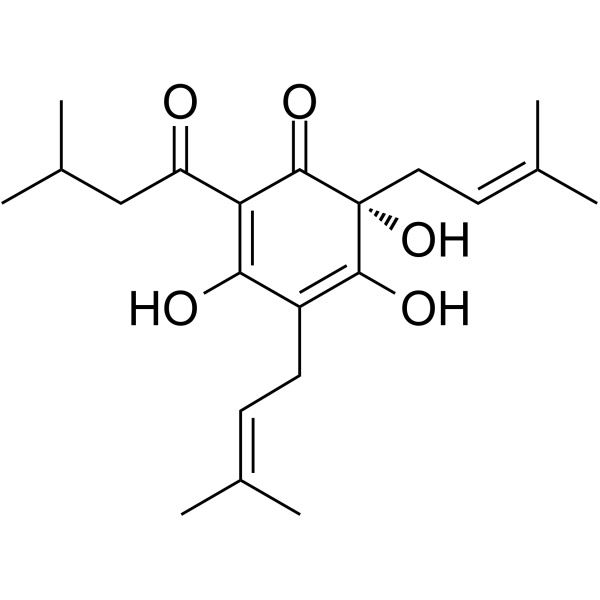
Humulone (α-Lupulic acid), a prenylated phloroglucinol derivative, is a potent cyclooxygenase-2 (COX-2) inhibitor. Humulone acts as a positive modulator of GABAA receptor at low micromolar concentrations. Humulone is an inhibitor of bone resorption. Humulone possesses antioxidant, anti-angiogenic and apoptosis-inducing properties.
For research use only. We do not sell to patients.
- Purity: 99.46%
- CAS No.: 26472-41-3
- Formula: C21H30O5
- Molecular Weight:362.46
-
Storage:
-20°C, protect from light
* In solvent : -80°C, 6 months; -20°C, 1 month (protect from light)

To place orders, for customer services and technical support, please contact: MedChemExpress USA
Tel: 609-228-6898 E-mail: [email protected] [email protected]


-
 Biological Activity
-
Chemical Information
-
Solvent & Solubility
- Purity & Documentation
- References
-
 Help & FAQs




Biological Activity
|
COX-2 |
Humulone (0.1, 1, 10, 100, 1000, 10000 nM; for 12 h) with with 10 ng/ml TNFα dose-dependently decreases the amount of released PGE2 with an IC50 of about 30 nM in MC3T3-E1 cells. Humulone reduces cyclooxygenase activity of the TNFK-treated cells[1].
Humulone (0.1-10000 nM; for 12 h) suppresses the TNFα-induced increase of cyclooxygenase-2 mRNA[1].
Humulone hardly affects the cyclooxygenase-1 activity below 10 μM, whereas inhibits the cyclooxygenase-2 activity with an IC50 of about 1.6 μM in MC3T3-E1 cells[1].
MedChemExpress (MCE) has not independently confirmed the accuracy of these methods. They are for reference only.
Humulone (10 μmol; applied topically to the dorsal shaved area) pre-treatment significantly inhibited TPA (10 nmol)-induced COX-2 expression in Female ICR mice (6-7 weeks of age) skin[3].
Humulone (1, 10 μmol; applied topical; pre-treatment 30 min) suppresses TPA-induced NF-κB DNA binding. Humulone attenuates TPA-stimulated nuclear translocation of p65 and p50 subunit proteins of NF-κB[3].
MedChemExpress (MCE) has not independently confirmed the accuracy of these methods. They are for reference only.
-
Animal Model:Male BALB/cAnNRj mice (9-11 weeks of age)[2]
-
Dosage:10 or 20 mg/kg
-
Administration:IP; pre-treatment before sodium pentobarbital (35 mg/kg; i.p.) and ethanol (3.5 g/kg)
-
Result:Significantly decreased the latency and prolonged the duration of sleep induced by pentobarbital at 20 mg/kg dose. These effects were not observed at a lower dose of 10 mg/kg.
Showed no effect on the onset of sleep induced by ethanol, but significantly increased sleep duration dose-dependently.


Chemical Information
-
CAS No. 26472-41-3
-
Appearance Oil
-
Molecular Weight 362.46
-
Formula C21H30O5
-
Color Light yellow to yellow
-
SMILES
C/C(C)=C/C[C@@]1(C(C(C(CC(C)C)=O)=C(O)C(C/C=C(C)\C)=C1O)=O)O
-
Synonyms
α-Lupulic acid
-
Structure Classification
-
Initial Source
-
Shipping
Room temperature in continental US; may vary elsewhere.
-
Storage
-20°C, protect from light
* In solvent : -80°C, 6 months; -20°C, 1 month (protect from light)


Solvent & Solubility
DMSO : 100 mg/mL (275.89 mM; Need ultrasonic; Hygroscopic DMSO has a significant impact on the solubility of product, please use newly opened DMSO)
Please refer to the solubility information to select the appropriate solvent. Once prepared, please aliquot and store the solution to prevent product inactivation from repeated freeze-thaw cycles.
Storage method and period of stock solution: -80°C, 6 months; -20°C, 1 month (protect from light). When stored at -80°C, please use it within 6 months. When stored at -20°C, please use it within 1 month.
Please refer to the solubility information to select the appropriate solvent. Once prepared, please aliquot and store the solution to prevent product inactivation from repeated freeze-thaw cycles.
Storage method and period of stock solution: -80°C, 6 months; -20°C, 1 month (protect from light). When stored at -80°C, please use it within 6 months. When stored at -20°C, please use it within 1 month.
Concentration (start) × Volume (start) = Concentration (final) × Volume (final)
Select the appropriate dissolution method based on your experimental animal and administration route.
- For the following dissolution methods, please ensure to first prepare a clear stock solution using an In Vitro approach and then sequentially add co-solvents:
- To ensure reliable experimental results, the clarified stock solution can be appropriately stored based on storage conditions. As for the working solution for In Vivo experiments, it is recommended to prepare freshly and use it on the same day.
- The percentages shown for the solvents indicate their volumetric ratio in the final prepared solution. If precipitation or phase separation occurs during preparation, heat and/or sonication can be used to aid dissolution.
Add each solvent one by one: 10% DMSO 40% PEG300 5% Tween-80 45% Saline
Solubility: ≥ 2.5 mg/mL (6.90 mM); Clear solution
This protocol yields a clear solution of ≥ 2.5 mg/mL (saturation unknown).
Taking 1 mL working solution as an example, add 100 μL DMSO stock solution (25.0 mg/mL) to 400 μL PEG300, and mix evenly; then add 50 μL Tween-80 and mix evenly; then add 450 μL Saline to adjust the volume to 1 mL.
Preparation of Saline: Dissolve 0.9 g sodium chloride in ddH₂O and dilute to 100 mL to obtain a clear Saline solution.
Please enter the basic information of animal experiments:
-
-
-
-
Recommended: Prepare an additional quantity of animals to account for potential losses during experiments.
Please enter your animal formula composition:
-
%DMSO +
Recommended: Keep the proportion of DMSO in working solution below 2% if your animal is weak.
-
%+
-
+%Tween-80 + +
-
%Saline +
The co-solvents required include: DMSO, . All of co-solvents are available by MedChemExpress (MCE). , Tween 80. All of co-solvents are available by MedChemExpress (MCE).
Working solution concentration: 0.22 mg/mL
Method for preparing stock solution: mg drug dissolved in μL DMSO. Stock solution concentration: mg/mL. * In solvent : -80°C, 6 months; -20°C, 1 month (protect from light)
1. Take μL DMSO stock solution;
2. Add μL .
μL , mix evenly;
3. Then add μL Tween 80, mix evenly;
4. Then add μL
Please ensure that the stock solution in the first step is dissolved to a clear state, and add co-solvents in sequence. You can use ultrasonic heating (ultrasonic cleaner, recommended frequency 20-40 kHz), vortexing, etc. to assist dissolution.


Purity & Documentation
-
Data Sheet (276 KB)
-
SDS (252 KB)
- English - EN (252 KB)
- Français - FR (252 KB)
- Deutsch - DE (252 KB)
- Norwegian - NO (252 KB)
- Español - ES (252 KB)
- Swedish - SV (252 KB)
- Italian - IT (252 KB)
- Korean - KR (252 KB)
- Portuguese - PT (252 KB)
-
Handling Instructions (2659 KB)
References
[1]. K Yamamoto, et al. Suppression of cyclooxygenase-2 gene transcription by humulon of beer hop extract studied with reference to glucocorticoid. FEBS Lett. 2000 Jan 14;465(2-3):103-6. [Content Brief]
[2]. Ali Y Benkherouf, et al. Humulone Modulation of GABA A Receptors and Its Role in Hops Sleep-Promoting Activity. Front Neurosci. 2020 Oct 14;14:594708. [Content Brief]
[3]. Jung-Chul Lee, et al. Humulone inhibits phorbol ester-induced COX-2 expression in mouse skin by blocking activation of NF-kappaB and AP-1: IkappaB kinase and c-Jun-N-terminal kinase as respective potential upstream targets. Carcinogenesis. 2007 Jul;28(7): [Content Brief]


Complete Stock Solution Preparation Table
Please refer to the solubility information to select the appropriate solvent. Once prepared, please aliquot and store the solution to prevent product inactivation from repeated freeze-thaw cycles.
Storage method and period of stock solution: -80°C, 6 months; -20°C, 1 month (protect from light). When stored at -80°C, please use it within 6 months. When stored at -20°C, please use it within 1 month.
| Optional Solvent | Concentration Solvent Mass | 1 mg | 5 mg | 10 mg | 25 mg |
|---|---|---|---|---|---|
| DMSO | 1 mM | 2.7589 mL | 13.7946 mL | 27.5893 mL | 68.9731 mL |
| 5 mM | 0.5518 mL | 2.7589 mL | 5.5179 mL | 13.7946 mL | |
| 10 mM | 0.2759 mL | 1.3795 mL | 2.7589 mL | 6.8973 mL | |
| 15 mM | 0.1839 mL | 0.9196 mL | 1.8393 mL | 4.5982 mL | |
| 20 mM | 0.1379 mL | 0.6897 mL | 1.3795 mL | 3.4487 mL | |
| 25 mM | 0.1104 mL | 0.5518 mL | 1.1036 mL | 2.7589 mL | |
| 30 mM | 0.0920 mL | 0.4598 mL | 0.9196 mL | 2.2991 mL | |
| 40 mM | 0.0690 mL | 0.3449 mL | 0.6897 mL | 1.7243 mL | |
| 50 mM | 0.0552 mL | 0.2759 mL | 0.5518 mL | 1.3795 mL | |
| 60 mM | 0.0460 mL | 0.2299 mL | 0.4598 mL | 1.1496 mL | |
| 80 mM | 0.0345 mL | 0.1724 mL | 0.3449 mL | 0.8622 mL | |
| 100 mM | 0.0276 mL | 0.1379 mL | 0.2759 mL | 0.6897 mL |


Humulone Related Classifications
HY-N6084 Related Classifications
 Powered by Bioz