7 Results for "

CAM assay

" in MedChemExpress (MCE) Product Catalog:
Products (7)

7 Results for "CAM assay" in MCE Product Catalog:

Cat. No.: HY-119443
CAS No.: 79778-41-9
Purity:  ≥98.0%
Target:  

Apoptosis

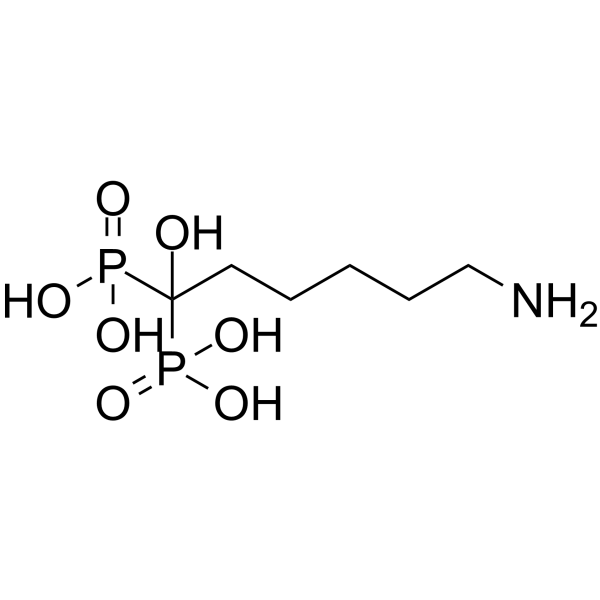
Neridronate is a bisphosphonate. Bisphosphonates initiate the Apoptotic process. Neridronate sodium reduces the levels of bone resorption, bone turnover markers, the degree of back pain, and the risk of fractures. Neridronate inhibits capillary tube formation. Neridronate itself has weak anticancer activity, but liposomal encapsulation enhances this activity. Neridronate can be used in research related to demineralizing metabolic bone diseases, thalassemia-associated osteoporosis, chronic inflammatory diseases, cancer, and osteogenesis imperfecta .
loading...
    loading...
Cat. No.: HY-108303
CAS No.: 80729-79-9
Neridronate sodium is a bisphosphonate. Bisphosphonates initiate the Apoptotic process. Neridronate sodium reduces the levels of bone resorption, bone turnover markers, the degree of back pain, and the risk of fractures. Neridronate sodium inhibits capillary tube formation. Neridronate sodium itself has weak anticancer activity, but liposomal encapsulation enhances this activity. Neridronate sodium can be used in research related to demineralizing metabolic bone diseases, thalassemia-associated osteoporosis, chronic inflammatory diseases, cancer, and osteogenesis imperfecta .
loading...
    loading...
Cat. No.: HY-119443R
CAS No.: 79778-41-9
Neridronate (Standard) is the analytical standard of Neridronate (HY-119443). This product is intended for research and analytical applications. Neridronate is a bisphosphonate. Bisphosphonates initiate the Apoptotic process. Neridronate sodium reduces the levels of bone resorption, bone turnover markers, the degree of back pain, and the risk of fractures. Neridronate inhibits capillary tube formation. Neridronate itself has weak anticancer activity, but liposomal encapsulation enhances this activity. Neridronate can be used in research related to demineralizing metabolic bone diseases, thalassemia-associated osteoporosis, chronic inflammatory diseases, cancer, and osteogenesis imperfecta .
loading...
    loading...
Cat. No.: HY-P992253

Research Areas:  

Inflammation/Immunology

Anti-L1-CAM Antibody is a monoclonal antibody that targets L1-CAM. It can be used in ELISA, FACS, and functional assays. For isotype controls of Anti-L1-CAM Antibody, please refer to Human IgG1 kappa, Isotype Control (HY-P99001).
loading...
    loading...
Cat. No.: HY-181009
CAS No.: 3124773-51-6
Target:  

HDAC Apoptosis Autophagy

Research Areas:  

Cancer

HDAC-IN-98 is a HDAC1, HDAC2, HDAC3 inhibitor (one of the most selective class I HDAC inhibitors) with human IC50 values of 41.2 nM, 52.5 nM, and 74.3 nM respectively. HDAC-IN-98 induces H3K9 acetylation, p21 upregulation, G2/M arrest, cell apoptosis, has strong antiproliferative effects in colorectal cancer cells, low toxicity in healthy colon epithelium, modulates short-term in vitro effects via autophagy, and shows strong antitumor efficacy in vivo in the chorioallantoic membrane model (CAM) assay. HDAC-IN-98 can be used for the research of colorectal cancer .
loading...
    loading...
Cat. No.: HY-181775
Target:  

VEGFR c-Met/HGFR EGFR

Research Areas:  

Cardiovascular Disease

VEGFR-2/c-Met/EGFR-IN-1 is a VEGFR-2/c-Met/EGFR inhibitor with IC50 values of 0.014 μM, 0.072 μM, and 0.94 μM, respectively. c-Met-IN-27 inhibits neovascularization in the chick chorioallantoic membrane (CAM) assay and exhibits in vivo anti-angiogenic activity. c-Met-IN-27 can be used in angiogenesis-related research .
loading...
    loading...
Cat. No.: HY-181776
Target:  

c-Met/HGFR VEGFR EGFR

Research Areas:  

Cancer

c-Met-IN-31 is a c-Met inhibitor with an IC50 value of 0.021 μM. c-Met-IN-31 also inhibits VEGFR-2 and EGFR activities, with IC50 values ​​of 0.32 μM and 9.3 μM, respectively. c-Met-IN-31 inhibits cancer cell proliferation. c-Met-IN-31 suppresses neovascularization in the chick chorioallantoic membrane (CAM) assay, exhibiting in vivo anti-angiogenic activity. c-Met-IN-31 can be used in research related to breast cancer and lung cancer .
loading...
    loading...

