1. Search Result
Search Result
Results for "

CD1 mouse

" in MedChemExpress (MCE) Product Catalog:

18

Inhibitors & Agonists

1

Peptides

7

Inhibitory Antibodies

4

Recombinant Proteins

Cat. No. Product Name Target Research Areas Chemical Structure
  • HY-121835

    GCGR Metabolic Disease
    GLP-1R agonist 2 (compound 2) is an effective GLP-1R agonist that exerts its activating effect by forming hydrogen bonds with the Tyr42, Cys71, and Ser84 residues of GLP-1R. GLP-1R agonist 2 has the potential for research in metabolic diseases such as type 2 diabetes and obesity .
    GLP-1R agonist 2
  • HY-P990273

    CD38 ERK CD1 Apoptosis Inflammation/Immunology Cancer
    Anti-Mouse CD38 Antibody (NIMR5) is an anti-mouse CD38 IgG2a monoclonal antibody. Anti-Mouse CD38 Antibody (NIMR5) can activate the ERK signaling pathway and promote cell apoptosis. Anti-Mouse CD38 Antibody (NIMR5) can restore T cell function. Anti-Mouse CD38 Antibody (NIMR5) upregulates the expression of CD1d protein and enhances spleen cell proliferation, dendritic cell (DC) and natural killer T cell (NKT) expansion. Anti-Mouse CD38 Antibody (NIMR5) can be used for researches on cancer and immunology such as melanoma and colon cancer .
    Anti-Mouse CD38 Antibody (NIMR5)
  • HY-153508

    Chloride Channel Others
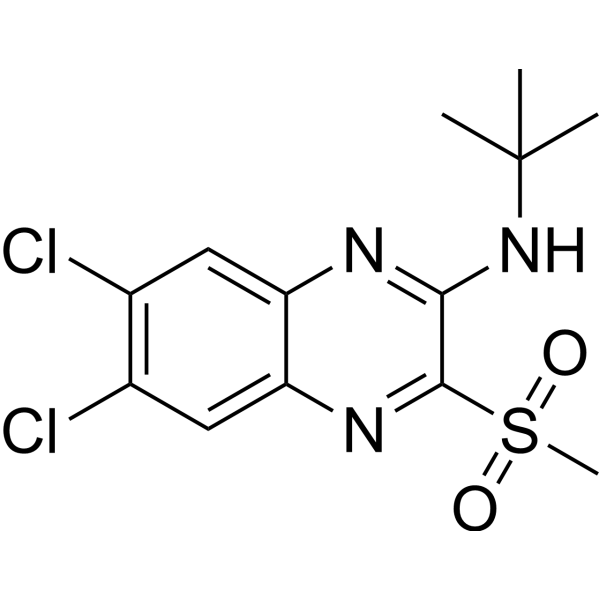
    ANO1-IN-4 (Compound 10bm) is a reversible inhibitor for calcium-activated chloride channel transmembrane protein 16A (TMEM16A, also known as ANO1) with an IC50 of 0.030 µM. ANO1-IN-4 exhibits good metabolic stability in rat liver microsomes. ANO1-IN-4 inhibits spontaneous contraction in mouse isolated ileum .
    ANO1-IN-4
  • HY-162484

    SARS-CoV Virus Protease Infection
    GZNL-P36 is an orally active inhibitor for SARS-CoV-2 papain-like protease (PL pro), with an IC50 of 6.45 nM. GZNL-P36 inhibits SARS-CoV and its variants with EC50 range from 58.2 nM to 2.66 μM. GZNL-P36 exhibits a peak plasma concentration Cmax of 549 ng/mL, a half-life T1/2 of 1.45 h and a bioavailability of 74.7% in CD-1 mouse. GZNL-P36 exhibits antiviral activity in SARS-CoV-2 XXB.1 infection in mouse .
    GZNL-P36
  • HY-P990287

    CD1 Inflammation/Immunology
    Anti-Mouse CD1d Antibody (19G11) is a rat-derived IgG1 type antibody inhibitor, targeting to mouse CD1d. Anti-Mouse CD1d Antibody (19G11) can neutralize CD1d and inhibit the activation of invariant natural killer T (iNKT) cells. Anti-Mouse CD1d Antibody (19G11) can be used for the researches of inflammation and immunology, such as colitis .
    Anti-Mouse CD1d Antibody (19G11)
  • HY-163673

    Glucocorticoid Receptor Drug-Linker Conjugates for ADC Inflammation/Immunology
    Glucocorticoid receptor modulator 4 (Compound DL5) is a conjugate of a linker and a glucocorticoid receptor modulator. Glucocorticoid receptor modulator 4 exhibits GRE Reporter activity in mTNF expressing K562 cell with an EC50 of 40 μM. Glucocorticoid receptor modulator 4 binds with an anti-tumor necrosis factor (TNF) antibody, and exhibits anti-inflammtory activity against arthritis in mouse models .
    Glucocorticoid receptor modulator 4
  • HY-162492

    Influenza Virus Infection
    Influenza A virus-IN-14 (Compound 37) is an inhibitor for influenza virus type A (IAV), which inhibits H1N1 with an EC50 of 23 nM. Influenza A virus-IN-14 exhibits low cytotoxicity with CC50 of more than 100 μM. Influenza A virus-IN-14 inhibits cytopathic effect and improves the survival rates of cell Calu3. Influenza A virus-IN-14 exhibits synergistic activity with the neuraminidase inhibitor Oseltamivir (HY-13317). Influenza A virus-IN-14 exhibits poor pharmacokinetic properties in CD-1 mouse .
    Influenza A virus-IN-14
  • HY-170832

    Epigenetic Reader Domain Potassium Channel Cancer
    Menin–KMT2A-IN-1 (Compound 20) is the inhibitor for menin–KMT2A that binds to menin with an IC50 of 8 nM, and inhibits the interaction between menin and lysine methyltransferase 2A (KMT2A). Menin–KMT2A-IN-1 inhibits hERG with an IC50 of 65 μM. Menin–KMT2A-IN-1 inhibits cell MV4-11 with an IC50 of 74 nM. Menin–KMT2A-IN-1 exhibits good pharmacokinetic characteristics in CD-1 mouse with an orally bioavailability of 74% .
    Menin–KMT2A-IN-1
  • HY-P990807

    CD1 Infection Inflammation/Immunology Cancer
    Anti-Mouse CD1d Antibody (20H2 (HB323)) is a rat-derived IgG1 κ type antibody inhibitor, targeting to mouse CD1d. Anti-Mouse CD1d Antibody (20H2 (HB323)) can block CD1d and neutralize invariant natural killer T (iNKT) cells. Anti-Mouse CD1d Antibody (20H2 (HB323)) can be used for the researches of cancer, infection, inflammation and immunology, such as melanoma, L. monocytogenes infection and arthritis .
    Anti-Mouse CD1d Antibody (20H2 (HB323))
  • HY-170497

    EGFR Cancer
    EGFR-IN-140 (Compound 31) is the inhibitor for EGFR, that inhibits EGFR wildtype and EGFR L858R/T790M/C797S mutant with Ki of 0.95 nM and 2.1 nM, and inhibits EGFR del19/T790M/C797S in Ba/F3 with an IC50 of 56.9 nM. EGFR-IN-140 exhibits antitumor efficacy in mouse model .
    EGFR-IN-140
  • HY-P991846

    CD1 Inflammation/Immunology
    Anti-CD1d Antibody (D5) reacts with the human CD1d. CD1d belongs to the cluster of differentiation 1 (CD1) family of glycoproteins. Recommend Isotype Controls: Mouse IgG2b kappa, Isotype Control (HY-P99982) .
    Anti-CD1d Antibody (D5)
  • HY-170503

    Methionine Adenosyltransferase (MAT) Cancer
    MAT2A-IN-20 (Compound A49) is an inhibitor for methionine adenosyltransferase 2A (MAT2A) with an IC50 ≤50 nM. MAT2A-IN-20 inhibits human UGT1A1 with an IC50 of 28.45 μM. MAT2A-IN-20 exhibits antitumor in mouse models .
    MAT2A-IN-20
  • HY-170523

    SARS-CoV DNA Methyltransferase Infection
    RU-0415529 is an orally active inhibitor for SARS-CoV-2 nonstructural protein 14 (NSP14) with an IC50 of 356 nM. RU-0415529 binds to the SAH-stabilized cap binding pocket, inhibits viral RNA methylation and the viral replication. RU-0415529 exhibits anti-infectious activity in mouse models .
    RU-0415529
  • HY-P5813

    β-TRTX-CD1a; β-Theraphotoxin-CD1a

    Calcium Channel Neurological Disease
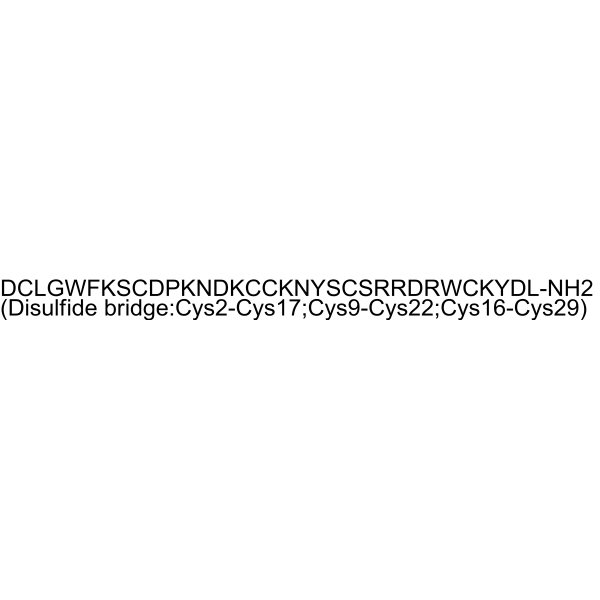
    Cd1a is a β-toxin derived from the African spider Ceratogyrus darlingi. Cd1a can regulate calcium ion channels. Cd1a inhibits human calcium ion channels (Cav2.2)(IC502.6 μM) and mouse sodium ion channels (Nav1.7). Cd1a can be used in the development of peripheral pain treatment drugs .
    Cd1a
  • HY-P990869

    CD1 IFNAR Interleukin Related Inflammation/Immunology Cancer
    Anti-CD1a Antibody (OKT-6) is an anti-human CD1a IgG1 monoclonal antibody. Anti-CD1a Antibody (OKT-6) blocks T cell activation by blocking CD1a function. Anti-CD1a Antibody (OKT-6) can reduce the production of IFN-γ. Anti-CD1a Antibody (OKT-6) can be used for researches on cancer and inflammation such as leukemia. The recommend isotype control of Anti-CD1a Antibody (OKT-6): Mouse IgG1 kappa, Isotype Control (HY-P99977) .
    Anti-CD1a Antibody (OKT-6)
  • HY-P992059

    CD1 Cancer
    Anti-Mouse CD1d Antibody (1B1) is an antibody targeting mouse CD1d (Kd=12.5 nM). By inserting into the lipid-binding groove of CD1d, Anti-Mouse CD1d Antibody (1B1) overlaps with the binding sites of type I and type II NKT cell receptors (TCR), thereby effectively blocking TCR-mediated interactions. Anti-Mouse CD1d Antibody (1B1) activates antigen-presenting cells such as dendritic cells and macrophages, induces them to release IL-12p70, and increases the levels of key cytokines including IL-12, IFN-γ and IFN-α in mouse serum. Anti-Mouse CD1d Antibody (1B1) can be used in studies related to renal cancer, breast cancer and colon adenocarcinoma. When combined with anti-DR5 or anti-CD137 antibodies and chemotherapeutic drugs, Anti-Mouse CD1d Antibody (1B1) exhibits significant tumor inhibitory and even eradication effects in mice .
    Anti-Mouse CD1d Antibody (1B1)
  • HY-P991890

    CD1 Inflammation/Immunology
    Anti-CD1a Antibody is an antibody against human CD1a. Recommend Isotype Controls:?Mouse IgG1 kappa, Isotype Control (HY-P99977).
    Anti-CD1a Antibody
  • HY-183557

    OGA Neurological Disease
    O-GlcNAcase-IN-6 is an orally active, blood-brain barrier-permeable O-GlcNAcase (OGA) inhibitor with an IC50 of 5.4 nM. O-GlcNAcase-IN-6 inhibits OGA activity, thereby increasing the level of O-GlcNAc glycosylation in brain tissues. O-GlcNAcase-IN-6 can be used for the research of Alzheimer's disease .
    O-GlcNAcase-IN-6

Inquiry Online

Your information is safe with us. * Required Fields.

Salutation


Country or Region *

Applicant Name *


Organization Name *

Department *


Email Address *


Product Name *

Cat. No.


Requested quantity *

Phone Number *


Remarks

Inquiry Online

Inquiry Information

Product Name:
Cat. No.:
Quantity:
MCE Japan Authorized Agent:

