
Search Result
Results for "
Hemocyanin
" in MedChemExpress (MCE) Product Catalog:
17
Biochemical Assay Reagents
| Cat. No. |
Product Name |
Target |
Research Areas |
Chemical Structure |
-
- HY-P2853
-
|
|
p38 MAPK
Reactive Oxygen Species (ROS)
Bacterial
Fungal
|
Infection
Inflammation/Immunology
Cancer
|
|
Hemocyanin is an extracellular giant copper-containing glycoprotein. Hemocyanin can be found in the hemolymph of both mollusk and arthropod. Hemocyanin is responsible for oxygen transport. Hemocyanin is also involved in several physiological processes, such as energy storage, osmoregulation, molt cycle and exoskeleton formation. Hemocyanin in shrimp can enhance its immune response by modulating the p38 MAPK pathway. Hemocyanin from Penaeus monodon could act as an antiviral agent against a variety of viruses including DNA and RNA viruses. Hemocyanin from horseshoe crab Carcinoscorpius rotundicauda could possess a strong antimicrobial defense by the production of ROS activated with microbial proteases. Hemocyanin from L. vannamei would be effective against cervical cancer cell growth .
|
-
-
- HY-NP133A
-
|
4-Hydroxy-3-nitrophenylacetyl-Keyhole Limpet Hemocyanin,Type II
|
Biochemical Assay Reagents
|
Inflammation/Immunology
|
|
NP-KLH,Type II is a complex formed by 4-Hydroxy-3-nitrophenylacetyl (NP, a hapten) with Keyhole Limpet Hemocyanin (KLH, a carrier protein). NP-KLH,Type II can induce specific humoral immune responses and NP-specific antibodies production. NP-KLH,Type II can act as a specific antigen tool used for immunological experiments .
|
-
-
- HY-P99451
-
-
-
- HY-161543
-
|
|
Biochemical Assay Reagents
|
Inflammation/Immunology
|
|
DHT/KLH is a conjugate of DHT (dihydrotestosterone) and keyhole limpet hemocyanin (KLH). By conjugating the antigen with a protein adjuvant, the production of antigen-specific antibodies in vaccine models can be enhanced. The conjugate does not affect protein folding or disrupt linear epitopes, and it can enhance cross-presentation and the generation of antigen-specific T cells.
|
-
-
- HY-NP028
-
-
-
- HY-161553
-
|
|
Biochemical Assay Reagents
|
Inflammation/Immunology
|
|
Biotin/KLH is an antigen-adjuvant conjugate that consists of Biotin and Keyhole Limpet Hemocyanin (KLH). By conjugating the antigen with a protein adjuvant, the production of antigen-specific antibodies in vaccine models can be enhanced. The conjugate does not affect protein folding or disrupt major epitopes, and it can enhance cross-presentation and the generation of antigen-specific T cells.
|
-
-
- HY-P11189
-
|
|
Bacterial
|
Infection
|
|
Astacidin 1 is an antibacterial peptide. Astacidin 1 can be produced by a proteolytic cleavage from hemocyanin under acidic conditions. Astacidin 1 has broad-spectrum antibacterial activity against both Gram-positive and Gram-negative bacteria .
|
-
-
- HY-161526
-
|
|
Biochemical Assay Reagents
|
Inflammation/Immunology
|
|
T3/KLH is an antigen-adjuvant conjugate formed by the coupling of T3 (thyroid hormone) with keyhole limpet hemocyanin (KLH). By coupling the antigen with the protein adjuvant, the production of antigen-specific antibodies in vaccine models can be enhanced. The conjugate does not affect protein folding or disrupt major epitopes, and it can enhance cross-presentation and the generation of antigen-specific T cells.
|
-
-
- HY-P2853A
-
|
|
Biochemical Assay Reagents
|
Others
|
|
Hemocyanin-SMCC is a hemocyanin that can be used as a carrier protein to couple low molecular weight molecules such as peptides, nucleic acids, drugs or toxins to make them highly immunogenic.
|
-
-
- HY-P10250
-
|
|
HIV
|
Inflammation/Immunology
|
|
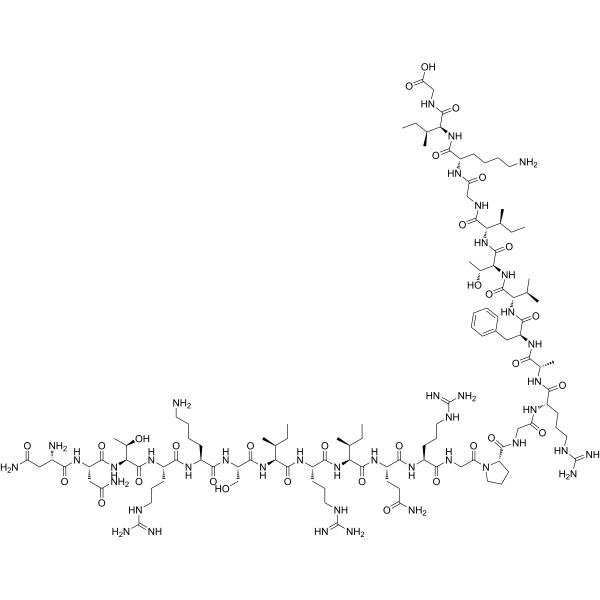
HIV gp120 308-331 is HIV antigen fragments, that conjugates with keyhole limpet hemocyanin (KLH) and generates specific anti-HIV antibody .
|
-
-
- HY-P10252
-
|
|
HIV
|
Inflammation/Immunology
|
|
HIV gp120 421-438 is HIV antigen fragments, that conjugates with keyhole limpet hemocyanin (KLH) and generates specific anti-HIV antibody .
|
-
-
- HY-157185
-
|
MPPEE acid
|
Biochemical Assay Reagents
|
Others
|
|
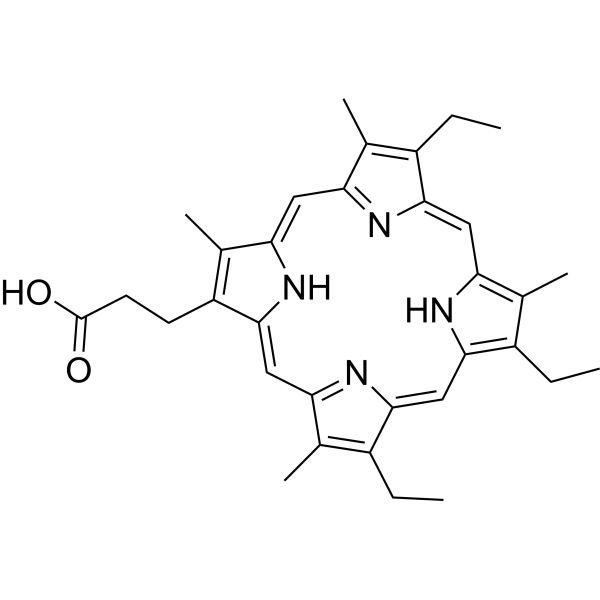
Methylpyrroporphyrin XXI acid is a hapten that can be coupled with bovine serum albumin and keyhole limpet hemocyanin. Methylpyrroporphyrin XXI acid can target porphyrin with IC50 of 1.3 μM .
|
-
-
- HY-P5334A
-
|
|
Tau Protein
|
Neurological Disease
|
|
AADvac 1 TFA is an active tau peptide vaccine for Alzheimer's disease research. AADvac 1 TFA is composed of a regulatory peptide 294KDNIKHVPGGGS 305 that drives tau oligomerization conjugated to Aplysia hemocyanin (KLH) and formulated with aluminum hydroxide .
|
-
-
- HY-161548
-
|
|
Biochemical Assay Reagents
|
Inflammation/Immunology
|
|
Metronidazole/KLH is a conjugate of Metronidazole (HY-B0318) and Keyhole Limpet Hemocyanin (KLH). By conjugating the antigen with the protein adjuvant, the production of antigen-specific antibodies in vaccine models can be enhanced. The conjugate does not affect protein folding or disrupt major epitopes and can enhance cross-presentation and the generation of antigen-specific T cells.
|
-
-
- HY-161555
-
|
|
Biochemical Assay Reagents
|
Inflammation/Immunology
|
|
Clenbuterol/KLH is an antigen-adjuvant conjugate of Clenbuterol (HY-B1615) and Keyhole Limpet Hemocyanin (KLH). By conjugating the antigen with a protein adjuvant, the production of antigen-specific antibodies in vaccine models can be enhanced. The conjugate does not affect protein folding or disrupt major epitopes, and it can enhance cross-presentation and the generation of antigen-specific T cells.
|
-
-
- HY-161558
-
|
|
Biochemical Assay Reagents
|
Inflammation/Immunology
|
|
Ractopamine/KLH is an antigen-adjuvant conjugate of Ractopamine (HY-113781) and Keyhole Limpet Hemocyanin (KLH). By conjugating the antigen with a protein adjuvant, the production of antigen-specific antibodies in vaccine models can be enhanced. The conjugate does not affect protein folding or disrupt major epitopes, and it can enhance cross-presentation and the production of antigen-specific T cells.
|
-
-
- HY-161546
-
|
|
Biochemical Assay Reagents
|
Inflammation/Immunology
|
|
Melamine/KLH is an antigen-adjuvant conjugate formed by coupling Melamine (HY-Y1117) with Keyhole Limpet Hemocyanin (KLH). By conjugating the antigen with a protein adjuvant, the production of antigen-specific antibodies in vaccine models can be enhanced. The conjugate does not affect protein folding or disrupt the primary epitopes, and can enhance cross-presentation and the generation of antigen-specific T cells.
|
-
-
- HY-161589
-
|
|
Biochemical Assay Reagents
|
Inflammation/Immunology
|
|
GABA/KLH is an antigen-adjuvant conjugate formed by the coupling of GABA (γ-aminobutyric acid) with keyhole limpet hemocyanin (KLH). By coupling the antigen with a protein adjuvant, it can enhance the production of antigen-specific antibodies in vaccine models. The conjugate does not affect protein folding or disrupt major epitopes, and it can enhance cross-presentation and the generation of antigen-specific T cells.
|
-
-
- HY-161585
-
|
|
Biochemical Assay Reagents
|
Inflammation/Immunology
|
|
Diethylstilbestrol/KLH is an antigen-adjuvant conjugate formed by the coupling of Diethylstilbestrol (HY-14598) with Keyhole Limpet Hemocyanin (KLH). By conjugating the antigen with a protein adjuvant, the production of antigen-specific antibodies in vaccine models can be enhanced. The conjugate does not affect protein folding or disrupt major epitopes, and it can enhance cross-presentation and the generation of antigen-specific T cells.
|
-
-
- HY-161556
-
|
|
Biochemical Assay Reagents
|
Inflammation/Immunology
|
|
Alginic acid/KLH is an antigen-adjuvant conjugate formed by the coupling of Alginic acid (HY-W127758) with Keyhole Limpet Hemocyanin (KLH). By conjugating the antigen with the protein adjuvant, the production of antigen-specific antibodies in vaccine models can be enhanced. The conjugate does not affect protein folding or disrupt major epitopes, and it can enhance cross-presentation and the generation of antigen-specific T cells.
|
-
-
- HY-161584
-
|
|
Biochemical Assay Reagents
|
Inflammation/Immunology
|
|
Sudan I/KLH is an antigen-adjuvant conjugate formed by the coupling of Sudan I (HY-D0024) with Keyhole Limpet Hemocyanin (KLH). By conjugating the antigen with a protein adjuvant, the production of antigen-specific antibodies in vaccine models can be enhanced. The conjugate does not affect protein folding or disrupt major epitopes, and it can enhance cross-presentation and the generation of antigen-specific T cells.
|
-
-
- HY-161551
-
|
|
Biochemical Assay Reagents
|
Inflammation/Immunology
|
|
25-OH Vitamin D3/KLH is an antigen-adjuvant conjugate of 25-OH Vitamin D3 (HY-158285) and Keyhole Limpet Hemocyanin (KLH). By conjugating the antigen with the protein adjuvant, the production of antigen-specific antibodies in vaccine models can be enhanced. The conjugate does not affect protein folding or disrupt major epitopes, and it can enhance cross-presentation and the generation of antigen-specific T cells.
|
-
-
- HY-P11472
-
|
|
Biochemical Assay Reagents
|
Inflammation/Immunology
|
|
Keratin K18-C is a phosphopeptide corresponding to amino acids 26-38 of human K18, with a cysteine residue added at the end for coupling. Keratin K18-C can be coupled to Keyhole limpet hemocyanin via m-maleimidobenzoyl-N-hydroxysuccinimide ester .
|
-
-
- HY-178885
-
|
|
Biochemical Assay Reagents
Drug Intermediate
|
Inflammation/Immunology
|
|
(S)-4-(4-(2-(Methylamino)propyl)phenoxy)butanoic acid (TFA) (Compound H1) is a Methamphetamine hapten.(S)-4-(4-(2-(Methylamino)propyl)phenoxy)butanoic acid (TFA) can be coupled to the BSA, Keyhole limpet hemocyanin molecule. The immunoconjugate H1-KLH strongly induces an antibody response .
|
-
-
- HY-120116
-
|
|
PI3K
Akt
|
Inflammation/Immunology
|
|
AM-8508 is an orally bioactive PI3Kδ inhibitor with an IC50 of 0.016 μM. AM-8508 selectively inhibits PI3Kδ, thereby blocking AKT phosphorylation mediated by the B cell receptor. AM-8508 suppresses the formation of antigen-specific IgG and IgM in rats immunized with keyhole limpet hemocyanin. AM-8508 can be used for the research of inflammatory diseases .
|
-
-
- HY-106901B
-
|
HI-6 dimesylate
|
Cholinesterase (ChE)
nAChR
|
Neurological Disease
|
|
Asoxime dimesylate (HI-6 dimesylate) is an orally active thiosemicarbazone-based antidote. Asoxime dimesylate is a reversible inhibitor of AChE, and its core mechanism of action is to re-activate AChE inhibited by nerve toxins, thereby restoring the cholinergic nerve function. Asoxime dimesylate significantly restores the function of poisoned muscles without reactivating AChE. Asoxime dimesylate is an antagonist of acetylcholine receptors (AChRs), including nicotinic receptor and α7 nAChR. Asoxime dimesylate can serve as an effective immunomodulator, improving the immune effect of the nervous system .
|
-
| Cat. No. |
Product Name |
Type |
-
- HY-P2853
-
|
|
Biochemical Assay Reagents
|
|
Hemocyanin is an extracellular giant copper-containing glycoprotein. Hemocyanin can be found in the hemolymph of both mollusk and arthropod. Hemocyanin is responsible for oxygen transport. Hemocyanin is also involved in several physiological processes, such as energy storage, osmoregulation, molt cycle and exoskeleton formation. Hemocyanin in shrimp can enhance its immune response by modulating the p38 MAPK pathway. Hemocyanin from Penaeus monodon could act as an antiviral agent against a variety of viruses including DNA and RNA viruses. Hemocyanin from horseshoe crab Carcinoscorpius rotundicauda could possess a strong antimicrobial defense by the production of ROS activated with microbial proteases. Hemocyanin from L. vannamei would be effective against cervical cancer cell growth .
|
-
- HY-NP133A
-
|
4-Hydroxy-3-nitrophenylacetyl-Keyhole Limpet Hemocyanin,Type II
|
Biochemical Assay Reagents
|
|
NP-KLH,Type II is a complex formed by 4-Hydroxy-3-nitrophenylacetyl (NP, a hapten) with Keyhole Limpet Hemocyanin (KLH, a carrier protein). NP-KLH,Type II can induce specific humoral immune responses and NP-specific antibodies production. NP-KLH,Type II can act as a specific antigen tool used for immunological experiments .
|
-
- HY-161543
-
|
|
Biochemical Assay Reagents
|
|
DHT/KLH is a conjugate of DHT (dihydrotestosterone) and keyhole limpet hemocyanin (KLH). By conjugating the antigen with a protein adjuvant, the production of antigen-specific antibodies in vaccine models can be enhanced. The conjugate does not affect protein folding or disrupt linear epitopes, and it can enhance cross-presentation and the generation of antigen-specific T cells.
|
-
- HY-NP028
-
|
KLH-FITC
|
Biochemical Assay Reagents
|
|
Keyhole Limpet Hemocyanin-FITC induces both T-cell-dependent and T-cell-independent immune responses .
|
-
- HY-161553
-
|
|
Biochemical Assay Reagents
|
|
Biotin/KLH is an antigen-adjuvant conjugate that consists of Biotin and Keyhole Limpet Hemocyanin (KLH). By conjugating the antigen with a protein adjuvant, the production of antigen-specific antibodies in vaccine models can be enhanced. The conjugate does not affect protein folding or disrupt major epitopes, and it can enhance cross-presentation and the generation of antigen-specific T cells.
|
-
- HY-161526
-
|
|
Biochemical Assay Reagents
|
|
T3/KLH is an antigen-adjuvant conjugate formed by the coupling of T3 (thyroid hormone) with keyhole limpet hemocyanin (KLH). By coupling the antigen with the protein adjuvant, the production of antigen-specific antibodies in vaccine models can be enhanced. The conjugate does not affect protein folding or disrupt major epitopes, and it can enhance cross-presentation and the generation of antigen-specific T cells.
|
-
- HY-P2853A
-
|
|
Biochemical Assay Reagents
|
|
Hemocyanin-SMCC is a hemocyanin that can be used as a carrier protein to couple low molecular weight molecules such as peptides, nucleic acids, drugs or toxins to make them highly immunogenic.
|
-
- HY-161548
-
|
|
Biochemical Assay Reagents
|
|
Metronidazole/KLH is a conjugate of Metronidazole (HY-B0318) and Keyhole Limpet Hemocyanin (KLH). By conjugating the antigen with the protein adjuvant, the production of antigen-specific antibodies in vaccine models can be enhanced. The conjugate does not affect protein folding or disrupt major epitopes and can enhance cross-presentation and the generation of antigen-specific T cells.
|
-
- HY-161555
-
|
|
Biochemical Assay Reagents
|
|
Clenbuterol/KLH is an antigen-adjuvant conjugate of Clenbuterol (HY-B1615) and Keyhole Limpet Hemocyanin (KLH). By conjugating the antigen with a protein adjuvant, the production of antigen-specific antibodies in vaccine models can be enhanced. The conjugate does not affect protein folding or disrupt major epitopes, and it can enhance cross-presentation and the generation of antigen-specific T cells.
|
-
- HY-161558
-
|
|
Biochemical Assay Reagents
|
|
Ractopamine/KLH is an antigen-adjuvant conjugate of Ractopamine (HY-113781) and Keyhole Limpet Hemocyanin (KLH). By conjugating the antigen with a protein adjuvant, the production of antigen-specific antibodies in vaccine models can be enhanced. The conjugate does not affect protein folding or disrupt major epitopes, and it can enhance cross-presentation and the production of antigen-specific T cells.
|
-
- HY-161546
-
|
|
Biochemical Assay Reagents
|
|
Melamine/KLH is an antigen-adjuvant conjugate formed by coupling Melamine (HY-Y1117) with Keyhole Limpet Hemocyanin (KLH). By conjugating the antigen with a protein adjuvant, the production of antigen-specific antibodies in vaccine models can be enhanced. The conjugate does not affect protein folding or disrupt the primary epitopes, and can enhance cross-presentation and the generation of antigen-specific T cells.
|
-
- HY-161589
-
|
|
Biochemical Assay Reagents
|
|
GABA/KLH is an antigen-adjuvant conjugate formed by the coupling of GABA (γ-aminobutyric acid) with keyhole limpet hemocyanin (KLH). By coupling the antigen with a protein adjuvant, it can enhance the production of antigen-specific antibodies in vaccine models. The conjugate does not affect protein folding or disrupt major epitopes, and it can enhance cross-presentation and the generation of antigen-specific T cells.
|
-
- HY-161585
-
|
|
Biochemical Assay Reagents
|
|
Diethylstilbestrol/KLH is an antigen-adjuvant conjugate formed by the coupling of Diethylstilbestrol (HY-14598) with Keyhole Limpet Hemocyanin (KLH). By conjugating the antigen with a protein adjuvant, the production of antigen-specific antibodies in vaccine models can be enhanced. The conjugate does not affect protein folding or disrupt major epitopes, and it can enhance cross-presentation and the generation of antigen-specific T cells.
|
-
- HY-163551
-
|
|
Biochemical Assay Reagents
|
|
The BNP peptide/KLH is an antigen-adjuvant conjugate formed by linking BNP peptide (human brain natriuretic peptide) with keyhole limpet hemocyanin (KLH). By conjugating the antigen with a protein adjuvant, the production of antigen-specific antibodies in vaccine models can be enhanced. The conjugate does not affect protein folding or damage the major epitopes, and it can enhance cross-presentation and the generation of antigen-specific T cells.
|
-
- HY-161556
-
|
|
Biochemical Assay Reagents
|
|
Alginic acid/KLH is an antigen-adjuvant conjugate formed by the coupling of Alginic acid (HY-W127758) with Keyhole Limpet Hemocyanin (KLH). By conjugating the antigen with the protein adjuvant, the production of antigen-specific antibodies in vaccine models can be enhanced. The conjugate does not affect protein folding or disrupt major epitopes, and it can enhance cross-presentation and the generation of antigen-specific T cells.
|
-
- HY-161584
-
|
|
Biochemical Assay Reagents
|
|
Sudan I/KLH is an antigen-adjuvant conjugate formed by the coupling of Sudan I (HY-D0024) with Keyhole Limpet Hemocyanin (KLH). By conjugating the antigen with a protein adjuvant, the production of antigen-specific antibodies in vaccine models can be enhanced. The conjugate does not affect protein folding or disrupt major epitopes, and it can enhance cross-presentation and the generation of antigen-specific T cells.
|
-
- HY-161551
-
|
|
Biochemical Assay Reagents
|
|
25-OH Vitamin D3/KLH is an antigen-adjuvant conjugate of 25-OH Vitamin D3 (HY-158285) and Keyhole Limpet Hemocyanin (KLH). By conjugating the antigen with the protein adjuvant, the production of antigen-specific antibodies in vaccine models can be enhanced. The conjugate does not affect protein folding or disrupt major epitopes, and it can enhance cross-presentation and the generation of antigen-specific T cells.
|
| Cat. No. |
Product Name |
Target |
Research Area |
-
- HY-P5334
-
|
|
Peptides
|
Neurological Disease
|
|
AADvac 1 is an active tau peptide vaccine for Alzheimer's disease research. AADvac 1 is composed of a regulatory peptide 294KDNIKHVPGGGS 305 that drives tau oligomerization conjugated to Aplysia hemocyanin (KLH) and formulated with aluminum hydroxide .
|
-
- HY-P11189
-
|
|
Bacterial
|
Infection
|
|
Astacidin 1 is an antibacterial peptide. Astacidin 1 can be produced by a proteolytic cleavage from hemocyanin under acidic conditions. Astacidin 1 has broad-spectrum antibacterial activity against both Gram-positive and Gram-negative bacteria .
|
-
- HY-P5271
-
|
|
Peptides
|
Others
|
|
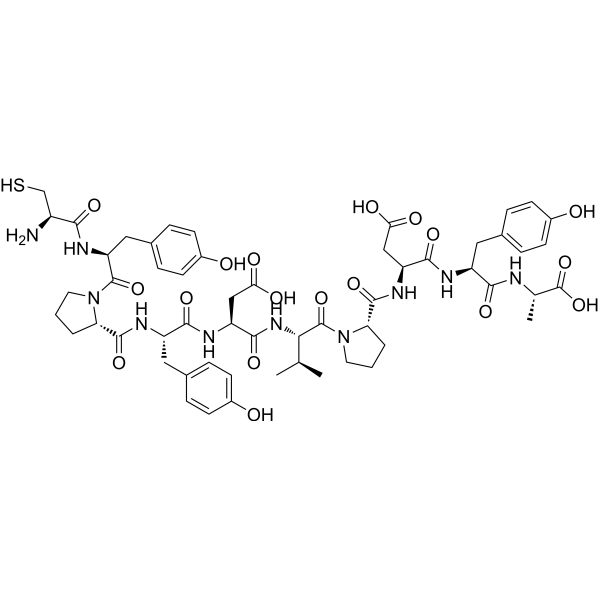
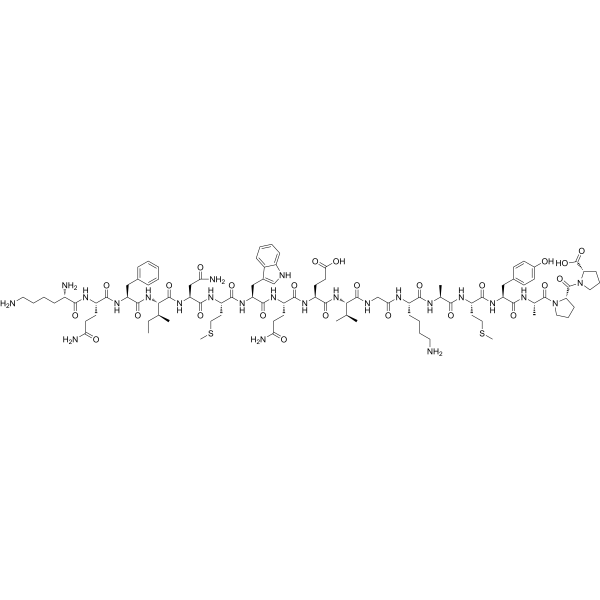
Influenza hemagglutinin (HA) epitope is a polypeptide. Influenza hemagglutinin (HA) epitope is conjugated to keyhole limpet hemocyanin to generate anti-HA polyclonal antibodies following immunization of rabbits .
|
-
- HY-P10250
-
|
|
HIV
|
Inflammation/Immunology
|
|
HIV gp120 308-331 is HIV antigen fragments, that conjugates with keyhole limpet hemocyanin (KLH) and generates specific anti-HIV antibody .
|
-
- HY-P10252
-
|
|
HIV
|
Inflammation/Immunology
|
|
HIV gp120 421-438 is HIV antigen fragments, that conjugates with keyhole limpet hemocyanin (KLH) and generates specific anti-HIV antibody .
|
-
- HY-P5334A
-
|
|
Tau Protein
|
Neurological Disease
|
|
AADvac 1 TFA is an active tau peptide vaccine for Alzheimer's disease research. AADvac 1 TFA is composed of a regulatory peptide 294KDNIKHVPGGGS 305 that drives tau oligomerization conjugated to Aplysia hemocyanin (KLH) and formulated with aluminum hydroxide .
|
-
- HY-P11472
-
|
|
Biochemical Assay Reagents
|
Inflammation/Immunology
|
|
Keratin K18-C is a phosphopeptide corresponding to amino acids 26-38 of human K18, with a cysteine residue added at the end for coupling. Keratin K18-C can be coupled to Keyhole limpet hemocyanin via m-maleimidobenzoyl-N-hydroxysuccinimide ester .
|
| Cat. No. |
Product Name |
Target |
Research Area |
Image |
| Cat. No. |
Product Name |
Category |
Target |
Chemical Structure |
-
- HY-P2853
-
|
|
Structural Classification
Natural Products
Animals
Source Classification
|
p38 MAPK
Reactive Oxygen Species (ROS)
Bacterial
Fungal
|
|
Hemocyanin is an extracellular giant copper-containing glycoprotein. Hemocyanin can be found in the hemolymph of both mollusk and arthropod. Hemocyanin is responsible for oxygen transport. Hemocyanin is also involved in several physiological processes, such as energy storage, osmoregulation, molt cycle and exoskeleton formation. Hemocyanin in shrimp can enhance its immune response by modulating the p38 MAPK pathway. Hemocyanin from Penaeus monodon could act as an antiviral agent against a variety of viruses including DNA and RNA viruses. Hemocyanin from horseshoe crab Carcinoscorpius rotundicauda could possess a strong antimicrobial defense by the production of ROS activated with microbial proteases. Hemocyanin from L. vannamei would be effective against cervical cancer cell growth .
|
-
Your information is safe with us. * Required Fields.
Inquiry Information
- Product Name:
- Cat. No.:
- Quantity:
- MCE Japan Authorized Agent:

