




18 Results for "

Rhesus macaques

" in MedChemExpress (MCE) Product Catalog:
Products (18)

18 Results for "Rhesus macaques" in MCE Product Catalog:

8
8 Publications Verification
Cat. No.: HY-19870
CAS No.: 920014-72-8
Synonyms: RM-493; BIM-22493; IRC-022493
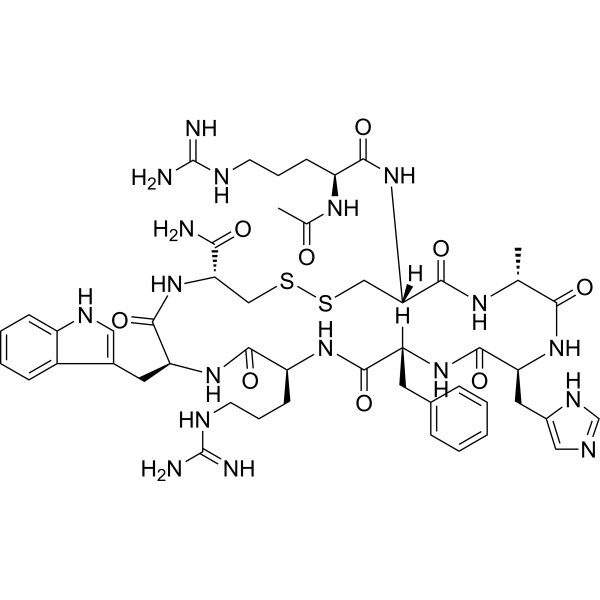
Setmelanotide (RM-493) is a blood-brain barrier-permeable, selective MC4R agonist with a Ki value of 2.1 nM for hMC4R. Setmelanotide activates the CaMKK2/AMPK signaling pathway. Setmelanotide mediates body weight homeostasis, feeding regulation and energy expenditure modulation; it reduces food intake, induces weight loss, decreases obesity severity, increases daytime activity and energy expenditure, lowers levels of leptin, triglycerides, fasting insulin and diastolic blood pressure, improves insulin sensitivity, glucose tolerance and fatty liver condition, and reverses respiratory depression. Setmelanotide is applicable to research related to obesity, hyperinsulinemia, fatty liver and respiratory depression .
loading...
    loading...
8
8 Publications Verification
Cat. No.: HY-19870C
CAS No.: 2759937-80-7
Synonyms: RM-493 monoacetate; BIM-22493 monoacetate; IRC-022493 monoacetate
Setmelanotide monoacetate (RM-493 monoacetate) is a blood-brain barrier-permeable, selective MC4R agonist with a Ki value of 2.1 nM for hMC4R. Setmelanotide monoacetate activates the CaMKK2/AMPK signaling pathway. Setmelanotide monoacetate mediates body weight homeostasis, feeding regulation and energy expenditure modulation; it reduces food intake, induces weight loss, decreases obesity severity, increases daytime activity and energy expenditure, lowers levels of leptin, triglycerides, fasting insulin and diastolic blood pressure, improves insulin sensitivity, glucose tolerance and fatty liver condition, and reverses respiratory depression. Setmelanotide monoacetate is applicable to research related to obesity, hyperinsulinemia, fatty liver and respiratory depression .
loading...
    loading...
4
4 Cited Publications
Cat. No.: HY-B1752
CAS No.: 80373-22-4
Synonyms: LY 171555; (-)-LY 141865
Quinpirole (LY 171555; (-)-LY 141865) is a D2/D3 dopamine receptor agonist and a CaV1.3 calcium channel modulator. Quinpirole normalizes dendritic spine density in dopamine-depleted striatum, upregulates the protein expression of BCL2 and GluR2, downregulates the protein expression of BAX, and delays the onset of seizures. Quinpirole enhances learning and memory, inhibits neuronal apoptosis (apoptosis), and induces anxiety-like, stereotyped, and compulsive behaviors. Quinpirole disrupts prepulse inhibition in rhesus monkeys, enhances the activity of paraventricular thalamic neurons to promote recovery from Isoflurane anesthesia, and alters the composition of the gut microbiota in rats. Quinpirole can be used in research related to dyskinesia, pain, epilepsy, and neurological disorders including anxiety disorder, obsessive-compulsive disorder, and schizophrenia .
loading...
    loading...
1
1 Cited Publications
Cat. No.: HY-P99302
CAS No.: 2235419-62-0
Synonyms: BMS-931699 Antibody

Target:  

CD28

Research Areas:  

Inflammation/Immunology

Lulizumab (Humanized Anti-CD28 Recombinant Antibody) is an anti-CD28 domain antibody antagonist. Lulizumab inhibits T-cell activation by selectively targeting the CD28 signal. In a sensitized non-human primate kidney transplantation model, when combined with Carfilzomib (HY-10455), Lulizumab can regulate immune cells and prolong the survival time of the graft .
loading...
    loading...
Cat. No.: HY-153810
CAS No.: 2890688-86-3
Purity:  99.31%
Synonyms: JNJ-1802
Research Areas:  

Infection

Mosnodenvir (JNJ-1802) is an orally active pan serotype dengue virus (DENV) inhibitor, with EC50 values ranging from 0.057 to 11 nM for four dengue virus (DENV) serotypes. Mosnodenvir blocks viral replication by inhibiting the formation of complexes between two viral proteins, nonstructural protein 3 (NS3) and NS4B, thereby preventing the formation of new viral RNA. Mosnodenvir exhibits picomolar to nanomolar antiviral activity in vitro and has antiviral efficacy in mice and non-human primates .
loading...
    loading...
Cat. No.: HY-176533
CAS No.: 3107268-28-7
Target:  

LPL Receptor

Research Areas:  

Neurological Disease

S1PR5-IN-1 (Compound 7a) is a highly selective S1PR5 antagonist and orally bioavailable inhibitor with a human S1PR5 IC50 of 85.4 nM and human S1PR5 Kd of 2.173 nM.S1PR5-IN-1 binds to S1PR5 and inhibits natural killer cell migration toward sphingosine-1-phosphate.S1PR5-IN-1 can be used for the research of multiple sclerosis .
loading...
    loading...
Cat. No.: HY-P99564
CAS No.: 2417213-72-8
Synonyms: 3BNC117-LS; GS-5423

Target:  

HIV

Research Areas:  

Infection Inflammation/Immunology

Teropavimab (3BNC117-LS) is a broadly neutralizing antibody targeting the CD4-binding site of the HIV-1 envelope. Teropavimab binds to the CD4-binding site of HIV-1 gp120 to neutralize viruses, including multidrug-resistant HIV-1. Teropavimab can be used in studies related to HIV-1 infection and multidrug-resistant HIV-1 infection .
loading...
    loading...
Cat. No.: HY-15618
CAS No.: 1227923-29-6
Purity:  99.89%
Synonyms: M1 receptor modulator
Target:  

mAChR Calcium Channel

Research Areas:  

Neurological Disease

MK-7622 (M1 receptor modulator) is an orally active positive allosteric modulator of muscarinic M1 acetylcholine receptors (mAChRs). MK-7622 enhances ACh-induced calcium flux in CHO cells expressing human M1 receptors (EC50 = 21 nM) and shows robust agonist activity in rat M1-expressing CHO cells, increasing intracellular calcium. MK-7622 reverses Scopolamine (HY-N0296)-induced cognitive deficits in rhesus macaques in an object retrieval detour task. MK-7622 can be used for the study of Alzheimer's disease (AD) .
loading...
    loading...
Cat. No.: HY-P990667
CAS No.: 1439902-67-6
Synonyms: BG00011

Target:  

Integrin TGF-beta/Smad

Research Areas:  

Inflammation/Immunology Cancer

STX-100 (BG00011) is a humanized monoclonal antibody targeting αVβ6 integrin. STX-100 specifically binds αVβ6 integrin, blocks latent TGF-β activation via latency-associated peptide (LAP) interaction prevention, and reduces profibrotic responses. STX-100 can be used for the research of idiopathic pulmonary fibrosis, and cancer .
loading...
    loading...
Cat. No.: HY-P99344
CAS No.: 2423943-37-5
Synonyms: Anti-Human SARS-CoV-2; LY-3819253; LY-CoV555

Target:  

SARS-CoV

Research Areas:  

Infection

Bamlanivimab (Anti-Human SARS-CoV-2; LY-CoV555) is an antiviral agent targeting the SARS-CoV-2 spike protein receptor-binding domain (RBD) with a mean Kd of 5.3 nM. Bamlanivimab binds epitopes overlapping the ACE2 binding site on both active and resting RBD conformations, blocks ACE2 attachment, mediates antibody-dependent cell-mediated cytotoxicity, and reduces viral replication and respiratory tract viral load. Bamlanivimab can be used for the research of COVID-19 .
loading...
    loading...
Cat. No.: HY-P99701
CAS No.: 1450981-87-9
Synonyms: BMS-986004

Target:  

TNF Receptor

Research Areas:  

Inflammation/Immunology

Letolizumab (BMS-986004) is a monoclonal antibody targeting CD40L, which is produced to express mutant IgG1 lacking effector function, including Fc binding and complement fixation. Letolizumab reduces rejection, thromboembolism and prolongs the survival time .
loading...
    loading...
Cat. No.: HY-W007317
CAS No.: 578-66-5
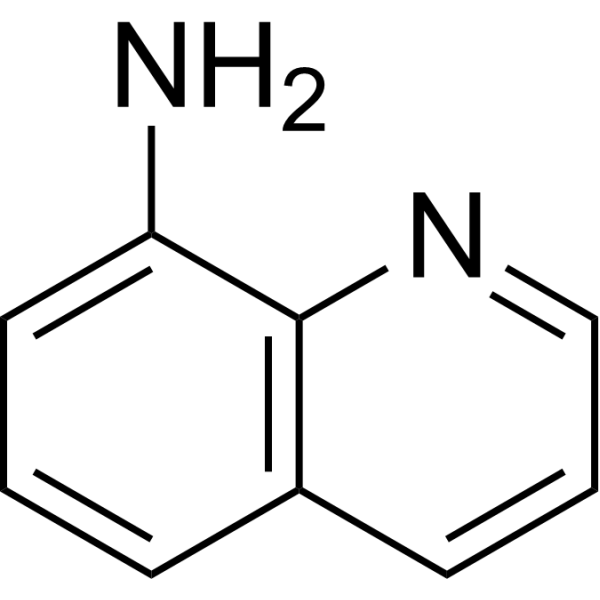
8-Aminoquinoline is a chelating ligand and intermediate. 8-Aminoquinoline assists metal-catalyzed direct C (sp 2)-H and unactivated C (sp 3)-H bond functionalization, copper-mediated C-H/C-H coupling, as well as copper/silver-catalyzed aryl C (sp 2)-H amination reactions. 8-Aminoquinoline forms cationic Pt (II) complexes with anti-tumor activity. 8-Aminoquinoline is used in research related to latent malaria, glioblastoma, pancreatic adenocarcinoma, adenocarcinoma and biphasic mesothelioma .
loading...
    loading...
Cat. No.: HY-W414588
CAS No.: 50673-97-7
Research Areas:  

Metabolic Disease

Colestolone is a 15-ketosterol compound and an orally active inhibitor of HMG-CoA reductase. Colestolone can inhibit the activity of cholesteryl ester transfer protein (CETP) in vitro (IC50 = 660 μM). Colestolone is a cholesterol-lowering agent, and can be used in the research of endocrine and metabolic diseases such as hyperlipidemia .
loading...
    loading...
Cat. No.: HY-P991655

Target:  

IFNAR HIV

Research Areas:  

Infection Inflammation/Immunology

AGS-009 is a humanized monoclonal neutralising antibody targeting IFN-α. AGS-009 significantly reduces activated lymphocytes, such as CD4 + and CD8 + T cells as well as B cells in SIV infection rhesus macaque models. AGS-009 can be used for autoimmune diseases like systemic lupus erythematosus (SLE) and HIV infections research .
loading...
    loading...
Cat. No.: HY-P5625
Target:  

Bacterial

Research Areas:  

Infection

ROAD-1 is an oral mucosal α-defensin of Rhesus Macaque. ROAD-1 is active against S. aureus, E. coli, and C. albicans .
loading...
    loading...
Cat. No.: HY-19870A
Synonyms: RM-493 TFA; BIM-22493 TFA; IRC-022493 TFA
Setmelanotide TFA (RM-493 TFA) is a blood-brain barrier-permeable, selective MC4R agonist with a Ki value of 2.1 nM for hMC4R. Setmelanotide TFA activates the CaMKK2/AMPK signaling pathway. Setmelanotide TFA mediates body weight homeostasis, feeding regulation and energy expenditure modulation; it reduces food intake, induces weight loss, decreases obesity severity, increases daytime activity and energy expenditure, lowers levels of leptin, triglycerides, fasting insulin and diastolic blood pressure, improves insulin sensitivity, glucose tolerance and fatty liver condition, and reverses respiratory depression. Setmelanotide TFA is applicable to research related to obesity, hyperinsulinemia, fatty liver and respiratory depression .
loading...
    loading...
Cat. No.: HY-120029
CAS No.: 129425-83-8
Research Areas:  

Endocrinology

Org-9935 is a selective inhibitor of PDE3 with an IC50 of 50 nM. Org-9935 inhibits maturation of oocyte in naturally selected dominant follicle in rhesus macaques. Org-9935 can augment glucose-induced insulin release in isolated rat islets with an EC50 of 20 μM .
loading...
    loading...
Cat. No.: HY-181351
PSN09 is a blood-brain barrier-permeable agonist of PSAM 4-GlyR and PSAM 4-5-HT3 receptors with high affinity. 18F-labeled PSN09 serves as a radiotracer for PET imaging in non-human primates .
loading...
    loading...
  • 1

