



Setmelanotide TFA
Based on 8 publication(s) in Google Scholar
Setmelanotide TFA (RM-493 TFA) is a blood-brain barrier-permeable, selective MC4R agonist with a Ki value of 2.1 nM for hMC4R. Setmelanotide TFA activates the CaMKK2/AMPK signaling pathway. Setmelanotide TFA mediates body weight homeostasis, feeding regulation and energy expenditure modulation; it reduces food intake, induces weight loss, decreases obesity severity, increases daytime activity and energy expenditure, lowers levels of leptin, triglycerides, fasting insulin and diastolic blood pressure, improves insulin sensitivity, glucose tolerance and fatty liver condition, and reverses respiratory depression. Setmelanotide TFA is applicable to research related to obesity, hyperinsulinemia, fatty liver and respiratory depression.
For research use only. We do not sell to patients.
- Formula: C51H69F3N18O11S2
- Molecular Weight:1231.33
-
Storage:
Please store the product under the recommended conditions in the Certificate of Analysis.


To place orders, for customer services and technical support, please contact: MedChemExpress USA
Tel: 609-228-6898 E-mail: [email protected] [email protected]


-
 Biological Activity
-
Chemical Information
- Protocols
- Purity & Documentation
- References
-
 Help & FAQs


Publications Citing Use of MedChemExpress (MCE) Setmelanotide TFA
More- Sci Transl Med. 2025 Jan 15;17(781):eadr6459. [Abstract]
- J Exp Med. 2021 Jul 5;218(7):e20202484. [Abstract]
- Cell Rep. 2022 Nov 1;41(5):111579. [Abstract]
- J Med Chem. 2017 Nov 9;60(21):8716-8730. [Abstract]
- Front Immunol. 2019 Oct 4:10:2312. [Abstract]
- Mol Metab. 2024 Nov:89:102027. [Abstract]
- J Clin Endocrinol Metab. 2024 Sep 16;109(10):2452-2466. [Abstract]
- Charles University. 2019 Jun.
 Customer Validation & Images

-
In Vivo Efficacy Study
-
Bio/Physico-chemical Assay
-
In Vivo Efficacy Study
-
In Vivo Efficacy Study
-
In Vivo Efficacy Study
All AMPK Isoforms
More

Biological Activity
Description
IC50 & Target
|
MC4R 2.1 nM (Ki) |
MC1R 3.9 nM (Ki) |
MC3R 10 nM (Ki) |
MC5R 430 nM (Ki) |
In Vitro
Setmelanotide binds to hMC1R, MC3R, MC4R and rat MC4R with high affinity, while it shows weak binding affinity to hMC5R[1].
Setmelanotide TFA (increasing concentrations; treated at 37°C for 40 min) acts as an agonist to stimulate cAMP production in CHO-K1 cells expressing hMC1R, hMC3R, hMC4R, and rat MC4R; it shows weak activity on hMC5R and no activity on mouse MC2R[1].
Setmelanotide is a potent agonist of hMC4R, with a binding Ki of 2.1 nM and a cAMP EC50 of 0.27 nM in CHO-K1 cells, and exhibits low potency against hMC1R, hMC3R and hMC5R[4].
Setmelanotide (>1.0×10⁻⁶ M) has no affinity for the μ-opioid receptor, as its IC50 exceeds 1.0×10⁻⁶ M in competitive radioligand binding assays[5].
MedChemExpress (MCE) has not independently confirmed the accuracy of these methods. They are for reference only.
In Vivo
TFA of Setmelanotide (6.4 μmol; intraperitoneal injection; single dose) acutely improves glucose clearance in leptin-deficient obese and glucose-intolerant C57BL/6J mice[1].
TFA of Setmelanotide (6.4 μmol; intraperitoneal injection; single dose) suppresses refeeding-induced food intake in C57BL/6J mice fed a normal diet, and this effect depends on functional MC4R rather than MC3R[1].
TFA of Setmelanotide (0.17-0.5 mg/kg/day; administered via a 2-week minipump every two weeks; for 8 weeks or variable duration) reduces peak body weight by 13.5% in diet-induced obese rhesus monkeys, improves insulin sensitivity and cardiovascular function, and does not cause adverse increases in heart rate or blood pressure; whereas lower doses only improve insulin sensitivity with minimal effects on body weight or cardiovascular parameters[2].
TFA of Setmelanotide (0.05 mg/kg; i.p.; single administration) activates PVN MC4R neurons via the CaMKK2/AMPK signaling pathway, thereby normalizing food intake during short-term refeeding in rats with hypothalamic obesity[3].
Setmelanotide TFA (0.05 mg/kg; i.p.; once daily) activates PVN MC4R neurons via the CaMKK2/AMPK signaling pathway, reduces food intake, body weight, Lee index and perirenal adipose tissue weight, thereby reversing hypothalamic obesity in rats[3].
TFA of Setmelanotide (6.4 µmole-1.34 mg/kg/day; intraperitoneal injection, subcutaneous injection; single injection, daily administration; for 14 consecutive days) induces MC4R-dependent feeding suppression and body weight loss in diet-induced obese mice[4].
TFA of Setmelanotide (100-500 nmol/kg; subcutaneous injection; single administration) suppresses food intake in fasted male Sprague-Dawley rats[4].
TFA of Setmelanotide (1 mg/kg; i.p.; single administration) effectively treats morphine-induced opioid-induced respiratory depression (OIRD) in lean male C57BL/6J mice by increasing respiratory rate and reducing apnea index, without impairing opioid analgesic effects[5].
TFA of Setmelanotide (1 mg/kg; i.p.; single administration) effectively treats morphine-induced opioid-related respiratory depression in obese male C57BL/6J mice by increasing respiratory rate and reducing the frequency and duration of apnea, without affecting opioid analgesic effects[5].
MedChemExpress (MCE) has not independently confirmed the accuracy of these methods. They are for reference only.
-
Animal Model:C57BL/6J (male, 10 months old, diet-induced obese)[1]
-
Dosage:300 nmol/kg/day
-
Administration:s.c.; continuous; 14 days
-
Result:Reduced food intake to ~50% of controls on day 1, increasing to 75% of control levels by day 4, with no significant difference by day 12.
Lowered fasting serum insulin, glucose, and HOMA-IR values significantly.
Reduced serum leptin and total cholesterol levels significantly.
Improved liver steatosis significantly (P < 0.05).
Increased liver-specific Cpt1a expression modestly but significantly.
-
Animal Model:C57BL/6J (male, 10 months old, leptin-deficient)[1]
-
Dosage:6.4 μmol
-
Administration:i.p.; single injection
-
Result:Improved glucose clearance significantly compared to saline-treated controls.
-
Animal Model:C57BL/6J (female, 10 months old; wild-type, MC3R knockout, MC4R knockout littermates)[1]
-
Dosage:6.4 μmol
-
Administration:i.p.; single injection
-
Result:Inhibited refeeding-induced food intake in WT and MC3RKO mice.
Showed no inhibitory effect on refeeding-induced food intake in MC4RKO mice.
-
Animal Model:mature adult male (age 9-11 years, body weight 9-19 kg; 9 diet-sensitive/obese, insulin-resistant, hypertensive; 3 diet-resistant/lean, normotensive)[2]
-
Dosage:0.5 mg/kg/day (8-week treatment); 0.17 mg/kg/day (subsequent treatment period)
-
Administration:s.c.; via biweekly 2-week minipumps; 8 weeks (0.5 mg/kg/day); variable duration (0.17 mg/kg/day)
-
Result:Decreased food intake by 35% in the first week, normalized by weeks 4-7, and increased during week 8.
Reached peak weight loss of 13.5% of total body weight (average 1.5 kg lost over 8 weeks), with weight loss persisting for 2 weeks post-treatment before recovery began.
Nearly doubled daytime activity by treatment end (P = 0.037, repeated-measures ANOVA).
Increased energy expenditure (CO2 production) by 14% (P = 0.0134, paired t-test) compared to baseline.
Decreased core body temperature by ~0.5°C (P = 0.0161, repeated-measures ANOVA).
Reduced fat mass by 18.8% (1.04 kg) in diet-sensitive animals and 38.3% (0.75 kg) in diet-resistant animals; fat mass remained significantly reduced in diet-sensitive animals post-washout.
Decreased lean mass by 4.9% in diet-sensitive animals.
Decreased fasting leptin levels significantly in diet-sensitive animals (P < 0.001), with the magnitude of leptin decrease correlating with weight loss (r2 = 0.6634, P = 0.0023).
Reduced fasting serum triglyceride levels significantly at 8 weeks (P = 0.0238, ANOVA).
Improved fasting insulin levels and homeostasis model assessment insulin resistance significantly in diet-sensitive animals, with reduced insulin secretion (area under the curve) and improved glucose clearance (area under the curve) during intravenous glucose tolerance testing; these improvements persisted for 4 weeks post-treatment.
Decreased heart rate significantly overall (P = 0.008, repeated-measures ANOVA), with a 13-bpm reduction in diet-sensitive animals, and reduced diastolic blood pressure significantly (P = 0.02, repeated-measures ANOVA); systolic blood pressure was unchanged.
No acute increases in heart rate or blood pressure were observed.
Improved insulin sensitivity with smaller effects on food intake and body weight at 0.17 mg/kg/day.
No changes to blood pressure or heart rate were observed at 0.17 mg/kg/day.
-
Animal Model:Sprague-Dawley (male)[4]
-
Dosage:100 nmol/kg; 500 nmol/kg
-
Administration:s.c.; single injection
-
Result:Reduced food intake during refeeding after an overnight fast at both 100 nmol/kg and 500 nmol/kg doses.


Chemical Information
-
Molecular Weight 1231.33
-
Formula C51H69F3N18O11S2
-
Synonyms
RM-493 TFA; BIM-22493 TFA; IRC-022493 TFA
-
Sequence
Ac-Arg-Cys-{d-Ala}-His-{d-Phe}-Arg-Trp-Cys-NH2 (Disulfide bridge:Cys2-Cys8)
-
Sequence Shortening
Ac-RC-{d-Ala}-H-{d-Phe}-RWC-NH2 (Disulfide bridge:Cys2-Cys8)
-
Shipping
Room temperature in continental US; may vary elsewhere.
-
Storage
Please store the product under the recommended conditions in the Certificate of Analysis.


Publications (8)
-
Journal Impact Factor
-
Most Recent
-
Sci Transl Med
2025 Jan 15;17(781):eadr6459. PMID: 39813316
Setmelanotide TFA purchased from MedChemExpress. Usage Cited in: Sci Transl Med. 2025 Jan 15;17(781):eadr6459. [Abstract]
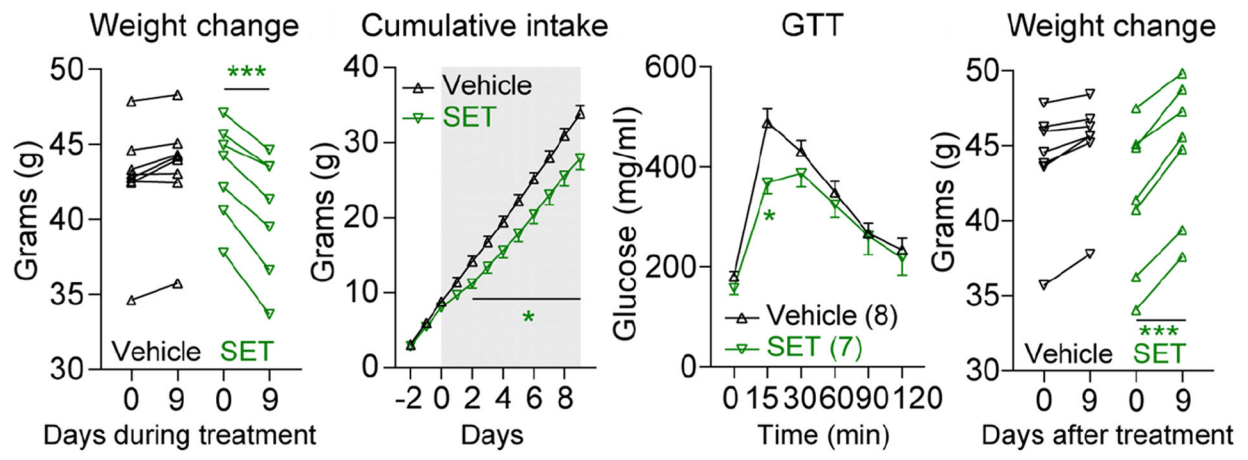
Setmelanotide (2 mg/kg; i.p.; once daily for 9 d) reduced body weights and food intake and improved glucose tolerance of HFD-fed OtpQ153R/+ mice, which quickly regained body weight after the treatment was discontinued.
-
J Exp Med
The atypical antipsychotic risperidone targets hypothalamic melanocortin 4 receptors to cause weight gain. [Abstract]2021 Jul 5;218(7):e20202484. PMID: 33978701
Setmelanotide TFA purchased from MedChemExpress. Usage Cited in: J Exp Med. 2021 Jul 5;218(7):e20202484. [Abstract]
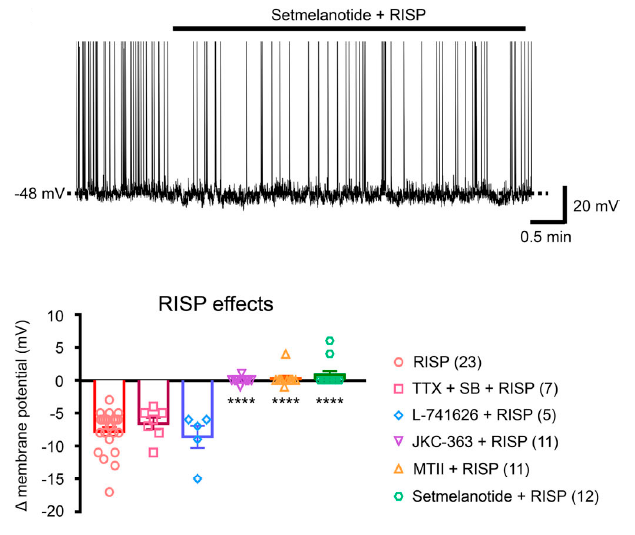
Setmelanotide (100 nM) blocked the risperidone-induced hyperpolarization of MC4RPVH neurons.
Setmelanotide TFA purchased from MedChemExpress. Usage Cited in: J Exp Med. 2021 Jul 5;218(7):e20202484. [Abstract]
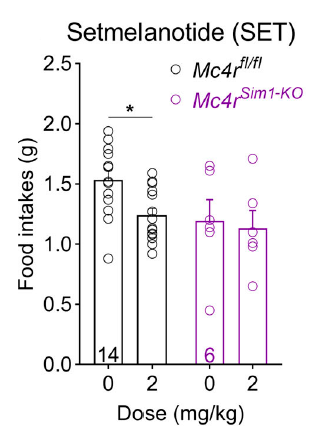
A single dose of Setmelanotide (SET) (2 mg/kg; i.p.) suppressed fast-induced refeeding in Mc4rfl/fl mice.
Setmelanotide TFA purchased from MedChemExpress. Usage Cited in: J Exp Med. 2021 Jul 5;218(7):e20202484. [Abstract]
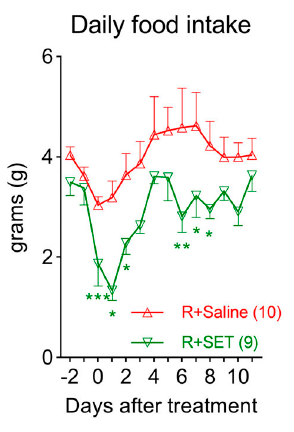
Infusion of Setmelanotide (SET) (2 mg/kg; once daily for 14 d) attenuated hyperphagia in C57BL/6 mice fed with risperidone.
Setmelanotide TFA purchased from MedChemExpress. Usage Cited in: J Exp Med. 2021 Jul 5;218(7):e20202484. [Abstract]
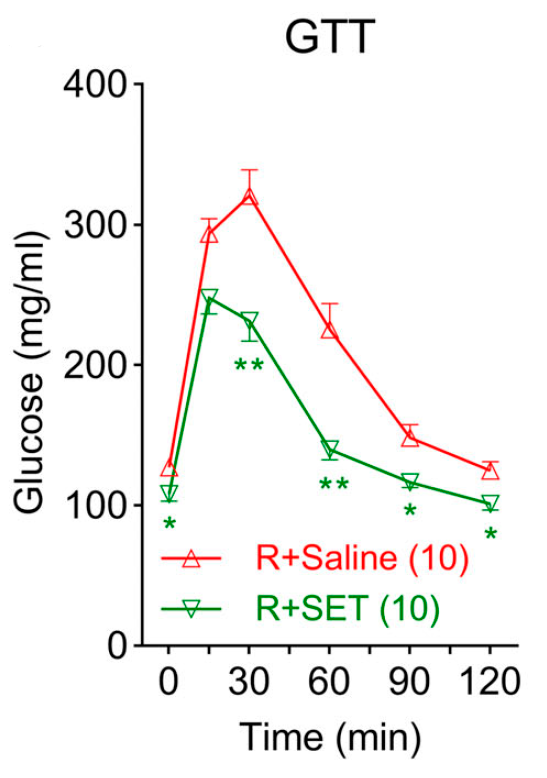
Setmelanotide (SET) (2 mg/kg; once daily for 14 d) caused accelerated glucose clearance of C57BL/6 mice fed with risperidone in a GTT.
-
Cell Rep
Melanocortin-4 receptors activate sympathetic preganglionic neurons and elevate blood pressure via TRPV1. [Abstract]2022 Nov 1;41(5):111579. PMID: 36323255 -
J Med Chem
2017 Nov 9;60(21):8716-8730. PMID: 28972753 -
Front Immunol
Setmelanotide, a Novel, Selective Melanocortin Receptor-4 Agonist Exerts Anti-inflammatory Actions in Astrocytes and Promotes an Anti-inflammatory Macrophage Phenotype. [Abstract]2019 Oct 4:10:2312. PMID: 31636637 -
Mol Metab
Lead-in calorie restriction enhances the weight-lowering efficacy of incretin hormone-based pharmacotherapies in mice. [Abstract]2024 Nov:89:102027. PMID: 39265725 -
J Clin Endocrinol Metab
MC4R variants modulate α-MSH and setmelanotide induced cellular signaling at multiple levels. [Abstract]2024 Sep 16;109(10):2452-2466. PMID: 38567654 -


Purity & Documentation
References
[1]. Kumar KG, et al. Analysis of the therapeutic functions of novel melanocortin receptor agonists in MC3R- and MC4R-deficient C57BL/6J mice. Peptides. 2009 Oct;30(10):1892-900. [Content Brief]
[2]. Kievit P, et al. Chronic treatment with a melanocortin-4 receptor agonist causes weight loss, reduces insulin resistance, and improves cardiovascular function in diet-induced obese rhesus macaques. Diabetes. 2013;62(2):490-497. [Content Brief]
[3]. Peng J, et al. Setmelanotide-mediated MC4R activation improves hypothalamic obesity via CaMKK2/AMPK pathways. Front Pharmacol. 2026;16:1730786. Published 2026 Jan 12. [Content Brief]
[4]. Sharma S, et al. Current Mechanistic and Pharmacodynamic Understanding of Melanocortin-4 Receptor Activation. Molecules. 2019;24(10):1892. Published 2019 May 16. [Content Brief]
[5]. Amorim MR, et al. Melanocortin receptor 4 agonist setmelanotide treats opioid-induced respiratory depression. bioRxiv [Preprint]. 2026 Mar 10:2026.03.08.708886. doi: 10.64898/2026.03.08.708886. PMID: 41959165; PMCID: PMC13061029. [Content Brief]

Calculators
Concentration (start) × Volume (start) = Concentration (final) × Volume (final)


Setmelanotide TFA Related Classifications
HY-19870A Related Classifications
 Powered by Bioz
Keywords
- Setmelanotide
- RM-493
- BIM-22493
- IRC-022493
- RM493
- RM 493
- BIM22493
- BIM 22493
- IRC022493
- IRC 022493
- Melanocortin Receptor
- Calmodulin
- AMPK
- PVN MC4R neurons
- Sprague-Dawley rats
- MC4R
- C57BL/6J mice
- rhesus macaques
- melanocortin-4 receptor
- cynomolgus monkeys
- HEK293 cells
- CHO-K1 cells
- CaMKK2/AMPK signaling pathway
- Inhibitor
- inhibitor
- inhibit