1. Search Result
Search Result
Results for "

Staphylococcus aureus spp.

" in MedChemExpress (MCE) Product Catalog:

10

Inhibitors & Agonists

2

Natural
Products

Cat. No. Product Name Target Research Areas Chemical Structure
  • HY-16911
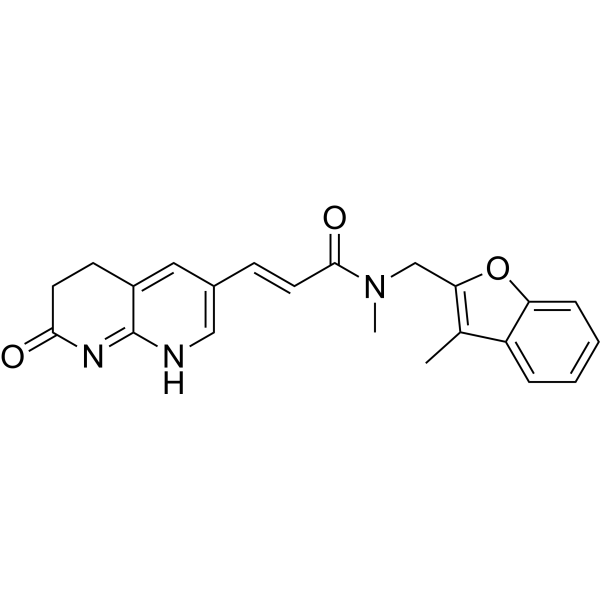
    AFN-1252
    Maximum Cited Publications
    11 Publications Verification

    API-1252; Debio 1452

    Bacterial Antibiotic Infection
    AFN-1252 is an orally active and selective inhibitor of FabI, an essential enzyme in fatty acid biosynthesis in Staphylococcus spp. AFN-1252 exhibits exquisite and highly selective activity against Staphylococcus spp. AFN-1252 exhibits typical MIC90 values of ⩽0.015 μg/ml against diverse clinical isolates of S. aureus. AFN-1252 is efficacious in a mouse model of septicemia providing 100% protection from an otherwise lethal peritoneal infection of S. aureus Smith .
    AFN-1252
  • HY-103249

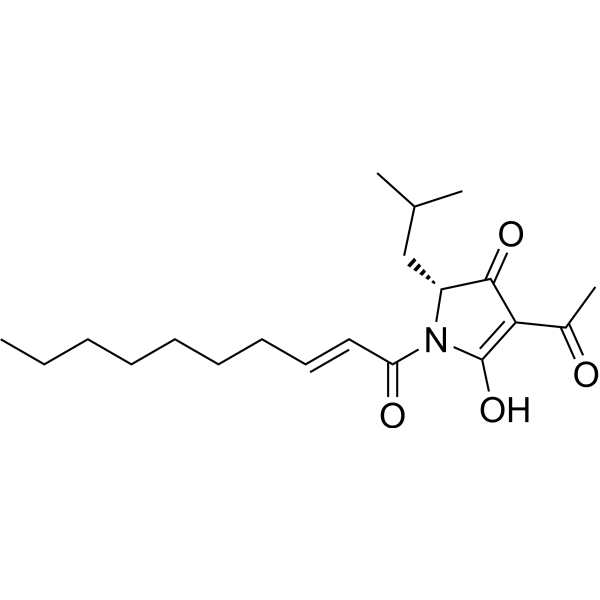
    Reutericycline

    Bacterial Infection Metabolic Disease
    Reutericyclin (Reutericycline) is an orally active antibacterial and anti-obesity agent that selectively inhibits Gram-positive bacteria. By selectively dissipating transmembrane potential, Reutericyclin exerts non-lytic bactericidal or bacteriostatic activity against pathogens such as Clostridium difficile and Staphylococcus aureus, and rapidly kills vegetative cells and spores of Clostridium difficile. Reutericyclin possesses favorable properties including resistance to enzymatic hydrolysis, iron-chelating function, and poor absorption by colonic epithelium. Reutericyclin not only eradicates staphylococcal biofilms and inhibits drug-resistant strains, but also counteracts Risperidone (HY-11018)-induced weight gain by inducing changes in gut microbiota composition and restoring energy utilization efficiency. Reutericyclin can be used in research related to Clostridium difficile infection, Risperidone-induced weight gain, and staphylococcal superficial skin infections .
    Reutericyclin
  • HY-W412175
    Coproporphyrin III dihydrochloride
    2 Publications Verification

    Zincphyrin dihydrochloride

    Bacterial Infection
    Coproporphyrin III dihydrochloride is a bioactive molecule excreted by nostril- and skin-associated Propionibacterium species that induces aggregation of Staphylococcus aureus (conditions: during early stationary phase growth, low pH: 4-6). Coproporphyrin III dihydrochloride also induces plasma-independent biofilm formation on abiotic surfaces by Staphylococcus aureus. Coproporphyrin III dihydrochloride may be an important mediator of S. aureus accumulation and/or biofilm formation in the nostrils or other sites where Propionibacterium and S. aureus inhabit .
    Coproporphyrin III dihydrochloride
  • HY-W010989

    Biochemical Assay Reagents Bacterial Infection Neurological Disease Inflammation/Immunology Cancer
    Gly-His-Lys acetate is a natural, circulating regulatory and antimicrobial tripeptide derived from extracellular matrix proteins. Gly-His-Lys acetate binds Cu 2+ to support copper enzyme activation, antioxidant processes, cellular bioenergetics, and the synthesis of elastin, collagen and catecholamines. Gly-His-Lys acetate regulates cell growth, differentiation and tissue repair, and exerts regenerative, anxiolytic, anti-inflammatory, analgesic and immunosuppressive activities. Gly-His-Lys acetate induces liver degenerative changes. Gly-His-Lys acetate can be used for the research of infections, anxiety, pain-related behaviors and immune-associated liver diseases .
    Gly-His-Lys acetate
  • HY-127072

    Antibiotic Bacterial Infection Inflammation/Immunology Cancer
    Amicoumacin A is an orally active antibiotic. Amicoumacin A targets bacterial ribosomes and inhibits bacterial translation by stabilizing the interaction between mRNA and ribosomes. Amicoumacin A induces cancer cell death by targeting eukaryotic ribosomes. Amicoumacin A exhibits anti-inflammatory and anti-ulcer activities, inhibits carrageenan-induced paw edema, and prevents stress-induced gastric ulcers. Amicoumacin A inhibits the growth of Gram-positive bacteria, Salmonella spp., Shigella spp., Helicobacter pylori, and methicillin-resistant Staphylococcus aureus. Amicoumacin A can be used in the research of lung cancer, breast cancer, bacterial infections, inflammatory edema and gastric ulcers [2] .
    Amicoumacin A
  • HY-114622

    API-1252 tosylate; Debio 1452 tosylate

    Bacterial Antibiotic Infection
    AFN-1252 (API-1252) tosylate is an orally active and selective inhibitor of FabI, an essential enzyme in fatty acid biosynthesis in Staphylococcus spp. AFN-1252 tosylate exhibits exquisite and highly selective activity against Staphylococcus spp. AFN-1252 tosylate exhibits typical MIC90 values of 0.015 μg/ml against diverse clinical isolates of S. aureus. AFN-1252 tosylate is efficacious in a mouse model of septicemia providing 100% protection from an otherwise lethal peritoneal infection of S. aureus Smith .
    AFN-1252 tosylate
  • HY-125042

    Bacterial Infection
    Sarothralin G is an antibacterial compound isolated from Hypericum japonicum Thunb. (Japanese spurfle). The structure of Sarothralin G contains phenolic and aromatic acid moieties and shows excellent antibacterial activity against Gram-positive bacteria such as Staphylococcus aureus, Bacillus subtilis and Nocardia spp., which is stronger than Sarothralen A, B and Saroaspidin A, B, C. Sarothralin G exhibits significant antibacterial potential.
    Sarothralin G
  • HY-123508

    Drug Metabolite Bacterial Infection
    PD 131628 is an antimicrobial agent and active PD 131112 metabolite. PD 131628 is two- to four-fold more active than Ciprofloxacin (HY-B0356), inhibiting all strains of Staphylococcus aureus and Streptococcus pneumoniae. PD 131628 is very active against Neisseria spp., Haemophilus influenzae and Moraxella catarrhalis, with MIC90s ranging from 0.004 to 0.008 mg/L .
    PD 131628
  • HY-181686

    Bacterial Reactive Oxygen Species (ROS) Infection
    Antibacterial agent 326 is a bactericide that inhibits the growth of various bacterial strains. Antibacterial agent 326 inhibits biofilm formation in Escherichia coli, disrupts bacterial cell membranes, induces oxidative stress and lipid peroxidation in Escherichia coli, increases ROS levels, and reduces GSH activity. Antibacterial agent 326 can be used in studies of bacterial infections, including those caused by Escherichia coli, Staphylococcus aureus, Enterococcus faecalis, Listeria spp., Bacillus subtilis, Serratia marcescens, Salmonella enteritidis and Acinetobacter calcoaceticus .
    Antibacterial agent 326
  • HY-116558

    Bacterial Infection
    E-4441 is an orally active Antibacterial agent. E-4441 exerts broad-spectrum in vitro antibacterial activity against Gram-positive bacteria and aerobic bacteria. E-4441 exhibits protective effects against Staphylococcus aureus, Escherichia coli, and Pseudomonas aeruginosa infections. E-4441 can be used in the research of systemic bacterial infections (Staphylococcus aureus, Escherichia coli, and Pseudomonas aeruginosa infections) .
    E-4441

Inquiry Online

Your information is safe with us. * Required Fields.

Salutation


Country or Region *

Applicant Name *


Organization Name *

Department *


Email Address *


Product Name *

Cat. No.


Requested quantity *

Phone Number *


Remarks

Inquiry Online

Inquiry Information

Product Name:
Cat. No.:
Quantity:
MCE Japan Authorized Agent:

