13 Results for "

aggregate dissociators

" in MedChemExpress (MCE) Product Catalog:
Products (13)

13 Results for "aggregate dissociators" in MCE Product Catalog:

2
2 Cited Publications
Cat. No.: HY-K6011

MCE Tumor Tissue Dissociation Solution is able to gently and efficiently dissociate tumor tissue samples into cell suspensions or cell aggregates, which can then be used for the subsequent construction of tumor organoids.

loading...
    loading...
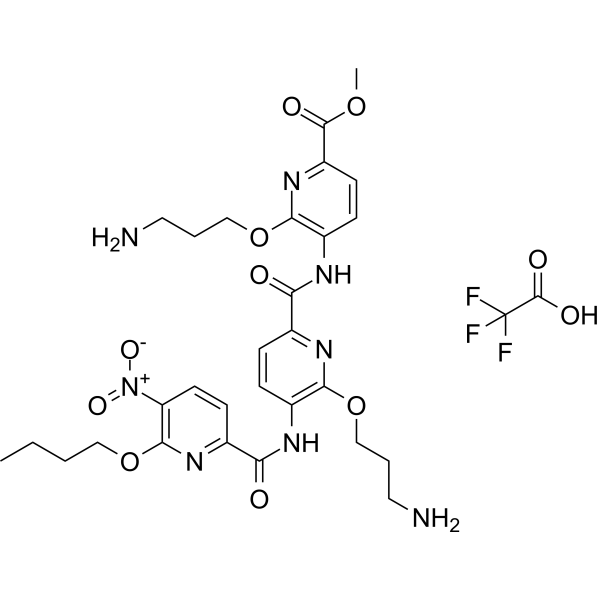
Cat. No.: HY-145785A
CAS No.: 2990065-87-5
Purity:  99.67%
Target:  

MDM-2/p53 Apoptosis

Research Areas:  

Cancer

ADH-6 TFA is a tripyridylamide compound. ADH-6 abrogates self-assembly of the aggregation-nucleating subdomain of mutant p53 DBD. ADH-6 TFA targets and dissociates mutant p53 aggregates in human cancer cells, which restores p53's transcriptional activity, leading to cell cycle arrest and apoptosis. ADH-6 TFA has the potential for the research of cancer diseases .
loading...
    loading...
Cat. No.: HY-173291
CAS No.: 3063166-64-0
Target:  

Tau Protein

Research Areas:  

Neurological Disease

Tau ligand-1 (Compound 75) is a ligand for aggregated tau protein that can penetrate the blood-brain barrier . In tissues from patients with Alzheimer's disease, progressive supranuclear palsy, corticobasal degeneration, and Pick's disease, Tau ligand-1 exhibits high affinity for aggregated tau protein, with equilibrium dissociation constant (KD) values ranging from 1 to 3.8 nM . Tau ligand-1 can serve as a potential positron emission tomography (PET) tracer and holds promise for application in positron emission tomography imaging studies of tau-related diseases in the central nervous system .
loading...
    loading...
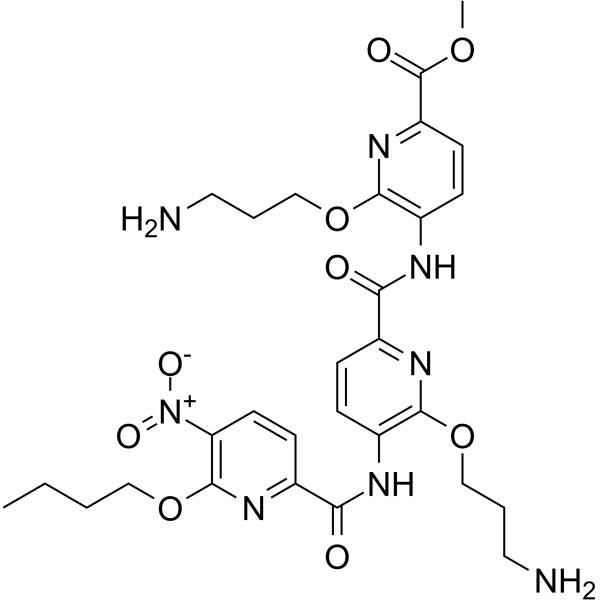
Cat. No.: HY-145785
CAS No.: 2227429-65-2
Target:  

MDM-2/p53 Apoptosis

Research Areas:  

Cancer

ADH-6 is a tripyridylamide compound. ADH-6 abrogates self-assembly of the aggregation-nucleating subdomain of mutant p53 DBD. ADH-6 targets and dissociates mutant p53 aggregates in human cancer cells, which restores p53's transcriptional activity, leading to cell cycle arrest and apoptosis. ADH-6 has the potential for the research of cancer diseases[1].
loading...
    loading...
Cat. No.: HY-149430
CAS No.: 2446054-34-6
Target:  

Amyloid-β

Research Areas:  

Neurological Disease

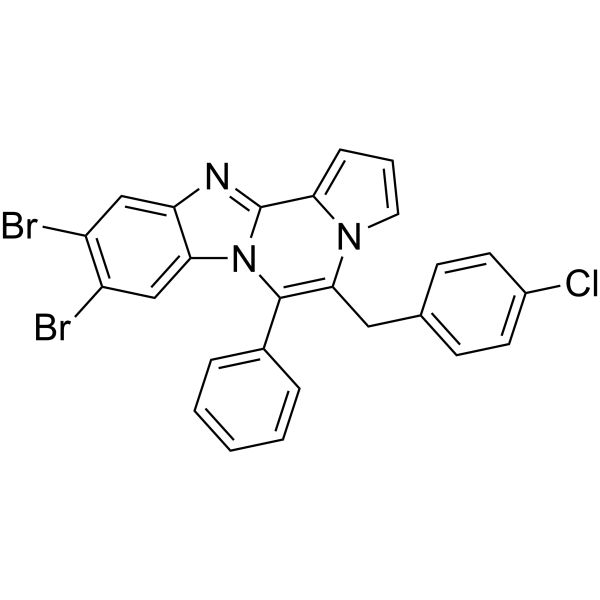
YIAD-0205 is an orally available Aβ(1?42) aggregation inhibitor. YIAD-0205 demonstrated in vivo efficacy in an AD transgenic mouse model with five familial AD mutations (5XFAD) .
loading...
    loading...
Cat. No.: HY-K6012

MCE Tissue Dissociation Solution is able to gently and efficiently dissociate tissue samples into cell suspensions or cell aggregates, which can then be used for the subsequent construction of tumor organoids.

loading...
    loading...
Cat. No.: HY-184818
CAS No.: 2883627-62-9
α-Synuclein-IN-23 is an inhibitor of α-synuclein with an IC50 of 2.1 μM. α-Synuclein-IN-23 dissociates preformed α-synuclein aggregates, scavenges reactive oxygen species (ROS), and inhibits the formation of α-synuclein inclusions in neuronal cells. α-Synuclein-IN-23 can be used for the research of Parkinson's disease .
loading...
    loading...
Cat. No.: HY-184847
CAS No.: 2883627-66-3
Target:  

α-synuclein

Research Areas:  

Neurological Disease

α-Synuclein-IN-25 is a quinone-acid hybrid and also an α-synuclein aggregation inhibitor with an IC50 of 3.0 μM. α-Synuclein-IN-25 dissociates preformed α-Syn aggregates, inhibits their re-aggregation, scavenges reactive oxygen species, and reduces the formation of α-Syn inclusions in neuronal cells. α-Synuclein-IN-25 can be used in the research of Parkinson's disease .
loading...
    loading...
Cat. No.: HY-184816
CAS No.: 2883627-65-2
α-Synuclein-IN-21 is an α-synuclein (α-Syn) aggregation inhibitor with an IC50 of 1.6 μM. α-Synuclein-IN-21 stabilizes the secondary conformation of α-synuclein monomers, inhibits β-sheet formation, reduces oligonucleation during the aggregation lag phase, dissociates preformed aggregates, and blocks re-aggregation. α-Synuclein-IN-21 reduces α-synuclein inclusions in neuronal cells and scavenges ROS. α-Synuclein-IN-21 can be used for the research of Parkinson's disease .
loading...
    loading...
Cat. No.: HY-184817
CAS No.: 2883627-63-0
α-Synuclein-IN-22 is an α-Synuclein inhibitor with an IC50 of 2.7 μM against human α-Syn. α-Synuclein-IN-22 exerts anti-aggregation effects by stabilizing the native conformation of α-Syn, inhibiting the formation of β-sheet aggregates and inclusion bodies, and dissociating mature fibrils into functional monomers. α-Synuclein-IN-22 scavenges ROS and shows low cytotoxicity. α-Synuclein-IN-22 can be used in research related to Parkinson's disease .
loading...
    loading...
Cat. No.: HY-184819
CAS No.: 2883627-56-1
α-Synuclein-IN-24 is an α-synuclein (α-Syn) aggregation inhibitor with an IC50 of 4.0 μM. α-Synuclein-IN-24 stabilizes the secondary conformation of α-synuclein monomers, inhibits β-sheet formation, reduces oligonucleation during the aggregation lag phase, dissociates preformed aggregates, and blocks reaggregation. α-Synuclein-IN-24 reduces α-synuclein inclusions in neuronal cells and scavenges ROS. α-Synuclein-IN-24 can be used for the research of Parkinson's disease .
loading...
    loading...
Cat. No.: HY-184815
CAS No.: 2883627-67-4
Research Areas:  

Neurological Disease

α-Synuclein-IN-20 is an inhibitor of α-synuclein (α-Synuclein) with an IC50 of 4.1 μM against human α-Syn. α-Synuclein-IN-20 exerts anti-aggregation effects by stabilizing the native conformation of α-Syn, inhibiting the formation of β-sheet aggregates and inclusion bodies, and dissociating mature fibrils into functional monomers. α-Synuclein-IN-20 scavenges ROS, protects and repairs dopaminergic neurons, ameliorates Parkinson's disease-like symptoms, and shows low cytotoxicity. α-Synuclein-IN-20 can be used for research related to Parkinson's disease .
loading...
    loading...
Cat. No.: HY-185721
CAS No.: 25191-14-4
Synonyms: Polyguanylic acid
Target:  

DNA/RNA Synthesis

Research Areas:  

Others

Poly (G) (Polyguanylic acid) is a high-molecular-weight synthetic ribopolynucleotide. In the presence of Na + or K + ions, Poly (G) undergoes time-dependent structural modification, gradually self-assembling from a single strand into large G-quadruplex aggregates. Poly (G) undergoes cooperative secondary structure dissociation under alkaline conditions, but its secondary structure can withstand high temperatures up to 100°C and is resistant to snake venom diesterase at low Na + concentrations. Poly (G) forms stable 1:1 complexes with polycytidylic acid or poly 5-bromocytidylic acid, but does not bind to polyinosinic acid or polyadenylic acid. Poly (G) can be applied to studies on the interactions between drugs and G-rich DNA fragments in electrochemical biosensors .
loading...
    loading...
  • 1

