Search Result
Results for "
azide derivative
" in MedChemExpress (MCE) Product Catalog:
97
Biochemical Assay Reagents
| Cat. No. |
Product Name |
Target |
Research Areas |
Chemical Structure |
-
- HY-130809
-
|
|
Biochemical Assay Reagents
|
Cancer
|
|
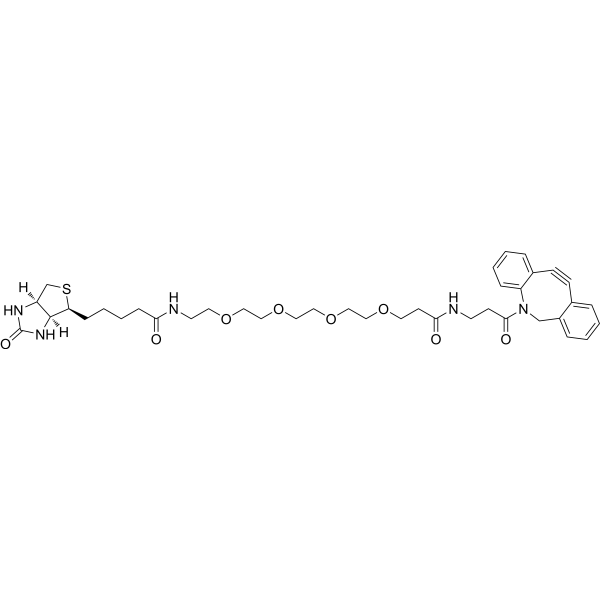
DBCO-PEG4-Biotin is an azadibenzocyclooctyne-biotin derivative containing a biotin group and 4 PEGs. DBCO-PEG4-Biotin is a versatile biotinylation reagent used for the introduction of a biotin moiety to azide-labeled biomolecules via copper-free strain-promoted alkyne-azide click chemistry (SPAAC) reaction . DBCO-PEG4-Biotin is a click chemistry reagent, it contains a DBCO group that can undergo strain-promoted alkyne-azide cycloaddition (SPAAC) with molecules containing Azide groups.
|
-
-
- HY-140947
-
|
|
Fluorescent Dye
|
Others
|
|
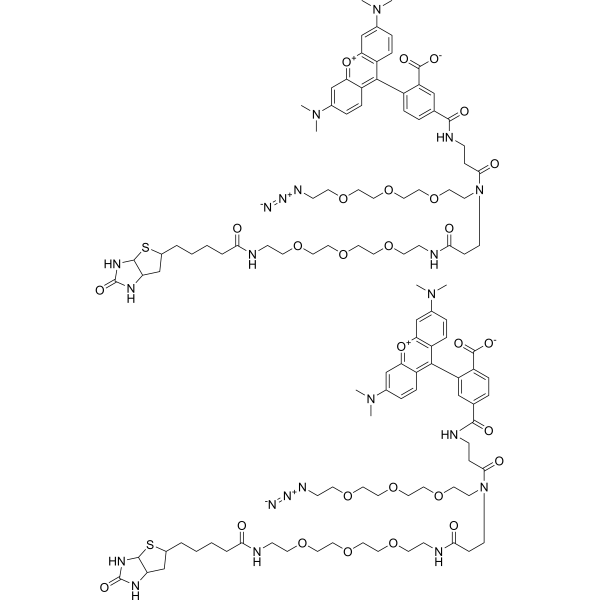
TAMRA-Azide-PEG-biotin is a dye derivative of TAMRA (HY-135640). TAMRA-Azide-PEG-biotin contains an Azide group and can undergo copper-catalyzed azide-alkyne cycloaddition reaction (CuAAc) with molecules containing Alkyne groups. It can also undergo strain-promoted alkyne-azide cycloaddition (SPAAC) reactions with molecules containing DBCO or BCN groups.
|
-
-
- HY-W040124
-
|
|
Amino Acid Derivatives
|
Others
|
|
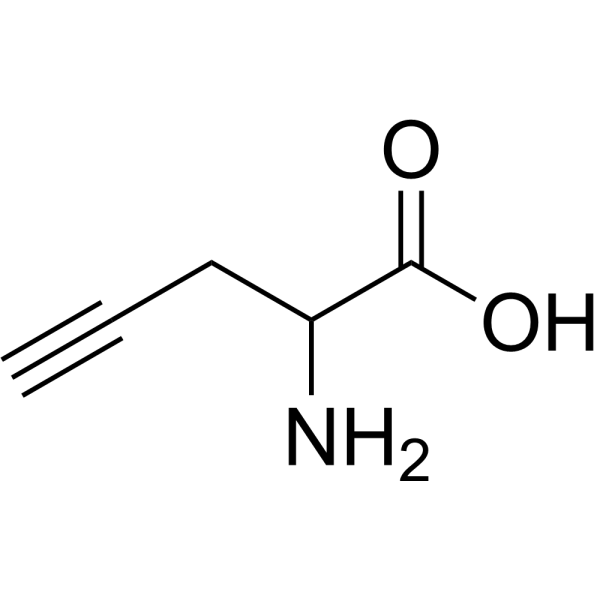
DL-Propargylglycine is a Glycine (HY-Y0966) derivative . DL-Propargylglycine is a click chemistry reagent, it contains an Alkyne group and can undergo copper-catalyzed azide-alkyne cycloaddition (CuAAc) with molecules containing Azide groups.
|
-
-
- HY-112789
-
|
|
Epigenetic Reader Domain
|
Cancer
|
|
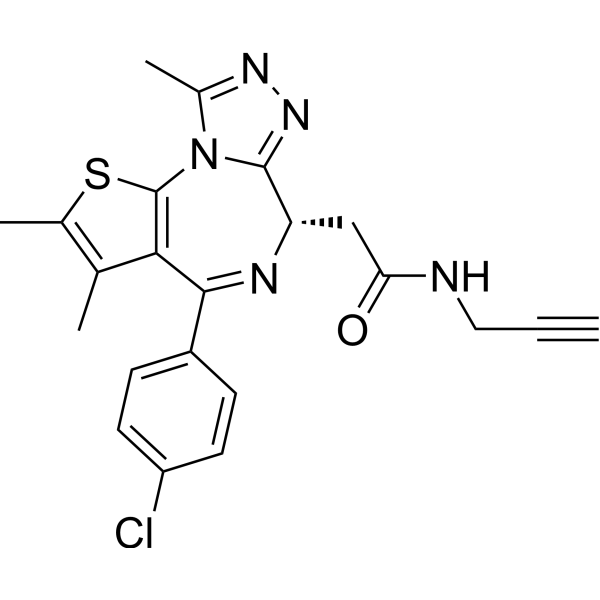
(+)-JQ1 PA is a derivative of the Bromodomain and extra-terminal (BET) inhibitor JQ1, with an IC50 of 10.4 nM. (+)-JQ1 PA is a click chemistry reagent, it contains an Alkyne group and can undergo copper-catalyzed azide-alkyne cycloaddition (CuAAc) with molecules containing Azide groups.
|
-
-
- HY-W011210
-
|
|
Amino Acid Derivatives
|
Others
|
|
Fmoc-Pra-OH is a Glycine (HY-Y0966) derivative . Fmoc-Pra-OH is a click chemistry reagent, it contains an Alkyne group and can undergo copper-catalyzed azide-alkyne cycloaddition (CuAAc) with molecules containing Azide groups.
|
-
-
- HY-D1314
-
|
6-FAM azide
|
Fluorescent Dye
|
Others
|
|
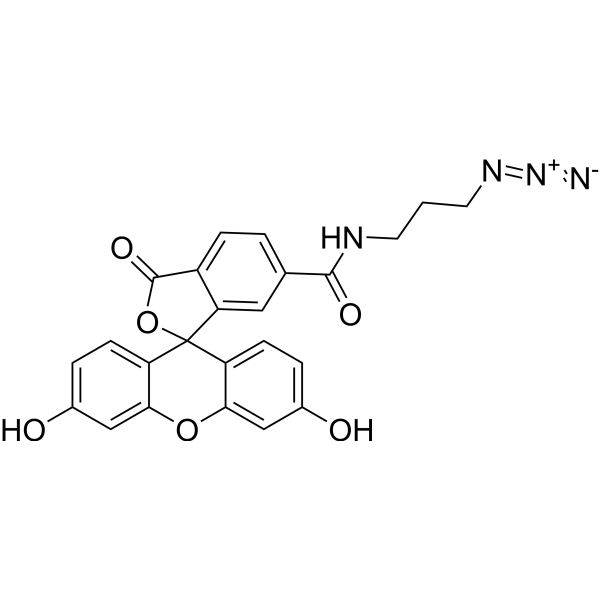
FAM azide, 6-isomer (6-FAM azide) is a 6-carboxyfluorescein derivative with an azide functional group and coupling partner in copper-catalyzed azide-alkyne cycloaddition. FAM azide, 6-isomer participates in synthesis of fluorescently tagged disparlure enantiomers for pheromone-binding protein binding assays. FAM azide, 6-isomer is widely used for labeling oligonucleotides (Ex/Em = 493/517 nm) .
|
-
-
- HY-123629
-
|
|
Fluorescent Dye
|
Others
|
|
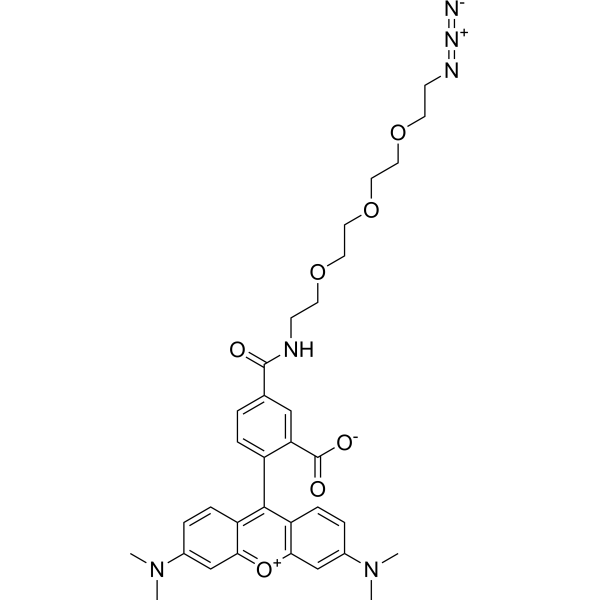
TAMRA-PEG3-Azide is a dye derivative of TAMRA (HY-135640) containing 3 PEG units. TAMRA-PEG3-Azide contains an Azide group and can undergo copper-catalyzed azide-alkyne cycloaddition reaction (CuAAc) with molecules containing Alkyne groups. It can also undergo strain-promoted alkyne-azide cycloaddition (SPAAC) reactions with molecules containing DBCO or BCN groups.
|
-
-
- HY-W008395
-
|
|
Amino Acid Derivatives
|
Others
|
|
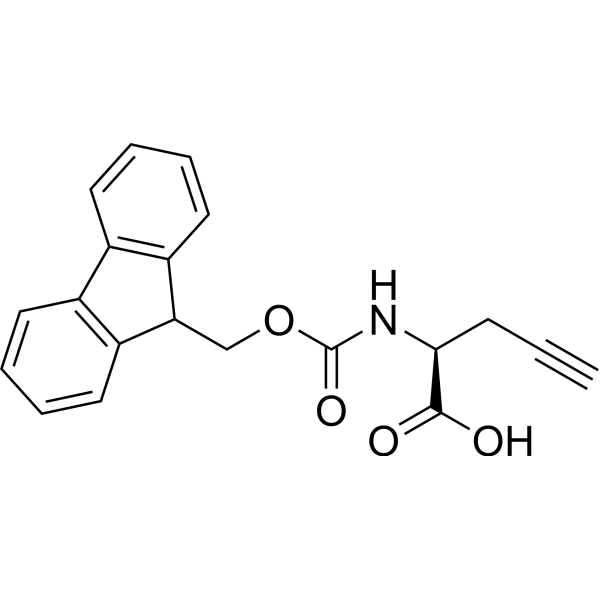
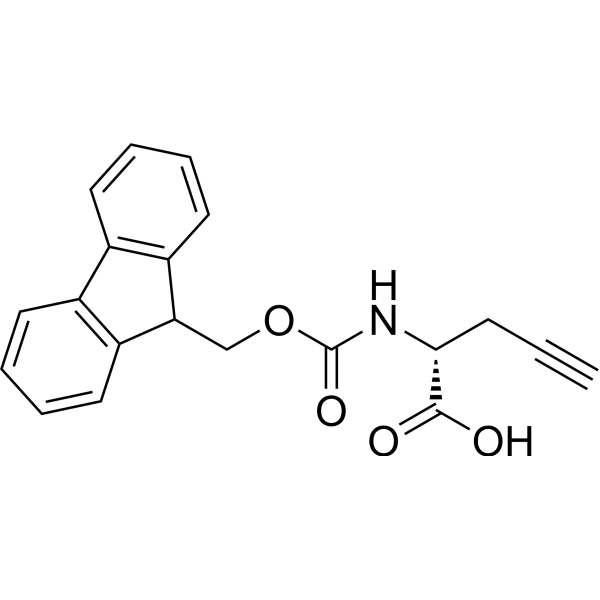
Fmoc-D-Pra-OH is a Glycine (HY-Y0966) derivative . Fmoc-D-Pra-OH is a click chemistry reagent, it contains an Alkyne group and can undergo copper-catalyzed azide-alkyne cycloaddition (CuAAc) with molecules containing Azide groups.
|
-
-
- HY-157573
-
|
|
Bacterial
|
Infection
|
|
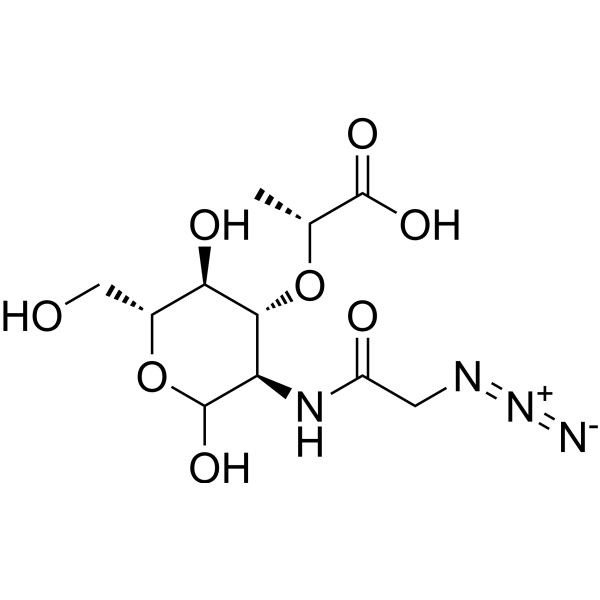
N-Acetylmuramic acid-azide (Compound 2) is a derivative of N-acetylaminoacetic acid (NAM) in bacterial peptidoglycan. Incorporated into bacterial peptidoglycan during biosynthesis .
|
-
-
- HY-P11195
-
|
|
Drug Derivative
|
Neurological Disease
|
|
Angiopep-2 azide is a peptide derivative of Angiopep-2 (HY-P2341) bearing a side chain azide (N3) group. Angiopep-2 exhibits high blood-brain barrier (BBB) penetration capability and can be used for brain compound delivery .
|
-
-
- HY-13443B
-
-
-
- HY-D2161A
-
|
|
Fluorescent Dye
|
Others
|
|
AF 594 azide (triethylamine) is an azide derivative of the red fluorescent dye AF 594, which has high fluorescence quantum yield and high photostability (maximum absorption wavelength of 586 nm, maximum emission wavelength of 613 nm). AF 594 azide (triethylamine) forms stable adducts by reaction of the azide group with alkynyl derivatives (terminal alkynes and cyclooctyne) .
|
-
-
- HY-W717800A
-
-
-
- HY-W250928D
-
|
|
Fluorescent Dye
|
Others
|
|
Biotin-PEG3400-azide is a biotin labeled PEG derivative. Biotin is an enzyme co-factor, can be used for labeling protein; PEG is a hydrophilic and water-soluble polymer with low toxicity; azide, is a moderately good leaving group, can react with alkyne by Cu-catalyzation, which improve the efficiency of biotin binding targets. It contains an azide group and can undergo copper-catalyzed azide-alkyne cycloaddition (CuAAc) with molecules containing alkyne groups. It can also undergo ring strain-promoted alkyne-azide cycloaddition (SPAAC) with molecules containing DBCO or BCN groups.
|
-
-
- HY-W250928C
-
|
|
Fluorescent Dye
|
Others
|
|
Biotin-PEG2000-azide is a biotin labeled PEG derivative. Biotin is an enzyme co-factor, can be used for labeling protein; PEG is a hydrophilic and water-soluble polymer with low toxicity; azide, is a moderately good leaving group, can react with alkyne by Cu-catalyzation, which improve the efficiency of biotin binding targets. It contains an azide group and can undergo copper-catalyzed azide-alkyne cycloaddition (CuAAc) with molecules containing alkyne groups. It can also undergo ring strain-promoted alkyne-azide cycloaddition (SPAAC) with molecules containing DBCO or BCN groups.
|
-
-
- HY-W190862
-
|
Biotin-PEG10-N3
|
Biochemical Assay Reagents
|
Others
|
|
Biotin-PEG10-azide (Biotin-PEG10-N3) is a PEG derivative composed of biotin, 10 PEG units, and an azide group. Biotin can form a stable non-covalent bond with streptavidin. It contains an azide group and can undergo copper-catalyzed azide-alkyne cycloaddition (CuAAc) with molecules containing alkyne groups. It can also undergo ring strain-driven alkyne-azide cycloaddition (SPAAC) with molecules containing DBCO or BCN groups.
|
-
-
- HY-136554
-
|
|
Drug Derivative
|
Cancer
|
|
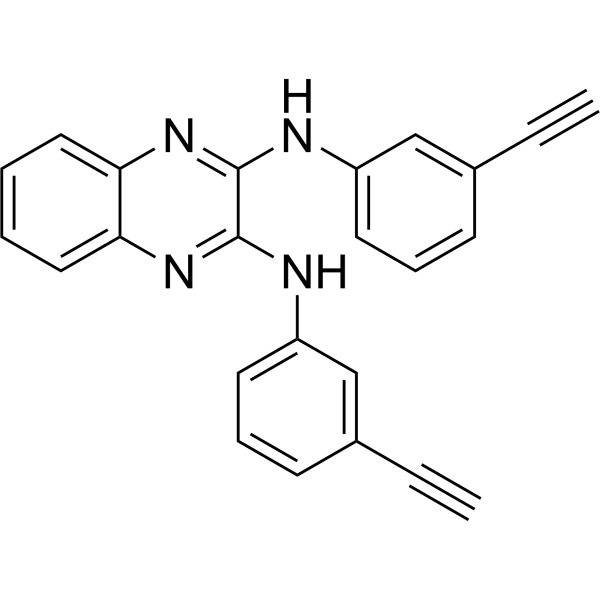
WYC-210, a Tazarotene derivative, is a retinoid compound with lower anticancer activity . WYC-210 is a click chemistry reagent, it contains an Alkyne group and can undergo copper-catalyzed azide-alkyne cycloaddition (CuAAc) with molecules containing Azide groups.
|
-
-
- HY-151693
-
|
|
ADC Linker
|
Others
|
|
H-L-Tyr(2-azidoethyl)-OH hydrochloride is a unnatural Tyrosine derivative. H-L-Tyr(2-azidoethyl)-OH hydrochloride is a click chemistry reagent containing an azide group . It contains an azide group and can undergo copper-catalyzed azide-alkyne cycloaddition (CuAAc) with molecules containing alkyne groups. It can also undergo ring strain-promoted alkyne-azide cycloaddition (SPAAC) with molecules containing DBCO or BCN groups.
|
-
-
- HY-151661
-
|
L-azidovaline (CHA)
|
ADC Linker
|
Others
|
|
N3-L-Val-OH (CHA) is a click chemistry containing an azide group, a valine derivative. N3-L-Val-OH (CHA) can also be used as a synthetic intermediate for Valaciclovir (Valacyclovir) . It contains an azide group and can undergo copper-catalyzed azide-alkyne cycloaddition (CuAAc) with molecules containing alkyne groups. It can also undergo ring strain-promoted alkyne-azide cycloaddition (SPAAC) with molecules containing DBCO or BCN groups.
|
-
-
- HY-151748
-
|
|
ADC Linker
|
Others
|
|
N3-L-Orn(Fmoc)-OH is a Fmoc-protected ornithine derivative, can be used as a click chemistry reagent. It contains an azide group and can undergo copper-catalyzed azide-alkyne cycloaddition (CuAAc) with molecules containing alkyne groups. It can also undergo ring strain-promoted alkyne-azide cycloaddition (SPAAC) with molecules containing DBCO or BCN groups.
|
-
-
- HY-D2113
-
|
|
Fluorescent Dye
|
Others
|
|
TAMRA-PEG3-Alkyne is a dye derivative of TAMRA (HY-135640) containing 3 PEG units. TAMRA-PEG3-Alkyne contains Alkyne groups and can undergo copper-catalyzed azide-alkyne cycloaddition (CuAAc) with molecules containing Azide groups.
|
-
-
- HY-174924
-
|
|
Biochemical Assay Reagents
|
Others
|
|
Cholesterol-PEG3-azide is a PEG derivative composed of Cholesterol, 3 PEG units and an azide group. It contains an azide group and can undergo copper-catalyzed azide-alkyne cycloaddition reaction (CuAAc) with molecules containing alkyne groups. It can also undergo ring strain-driven alkyne-azide cycloaddition reaction (SPAAC) with molecules containing DBCO or BCN groups.
|
-
-
- HY-W051612A
-
|
|
Amino Acid Derivatives
Biochemical Assay Reagents
|
Others
|
|
DL-Propargylglycine sodium is a Glycine (HY-Y0966) derivative. DL-Propargylglycine sodium is a click chemistry reagent, it contains an Alkyne group and can undergo copper-catalyzed azide-alkyne cycloaddition (CuAAc) with molecules containing Azide groups .
|
-
-
- HY-151693A
-
|
|
ADC Linker
|
Others
|
|
H-L-Tyr(2-azidoethyl)-OH is a unnatural Tyrosine derivative. H-L-Tyr(2-azidoethyl)-OH is a click chemistry reagent containing an azide group . It contains an azide group and can undergo copper-catalyzed azide-alkyne cycloaddition (CuAAc) with molecules containing alkyne groups. It can also undergo ring strain-promoted alkyne-azide cycloaddition (SPAAC) with molecules containing DBCO or BCN groups.
|
-
-
- HY-151703
-
|
|
ADC Linker
|
Others
|
|
Boc-D-Lys(N3)-OH is a Boc-protected amino acid derivative, can be used as a click chemistry reagent and an intermediate for synthesis of linkers . It contains an azide group and can undergo copper-catalyzed azide-alkyne cycloaddition (CuAAc) with molecules containing alkyne groups. It can also undergo ring strain-promoted alkyne-azide cycloaddition (SPAAC) with molecules containing DBCO or BCN groups.
|
-
-
- HY-151687
-
|
|
ADC Linker
|
Others
|
|
Fmoc-L-Tyr(2-azidoethyl)-OH is a click chemistry reagent containing an azide group. Fmoc-L-Tyr(2-azidoethyl)-OH is unnatural Fmoc-protected Tyrosine derivative bears an azidoethyl substitution as reactive handle e.g. for biorthogonal conjugations, via a Cu(I)-catalyzed 1,3-dipolar Click cycloaddition with alkynes. And azido-UAAs can be employed as IR reporters . It contains an azide group and can undergo copper-catalyzed azide-alkyne cycloaddition (CuAAc) with molecules containing alkyne groups. It can also undergo ring strain-promoted alkyne-azide cycloaddition (SPAAC) with molecules containing DBCO or BCN groups.
|
-
-
- HY-D2161
-
|
|
Fluorescent Dye
|
Others
|
|
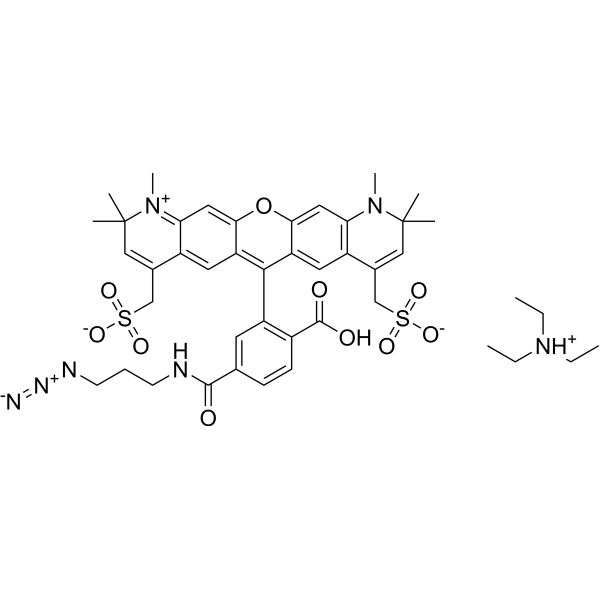
AF 594 azide is an azide derivative of the red fluorescent dye AF 594, which has high fluorescence quantum yield and high photostability (maximum absorption wavelength of 586 nm, maximum emission wavelength of 613 nm). AF 594 azide forms stable adducts by reaction of the azide group with alkynyl derivatives (terminal alkynes and cyclooctyne). It contains an azide group and can undergo copper-catalyzed azide-alkyne cycloaddition (CuAAc) with molecules containing alkyne groups. It can also undergo ring strain-promoted alkyne-azide cycloaddition (SPAAC) with molecules containing DBCO or BCN groups .
|
-
-
- HY-167063
-
|
azide-Polysarcosine20
|
Biochemical Assay Reagents
|
Others
|
|
Azide-pSar20 (Azide-Polysarcosine20) is a pSar-lipid derivative. Azide-pSar20 is a hydrophilic alternative to PEG and can be used in drug delivery research .
|
-
-
- HY-D1944
-
|
|
Fluorescent Dye
|
Others
|
|
ATTO 590 Azide is an azide derivative of ATTO 590 with excitation/emission maxima at 594/622 nm. ATTO 590 azide is a click chemistry reagent, it contains an Azide group and can undergo copper-catalyzed azide-alkyne cycloaddition reaction (CuAAc) with molecules containing Alkyne groups. It can also undergo strain-promoted alkyne-azide cycloaddition (SPAAC) reactions with molecules containing DBCO or BCN groups.
|
-
-
- HY-W1048861D
-
|
4-Arm PEG40000-N3
|
Biochemical Assay Reagents
|
Others
|
|
4-Arm PEG40000-Azide (4-Arm PEG40000-N3) is a multi-arm PEG derivative with an azide group at each end of four arms attached to a pentaerythritol core .
|
-
-
- HY-W096120A
-
|
|
Biochemical Assay Reagents
|
Others
|
|
Azide-PEG1-Desthiobiotin is a PEG derivative consisting of desthiobiotin, 1 PEG unit, and an azide group. Biotin can form a stable non-covalent bond with streptavidin. It contains an azide group and can undergo copper-catalyzed azide-alkyne cycloaddition (CuAAc) with molecules containing alkyne groups. It can also undergo ring strain-driven alkyne-azide cycloaddition (SPAAC) with molecules containing DBCO or BCN groups .
|
-
-
- HY-W051612
-
|
|
Amino Acid Derivatives
|
Others
|
|
DL-Propargylglycine hydrochloride is a Glycine (HY-Y0966) derivative. DL-Propargylglycine hydrochloride is a click chemistry reagent, it contains an Alkyne group and can undergo copper-catalyzed azide-alkyne cycloaddition (CuAAc) with molecules containing Azide groups .
|
-
-
- HY-174970D
-
|
Silane-PEG3400-azide
|
Biochemical Assay Reagents
|
Others
|
|
Silane-PEG3400-N3 (Silane-PEG3400-azide) is a PEG derivative composed of silane, PEG units, and azide groups, which can be used to modify glass, silicon, or other surfaces by reacting hydroxyl groups with ethoxy (methoxy) silanes. Silane-PEG3400-N3 contains an azide group and can undergo copper-catalyzed azide-alkyne cycloaddition (CuAAc) with molecules containing alkyne groups. It can also undergo ring strain-driven alkyne-azide cycloaddition (SPAAC) with molecules containing DBCO or BCN groups .
|
-
-
- HY-174963C
-
|
|
Biochemical Assay Reagents
|
Others
|
|
DBCO-PEG2000-OH is a PEG derivative composed of DBCO, PEG, and hydroxyl groups. DBCO-PEG2000-OH contains a DBCO group that can undergo strain-promoted alkyne-azide cycloaddition (SPAAC) with molecules containing Azide groups .
|
-
-
- HY-181228
-
|
|
Biochemical Assay Reagents
|
Others
|
|
DBCO-PEG10-Biotin is an azadibenzocyclooctyne-biotin derivative containing a biotin group and 10 PEGs. DBCO-PEG10-Biotin is a versatile biotinylation reagent used for the introduction of a biotin moiety to azide-labeled biomolecules via copper-free strain-promoted alkyne-azide click chemistry (SPAAC) reaction. DBCO-PEG10-Biotin is a click chemistry reagent, it contains a DBCO group that can undergo strain-promoted alkyne-azide cycloaddition (SPAAC) with molecules containing Azide groups .
|
-
-
- HY-W1049105
-
|
|
Biochemical Assay Reagents
|
Others
|
|
mPEG2000-Alkyne is a PEG derivative. The alkynyl group can react with azide in aqueous solution under the catalysis of monovalent copper. Polyethylene glycol derivatives can increase the solubility and stability of drugs, reduce the immunogenicity of peptides, and have good biocompatibility .
|
-
-
- HY-174965H
-
|
DBCO-PEG10000-Thiol
|
Biochemical Assay Reagents
|
Others
|
|
DBCO-PEG10000-SH (DBCO-PEG10000-Thiol) is a DBCO-modified PEG derivative. DBCO-PEG10000-SH contains a DBCO group and can undergo a strain-promoted alkyne-azide cycloaddition reaction (SPAAC) with molecules containing an azide group .
|
-
-
- HY-D1953
-
|
|
Fluorescent Dye
|
Others
|
|
ATTO 594 Azide is an azide derivative of ATTO 594 with excitation/emission maxima at 603/626 nm.
|
-
-
- HY-D1967
-
|
|
Fluorescent Dye
|
Others
|
|
ATTO 633 Azide is an azide derivative of ATTO 520 with excitation/emission maxima at 630/651 nm.
|
-
-
- HY-D2006
-
|
|
Fluorescent Dye
|
Others
|
|
ATTO 565 azide is an azide derivative of ATTO 565 with excitation/emission maxima at 564/590 nm.
|
-
-
- HY-D1990
-
|
|
Fluorescent Dye
|
Others
|
|
ATTO 620 Azide is an azide derivative of ATTO 520 with excitation/emission maxima at 620/642 nm.
|
-
-
- HY-D2079
-
|
|
Fluorescent Dye
|
Others
|
|
ATTO 665 azide is an azide derivative of ATTO 665 with excitation/emission maxima at 663/680 nm.
|
-
-
- HY-167069
-
|
azide-Polysarcosine100
|
Biochemical Assay Reagents
|
Others
|
|
Azide-pSar100 (Azide-Polysarcosine100) is a pSar-lipid derivative. Azide-pSar100 is a hydrophilic alternative to PEG and can be used in drug delivery research .
|
-
-
- HY-W440695
-
|
|
Biochemical Assay Reagents
|
Others
|
|
Cholesterol-PEG3400-azide is a cholesterol PEG derivative that can form micelles through molecular self-assembly and has a longer half-life in vivo. Cholesterol-PEG3400-azide can be used in drug delivery research .
|
-
-
- HY-W440696
-
|
|
Biochemical Assay Reagents
|
Others
|
|
Cholesterol-PEG5000-azide is a cholesterol PEG derivative that can form micelles through molecular self-assembly and has a longer half-life in vivo. Cholesterol-PEG5000-azide can be used in drug delivery research .
|
-
-
- HY-W440693
-
|
|
Biochemical Assay Reagents
|
Others
|
|
Cholesterol-PEG1000-azide is a cholesterol PEG derivative that can form micelles through molecular self-assembly and has a longer half-life in vivo. Cholesterol-PEG1000-azide can be used in drug delivery research .
|
-
-
- HY-167071
-
|
|
Biochemical Assay Reagents
|
Others
|
|
PLLA-azide (MW 5000) is a polylactic acid derivative that can self-assemble in water. PLLA-azide (MW 5000) can be used in drug delivery research .
|
-
-
- HY-167117
-
|
|
Biochemical Assay Reagents
|
Others
|
|
PLLA-azide (MW 10000) is a polylactic acid derivative that can self-assemble in water. PLLA-azide (MW 10000) can be used in drug delivery research .
|
-
-
- HY-103700A
-
|
UAA crosslinker 2
|
Amino Acid Derivatives
|
Others
|
|
Azide-phenylalanine hydrochloride is a phenylalanine derivative. Azide-phenylalanine (hydrochloride) is a click chemistry reagent, it contains an Azide group and can undergo copper-catalyzed azide-alkyne cycloaddition reaction (CuAAc) with molecules containing Alkyne groups. It can also undergo strain-promoted alkyne-azide cycloaddition (SPAAC) reactions with molecules containing DBCO or BCN groups.
|
-
-
- HY-174924A
-
|
|
Biochemical Assay Reagents
|
Others
|
|
Cholesterol-PEG8-azide is a PEG derivative composed of Cholesterol, 8 PEG units and an azide group. It contains an azide group and can undergo copper-catalyzed azide-alkyne cycloaddition reaction (CuAAc) with molecules containing alkyne groups. It can also undergo ring strain-driven alkyne-azide cycloaddition reaction (SPAAC) with molecules containing DBCO or BCN groups.
|
-
- HY-D2033
-
|
|
Fluorescent Dye
|
Others
|
|
ATTO 514 azide is an azide derivative of ATTO 514 with excitation/emission maxima at 511/531 nm. ATTO 514 azide is a click chemistry reagent, it contains an Azide group and can undergo copper-catalyzed azide-alkyne cycloaddition reaction (CuAAc) with molecules containing Alkyne groups. It can also undergo strain-promoted alkyne-azide cycloaddition (SPAAC) reactions with molecules containing DBCO or BCN groups.
|
-
- HY-D1920
-
|
|
Fluorescent Dye
|
Others
|
|
ATTO 390 azide is an azide derivative of ATTO 390 with excitation/emission maxima at 390/476 nm. ATTO 390 azide is a click chemistry reagent, it contains an Azide group and can undergo copper-catalyzed azide-alkyne cycloaddition reaction (CuAAc) with molecules containing Alkyne groups. It can also undergo strain-promoted alkyne-azide cycloaddition (SPAAC) reactions with molecules containing DBCO or BCN groups.
|
-
- HY-D2077
-
|
|
Fluorescent Dye
|
Others
|
|
ATTO 725 azide is an azide derivative of ATTO 725 with excitation/emission maxima at 728/751 nm. ATTO 725 azide is a click chemistry reagent, it contains an Azide group and can undergo copper-catalyzed azide-alkyne cycloaddition reaction (CuAAc) with molecules containing Alkyne groups. It can also undergo strain-promoted alkyne-azide cycloaddition (SPAAC) reactions with molecules containing DBCO or BCN groups.
|
-
- HY-D1930
-
|
|
Fluorescent Dye
|
Others
|
|
ATTO 425 Azide is an azide derivative of ATTO 425, the maximum excitation and emission wavelength: 439/489 nm. ATTO 425 azide is a click chemistry reagent, it contains an Azide group and can undergo copper-catalyzed azide-alkyne cycloaddition reaction (CuAAc) with molecules containing Alkyne groups. It can also undergo strain-promoted alkyne-azide cycloaddition (SPAAC) reactions with molecules containing DBCO or BCN groups.
|
-
- HY-103700B
-
|
|
Amino Acid Derivatives
|
Others
|
|
(Rac)-Azide-phenylalanine is a racemate of Azide-phenylalanine. Azide-phenylalanine is a phenylalanine derivative and a non-natural amino acid. Azide-phenylalanine can be site-specifically incorporated into proteins and used to label proteins . (Rac)-Azide-phenylalanine is a click chemistry reagent, it contains an Azide group and can undergo copper-catalyzed azide-alkyne cycloaddition reaction (CuAAc) with molecules containing Alkyne groups. It can also undergo strain-promoted alkyne-azide cycloaddition (SPAAC) reactions with molecules containing DBCO or BCN groups.
|
-
- HY-D2138
-
|
|
Fluorescent Dye
|
Others
|
|
Cy3-PEG7-Azide is a Cyanine 3 (Cy3) (HY-D0822) dye derivative containing 7 PEG units. Cy3-PEG7-Azide contains an azide group and can undergo copper-catalyzed azide-alkyne cycloaddition (CuAAc) with molecules containing alkyne groups. It can also undergo ring strain-promoted alkyne-azide cycloaddition (SPAAC) with molecules containing DBCO or BCN groups.
|
-
- HY-D2136
-
|
|
Fluorescent Dye
|
Others
|
|
Cy3-PEG2-Azide is a Cyanine 3 (Cy3) (HY-D0822) dye derivative containing 2 PEG units. Cy3-PEG2-Azide contains an azide group and can undergo copper-catalyzed azide-alkyne cycloaddition (CuAAc) with molecules containing alkyne groups. It can also undergo ring strain-promoted alkyne-azide cycloaddition (SPAAC) with molecules containing DBCO or BCN groups.
|
-
- HY-D2137
-
|
|
Fluorescent Dye
|
Others
|
|
Cy3-PEG3-Azide is a Cyanine 3 (Cy3) (HY-D0822) dye derivative containing 3 PEG units. Cy3-PEG3-Azide contains an azide group and can undergo copper-catalyzed azide-alkyne cycloaddition (CuAAc) with molecules containing alkyne groups. It can also undergo ring strain-promoted alkyne-azide cycloaddition (SPAAC) with molecules containing DBCO or BCN groups.
|
-
- HY-W1048861K
-
|
4-Arm-PEG2000-N3
|
Biochemical Assay Reagents
|
Others
|
|
4-Arm-PEG2000-Azide (4-Arm-PEG2000-N3) is a PEG derivative composed of a PEG unit and an azide group. It contains an azide group and can undergo copper-catalyzed azide-alkyne cycloaddition reaction (CuAAc) with molecules containing alkyne groups. It can also undergo ring strain-driven alkyne-azide cycloaddition reaction (SPAAC) with molecules containing DBCO or BCN groups .
|
-
- HY-141091
-
|
|
Fluorescent Dye
|
Others
|
|
Biotin-PEG4-Dde-TAMRA-PEG3-Azide is a dye derivative of TAMRA (HY-135640) modified with a cleavable biotin group. Biotin-PEG4-Dde-TAMRA-PEG3-Azide contains an Azide group and can undergo copper-catalyzed azide-alkyne cycloaddition reaction (CuAAc) with molecules containing Alkyne groups. It can also undergo strain-promoted alkyne-azide cycloaddition (SPAAC) reactions with molecules containing DBCO or BCN groups.
|
-
- HY-W096120B
-
|
|
Biochemical Assay Reagents
|
Others
|
|
Azide-PEG2-Desthiobiotin is a PEG derivative consisting of desthiobiotin, 2 PEG units, and an azide group. Biotin can form a stable non-covalent bond with streptavidin. It contains an azide group and can undergo copper-catalyzed azide-alkyne cycloaddition (CuAAc) with molecules containing alkyne groups. It can also undergo ring strain-driven alkyne-azide cycloaddition (SPAAC) with molecules containing DBCO or BCN groups .
|
-
- HY-D2156
-
|
|
Fluorescent Dye
|
Others
|
|
AF 430 azide is a derivative of the yellow fluorescent dye AF 430. AF430 has an excitation wavelength of 425 nm and an emission wavelength of 542 nm. AF 430 azide can undergo copper-catalyzed azide-alkyne cycloaddition (CuAAc) via the azide group and molecules containing Alkyne groups. It can also undergo strain-promoted alkyne-azide cycloaddition (SPAAC) reactions with molecules containing DBCO or BCN groups. To achieve specific coupling of dye labels and biomolecules .
|
-
- HY-D1868
-
|
|
Fluorescent Dye
|
Others
|
|
Cy3 azide plus is a Cyanine 3 (Cy3) (HY-D0822) dye derivative with an azide functional group. Cy3 is a fluorescent dye with a fluorescence spectrum typically in the green to orange wavelength range. The azide group of Cy3 azide plus can react chemically with molecules containing alkyne functionality, such as alkyne or cyclooctyne, to form covalent bonds. Therefore, Cy3 azide plus can bind to biomolecules such as proteins and antibodies to track their location and dynamic changes in biological samples.
|
-
- HY-D2168
-
|
|
Fluorescent Dye
|
Others
|
|
AF 568 azide is an azide derivative of the orange fluorescent dye AF 568. AF 568 has an absorption wavelength of 590-720 nm (FRET) and an emission wavelength of 515-720 nm. AF 568 alkyne can undergo copper-catalyzed azide-alkyne cycloaddition (CuAAc) via the Azide group and molecules containing Alkyne groups. Strain-promoted alkyne-azide cycloaddition (SPAAC) can also occur with molecules containing DBCO or BCN groups. To achieve specific coupling of dye labels and biomolecules .
|
-
- HY-174970C
-
|
Silane-PEG2000-azide
|
Biochemical Assay Reagents
|
Others
|
|
Silane-PEG2000-N3 (Silane-PEG2000-azide) is a PEG derivative composed of silane, PEG units, and azide groups, which can be used to modify glass, silicon, or other surfaces by reacting hydroxyl groups with ethoxy (methoxy) silanes. Silane-PEG2000-N3 contains an azide group and can undergo copper-catalyzed azide-alkyne cycloaddition (CuAAc) with molecules containing alkyne groups. It can also undergo ring strain-driven alkyne-azide cycloaddition (SPAAC) with molecules containing DBCO or BCN groups .
|
-
- HY-174970H
-
|
Silane-PEG10000-azide
|
Biochemical Assay Reagents
|
Others
|
|
Silane-PEG10000-N3 (Silane-PEG10000-azide) is a PEG derivative composed of silane, PEG units, and azide groups, which can be used to modify glass, silicon, or other surfaces by reacting hydroxyl groups with ethoxy (methoxy) silanes. Silane-PEG10000-N3 contains an azide group and can undergo copper-catalyzed azide-alkyne cycloaddition (CuAAc) with molecules containing alkyne groups. It can also undergo ring strain-driven alkyne-azide cycloaddition (SPAAC) with molecules containing DBCO or BCN groups .
|
-
- HY-174970B
-
|
Silane-PEG1000-azide
|
Biochemical Assay Reagents
|
Others
|
|
Silane-PEG1000-N3 (Silane-PEG1000-azide) is a PEG derivative composed of silane, PEG units, and azide groups, which can be used to modify glass, silicon, or other surfaces by reacting hydroxyl groups with ethoxy (methoxy) silanes. Silane-PEG1000-N3 contains an azide group and can undergo copper-catalyzed azide-alkyne cycloaddition (CuAAc) with molecules containing alkyne groups. It can also undergo ring strain-driven alkyne-azide cycloaddition (SPAAC) with molecules containing DBCO or BCN groups .
|
-
- HY-151658
-
|
|
ADC Linker
|
Others
|
|
H-L-Lys(N3-Gly)-OH is a click chemistry containing an azide group, a lysine derivative. H-L-Lys(N3-Gly)-OH can be incorporated into proteins for click modifications . It contains an azide group and can undergo copper-catalyzed azide-alkyne cycloaddition (CuAAc) with molecules containing alkyne groups. It can also undergo ring strain-promoted alkyne-azide cycloaddition (SPAAC) with molecules containing DBCO or BCN groups.
|
-
- HY-151658A
-
|
|
ADC Linker
|
Others
|
|
H-L-Lys(N3-Gly)-OH hydrochloride is a click chemistry containing an azide group, a lysine derivative. H-L-Lys(N3-Gly)-OH hydrochloride can be incorporated into proteins for click modifications . It contains an azide group and can undergo copper-catalyzed azide-alkyne cycloaddition (CuAAc) with molecules containing alkyne groups. It can also undergo ring strain-promoted alkyne-azide cycloaddition (SPAAC) with molecules containing DBCO or BCN groups.
|
-
- HY-D1969
-
|
|
Fluorescent Dye
|
Others
|
|
ATTO 700 Alkin is an alkyne derivative of ATTO 700 with maximum excitation/emission wavelengths: 700/716 nm. ATTO 700 Alkin is a click chemistry reagent, it contains an Alkyne group and can undergo copper-catalyzed azide-alkyne cycloaddition (CuAAc) with molecules containing Azide groups.
|
-
- HY-D2054
-
|
|
Fluorescent Dye
|
Others
|
|
ATTO 532 alkin is an alkyne derivative of ATTO 532 with maximum excitation/emission wavelengths: 532/552 nm. ATTO 532 alkin is a click chemistry reagent, it contains an Alkyne group and can undergo copper-catalyzed azide-alkyne cycloaddition (CuAAc) with molecules containing Azide groups.
|
-
- HY-D1924
-
|
|
Fluorescent Dye
|
Others
|
|
ATTO 390 alkyne is an alkyne derivative of ATTO 390 with maximum excitation/emission wavelengths: 390/476 nm. ATTO 390 alkyne is a click chemistry reagent, it contains an Alkyne group and can undergo copper-catalyzed azide-alkyne cycloaddition (CuAAc) with molecules containing Azide groups.
|
-
- HY-140020
-
|
|
Biochemical Assay Reagents
|
Others
|
|
Propargyl-PEG10-acid is a PEG derivative containing a propargyl group with a terminal carboxylic acid. Propargyl-PEG10-acid is a click chemistry reagent, it contains an Alkyne group and can undergo copper-catalyzed azide-alkyne cycloaddition (CuAAc) with molecules containing Azide groups.
|
-
- HY-174963
-
|
|
Biochemical Assay Reagents
|
Others
|
|
DBCO-PEG400-OH is a PEG derivative composed of DBCO, PEG, and hydroxyl groups. DBCO-PEG400-OH contains a DBCO group that can undergo strain-promoted alkyne-azide cycloaddition (SPAAC) with molecules containing Azide groups .
|
-
- HY-174963D
-
|
|
Biochemical Assay Reagents
|
Others
|
|
DBCO-PEG3400-OH is a PEG derivative composed of DBCO, PEG, and hydroxyl groups. DBCO-PEG3400-OH contains a DBCO group that can undergo strain-promoted alkyne-azide cycloaddition (SPAAC) with molecules containing Azide groups .
|
-
- HY-174963E
-
|
|
Biochemical Assay Reagents
|
Others
|
|
DBCO-PEG5000-OH is a PEG derivative composed of DBCO, PEG, and hydroxyl groups. DBCO-PEG5000-OH contains a DBCO group that can undergo strain-promoted alkyne-azide cycloaddition (SPAAC) with molecules containing Azide groups .
|
-
- HY-174963A
-
|
|
Biochemical Assay Reagents
|
Others
|
|
DBCO-PEG600-OH is a PEG derivative composed of DBCO, PEG, and hydroxyl groups. DBCO-PEG600-OH contains a DBCO group that can undergo strain-promoted alkyne-azide cycloaddition (SPAAC) with molecules containing Azide groups .
|
-
- HY-174963B
-
|
|
Biochemical Assay Reagents
|
Others
|
|
DBCO-PEG1000-OH is a PEG derivative composed of DBCO, PEG, and hydroxyl groups. DBCO-PEG1000-OH contains a DBCO group that can undergo strain-promoted alkyne-azide cycloaddition (SPAAC) with molecules containing Azide groups .
|
-
- HY-140948
-
|
|
Fluorescent Dye
|
Others
|
|
(5,6)TAMRA-PEG3-Azide-PEG3-Desthiobiotin is a dye derivative of TAMRA (HY-135640) containing 3 PEG units. (5,6)TAMRA-PEG3-Azide-PEG3-Desthiobiotin contains an Azide group and can undergo copper-catalyzed azide-alkyne cycloaddition reaction (CuAAc) with molecules containing Alkyne groups. It can also undergo strain-promoted alkyne-azide cycloaddition (SPAAC) reactions with molecules containing DBCO or BCN groups.
|
-
- HY-D1318
-
|
|
Fluorescent Dye
|
Others
|
|
Cyanine7.5 azide chloride is a dye derivative of Cyanine 7.5 (Cy7.5) (HY-D0926) with an azide functional group. Cy7.5 is a near-infrared fluorescent dye commonly used for biolabeling and cell imaging. The azide group of Cyanine7.5 azide chloride can react chemically with molecules containing alkyne functionality, such as alkyne or cyclooctyne, to form covalent bonds. Therefore, Cyanine7.5 azide chloride can bind to biomolecules such as proteins and antibodies to track their location and dynamic changes in biological samples.
|
-
- HY-D2114
-
|
|
Fluorescent Dye
|
Others
|
|
TAMRA-PEG8-Alkyne is a dye derivative of TAMRA (HY-135640) containing 8 PEG units. TAMRA-PEG8-Alkyne contains Alkyne groups and can undergo copper-catalyzed azide-alkyne cycloaddition (CuAAc) with molecules containing Azide groups.
|
-
- HY-174934
-
|
|
Biochemical Assay Reagents
|
Others
|
|
TCO-PEG3400-DBCO is a PEG derivative consisting of DBCO, PEG units, and trans-cyclooctene (TCO). TCO-PEG3400-DBCO contains a DBCO group and can undergo a strain-promoted alkyne-azide cycloaddition reaction (SPAAC) with molecules containing an azide group .
|
-
- HY-W1049091C
-
|
|
Biochemical Assay Reagents
|
Others
|
|
mPEG20000-Alkyne is a PEG derivative. The alkynyl group can react with azide in aqueous solution under the catalysis of monovalent copper. Polyethylene glycol derivatives can increase the solubility and stability of drugs, reduce the immunogenicity of peptides, and have good biocompatibility .
|
-
- HY-W190984A
-
|
|
Biochemical Assay Reagents
|
Others
|
|
Desthiobiotin-PEG1-alkyne is a PEG derivative composed of desthiobiotin, 1 PEG unit and alkyne. Desthiobiotin-PEG1-alkyne is a click chemistry reagent. It contains an alkyne group and can undergo copper-catalyzed azide-alkyne cycloaddition reaction (CuAAc) with molecules containing an azide group.
|
-
- HY-180122
-
-
- HY-167068
-
|
azide-Polysarcosine150
|
Biochemical Assay Reagents
|
Others
|
|
Azide-pSar150 (Azide-Polysarcosine150) is a pSar-lipid derivative. Azide-pSar150 is a hydrophilic alternative to PEG and can be used in drug delivery research .
|
-
- HY-167115
-
|
|
Biochemical Assay Reagents
|
Others
|
|
PLLA-azide (MW 20000) is a polylactic acid derivative that can self-assemble in water. PLLA-azide (MW 20000) can be used in drug delivery research .
|
-
- HY-140617B
-
|
|
Biochemical Assay Reagents
|
Others
|
|
DNP-PEG12-azide is a PEG derivative that can be used for drug delivery and other research. DNP-PEG12-azide is a click chemistry reagent, it contains an Azide group and can undergo copper-catalyzed azide-alkyne cycloaddition reaction (CuAAc) with molecules containing Alkyne groups. It can also undergo strain-promoted alkyne-azide cycloaddition (SPAAC) reactions with molecules containing DBCO or BCN groups .
|
-
- HY-140617A
-
|
|
Biochemical Assay Reagents
|
Others
|
|
DNP-PEG2-azide is a PEG derivative that can be used for drug delivery and other research. DNP-PEG2-azide is a click chemistry reagent, it contains an Azide group and can undergo copper-catalyzed azide-alkyne cycloaddition reaction (CuAAc) with molecules containing Alkyne groups. It can also undergo strain-promoted alkyne-azide cycloaddition (SPAAC) reactions with molecules containing DBCO or BCN groups .
|
-
- HY-W1048861A
-
|
4-Arm PEG5000-N3
|
Biochemical Assay Reagents
|
Others
|
|
4-Arm PEG5000-Azide (4-Arm PEG5000-N3) is a multi-arm PEG derivative with an azide group at each end of four arms attached to a pentaerythritol core .
|
-
- HY-W1048861B
-
|
4-Arm PEG10000-N3
|
Biochemical Assay Reagents
|
Others
|
|
4-Arm PEG10000-Azide (4-Arm PEG10000-N3) is a multi-arm PEG derivative with an azide group at each end of four arms attached to a pentaerythritol core .
|
-
- HY-W1048861C
-
|
4-Arm PEG20000-N3
|
Biochemical Assay Reagents
|
Others
|
|
4-Arm PEG20000-Azide (4-Arm PEG20000-N3) is a multi-arm PEG derivative with an azide group at each end of four arms attached to a pentaerythritol core .
|
-
- HY-W096120C
-
|
|
Biochemical Assay Reagents
|
Others
|
|
Azide-PEG4-Desthiobiotin is a PEG derivative consisting of desthiobiotin, 4 PEG unit, and an azide group. Biotin can form a stable non-covalent bond with streptavidin. It contains an azide group and can undergo copper-catalyzed azide-alkyne cycloaddition (CuAAc) with molecules containing alkyne groups. It can also undergo ring strain-driven alkyne-azide cycloaddition (SPAAC) with molecules containing DBCO or BCN groups .
|
-
- HY-174970E
-
|
Silane-PEG5000-azide
|
Biochemical Assay Reagents
|
Others
|
|
Silane-PEG5000-N3 (Silane-PEG5000-azide) is a PEG derivative composed of silane, PEG units, and azide groups, which can be used to modify glass, silicon, or other surfaces by reacting hydroxyl groups with ethoxy (methoxy) silanes. Silane-PEG5000-N3 contains an azide group and can undergo copper-catalyzed azide-alkyne cycloaddition (CuAAc) with molecules containing alkyne groups. It can also undergo ring strain-driven alkyne-azide cycloaddition (SPAAC) with molecules containing DBCO or BCN groups .
|
-
- HY-174963H
-
|
|
Biochemical Assay Reagents
|
Others
|
|
DBCO-PEG10000-OH is a PEG derivative composed of DBCO, PEG, and hydroxyl groups. DBCO-PEG10000-OH contains a DBCO group that can undergo strain-promoted alkyne-azide cycloaddition (SPAAC) with molecules containing Azide groups .
|
-
- HY-W1049091B
-
|
|
Biochemical Assay Reagents
|
Others
|
|
mPEG10000-Alkyne is a PEG derivative. The alkynyl group can react with azide in aqueous solution under the catalysis of monovalent copper. Polyethylene glycol derivatives can increase the solubility and stability of drugs, reduce the immunogenicity of peptides, and have good biocompatibility .
|
-
- HY-W1049091D
-
|
|
Biochemical Assay Reagents
|
Others
|
|
mPEG40000-Alkyne is a PEG derivative. The alkynyl group can react with azide in aqueous solution under the catalysis of monovalent copper. Polyethylene glycol derivatives can increase the solubility and stability of drugs, reduce the immunogenicity of peptides, and have good biocompatibility .
|
-
- HY-W1049091A
-
|
|
Biochemical Assay Reagents
|
Others
|
|
mPEG5000-Alkyne is a PEG derivative. The alkynyl group can react with azide in aqueous solution under the catalysis of monovalent copper. Polyethylene glycol derivatives can increase the solubility and stability of drugs, reduce the immunogenicity of peptides, and have good biocompatibility .
|
-
- HY-W1049091
-
|
|
Biochemical Assay Reagents
|
Others
|
|
mPEG1000-Alkyne is a PEG derivative. The alkynyl group can react with azide in aqueous solution under the catalysis of monovalent copper. Polyethylene glycol derivatives can increase the solubility and stability of drugs, reduce the immunogenicity of peptides, and have good biocompatibility .
|
-
- HY-W1049091E
-
|
|
Biochemical Assay Reagents
|
Others
|
|
mPEG3400-Alkyne is a PEG derivative. The alkynyl group can react with azide in aqueous solution under the catalysis of monovalent copper. Polyethylene glycol derivatives can increase the solubility and stability of drugs, reduce the immunogenicity of peptides, and have good biocompatibility .
|
-
- HY-174912D
-
|
|
Biochemical Assay Reagents
|
Others
|
|
DBCO-PEG3400-LA is a PEG derivative consisting of DBCO, PEG units, and Lipoic Acid (HY-18733). DBCO-PEG3400-LA contains a DBCO group and can undergo a strain-promoted alkyne-azide cycloaddition reaction (SPAAC) with molecules containing an azide group .
|
-
- HY-174912B
-
|
|
Biochemical Assay Reagents
|
Others
|
|
DBCO-PEG1000-LA is a PEG derivative consisting of DBCO, PEG units, and Lipoic Acid (HY-18733). DBCO-PEG1000-LA contains a DBCO group and can undergo a strain-promoted alkyne-azide cycloaddition reaction (SPAAC) with molecules containing an azide group .
|
-
- HY-174965D
-
|
DBCO-PEG3400-Thiol
|
Biochemical Assay Reagents
|
Others
|
|
DBCO-PEG3400-SH (DBCO-PEG3400-Thiol) is a DBCO-modified PEG derivative. DBCO-PEG3400-SH contains a DBCO group and can undergo a strain-promoted alkyne-azide cycloaddition reaction (SPAAC) with molecules containing an azide group .
|
-
- HY-174912
-
|
|
Biochemical Assay Reagents
|
Others
|
|
DBCO-PEG400-LA is a PEG derivative consisting of DBCO, PEG units, and Lipoic Acid (HY-18733). DBCO-PEG400-LA contains a DBCO group and can undergo a strain-promoted alkyne-azide cycloaddition reaction (SPAAC) with molecules containing an azide group .
|
-
- HY-174912A
-
|
|
Biochemical Assay Reagents
|
Others
|
|
DBCO-PEG600-LA is a PEG derivative consisting of DBCO, PEG units, and Lipoic Acid (HY-18733). DBCO-PEG600-LA contains a DBCO group and can undergo a strain-promoted alkyne-azide cycloaddition reaction (SPAAC) with molecules containing an azide group .
|
-
- HY-174912H
-
|
|
Biochemical Assay Reagents
|
Others
|
|
DBCO-PEG10000-LA is a PEG derivative consisting of DBCO, PEG units, and Lipoic Acid (HY-18733). DBCO-PEG10000-LA contains a DBCO group and can undergo a strain-promoted alkyne-azide cycloaddition reaction (SPAAC) with molecules containing an azide group .
|
-
- HY-174965B
-
|
DBCO-PEG1000-Thiol
|
Biochemical Assay Reagents
|
Others
|
|
DBCO-PEG1000-SH (DBCO-PEG1000-Thiol) is a DBCO-modified PEG derivative. DBCO-PEG1000-SH contains a DBCO group and can undergo a strain-promoted alkyne-azide cycloaddition reaction (SPAAC) with molecules containing an azide group .
|
-
- HY-174912E
-
|
|
Biochemical Assay Reagents
|
Others
|
|
DBCO-PEG5000-LA is a PEG derivative consisting of DBCO, PEG units, and Lipoic Acid (HY-18733). DBCO-PEG5000-LA contains a DBCO group and can undergo a strain-promoted alkyne-azide cycloaddition reaction (SPAAC) with molecules containing an azide group .
|
-
- HY-D2500
-
|
|
Fluorescent Dye
|
Others
|
|
CY7 DBCO chloride is a dye derivative of CY7 (HY-D0825) bearing a DBCO group. CY7 DBCO chloride is a click chemistry reagent. CY7 DBCO chloride contains a DBCO group that can undergo strain-promoted alkyne-azide cycloaddition (SPAAC) with molecules containing Azide groups .
|
-
- HY-174912C
-
|
|
Biochemical Assay Reagents
|
Others
|
|
DBCO-PEG2000-LA is a PEG derivative consisting of DBCO, PEG units, and Lipoic Acid (HY-18733). DBCO-PEG2000-LA contains a DBCO group and can undergo a strain-promoted alkyne-azide cycloaddition reaction (SPAAC) with molecules containing an azide group .
|
-
- HY-164211
-
|
|
PROTAC Linkers
|
Others
|
|
DBCO-PEG2-OH is a functionalized polyethylene glycol (PEG) derivative that can be used to label azide-modified biomolecules spontaneously and as a component of drug carriers .
|
-
- HY-D1900
-
|
|
Fluorescent Dye
|
Others
|
|
VIC azide, 6-isomer is a VIC derivative that can be used for conjugating VIC to other molecules. VIC can be used for labeling oligonucleotides at the 5’-end .
|
-
- HY-W190972
-
|
|
Drug Derivative
|
Others
|
|
3-(3-Nitrophenyl)-5-phenyl-1,2,4-oxadiazole is a PEG derivative containing a tert-butyl ester and an azide group .
|
-
- HY-120666
-
|
|
Fluorescent Dye
|
Others
|
|
TAMRA-PEG4-Alkyne is a dye derivative of TAMRA (HY-135640) containing 4 PEG units. TAMRA-PEG4-Alkyne contains Alkyne groups and can undergo copper-catalyzed azide-alkyne cycloaddition (CuAAc) with molecules containing Azide groups (Ex/Em = 553/575 nm).
|
-
- HY-174894
-
|
|
Biochemical Assay Reagents
|
Others
|
|
Azido-PEG11-NHS ester is a PEG derivative that can be used for drug delivery and other research. Azido-PEG11-NHS ester is a click chemistry reagent. It contains an azide group and can undergo copper-catalyzed azide-alkyne cycloaddition reaction (CuAAc) with molecules containing an alkyne group. It can also undergo ring strain driven alkyne-azide cycloaddition (SPAAC) with molecules containing DBCO or BCN groups .
|
-
- HY-174922
-
|
|
Biochemical Assay Reagents
|
Others
|
|
Azido-PEG24-Tos is a PEG derivative that can be used for drug delivery and other research. Azido-PEG24-Tos is a click chemistry reagent. It contains an azide group and can undergo copper-catalyzed azide-alkyne cycloaddition reaction (CuAAc) with molecules containing an alkyne group. It can also undergo ring strain driven alkyne-azide cycloaddition (SPAAC) with molecules containing DBCO or BCN groups.
|
-
- HY-180123
-
|
|
Drug Intermediate
|
Infection
|
|
42-O-(2-Azidoethyl)-Rapamycin (Compound 4) is an azide compound that can be used as a drug intermediate to synthesize the derivative of Rapamycin (HY-10219) .
|
-
- HY-151764A
-
|
|
ADC Linker
|
Others
|
|
N3-D-Orn(Boc)-OH (CHA) is a Boc-protected pentanoic amino acid derivative, can be used as a click chemistry reagent and has been used to synthesis antibody-drug conjugates (ADC) . It contains an azide group and can undergo copper-catalyzed azide-alkyne cycloaddition (CuAAc) with molecules containing alkyne groups. It can also undergo ring strain-promoted alkyne-azide cycloaddition (SPAAC) with molecules containing DBCO or BCN groups.
|
-
- HY-120832
-
|
|
HIV
|
Infection
|
|
Azt-pmap, a nucleoside analogue, is an aryl phosphate derivative of AZT. Azt-pmap shows anti-HIV activity . AZT is a nucleoside reverse transcriptase inhibitor (NRTI) for HIV infection . Azt-pmap is a click chemistry reagent, it contains an Azide group and can undergo copper-catalyzed azide-alkyne cycloaddition reaction (CuAAc) with molecules containing Alkyne groups. It can also undergo strain-promoted alkyne-azide cycloaddition (SPAAC) reactions with molecules containing DBCO or BCN groups.
|
-
- HY-151764
-
|
|
ADC Linker
|
Others
|
|
N3-D-Orn(Boc)-OH is a Boc-protected pentanoic amino acid derivative, can be used as a click chemistry reagent and has been used to synthesis antibody-drug conjugates (ADC) . It contains an azide group and can undergo copper-catalyzed azide-alkyne cycloaddition (CuAAc) with molecules containing alkyne groups. It can also undergo ring strain-promoted alkyne-azide cycloaddition (SPAAC) with molecules containing DBCO or BCN groups.
|
-
- HY-W423080
-
|
|
Biochemical Assay Reagents
Fluorescent Dye
|
Others
|
|
TAMRA alkyne, 5-isomer (Compound 3) is an alkyne derivative of TAMRA and can be used for the enrichment, in-gel fluorescence detection, and identification of O-GlcNAc-modified proteins. TAMRA alkyne, 5-isomer contains an Alkyne group and can undergo copper-catalyzed azide-alkyne cycloaddition reaction (CuAAc) with molecules containing Azide groups. It can also undergo strain-promoted alkyne-azide cycloaddition (SPAAC) reactions with molecules containing DBCO or BCN groups .
|
-
- HY-D2151
-
|
|
Fluorescent Dye
|
Others
|
|
AF 430 hydrazide is a derivative of the yellow fluorescent dye AF 430. AF430 has an excitation wavelength of 425 nm and an emission wavelength of 542 nm. AF 430 hydrazide can undergo copper-catalyzed azide-alkyne cycloaddition (CuAAc) via the Azide group and molecules containing Alkyne groups. Strain-promoted alkyne-azide cycloaddition (SPAAC) can also occur with molecules containing DBCO or BCN groups. To achieve specific coupling of dye labels and biomolecules .
|
-
- HY-111642
-
|
|
Nucleoside Antimetabolite/Analog
|
Others
|
|
3'-Azido-3'-deoxy-beta-L-uridine (Compound 25) is a nucleoside derivative. 3'-Azido-3'-deoxy-beta-L-uridine is a click chemistry reagent, it contains an Azide group and can undergo copper-catalyzed azide-alkyne cycloaddition reaction (CuAAc) with molecules containing Alkyne groups. It can also undergo strain-promoted alkyne-azide cycloaddition (SPAAC) reactions with molecules containing DBCO or BCN groups.
|
-
- HY-W142062
-
|
Fmoc-(2S,4S)-4-azidoproline
|
Amino Acid Derivatives
|
Others
|
|
cis-Fmoc-Pro(4-N3)-OH is a proline derivative . cis-Fmoc-Pro(4-N3)-OH is a click chemistry reagent, it contains an Azide group and can undergo copper-catalyzed azide-alkyne cycloaddition reaction (CuAAc) with molecules containing Alkyne groups. It can also undergo strain-promoted alkyne-azide cycloaddition (SPAAC) reactions with molecules containing DBCO or BCN groups.
|
-
- HY-D2112
-
|
|
Fluorescent Dye
|
Others
|
|
TAMRA-PEG7-N3 is a TAMRA (HY-135640) dye derivative containing 7 PEG units. TAMRA-PEG7-N3 undergoes copper-catalyzed azide-alkyne cycloaddition (CuAAc) with molecules containing an alkynyl group (N3). It also undergoes strain-promoted alkyne-azide cycloaddition (SPAAC) with molecules containing DBCO or BCN groups. It contains an azide group and can undergo copper-catalyzed azide-alkyne cycloaddition (CuAAc) with molecules containing alkyne groups. It can also undergo ring strain-promoted alkyne-azide cycloaddition (SPAAC) with molecules containing DBCO or BCN groups.
|
-
- HY-D2111
-
|
|
Fluorescent Dye
|
Others
|
|
TAMRA-PEG2-N3 is a TAMRA (HY-135640) dye derivative containing 4 PEG units. TAMRA-PEG2-N3 undergoes copper-catalyzed azide-alkyne cycloaddition (CuAAc) with molecules containing an alkynyl group (N3). It also undergoes strain-promoted alkyne-azide cycloaddition (SPAAC) with molecules containing DBCO or BCN groups. It contains an azide group and can undergo copper-catalyzed azide-alkyne cycloaddition (CuAAc) with molecules containing alkyne groups. It can also undergo ring strain-promoted alkyne-azide cycloaddition (SPAAC) with molecules containing DBCO or BCN groups.
|
-
- HY-D2164
-
|
|
Fluorescent Dye
|
Others
|
|
AF 430 alkyne is a derivative of the yellow fluorescent dye AF 430. AF430 has an excitation wavelength of 425 nm and an emission wavelength of 542 nm. AF 430 alkyne can undergo copper-catalyzed azide-alkyne cycloaddition (CuAAc) via Alkyne groups and molecules containing Azide groups. To achieve specific coupling of dye labels and biomolecules .
|
-
- HY-D2499
-
|
|
Fluorescent Dye
|
Others
|
|
Sulfo Cy7 DBCO potassium is a dye derivative of CY7 (HY-D0825) bearing a DBCO group. Sulfo Cy7 DBCO potassium is a click chemistry reagent. Sulfo Cy7 DBCO potassium contains a DBCO group that can undergo strain-promoted alkyne-azide cycloaddition (SPAAC) with molecules containing Azide groups .
|
-
- HY-D1850
-
|
|
Fluorescent Dye
|
Others
|
|
Sulfo-Cy7.5 azide is a Cyanine 7.5 (Cy7.5) (HY-D0926) dye derivative with azide and sulfonate functional groups. The sulfonate ion increases the water solubility of the compound, making it suitable for use in aqueous solutions. Cy7.5 is a near-infrared fluorescent dye commonly used for biolabeling and cell imaging. The azide group of Sulfo-Cy7.5 azide can react chemically with molecules containing alkyne functionality, such as alkyne or cyclooctyne, to form covalent bonds. Therefore, Sulfo-Cy7.5 azide can bind to biomolecules such as proteins and antibodies to track their location and dynamic changes in biological samples. It contains an azide group and can undergo copper-catalyzed azide-alkyne cycloaddition (CuAAc) with molecules containing alkyne groups. It can also undergo ring strain-promoted alkyne-azide cycloaddition (SPAAC) with molecules containing DBCO or BCN groups.
|
-
- HY-115524
-
|
|
ADC Linker
|
Cancer
|
|
DBCO-NHS ester 2 is a cleavable linker that is used for making antibody-drug conjugate (ADC). DBCO-NHS ester 2 is a derivative of Dibenzylcyclooctyne (DBCO) used in copper-free click chemistry[1]. DBCO-NHS ester 2 is a click chemistry reagent, it contains a DBCO group that can undergo strain-promoted alkyne-azide cycloaddition (SPAAC) with molecules containing Azide groups.
|
-
- HY-D1588
-
|
|
Fluorescent Dye
|
Others
|
|
BODIPY-X-Alkyne is an alkyne-modified BODIPY derivative (Ex=526 nm, Em=540 nm). BODIPY-X-Alkyne can react with azides via a copper-catalyzed click reaction .
|
-
- HY-140807A
-
|
Azido-PEG35-acid
|
Biochemical Assay Reagents
|
Others
|
|
Azido-PEG35-alcohol (Azido-PEG35-acid) is a PEG derivative that can be used for drug delivery and other research. Azido-PEG35-alcohol is a click chemistry reagent. It contains an azide group and can undergo copper-catalyzed azide-alkyne cycloaddition reaction (CuAAc) with molecules containing an alkyne group. It can also undergo ring strain driven alkyne-azide cycloaddition (SPAAC) with molecules containing DBCO or BCN groups .
|
-
- HY-174900
-
|
Azido-PEG13-NH2
|
Biochemical Assay Reagents
|
Others
|
|
Azido-PEG13-amine (Azido-PEG13-NH2) is a PEG derivative that can be used for drug delivery and other research. Azido-PEG13-amine is a click chemistry reagent. It contains an azide group and can undergo copper-catalyzed azide-alkyne cycloaddition reaction (CuAAc) with molecules containing an alkyne group. It can also undergo ring strain driven alkyne-azide cycloaddition (SPAAC) with molecules containing DBCO or BCN groups .
|
-
- HY-111641
-
|
|
Nucleoside Antimetabolite/Analog
|
Infection
Inflammation/Immunology
|
|
3'-Azido-3'-deoxy-5-fluorocytidine (Compound 12) is a cytidine derivative. 3'-Azido-3'-deoxy-5-fluorocytidine is a click chemistry reagent, it contains an Azide group and can undergo copper-catalyzed azide-alkyne cycloaddition reaction (CuAAc) with molecules containing Alkyne groups. It can also undergo strain-promoted alkyne-azide cycloaddition (SPAAC) reactions with molecules containing DBCO or BCN groups.
|
-
- HY-P10303
-
|
Cyclo[RGDfK(azide)]
|
Biochemical Assay Reagents
|
Others
|
|
Cyclo[Arg-Gly-Asp-D-Phe-Lys(Azide)] is the derivative of Cyclo(-RGDfK) (HY-P0023). Cyclo[Arg-Gly-Asp-D-Phe-Lys(Azide)] is a click chemistry reagent containing an azide group. Click chemistry has great potential for use in binding between nucleic acids, lipids, proteins, and other molecules, and has been used in many research fields because of its beneficial characteristics, including high yield, high specificity, and simplicity .
|
-
- HY-140807C
-
|
Azido-PEG22-acid
|
Biochemical Assay Reagents
|
Others
|
|
Azido-PEG22-alcohol (Azido-PEG22-acid) is a PEG derivative that can be used for drug delivery and other research. Azido-PEG22-alcohol is a click chemistry reagent. It contains an azide group and can undergo copper-catalyzed azide-alkyne cycloaddition reaction (CuAAc) with molecules containing an alkyne group. It can also undergo ring strain driven alkyne-azide cycloaddition (SPAAC) with molecules containing DBCO or BCN groups .
|
-
- HY-140807B
-
|
Azido-PEG39-acid
|
Biochemical Assay Reagents
|
Others
|
|
Azido-PEG39-alcohol (Azido-PEG39-acid) is a PEG derivative that can be used for drug delivery and other research. Azido-PEG39-alcohol is a click chemistry reagent. It contains an azide group and can undergo copper-catalyzed azide-alkyne cycloaddition reaction (CuAAc) with molecules containing an alkyne group. It can also undergo ring strain driven alkyne-azide cycloaddition (SPAAC) with molecules containing DBCO or BCN groups .
|
-
- HY-D2139
-
|
|
Fluorescent Dye
|
Others
|
|
Cy3-PEG3-Alkyne is a dye derivative of Cyanine 3 (Cy3) (HY-D0822) containing 3 PEG units. Cy3-PEG3-Alkyne contains Alkyne groups and can undergo copper-catalyzed azide-alkyne cycloaddition (CuAAc) with molecules containing Azide groups.
|
-
- HY-D2141
-
|
|
Fluorescent Dye
|
Others
|
|
Cy3-PEG8-Alkyne is a dye derivative of Cyanine 3 (Cy3) (HY-D0822) containing 8 PEG units. Cy3-PEG8-Alkyne contains Alkyne groups and can undergo copper-catalyzed azide-alkyne cycloaddition (CuAAc) with molecules containing Azide groups.
|
-
- HY-D2140
-
|
|
Fluorescent Dye
|
Others
|
|
Cy3-PEG4-Alkyne is a dye derivative of Cyanine 3 (Cy3) (HY-D0822) containing 4 PEG units. Cy3-PEG4-Alkyne contains Alkyne groups and can undergo copper-catalyzed azide-alkyne cycloaddition (CuAAc) with molecules containing Azide groups.
|
-
- HY-174888
-
|
|
Biochemical Assay Reagents
|
Others
|
|
DBCO-PEG16-NHS ester is a PEG derivative consisting of DBCO, PEG units, and NHS ester. NHS ester can bind to amino acids or other molecules containing amino groups. DBCO-PEG16-NHS ester contains a DBCO group and can undergo a strain-promoted alkyne-azide cycloaddition reaction (SPAAC) with molecules containing an azide group .
|
-
- HY-D2167
-
|
|
Fluorescent Dye
|
Others
|
|
AF 568 alkyne is a derivative of the orange fluorescent dye AF 568. AF 568 has an absorption wavelength of 590-720 nm (FRET) and an emission wavelength of 515-720 nm. AF 568 alkyne can undergo copper-catalyzed azide-alkyne cycloaddition (CuAAc) via the Alkyne group and molecules containing Azide groups. To achieve specific coupling of dye labels and biomolecules .
|
-
- HY-140877
-
|
|
Fluorescent Dye
|
Others
|
|
Dde Biotin-PEG4-TAMRA-PEG4 Alkyne is a dye derivative of TAMRA (HY-135640) modified with a cleavable biotin group. Dde Biotin-PEG4-TAMRA-PEG4 Alkyne contains Alkyne groups that can undergo copper-catalyzed azide-alkyne cycloaddition (CuAAc) with molecules containing Azide groups.
|
-
- HY-183002
-
-
- HY-174893
-
|
|
Biochemical Assay Reagents
|
Others
|
|
Azido-PEG20-NHS ester is a PEG derivative that can be used for drug delivery and other research. Azido-PEG20-NHS ester is a click chemistry reagent. Azido-PEG20-NHS contains an azide group and can undergo copper-catalyzed azide-alkyne cycloaddition reaction (CuAAc) with molecules containing an alkyne group. Azido-PEG20-NHS can also undergo ring strain driven alkyne-azide cycloaddition (SPAAC) with molecules containing DBCO or BCN groups .
|
-
- HY-W014258
-
|
|
Amino Acid Derivatives
|
Others
|
|
(R)-2-((tert-Butoxycarbonyl)amino)pent-4-ynoic acid is a Glycine (HY-Y0966) derivative . (R)-2-((tert-Butoxycarbonyl)amino)pent-4-ynoic acid is a click chemistry reagent, it contains an Alkyne group and can undergo copper-catalyzed azide-alkyne cycloaddition (CuAAc) with molecules containing Azide groups.
|
-
- HY-W014259
-
|
|
Amino Acid Derivatives
|
Others
|
|
(S)-2-((tert-Butoxycarbonyl)amino)pent-4-ynoic acid is a Glycine (HY-Y0966) derivative . (S)-2-((tert-Butoxycarbonyl)amino)pent-4-ynoic acid is a click chemistry reagent, it contains an Alkyne group and can undergo copper-catalyzed azide-alkyne cycloaddition (CuAAc) with molecules containing Azide groups.
|
-
- HY-W879049
-
|
DBCO-NHCO-PEG3-maleimide
|
Biochemical Assay Reagents
|
Others
|
|
DBCO-PEG3-Maleimide is a PEG derivative consisting of DBCO, PEG units, and Maleimide (HY-W007324). NMaleimide forms a stable thioether bond with sulfhydryl (-SH) groups. DBCO-PEG3-Maleimide contains a DBCO group, which can undergo a strain-promoted alkyne-azide cycloaddition reaction (SPAAC) with molecules containing an azide group .
|
-
- HY-W879036
-
|
|
Biochemical Assay Reagents
|
Others
|
|
DBCO-PEG8-Maleimide is a PEG derivative consisting of DBCO, PEG units, and Maleimide (HY-W007324). NMaleimide forms a stable thioether bond with sulfhydryl (-SH) groups. DBCO-PEG8-Maleimide contains a DBCO group, which can undergo a strain-promoted alkyne-azide cycloaddition reaction (SPAAC) with molecules containing an azide group .
|
-
- HY-D2758
-
|
|
Fluorescent Dye
|
Others
|
|
TAMRA DBCO, 5-isomer is a derivative of tetramethylrhodamine (TMR, TAMRA) containing a cyclooctyne moiety (dibenzocyclooctyne, DBCO). Pure 5-isomer. DBCO reacts quickly and efficiently with azides by simply mixing the components without the need for a copper catalyst (so-called sterically promoted cycloaddition reaction (SPAAC)). TAMRA DBCO can be used for the labeling of proteins, peptides, nucleic acids, and other molecules containing azide groups.
|
-
- HY-140533
-
|
|
Biochemical Assay Reagents
|
Others
|
|
N-(Azido-PEG2)-N-biotin-PEG3-acid is a PEG derivative which contains biotin and carboxylic acid moieties. N-(Azido-PEG2)-N-biotin-PEG3-acid is a click chemistry reagent, it contains an Azide group and can undergo copper-catalyzed azide-alkyne cycloaddition reaction (CuAAc) with molecules containing Alkyne groups .
|
-
- HY-119647
-
|
|
COX
Cytochrome P450
|
Others
|
|
PPOH, a fatty acid derivative, is a selective cyclooxygenase (COX) inhibitor that inhibits arachidonic acid cyclooxygenase activity in renal cortical microsomes. In addition, PPOH acts on CYP4A2 and CYP4A3 with the IC50 values of 22 μM and 6.5 μM, respectively . PPOH is a click chemistry reagent, it contains an Alkyne group and can undergo copper-catalyzed azide-alkyne cycloaddition (CuAAc) with molecules containing Azide groups.
|
-
- HY-103476
-
|
|
GABA Receptor
|
Neurological Disease
|
|
Ro15-4513, imidazobenzodiazepinone derivative, is a partial inverse agonist of benzodiazepine receptor (BZR) . Ro15-4513 is a potent ethanol antagonist . Ro15-4513 has anti-anxiety effect . Ro15-4513 is a click chemistry reagent, it contains an Azide group and can undergo copper-catalyzed azide-alkyne cycloaddition reaction (CuAAc) with molecules containing Alkyne groups. It can also undergo strain-promoted alkyne-azide cycloaddition (SPAAC) reactions with molecules containing DBCO or BCN groups.
|
-
- HY-174927E
-
|
DBCO-PEG3400-Mal
|
Biochemical Assay Reagents
|
Others
|
|
DBCO-PEG3400-Maleimide (DBCO-PEG3400-Mal) is a PEG derivative composed of DBCO, PEG units and Maleimide (HY-W007324). Maleimide forms a stable thioether bond with sulfhydryl (-SH) groups. DBCO-PEG3400-Maleimide contains a DBCO group and can undergo strain-promoted alkyne-azide cycloaddition (SPAAC) with molecules containing an azide group .
|
-
- HY-174927B
-
|
DBCO-PEG600-Mal
|
Biochemical Assay Reagents
|
Others
|
|
DBCO-PEG600-Maleimide (DBCO-PEG600-Mal) is a PEG derivative composed of DBCO, PEG units and Maleimide (HY-W007324). Maleimide forms a stable thioether bond with sulfhydryl (-SH) groups. DBCO-PEG600-Maleimide contains a DBCO group and can undergo strain-promoted alkyne-azide cycloaddition (SPAAC) with molecules containing an azide group .
|
-
- HY-D1404
-
|
|
Fluorescent Dye
|
Others
|
|
5MP-Propargyl is the derivative of 5-Methylene pyrrolone (5MP). 5-Methylene pyrrolones (5MPs) are thiol-specific, reversible bioconjugation reagents for cysteine-specific protein modification, that are commonly used for protein bioconjugation . 5MP-Propargyl is a click chemistry reagent, it contains an Alkyne group and can undergo copper-catalyzed azide-alkyne cycloaddition (CuAAc) with molecules containing Azide groups.
|
-
- HY-W1052510
-
|
|
Biochemical Assay Reagents
|
Others
|
|
N3-PEG2-CH2CO2-NHS is a PEG derivative containing an azide group and an NHS ester. The azide group can react with alkyne, BCN, DBCO via Click Chemistry to yield a stable triazole linkage. The NHS ester can be used to label the primary amines (-NH2) of proteins, amine-modified oligonucleotides, and other amine-containing molecules.
|
-
- HY-134107
-
|
|
Biochemical Assay Reagents
|
Others
|
|
Azido-erythro-sphingosines is an intermidate for synthesis of lipid molecules with two hydroxyl groups and a terminal azide group. Azide (N3) group can react with alkyne, BCN, DBCO via Click Chemistry. The hydroxyl groups enable further derivatization or replacement with other reactive functional groups. Azido-erythro-sphingosine is a derivative of Sphingosine, which is a selective inhibitor of protein kinase C activity and phorbol dibutyrate binding in vitro in human platelets.
|
-
- HY-N0970
-
|
|
Others
|
Others
|
|
(4Z)-Lachnophyllum lactone is a enyne derivative. (4Z)-Lachnophyllum lactone shows growth inhibitory activity against Lemna paucicostata (IC50=104 μM), which is a problematic and invasive weed . (4Z)-Lachnophyllum lactone is a click chemistry reagent, it contains an Alkyne group and can undergo copper-catalyzed azide-alkyne cycloaddition (CuAAc) with molecules containing Azide groups.
|
-
- HY-174927A
-
|
DBCO-PEG400-Mal
|
Biochemical Assay Reagents
|
Others
|
|
DBCO-PEG400-Maleimide (DBCO-PEG400-Mal) is a PEG derivative composed of DBCO, PEG units and Maleimide (HY-W007324). Maleimide forms a stable thioether bond with sulfhydryl (-SH) groups. DBCO-PEG400-Maleimide contains a DBCO group and can undergo strain-promoted alkyne-azide cycloaddition (SPAAC) with molecules containing an azide group .
|
-
- HY-115545
-
|
|
ADC Linker
|
Cancer
|
|
DBCO-NHS ester 3 (Compound 12) is a cleavable linker that is used for making antibody-drug conjugate (ADC). DBCO-NHS ester 3 is a derivative of Dibenzylcyclooctyne (DBCO) obtained by activation of N-hydroxysuccinimide by the carboxylic acid moiety of both methyl-oxanorbornadiene (MeOND) and dibenzoazacyclooctyne (DIBAC) . DBCO-NHS ester 3 is a click chemistry reagent, it contains a DBCO group that can undergo strain-promoted alkyne-azide cycloaddition (SPAAC) with molecules containing Azide groups.
|
-
- HY-174927
-
|
DBCO-PEG5000-Mal
|
Biochemical Assay Reagents
|
Others
|
|
DBCO-PEG5000-Maleimide (DBCO-PEG5000-Mal) is a PEG derivative composed of DBCO, PEG units and Maleimide (HY-W007324). Maleimide forms a stable thioether bond with sulfhydryl (-SH) groups. DBCO-PEG5000-Maleimide contains a DBCO group and can undergo strain-promoted alkyne-azide cycloaddition (SPAAC) with molecules containing an azide group .
|
-
- HY-174927D
-
|
DBCO-PEG2000-Mal
|
Biochemical Assay Reagents
|
Others
|
|
DBCO-PEG2000-Maleimide (DBCO-PEG2000-Mal) is a PEG derivative composed of DBCO, PEG units and Maleimide (HY-W007324). Maleimide forms a stable thioether bond with sulfhydryl (-SH) groups. DBCO-PEG2000-Maleimide contains a DBCO group and can undergo strain-promoted alkyne-azide cycloaddition (SPAAC) with molecules containing an azide group .
|
-
- HY-174969C
-
|
|
Biochemical Assay Reagents
|
Others
|
|
Alkyne-PEG5000-Silane is a PEG derivative composed of silane, PEG, and alkynyl groups. Alkyne-PEG5000-Silane is a click chemistry reagent. It contains an Alkyne group, which can undergo copper-catalyzed azide-alkyne cycloaddition reaction (CuAAc) with molecules containing an Azide group. The Silane group enables Alkyne-PEG5000-Silane to modify surfaces such as glass and silicon .
|
-
- HY-174969A
-
|
|
Biochemical Assay Reagents
|
Others
|
|
Alkyne-PEG2000-Silane is a PEG derivative composed of silane, PEG, and alkynyl groups. Alkyne-PEG2000-Silane is a click chemistry reagent. It contains an Alkyne group, which can undergo copper-catalyzed azide-alkyne cycloaddition reaction (CuAAc) with molecules containing an Azide group. The Silane group enables Alkyne-PEG2000-Silane to modify surfaces such as glass and silicon .
|
-
- HY-174927H
-
|
DBCO-PEG10000-Mal
|
Biochemical Assay Reagents
|
Others
|
|
DBCO-PEG10000-Maleimide (DBCO-PEG10000-Mal) is a PEG derivative composed of DBCO, PEG units and Maleimide (HY-W007324). Maleimide forms a stable thioether bond with sulfhydryl (-SH) groups. DBCO-PEG10000-Maleimide contains a DBCO group and can undergo strain-promoted alkyne-azide cycloaddition (SPAAC) with molecules containing an azide group .
|
-
- HY-174969B
-
|
|
Biochemical Assay Reagents
|
Others
|
|
Alkyne-PEG3400-Silane is a PEG derivative composed of silane, PEG, and alkynyl groups. Alkyne-PEG3400-Silane is a click chemistry reagent. It contains an Alkyne group, which can undergo copper-catalyzed azide-alkyne cycloaddition reaction (CuAAc) with molecules containing an Azide group. The Silane group enables Alkyne-PEG3400-Silane to modify surfaces such as glass and silicon .
|
-
- HY-174927C
-
|
DBCO-PEG1000-Mal
|
Biochemical Assay Reagents
|
Others
|
|
DBCO-PEG1000-Maleimide (DBCO-PEG1000-Mal) is a PEG derivative composed of DBCO, PEG units and Maleimide (HY-W007324). Maleimide forms a stable thioether bond with sulfhydryl (-SH) groups. DBCO-PEG1000-Maleimide contains a DBCO group and can undergo strain-promoted alkyne-azide cycloaddition (SPAAC) with molecules containing an azide group .
|
-
- HY-174969
-
|
|
Biochemical Assay Reagents
|
Others
|
|
Alkyne-PEG1000-Silane is a PEG derivative composed of silane, PEG, and alkynyl groups. Alkyne-PEG1000-Silane is a click chemistry reagent. It contains an Alkyne group, which can undergo copper-catalyzed azide-alkyne cycloaddition reaction (CuAAc) with molecules containing an Azide group. The Silane group enables Alkyne-PEG1000-Silane to modify surfaces such as glass and silicon .
|
-
- HY-140044
-
|
Propargyl-PEG2-NHMe
|
PROTAC Linkers
|
Cancer
|
|
Propargyl-PEG2-methylamine (Propargyl-PEG2-NHMe) is a PEG derivative containing a propargyl group and methylamine group. Propargyl-PEG2-methylamine is an PROTAC linker used in the synthesis of PROTACs. Propargyl-PEG2-methylamine is a click chemistry reagent, it contains an Alkyne group and can undergo copper-catalyzed azide-alkyne cycloaddition (CuAAc) with molecules containing Azide groups .
|
-
- HY-141513
-
NH-3
4 Publications Verification
|
Thyroid Hormone Receptor
|
Neurological Disease
|
|
NH-3 is an orally active, reversible thyroid hormone receptor (THR) antagonist with an IC50 of 55 nM. NH-3, a derivative of the selective thyromi-metic GC-1, inhibits binding of thyroid hormones to their receptor and that inhibits cofactor recruitment . NH-3 is a click chemistry reagent, it contains an Alkyne group and can undergo copper-catalyzed azide-alkyne cycloaddition (CuAAc) with molecules containing Azide groups.
|
-
- HY-137073
-
|
|
Fluorescent Dye
|
Others
|
|
Cy7 alkyne chloride is a dye derivative of Cyanine 7 (Cy7) containing an alkyne functional group (Ex/Em = 740/770 nm). The alkyne functionality of Cy7 alkyne chloride can react with molecules containing the azide functionality to form covalent bonds .
|
-
- HY-D1407
-
|
|
Fluorescent Dye
|
Others
|
|
Br-5MP-Propargyl is the derivative of 5-Methylene pyrrolone (5MP). 5-Methylene pyrrolones (5MPs) are thiol-specific, reversible bioconjugation reagents for cysteine-specific protein modification, that are commonly used for protein bioconjugation . Br-5MP-Propargyl is a click chemistry reagent, it contains an Alkyne group and can undergo copper-catalyzed azide-alkyne cycloaddition (CuAAc) with molecules containing Azide groups.
|
-
- HY-W1048860B
-
|
|
Biochemical Assay Reagents
|
Others
|
|
4-Arm PEG10000-alkyne is a multi-arm PEG derivative with alkynyl groups at each end of four arms attached to a pentaerythritol core. PEG alkyne can be used for PEGylation via copper-catalyzed click chemistry with azides .
|
-
- HY-W1048860D
-
|
|
Biochemical Assay Reagents
|
Others
|
|
4-Arm PEG40000-alkyne is a multi-arm PEG derivative with alkynyl groups at each end of four arms attached to a pentaerythritol core. PEG alkyne can be used for PEGylation via copper-catalyzed click chemistry with azides .
|
-
- HY-W1048860A
-
|
|
Biochemical Assay Reagents
|
Others
|
|
4-Arm PEG5000-alkyne is a multi-arm PEG derivative with alkynyl groups at each end of four arms attached to a pentaerythritol core. PEG alkyne can be used for PEGylation via copper-catalyzed click chemistry with azides .
|
-
- HY-W1048860C
-
|
|
Biochemical Assay Reagents
|
Others
|
|
4-Arm PEG20000-alkyne is a multi-arm PEG derivative with alkynyl groups at each end of four arms attached to a pentaerythritol core. PEG alkyne can be used for PEGylation via copper-catalyzed click chemistry with azides .
|
-
- HY-151715
-
|
|
Biochemical Assay Reagents
|
Others
|
|
N3-D-Dap(Fmoc)-OH is a click chemistry reagent. N3-D-Dap(Fmoc)-OH can be used as a component for coupling by click reaction and as an orthogonally protected diaminocarboxylic acid derivative. N3-D-Dap(Fmoc)-OH contains an azide group and can undergo copper-catalyzed azide-alkyne cycloaddition (CuAAc) with molecules containing alkyne groups. N3-D-Dap(Fmoc)-OH can also undergo ring strain-promoted alkyne-azide cycloaddition (SPAAC) with molecules containing DBCO or BCN groups .
|
-
- HY-119647R
-
|
|
COX
Cytochrome P450
|
Others
|
|
PPOH (Standard) is the analytical standard of PPOH. This product is intended for research and analytical applications. PPOH, a fatty acid derivative, is a selective cyclooxygenase (COX) inhibitor that inhibits arachidonic acid cyclooxygenase activity in renal cortical microsomes. In addition, PPOH acts on CYP4A2 and CYP4A3 with the IC50 values of 22 μM and 6.5 μM, respectively . PPOH is a click chemistry reagent, it contains an Alkyne group and can undergo copper-catalyzed azide-alkyne cycloaddition (CuAAc) with molecules containing Azide groups.
|
-
- HY-145273
-
|
|
Glycosidase
|
Infection
|
|
EB-0150 is a potent inhibitor of ER α-glucosidases (α-Glu) Iand II with IC50s of 0.73 and 0.0337 μM, respectively. EB-0150 is a N-substituted derivative of valiolamine with broad-spectrum antiviral. EB-0150 has the potential for the reseach of broad-spectrum agent against the existing and emerging viruses . EB-0150 is a click chemistry reagent, it contains an Azide group and can undergo copper-catalyzed azide-alkyne cycloaddition reaction (CuAAc) with molecules containing Alkyne groups. It can also undergo strain-promoted alkyne-azide cycloaddition (SPAAC) reactions with molecules containing DBCO or BCN groups.
|
-
- HY-103476R
-
|
|
Reference Standards
GABA Receptor
|
Neurological Disease
|
|
Ro15-4513 (Standard) is the analytical standard of Ro15-4513. This product is intended for research and analytical applications. Ro15-4513, imidazobenzodiazepinone derivative, is a partial inverse agonist of benzodiazepine receptor (BZR) . Ro15-4513 is a potent ethanol antagonist . Ro15-4513 has anti-anxiety effect . Ro15-4513 is a click chemistry reagent, it contains an Azide group and can undergo copper-catalyzed azide-alkyne cycloaddition reaction (CuAAc) with molecules containing Alkyne groups. It can also undergo strain-promoted alkyne-azide cycloaddition (SPAAC) reactions with molecules containing DBCO or BCN groups.
|
-
- HY-W879032
-
|
|
Biochemical Assay Reagents
|
Others
|
|
Endo-BCN-PEG4-Pomalidomide is a PEG derivative composed of BCN, PEG4 and Pomalidomide (HY-10984). The BCN groupis very reactive with azide-tagged molecules. The amino group is reactive with carboxylic acids, activated NHS esters, carbonyls (ketone, aldehyde) etc .
|
-
- HY-183022
-
|
|
Biochemical Assay Reagents
|
Others
|
|
1-(3-Azidopropyl)-1H-pyrrole-2,5-dione is a maleimide derivative with a 3-azidopropyl substituent, used to introduce an azide functional group to bovine serum albumin (BSA). 1-(3-Azidopropyl)-1H-pyrrole-2,5-dione reacts with the free, solvent-accessible thiol group of BSA to produce azide-functionalized BSA, which is used in click chemistry to form a TLL-BSA hetero-dimer .
|
-
- HY-147206C
-
|
|
Fluorescent Dye
|
Others
|
|
Biotin-PEG3400-Alk is a biotin labeled PEG derivative. Biotin is an enzyme co-factor, can be used for labeling protein; PEG is a hydrophilic and water-soluble polymer with low toxicity; Alk (Alkyne), acyclic (branched or unbranched) aliphatic hydrocarbon, can react with azido, which improve the efficiency of biotin binding targets. Biotin-PEG3400-Alk is a click chemistry reagent, it contains an Alkyne group and can undergo copper-catalyzed azide-alkyne cycloaddition (CuAAc) with molecules containing Azide groups.
|
-
- HY-147206A
-
|
|
Fluorescent Dye
|
Others
|
|
Biotin-PEG1000-Alk is a biotin labeled PEG derivative. Biotin is an enzyme co-factor, can be used for labeling protein; PEG is a hydrophilic and water-soluble polymer with low toxicity; Alk (Alkyne), acyclic (branched or unbranched) aliphatic hydrocarbon, can react with azido, which improve the efficiency of biotin binding targets. Biotin-PEG1000-Alk is a click chemistry reagent, it contains an Alkyne group and can undergo copper-catalyzed azide-alkyne cycloaddition (CuAAc) with molecules containing Azide groups.
|
-
- HY-147206E
-
|
|
Fluorescent Dye
|
Others
|
|
Biotin-PEG10000-Alk is a biotin labeled PEG derivative. Biotin is an enzyme co-factor, can be used for labeling protein; PEG is a hydrophilic and water-soluble polymer with low toxicity; Alk (Alkyne), acyclic (branched or unbranched) aliphatic hydrocarbon, can react with azido, which improve the efficiency of biotin binding targets. Biotin-PEG10000-Alk is a click chemistry reagent, it contains an Alkyne group and can undergo copper-catalyzed azide-alkyne cycloaddition (CuAAc) with molecules containing Azide groups.
|
-
- HY-147206B
-
|
|
Fluorescent Dye
|
Others
|
|
Biotin-PEG2000-Alk is a biotin labeled PEG derivative. Biotin is an enzyme co-factor, can be used for labeling protein; PEG is a hydrophilic and water-soluble polymer with low toxicity; Alk (Alkyne), acyclic (branched or unbranched) aliphatic hydrocarbon, can react with azido, which improve the efficiency of biotin binding targets. Biotin-PEG2000-Alk is a click chemistry reagent, it contains an Alkyne group and can undergo copper-catalyzed azide-alkyne cycloaddition (CuAAc) with molecules containing Azide groups.
|
-
- HY-147206F
-
|
|
Fluorescent Dye
|
Others
|
|
Biotin-PEG20000-Alk is a biotin labeled PEG derivative. Biotin is an enzyme co-factor, can be used for labeling protein; PEG is a hydrophilic and water-soluble polymer with low toxicity; Alk (Alkyne), acyclic (branched or unbranched) aliphatic hydrocarbon, can react with azido, which improve the efficiency of biotin binding targets. Biotin-PEG20000-Alk is a click chemistry reagent, it contains an Alkyne group and can undergo copper-catalyzed azide-alkyne cycloaddition (CuAAc) with molecules containing Azide groups.
|
-
- HY-D1069
-
|
DBCO-Sulfo-Cy3
|
Fluorescent Dye
|
Others
|
|
DBCO-Cy3 (DBCO-Sulfo-Cy3) is the derivative of Cyanine3 fluorophore, a pH insensitive from pH (4-10) orange fluorescent dyewith excitation maximum 555 nm and emission maximum of 580nm. DBCO-Cy3 has fast reaction kinetics and good stability, and is productive to use in many standard fluorescent instrumentations. DBCO-Cy3 is a click chemistry reagent, it contains a DBCO group that can undergo strain-promoted alkyne-azide cycloaddition (SPAAC) with molecules containing Azide groups.
|
-
- HY-174359C
-
|
|
Biochemical Assay Reagents
|
Others
|
|
Alkyne-PEG5000-NH2 is an alkyne-functionalized bifunctional PEG derivative that can be used to modify proteins, peptides, and other materials. The alkyne group reacts with azides in aqueous solution in a copper-catalyzed manner. PEGylation can increase solubility and stability and reduce the immunogenicity of peptides and proteins .
|
-
- HY-174359D
-
|
|
Biochemical Assay Reagents
|
Others
|
|
Alkyne-PEG10000-NH2 is an alkyne-functionalized bifunctional PEG derivative that can be used to modify proteins, peptides, and other materials. The alkyne group reacts with azides in aqueous solution in a copper-catalyzed manner. PEGylation can increase solubility and stability and reduce the immunogenicity of peptides and proteins .
|
-
- HY-174359
-
|
|
Biochemical Assay Reagents
|
Others
|
|
Alkyne-PEG1000-NH2 is an alkyne-functionalized bifunctional PEG derivative that can be used to modify proteins, peptides, and other materials. The alkyne group reacts with azides in aqueous solution in a copper-catalyzed manner. PEGylation can increase solubility and stability and reduce the immunogenicity of peptides and proteins .
|
-
- HY-174359B
-
|
|
Biochemical Assay Reagents
|
Others
|
|
Alkyne-PEG3400-NH2 is an alkyne-functionalized bifunctional PEG derivative that can be used to modify proteins, peptides, and other materials. The alkyne group reacts with azides in aqueous solution in a copper-catalyzed manner. PEGylation can increase solubility and stability and reduce the immunogenicity of peptides and proteins .
|
-
- HY-174359E
-
|
|
Biochemical Assay Reagents
|
Others
|
|
Alkyne-PEG20000-NH2 is an alkyne-functionalized bifunctional PEG derivative that can be used to modify proteins, peptides, and other materials. The alkyne group reacts with azides in aqueous solution in a copper-catalyzed manner. PEGylation can increase solubility and stability and reduce the immunogenicity of peptides and proteins .
|
-
- HY-174359H
-
|
|
Biochemical Assay Reagents
|
Others
|
|
Alkyne-PEG40000-NH2 is an alkyne-functionalized bifunctional PEG derivative that can be used to modify proteins, peptides, and other materials. The alkyne group reacts with azides in aqueous solution in a copper-catalyzed manner. PEGylation can increase solubility and stability and reduce the immunogenicity of peptides and proteins .
|
-
- HY-174359A
-
|
|
Biochemical Assay Reagents
|
Others
|
|
Alkyne-PEG2000-NH2 is an alkyne-functionalized bifunctional PEG derivative that can be used to modify proteins, peptides, and other materials. The alkyne group reacts with azides in aqueous solution in a copper-catalyzed manner. PEGylation can increase solubility and stability and reduce the immunogenicity of peptides and proteins .
|
-
- HY-D2743
-
|
|
Fluorescent Dye
|
Others
|
|
ROX alkyne, 6-isomer is an alkyne derivative of the bright red-emitting dye ROX (Rhodamine X, Rhodamine 101). Due to its quantum yield approaching unity, ROX is a popular dye for qPCR and microscopy applications. It is used for fluorescent labeling of azide-containing biomolecules via copper-catalyzed click reaction.
|
-
- HY-W190974
-
|
Perylene, 3-ethynyl-
|
Biochemical Assay Reagents
|
Others
|
|
3-Ethynylperylene (Perylene, 3-ethynyl-) is a polyaromatic hydrocarbon with five fused rings and has a terminal propargyl group. 3-Ethynyl perylene possesses intrinsic fluorescence and pyrene derivatives are known for their ability to intercalate dsDNA. The propargyl group can react with azide-bearing compounds to form stable triazole rings.
|
-
- HY-D2740
-
|
|
Fluorescent Dye
|
Others
|
|
ROX azide, 6-isomer is an alkyne-reactive derivative of ROX (Rhodamine X, Rhodamine 101) dye. ROX is a red-emitting fluorophore possessing high brightness and fluorescence quantum yield. This reagent is a pure 6-isomer. It is used for labeling alkyne and cycloalkyne-containing biomolecules via copper-catalyzed and copper-free click chemistry reactions.
|
-
- HY-108039
-
|
HE 3286; NE-3107
|
NF-κB
|
Neurological Disease
Metabolic Disease
Inflammation/Immunology
|
|
Bezisterim (HE 3286; NE-3107) is a synthetic derivative of a natural anti-inflammatory steroid, β-AET. Bezisterim is an orally active partial NF-κB inhibitor. HE3286 reduces proinflammatory signals, including IL-6 and matrix metallopeptidase 3. Bezisterim freely penetrates the blood brain barrier in mice. Bezisterim can be used for the research of the ulcerative colitis, arthritis, experimental autoimmune encephalomyelitis . Bezisterim is a click chemistry reagent, it contains an Alkyne group and can undergo copper-catalyzed azide-alkyne cycloaddition (CuAAc) with molecules containing Azide groups.
|
-
- HY-147363
-
|
|
Drug-Linker Conjugates for ADC
|
Others
|
|
DIBAC-GGFG-NH2CH2-Dxd (compound LP4), a Camptothecin (HY-16560) derivative, is a linker-payload of protein-agent conjugates . Dxd (HY-13631D) can be used as a payload for the antibody-coupling drug ADC (DS-8201a).DIBAC-GGFG-NH2CH2-Dxd is a click chemistry reagent, it contains a DBCO group that can undergo strain-promoted alkyne-azide cycloaddition (SPAAC) with molecules containing Azide groups .
|
-
- HY-151738
-
|
|
ADC Linker
|
Others
|
|
Fmoc-Aeg(N3)-OH is a click chemistry reagent containing an Azide. Alkylating the Nitrogen of an amide bond results in peptoid structures, which leads to conformational restrains, like N-methylation and allows backbone derivatisation. Altering cytotoxicity, bacterial cell selectivity and receptor pharmacology through formation of peptoid derivatives have been published for Cilengitide, Piscidin 1, and MC3, MC4 and MC5 receptor agonist. This building block enables design of macrocycles through intermolecular crosslinking or backbone stabilization through intermolecular ring-closure. This compound is a potential building block for the construction of (customized) peptide nucleic acids (PNAs) and for peptoid synthesis . Fmoc-Aeg(N3)-OH is a click chemistry reagent, it contains an Azide group and can undergo copper-catalyzed azide-alkyne cycloaddition reaction (CuAAc) with molecules containing Alkyne groups. It can also undergo strain-promoted alkyne-azide cycloaddition (SPAAC) reactions with molecules containing DBCO or BCN groups.
|
-
- HY-136314
-
|
|
Drug-Linker Conjugates for ADC
|
Cancer
|
|
DBCO-PEG4-VC-PAB-MMAE consists a ADC linker (DBCO-PEG4-VC-PAB) and a tubulin polymerization inhibitor MMAE (HY-15162). DBCO-PEG4-VC-PAB-MMAE can be used in the synthesis of antibody-agent conjugates (ADCs). MMAE is a synthetic derivative of dolastatin 10 and functions as a potent mitotic inhibitor by inhibiting tubulin polymerization. DBCO-PEG4-VC-PAB-MMAE is a click chemistry reagent, it contains a DBCO group that can undergo strain-promoted alkyne-azide cycloaddition (SPAAC) with molecules containing Azide groups.
|
-
- HY-150569
-
|
|
Bcr-Abl
|
Cancer
|
|
BCR-ABL-IN-6 (9h) is a selective Bcr-Abl kinase inhibitor with IC50s of 4.6 and 227 nM for Bcr-Abl WT and Bcr-Abl T3151 respectively. BCR-ABL-IN-6 inhibits Bcr-Abl kinase with strong affinity inside the cells with an EC50 of 14.6 nM. BCR-ABL-IN-6 is an imatinib derivative which can be used for research of chronic myelogenous leukemia . BCR-ABL-IN-6 is a click chemistry reagent, it contains an Alkyne group and can undergo copper-catalyzed azide-alkyne cycloaddition (CuAAc) with molecules containing Azide groups.
|
-
- HY-156305
-
|
|
Fluorescent Dye
|
Others
|
|
Coumarin-C2-exoBCN is a dye derivative of Coumarin (HY-N0709). Coumarin-C2-exoBCN contains the lyophilic bidentate macrocyclic ligand exo-BCN, which can further synthesize macrocyclic complexes. In click chemistry, exo-BCN can react with molecules containing azide groups to generate stable triazoles under catalyst-free conditions.
|
-
- HY-174935A
-
|
|
Biochemical Assay Reagents
|
Others
|
|
DBCO-PEG2000-NHS is a dibenzocyclooctyne-conjugated polyethylene glycol derivative bearing an NHS group. DBCO-PEG-NHS forms a stable covalent linkage with the amino group of target molecules via the NHS ester at one end, while introducing a DBCO group at the other end, thus preparing for subsequent click chemical conjugation with any azide-bearing molecule or material .
|
-
- HY-174935B
-
|
|
Biochemical Assay Reagents
|
Others
|
|
DBCO-PEG3400-NHS is a dibenzocyclooctyne-conjugated polyethylene glycol derivative bearing an NHS group. DBCO-PEG-NHS forms a stable covalent linkage with the amino group of target molecules via the NHS ester at one end, while introducing a DBCO group at the other end, thus preparing for subsequent click chemical conjugation with any azide-bearing molecule or material .
|
-
- HY-174935
-
|
|
Biochemical Assay Reagents
|
Others
|
|
DBCO-PEG1000-NHS is a dibenzocyclooctyne-conjugated polyethylene glycol derivative bearing an NHS group. DBCO-PEG-NHS forms a stable covalent linkage with the amino group of target molecules via the NHS ester at one end, while introducing a DBCO group at the other end, thus preparing for subsequent click chemical conjugation with any azide-bearing molecule or material .
|
-
- HY-174935C
-
|
|
Biochemical Assay Reagents
|
Others
|
|
DBCO-PEG5000-NHS is a dibenzocyclooctyne-conjugated polyethylene glycol derivative bearing an NHS group. DBCO-PEG-NHS forms a stable covalent linkage with the amino group of target molecules via the NHS ester at one end, while introducing a DBCO group at the other end, thus preparing for subsequent click chemical conjugation with any azide-bearing molecule or material .
|
-
- HY-174935D
-
|
|
Biochemical Assay Reagents
|
Others
|
|
DBCO-PEG10000-NHS is a dibenzocyclooctyne-conjugated polyethylene glycol derivative bearing an NHS group. DBCO-PEG-NHS forms a stable covalent linkage with the amino group of target molecules via the NHS ester at one end, while introducing a DBCO group at the other end, thus preparing for subsequent click chemical conjugation with any azide-bearing molecule or material .
|
-
- HY-140025
-
|
|
ADC Linker
|
Cancer
|
|
Propargyl-PEG4-CH2CO2-NHS (compound P-7) is a PEG derivative containing a propargyl group and an NHS group. Propargyl-PEG4-CH2CO2-NHS is an ADC linker used in the synthesis of antibody-drug conjugates (ADCs). Propargyl-PEG4-CH2CO2-NHS is a click chemistry reagent, it contains an Alkyne group and can undergo copper-catalyzed azide-alkyne cycloaddition (CuAAc) with molecules containing Azide groups .
|
-
- HY-118783
-
|
(±)-2-Hexyl-4-pentynoic acid
|
HDAC
HSP
|
Neurological Disease
Cancer
|
|
2-Hexyl-4-pentynoic acid ((±)-2-Hexyl-4-pentynoic acid), a Valproic acid (HY-10585) derivative, exhibits potential roles of HDAC inhibition (IC50 = 13 μM) and HSP70 induction. 2-Hexyl-4-pentynoic acid causes histone hyperacetylation and protect against glutamate-induced excitotoxicity in cultured neurons. 2-Hexyl-4-pentynoic acid can be used for the study of breast carcinoma. 2-Hexyl-4-pentynoic acid is a click chemistry reagent, it contains an Alkyne group and can undergo copper-catalyzed azide-alkyne cycloaddition (CuAAc) with molecules containing Azide groups .
|
-
- HY-126192
-
|
PiB; 6-OH-BTA-1
|
Amyloid-β
|
Neurological Disease
|
|
Pittsburgh Compound B (PiB) is a blood-brain barrier-permeable, specific Aβ deposition PET tracer that binds to Aβ(1-40) fibrils with a Ki value of 678.4 nM. Through click chemical modification (a clickable Pittsburgh Compound B derivative is prepared by introducing a PEG3 linker and an alkynyl group at the 6-hydroxy site of Pittsburgh Compound B, followed by covalent conjugation with azide-labeled fluorescent dyes or affinity tags via copper-catalyzed azide-alkyne cycloaddition (CuAAC)), Pittsburgh Compound B and its conjugates can be used for fluorescence imaging, ultrastructural studies, and enrichment and characterization of Aβ complexes. Pittsburgh Compound B is applicable to Alzheimer's disease research .
|
-
- HY-108039R
-
|
HE 3286 (Standard); NE-3107 (Standard)
|
Reference Standards
NF-κB
|
Neurological Disease
Metabolic Disease
Inflammation/Immunology
|
|
Bezisterim (Standard) is the analytical standard of Bezisterim (HY-108039). This product is intended for research and analytical applications. Bezisterim (HE 3286; NE-3107) is a synthetic derivative of a natural anti-inflammatory steroid, β-AET. Bezisterim is an orally active partial NF-κB inhibitor. HE3286 reduces proinflammatory signals, including IL-6 and matrix metallopeptidase 3. Bezisterim freely penetrates the blood brain barrier in mice. Bezisterim can be used for the research of the ulcerative colitis, arthritis, experimental autoimmune encephalomyelitis . Bezisterim is a click chemistry reagent, it contains an Alkyne group and can undergo copper-catalyzed azide-alkyne cycloaddition (CuAAc) with molecules containing Azide groups.
|
-
- HY-32813
-
|
3-Iodopyridin-2-amine
|
Biochemical Assay Reagents
|
Others
|
|
2-Amino-3-iodopyridine (3-Iodopyridin-2-amine) can be coupled with formyl derivatives under a copper-catalyzed indole synthesis method, and then constructed azide analogs through copper-mediated conjugated adducts things. The nucleophilicity of 2-Amino-3-iodopyridine is lower than that of the corresponding aniline used in the synthesis of indole, a potential obstacle for future synthesis .
|
-
- HY-114354
-
|
BOD FL alkyne
|
Fluorescent Dye
|
Inflammation/Immunology
|
|
BODIPY (BOD) FL alkyne is an alkyne-containing BODIPY fluorophore derivative. BODIPY FL alkyne is a bioorthogonal labeling reagent with low toxicity and extremely low non-specific reactivity, and it is widely used in fluorescent bioimaging. BODIPY FL alkyne specifically labels azide groups on intracellular glycoconjugates mainly via strain-promoted azide-alkyne cycloaddition (SPAAC), or mediates site-specific conjugation with proteins such as IL-33, and supports positive cross-linking with other probes (e.g., DBCO-SCy5) for dual labeling. With the advantages of high specificity and low background interference, BODIPY FL alkyne can be used in the research of related diseases such as asthma, atopic dermatitis and inflammatory bowel disease .
|
-
- HY-135699
-
TD52
2 Publications Verification
|
Apoptosis
Phosphatase
Akt
|
Cancer
|
|
TD52, an Erlotinib (HY-50896) derivative, is an orally active, potent cancerous inhibitor of protein phosphatase 2A (CIP2A) inhibitor. TD52 mediates the apoptotic effect in triple-negative breast cancer (TNBC) cells via regulating the CIP2A/PP2A/p-Akt signalling pathway. TD52 indirectly reduced CIP2A by disturbing Elk1 binding to the CIP2A promoter. TD52 has less p-EGFR inhibition and has potent anti-cancer activity . TD52 is a click chemistry reagent, it contains an Alkyne group and can undergo copper-catalyzed azide-alkyne cycloaddition (CuAAc) with molecules containing Azide groups.
|
-
- HY-135699A
-
|
|
Akt
Phosphatase
Apoptosis
|
Cancer
|
|
TD52 dihydrochloride, an Erlotinib (HY-50896) derivative, is an orally active, potent cancerous inhibitor of protein phosphatase 2A (CIP2A) inhibitor. TD52 dihydrochloride mediates the apoptotic effect in triple-negative breast cancer (TNBC) cells via regulating the CIP2A/PP2A/p-Akt signalling pathway. TD52 dihydrochloride indirectly reduced CIP2A by disturbing Elk1 binding to the CIP2A promoter. TD52 dihydrochloride has less p-EGFR inhibition and has potent anti-cancer activity . TD52 (dihydrochloride) is a click chemistry reagent, it contains an Alkyne group and can undergo copper-catalyzed azide-alkyne cycloaddition (CuAAc) with molecules containing Azide groups.
|
-
- HY-149620
-
|
|
Fluorescent Dye
|
Others
|
|
Cy5-PEG2-exo-BCN is a dye derivative of Cyanine 5 (Cy5) (HY-D0821) containing 2 PEG units. Cy5-PEG2-exo-BCN contains the lyophilic bidentate macrocyclic ligand BCN, which can further synthesize macrocyclic complexes. In click chemistry, BCN reacts with molecules containing azide groups to form stable triazoles in the absence of catalysts.
|
-
- HY-D1860
-
|
|
Fluorescent Dye
|
Others
|
|
Cy3 alkyne chloride is a dye derivative of Cyanine 3 (Cy3) (HY-D0822) containing a sulfonate ion and an alkyne functional group. Cy3 is a fluorescent dye with a fluorescence spectrum typically in the green to orange wavelength range. The alkyne functional group of Cy3 alkyne chloride can react with molecules containing the azide functional group to form covalent bonds. Cy3 alkyne chloride can bind to biological molecules such as proteins and antibodies to track their location and dynamic changes in biological samples.
|
-
- HY-D2120A
-
|
|
Fluorescent Dye
|
Others
|
|
Cy3-PEG3-exo-BCN is a dye derivative of Cyanine 3 (Cy3) (HY-D0822) containing 3 PEG units. Cy3-PEG3-exo-BCN contains the lyophilic bidentate macrocyclic ligand BCN, which can further synthesize macrocyclic complexes. In click chemistry, exo-BCN can react with molecules containing azide groups to form stable triazoles in the absence of catalysts.
|
-
- HY-D2149
-
|
|
Fluorescent Dye
|
Others
|
|
Cy5-PEG7-exo-BCN is a dye derivative of Cyanine 5 (Cy5) (HY-D0821) containing 7 PEG units. Cy5-PEG7-exo-BCN contains the lyophilic bidentate macrocyclic ligand BCN, which can further synthesize macrocyclic complexes. In click chemistry, exo-BCN can react with molecules containing azide groups to form stable triazoles in the absence of catalysts.
|
-
- HY-D2121A
-
|
|
Fluorescent Dye
|
Others
|
|
Cy3-PEG7-exo-BCN is a dye derivative of Cyanine 3 (Cy3) (HY-D0822) containing 7 PEG units. Cy3-PEG7-exo-BCN contains the lyophilic bidentate macrocyclic ligand BCN, which can further synthesize macrocyclic complexes. In click chemistry, exo-BCN can react with molecules containing azide groups to form stable triazoles in the absence of catalysts.
|
-
- HY-D2121
-
|
|
Fluorescent Dye
|
Others
|
|
Cy3-PEG7-endo-BCN is a dye derivative of Cyanine 3 (Cy3) (HY-D0822) containing 7 PEG units. Cy3-PEG7-endo-BCN contains the lyophilic bidentate macrocyclic ligand BCN, which can further synthesize macrocyclic complexes. In click chemistry, endo-BCN can react with molecules containing azide groups to form stable triazoles in the absence of catalysts.
|
-
- HY-149618
-
|
|
Fluorescent Dye
|
Others
|
|
Cy5-PEG3-endo-BCN is a derivative of the Cyanine 5 (Cy5) (HY-D0821) dye bearing 3 PEG units. Cy5-PEG3-endo-BCN contains the lyophilic bidentate macrocyclic ligand endo-BCN, which allows for further synthesis of macrocyclic complexes. In click chemistry, endo-BCN forms stable triazoles with azide-containing molecules under catalyst-free conditions .
|
-
- HY-149619
-
|
|
Fluorescent Dye
|
Others
|
|
Cy5-PEG7-endo-BCN is a dye derivative of Cyanine 5 (Cy5) (HY-D0821) containing 7 PEG units. Cy5-PEG7-endo-BCN contains the lyophilic bidentate macrocyclic ligand endo-BCN, which can further synthesize macrocyclic complexes. In click chemistry, endo-BCN can react with molecules containing azide groups to form stable triazoles in the absence of catalysts.
|
-
- HY-155327
-
|
|
Fluorescent Dye
|
Others
|
|
Cy3-PEG2-endo-BCN is a dye derivative of Cyanine 3 (Cy3) (HY-D0822) containing 2 PEG units. Cy3-PEG2-endo-BCN contains the lyophilic bidentate macrocyclic ligand endo-BCN, which can further synthesize macrocyclic complexes. In click chemistry, endo-BCN can react with molecules containing azide groups to form stable triazoles in the absence of catalysts.
|
-
- HY-155327A
-
|
|
Fluorescent Dye
|
Others
|
|
Cy3-PEG2-exo-BCN is a dye derivative of Cyanine 3 (Cy3) (HY-D0822) containing 2 PEG units. Cy3-PEG2-exo-BCN contains the lyophilic bidentate macrocyclic ligand BCN, which can further synthesize macrocyclic complexes. In click chemistry, exo-BCN can react with molecules containing azide groups to form stable triazoles in the absence of catalysts.
|
-
- HY-D2120
-
|
|
Fluorescent Dye
|
Others
|
|
Cy3-PEG3-endo-BCN is a dye derivative of Cyanine 3 (Cy3) (HY-D0822) containing 3 PEG units. Cy3-PEG3-endo-BCN contains the lyophilic bidentate macrocyclic ligand BCN, which can further synthesize macrocyclic complexes. In click chemistry, endo-BCN can react with molecules containing azide groups to form stable triazoles in the absence of catalysts.
|
-
- HY-174929
-
|
DBCO-PEG3400-NH2
|
Biochemical Assay Reagents
|
Others
|
|
DBCO-PEG3400-Amine (DBCO-PEG3400-NH2) is a polyethylene glycol derivative containing dibenzocyclooctyne. DBCO-PEG-Amine is a universal, modular "bridge molecule": it forms stable covalent linkage with target materials (e.g., MSN or polymers) via the amino group at one end, while the DBCO group at the other end enables efficient, specific, and biocompatible click chemical conjugation with any azide-bearing biological entities (e.g., bacteria, cells) in subsequent steps .
|
-
- HY-140678
-
|
mPEG10000-NH2
|
PROTAC Linkers
|
Cancer
|
|
DBCO-PEG10000-Amine (DBCO-PEG10000-NH2) is a polyethylene glycol derivative containing dibenzocyclooctyne. DBCO-PEG-Amine is a universal, modular "bridge molecule": it forms stable covalent linkage with target materials (e.g., MSN or polymers) via the amino group at one end, while the DBCO group at the other end enables efficient, specific, and biocompatible click chemical conjugation with any azide-bearing biological entities (e.g., bacteria, cells) in subsequent steps .
|
-
- HY-174929A
-
|
DBCO-PEG5000-NH2
|
Biochemical Assay Reagents
|
Others
|
|
DBCO-PEG5000-Amine (DBCO-PEG5000-NH2) is a polyethylene glycol derivative containing dibenzocyclooctyne. DBCO-PEG-Amine is a universal, modular "bridge molecule": it forms stable covalent linkage with target materials (e.g., MSN or polymers) via the amino group at one end, while the DBCO group at the other end enables efficient, specific, and biocompatible click chemical conjugation with any azide-bearing biological entities (e.g., bacteria, cells) in subsequent steps .
|
-
- HY-D1862
-
|
|
Fluorescent Dye
|
Others
|
|
Cy7.5 alkyne chloride is a dye derivative of Cyanine 7.5 (Cy7.5) (HY-D0926) containing a sulfonate ion and an alkyne functional group. Cy7.5 is a near-infrared fluorescent dye commonly used for biolabeling and cell imaging. The alkyne functional group of Cy7.5 alkyne chloride can react with molecules containing the azide functional group to form covalent bonds. Cy7.5 alkyne chloride can bind to biological molecules such as proteins and antibodies to track their location and dynamic changes in biological samples.
|
-
- HY-D1861
-
|
|
Fluorescent Dye
|
Others
|
|
Sulfo-Cy3 hydrazide is a Cyanine 3 (Cy3) (HY-D0822) dye derivative with hydrazine functionality. The sulfonate ion increases the water solubility of the compound, making it suitable for use in aqueous solutions. Cy3 is a fluorescent dye with a fluorescence spectrum typically in the green to orange wavelength range. The hydrazide group of Sulfo-Cy3 hydrazide can form hydrazinone coupling with molecules containing aldehydes or ketones to form covalent bonds. Therefore, Cy3 azide plus can bind to biomolecules such as proteins and antibodies to track their location and dynamic changes in biological samples.
|
-
- HY-D1859
-
|
|
Fluorescent Dye
|
Others
|
|
Sulfo-Cy7.5 alkyne is a dye derivative of Cyanine 7.5 (Cy7.5) (HY-D0926) containing a sulfonate ion and an alkyne functional group. The sulfonate ion increases the water solubility of the compound, making it suitable for use in aqueous solutions. Cy7.5 is a near-infrared fluorescent dye commonly used for biolabeling and cell imaging. The alkyne functionality of Sulfo-Cy7.5 alkyne can react with molecules containing the azide functionality to form covalent bonds. Sulfo-Cy7.5 alkyne can bind to biomolecules such as proteins and antibodies to track their location and dynamic changes in biological samples.
|
-
- HY-155327B
-
|
|
Fluorescent Dye
|
Others
|
|
Cy3-PEG2-endo-BCN bromide is the bromide salt form of Cy3-PEG2-endo-BCN (HY-155327). Cy3-PEG2-endo-BCN bromide is a dye derivative of Cyanine 3 (Cy3) (HY-D0822) containing 2 PEG units. Cy3-PEG2-endo-BCN bromide contains the lyophilic bidentate macrocyclic ligand endo-BCN, which can further synthesize macrocyclic complexes. In click chemistry, endo-BCN can react with molecules containing azide groups to form stable triazoles in the absence of catalysts .
|
-
- HY-W039939
-
|
2-ADG, 98%
|
Biochemical Assay Reagents
OGT
|
Cancer
|
|
2-Azido-2-deoxy-D-glucose, 98% (2-ADG, 98%) is a substrate of O-GlcNAc transferase (OGT). 2-Azido-2-deoxy-D-glucose, 98% can be transferred from UDP-GlcAz to proteins in vitro via OGT mediation. When delivered as AcGlcAz, 2-Azido-2-deoxy-D-glucose, 98% enables the labeling and investigation of O-GlcNAc-modified nuclear and cytoplasmic proteins in cells. 2-Azido-2-deoxy-D-glucose, 98% undergoes strain-promoted [3+2] azide-alkyne cycloaddition (SPAAC) with technetium- 99m-labeled dibenzocyclooctyne derivatives in vivo. 2-Azido-2-deoxy-D-glucose, 98% can be used in sarcoma-related research .
|
-
- HY-151833
-
|
|
ADC Linker
|
Others
|
|
Methyltetrazine-amido-N-bis(PEG4-acid) is a click chemistry reagent containing an azide group. Methyltetrazine-amido-N-bis(PEG4-acid) is a PEG derivative that contains a methyltetrazine group and two acid groups. This reagent can react with TCO-containing compounds to form a stable covalent bond without the catalysis of Cu or elevated temperatures. The inverse-electron demand Diels-Alder cycloaddition reaction of TCO with tetrazines is the fastest bioorthogonal reaction with exceptional selectivity. The terminal carboxylic acid can react with primary amine groups in the presence of activators (e.g. EDC, or HATU) to form a stable amide bond. PEG linker increases the water solubility of the compound. Reagent grade, for research use only . Methyltetrazine-amido-N-bis(PEG4-acid) is a click chemistry reagent, it contains a Tetrazine group that can undergo an inverse electron demand Diels-Alder reaction (iEDDA) with molecules containing TCO groups.
|
-
| Cat. No. |
Product Name |
Type |
-
- HY-D1069
-
|
DBCO-Sulfo-Cy3
|
Fluorescent Dyes
|
|
DBCO-Cy3 (DBCO-Sulfo-Cy3) is the derivative of Cyanine3 fluorophore, a pH insensitive from pH (4-10) orange fluorescent dyewith excitation maximum 555 nm and emission maximum of 580nm. DBCO-Cy3 has fast reaction kinetics and good stability, and is productive to use in many standard fluorescent instrumentations. DBCO-Cy3 is a click chemistry reagent, it contains a DBCO group that can undergo strain-promoted alkyne-azide cycloaddition (SPAAC) with molecules containing Azide groups.
|
-
- HY-D1314
-
|
6-FAM azide
|
Fluorescent Dyes
|
|
FAM azide, 6-isomer (6-FAM azide) is a 6-carboxyfluorescein derivative with an azide functional group and coupling partner in copper-catalyzed azide-alkyne cycloaddition. FAM azide, 6-isomer participates in synthesis of fluorescently tagged disparlure enantiomers for pheromone-binding protein binding assays. FAM azide, 6-isomer is widely used for labeling oligonucleotides (Ex/Em = 493/517 nm) .
|
-
- HY-D1588
-
|
|
Fluorescent Dyes
|
|
BODIPY-X-Alkyne is an alkyne-modified BODIPY derivative (Ex=526 nm, Em=540 nm). BODIPY-X-Alkyne can react with azides via a copper-catalyzed click reaction .
|
-
- HY-114354
-
|
BOD FL alkyne
|
Fluorescent Dyes
|
|
BODIPY (BOD) FL alkyne is an alkyne-containing BODIPY fluorophore derivative. BODIPY FL alkyne is a bioorthogonal labeling reagent with low toxicity and extremely low non-specific reactivity, and it is widely used in fluorescent bioimaging. BODIPY FL alkyne specifically labels azide groups on intracellular glycoconjugates mainly via strain-promoted azide-alkyne cycloaddition (SPAAC), or mediates site-specific conjugation with proteins such as IL-33, and supports positive cross-linking with other probes (e.g., DBCO-SCy5) for dual labeling. With the advantages of high specificity and low background interference, BODIPY FL alkyne can be used in the research of related diseases such as asthma, atopic dermatitis and inflammatory bowel disease .
|
-
- HY-149618
-
|
|
Fluorescent Dyes
|
|
Cy5-PEG3-endo-BCN is a derivative of the Cyanine 5 (Cy5) (HY-D0821) dye bearing 3 PEG units. Cy5-PEG3-endo-BCN contains the lyophilic bidentate macrocyclic ligand endo-BCN, which allows for further synthesis of macrocyclic complexes. In click chemistry, endo-BCN forms stable triazoles with azide-containing molecules under catalyst-free conditions .
|
-
- HY-D2161A
-
|
|
Fluorescent Dyes
|
|
AF 594 azide (triethylamine) is an azide derivative of the red fluorescent dye AF 594, which has high fluorescence quantum yield and high photostability (maximum absorption wavelength of 586 nm, maximum emission wavelength of 613 nm). AF 594 azide (triethylamine) forms stable adducts by reaction of the azide group with alkynyl derivatives (terminal alkynes and cyclooctyne) .
|
-
- HY-D2500
-
|
|
Fluorescent Dyes
|
|
CY7 DBCO chloride is a dye derivative of CY7 (HY-D0825) bearing a DBCO group. CY7 DBCO chloride is a click chemistry reagent. CY7 DBCO chloride contains a DBCO group that can undergo strain-promoted alkyne-azide cycloaddition (SPAAC) with molecules containing Azide groups .
|
-
- HY-156305
-
|
|
Fluorescent Dyes
|
|
Coumarin-C2-exoBCN is a dye derivative of Coumarin (HY-N0709). Coumarin-C2-exoBCN contains the lyophilic bidentate macrocyclic ligand exo-BCN, which can further synthesize macrocyclic complexes. In click chemistry, exo-BCN can react with molecules containing azide groups to generate stable triazoles under catalyst-free conditions.
|
-
- HY-D2113
-
|
|
Fluorescent Dyes
|
|
TAMRA-PEG3-Alkyne is a dye derivative of TAMRA (HY-135640) containing 3 PEG units. TAMRA-PEG3-Alkyne contains Alkyne groups and can undergo copper-catalyzed azide-alkyne cycloaddition (CuAAc) with molecules containing Azide groups.
|
-
- HY-D2167
-
|
|
Fluorescent Dyes
|
|
AF 568 alkyne is a derivative of the orange fluorescent dye AF 568. AF 568 has an absorption wavelength of 590-720 nm (FRET) and an emission wavelength of 515-720 nm. AF 568 alkyne can undergo copper-catalyzed azide-alkyne cycloaddition (CuAAc) via the Alkyne group and molecules containing Azide groups. To achieve specific coupling of dye labels and biomolecules .
|
-
- HY-D2161
-
|
|
Fluorescent Dyes
|
|
AF 594 azide is an azide derivative of the red fluorescent dye AF 594, which has high fluorescence quantum yield and high photostability (maximum absorption wavelength of 586 nm, maximum emission wavelength of 613 nm). AF 594 azide forms stable adducts by reaction of the azide group with alkynyl derivatives (terminal alkynes and cyclooctyne). It contains an azide group and can undergo copper-catalyzed azide-alkyne cycloaddition (CuAAc) with molecules containing alkyne groups. It can also undergo ring strain-promoted alkyne-azide cycloaddition (SPAAC) with molecules containing DBCO or BCN groups .
|
-
- HY-D1944
-
|
|
Fluorescent Dyes
|
|
ATTO 590 Azide is an azide derivative of ATTO 590 with excitation/emission maxima at 594/622 nm. ATTO 590 azide is a click chemistry reagent, it contains an Azide group and can undergo copper-catalyzed azide-alkyne cycloaddition reaction (CuAAc) with molecules containing Alkyne groups. It can also undergo strain-promoted alkyne-azide cycloaddition (SPAAC) reactions with molecules containing DBCO or BCN groups.
|
-
- HY-D1900
-
|
|
Fluorescent Dyes
|
|
VIC azide, 6-isomer is a VIC derivative that can be used for conjugating VIC to other molecules. VIC can be used for labeling oligonucleotides at the 5’-end .
|
-
- HY-D2112
-
|
|
Fluorescent Dyes
|
|
TAMRA-PEG7-N3 is a TAMRA (HY-135640) dye derivative containing 7 PEG units. TAMRA-PEG7-N3 undergoes copper-catalyzed azide-alkyne cycloaddition (CuAAc) with molecules containing an alkynyl group (N3). It also undergoes strain-promoted alkyne-azide cycloaddition (SPAAC) with molecules containing DBCO or BCN groups. It contains an azide group and can undergo copper-catalyzed azide-alkyne cycloaddition (CuAAc) with molecules containing alkyne groups. It can also undergo ring strain-promoted alkyne-azide cycloaddition (SPAAC) with molecules containing DBCO or BCN groups.
|
-
- HY-D2111
-
|
|
Fluorescent Dyes
|
|
TAMRA-PEG2-N3 is a TAMRA (HY-135640) dye derivative containing 4 PEG units. TAMRA-PEG2-N3 undergoes copper-catalyzed azide-alkyne cycloaddition (CuAAc) with molecules containing an alkynyl group (N3). It also undergoes strain-promoted alkyne-azide cycloaddition (SPAAC) with molecules containing DBCO or BCN groups. It contains an azide group and can undergo copper-catalyzed azide-alkyne cycloaddition (CuAAc) with molecules containing alkyne groups. It can also undergo ring strain-promoted alkyne-azide cycloaddition (SPAAC) with molecules containing DBCO or BCN groups.
|
-
- HY-149620
-
|
|
Fluorescent Dyes
|
|
Cy5-PEG2-exo-BCN is a dye derivative of Cyanine 5 (Cy5) (HY-D0821) containing 2 PEG units. Cy5-PEG2-exo-BCN contains the lyophilic bidentate macrocyclic ligand BCN, which can further synthesize macrocyclic complexes. In click chemistry, BCN reacts with molecules containing azide groups to form stable triazoles in the absence of catalysts.
|
-
- HY-155327
-
|
|
Fluorescent Dyes
|
|
Cy3-PEG2-endo-BCN is a dye derivative of Cyanine 3 (Cy3) (HY-D0822) containing 2 PEG units. Cy3-PEG2-endo-BCN contains the lyophilic bidentate macrocyclic ligand endo-BCN, which can further synthesize macrocyclic complexes. In click chemistry, endo-BCN can react with molecules containing azide groups to form stable triazoles in the absence of catalysts.
|
-
- HY-D1860
-
|
|
Fluorescent Dyes
|
|
Cy3 alkyne chloride is a dye derivative of Cyanine 3 (Cy3) (HY-D0822) containing a sulfonate ion and an alkyne functional group. Cy3 is a fluorescent dye with a fluorescence spectrum typically in the green to orange wavelength range. The alkyne functional group of Cy3 alkyne chloride can react with molecules containing the azide functional group to form covalent bonds. Cy3 alkyne chloride can bind to biological molecules such as proteins and antibodies to track their location and dynamic changes in biological samples.
|
-
- HY-D1953
-
|
|
Fluorescent Dyes
|
|
ATTO 594 Azide is an azide derivative of ATTO 594 with excitation/emission maxima at 603/626 nm.
|
-
- HY-D1967
-
|
|
Fluorescent Dyes
|
|
ATTO 633 Azide is an azide derivative of ATTO 520 with excitation/emission maxima at 630/651 nm.
|
-
- HY-D2006
-
|
|
Fluorescent Dyes
|
|
ATTO 565 azide is an azide derivative of ATTO 565 with excitation/emission maxima at 564/590 nm.
|
-
- HY-D1990
-
|
|
Fluorescent Dyes
|
|
ATTO 620 Azide is an azide derivative of ATTO 520 with excitation/emission maxima at 620/642 nm.
|
-
- HY-D2079
-
|
|
Fluorescent Dyes
|
|
ATTO 665 azide is an azide derivative of ATTO 665 with excitation/emission maxima at 663/680 nm.
|
-
- HY-D2033
-
|
|
Fluorescent Dyes
|
|
ATTO 514 azide is an azide derivative of ATTO 514 with excitation/emission maxima at 511/531 nm. ATTO 514 azide is a click chemistry reagent, it contains an Azide group and can undergo copper-catalyzed azide-alkyne cycloaddition reaction (CuAAc) with molecules containing Alkyne groups. It can also undergo strain-promoted alkyne-azide cycloaddition (SPAAC) reactions with molecules containing DBCO or BCN groups.
|
-
- HY-D1920
-
|
|
Fluorescent Dyes
|
|
ATTO 390 azide is an azide derivative of ATTO 390 with excitation/emission maxima at 390/476 nm. ATTO 390 azide is a click chemistry reagent, it contains an Azide group and can undergo copper-catalyzed azide-alkyne cycloaddition reaction (CuAAc) with molecules containing Alkyne groups. It can also undergo strain-promoted alkyne-azide cycloaddition (SPAAC) reactions with molecules containing DBCO or BCN groups.
|
-
- HY-D2077
-
|
|
Fluorescent Dyes
|
|
ATTO 725 azide is an azide derivative of ATTO 725 with excitation/emission maxima at 728/751 nm. ATTO 725 azide is a click chemistry reagent, it contains an Azide group and can undergo copper-catalyzed azide-alkyne cycloaddition reaction (CuAAc) with molecules containing Alkyne groups. It can also undergo strain-promoted alkyne-azide cycloaddition (SPAAC) reactions with molecules containing DBCO or BCN groups.
|
-
- HY-D1930
-
|
|
Fluorescent Dyes
|
|
ATTO 425 Azide is an azide derivative of ATTO 425, the maximum excitation and emission wavelength: 439/489 nm. ATTO 425 azide is a click chemistry reagent, it contains an Azide group and can undergo copper-catalyzed azide-alkyne cycloaddition reaction (CuAAc) with molecules containing Alkyne groups. It can also undergo strain-promoted alkyne-azide cycloaddition (SPAAC) reactions with molecules containing DBCO or BCN groups.
|
-
- HY-D2138
-
|
|
Fluorescent Dyes
|
|
Cy3-PEG7-Azide is a Cyanine 3 (Cy3) (HY-D0822) dye derivative containing 7 PEG units. Cy3-PEG7-Azide contains an azide group and can undergo copper-catalyzed azide-alkyne cycloaddition (CuAAc) with molecules containing alkyne groups. It can also undergo ring strain-promoted alkyne-azide cycloaddition (SPAAC) with molecules containing DBCO or BCN groups.
|
-
- HY-D2136
-
|
|
Fluorescent Dyes
|
|
Cy3-PEG2-Azide is a Cyanine 3 (Cy3) (HY-D0822) dye derivative containing 2 PEG units. Cy3-PEG2-Azide contains an azide group and can undergo copper-catalyzed azide-alkyne cycloaddition (CuAAc) with molecules containing alkyne groups. It can also undergo ring strain-promoted alkyne-azide cycloaddition (SPAAC) with molecules containing DBCO or BCN groups.
|
-
- HY-D2137
-
|
|
Fluorescent Dyes
|
|
Cy3-PEG3-Azide is a Cyanine 3 (Cy3) (HY-D0822) dye derivative containing 3 PEG units. Cy3-PEG3-Azide contains an azide group and can undergo copper-catalyzed azide-alkyne cycloaddition (CuAAc) with molecules containing alkyne groups. It can also undergo ring strain-promoted alkyne-azide cycloaddition (SPAAC) with molecules containing DBCO or BCN groups.
|
-
- HY-D2156
-
|
|
Fluorescent Dyes
|
|
AF 430 azide is a derivative of the yellow fluorescent dye AF 430. AF430 has an excitation wavelength of 425 nm and an emission wavelength of 542 nm. AF 430 azide can undergo copper-catalyzed azide-alkyne cycloaddition (CuAAc) via the azide group and molecules containing Alkyne groups. It can also undergo strain-promoted alkyne-azide cycloaddition (SPAAC) reactions with molecules containing DBCO or BCN groups. To achieve specific coupling of dye labels and biomolecules .
|
-
- HY-D1868
-
|
|
Fluorescent Dyes
|
|
Cy3 azide plus is a Cyanine 3 (Cy3) (HY-D0822) dye derivative with an azide functional group. Cy3 is a fluorescent dye with a fluorescence spectrum typically in the green to orange wavelength range. The azide group of Cy3 azide plus can react chemically with molecules containing alkyne functionality, such as alkyne or cyclooctyne, to form covalent bonds. Therefore, Cy3 azide plus can bind to biomolecules such as proteins and antibodies to track their location and dynamic changes in biological samples.
|
-
- HY-D2168
-
|
|
Fluorescent Dyes
|
|
AF 568 azide is an azide derivative of the orange fluorescent dye AF 568. AF 568 has an absorption wavelength of 590-720 nm (FRET) and an emission wavelength of 515-720 nm. AF 568 alkyne can undergo copper-catalyzed azide-alkyne cycloaddition (CuAAc) via the Azide group and molecules containing Alkyne groups. Strain-promoted alkyne-azide cycloaddition (SPAAC) can also occur with molecules containing DBCO or BCN groups. To achieve specific coupling of dye labels and biomolecules .
|
-
- HY-D1969
-
|
|
Fluorescent Dyes
|
|
ATTO 700 Alkin is an alkyne derivative of ATTO 700 with maximum excitation/emission wavelengths: 700/716 nm. ATTO 700 Alkin is a click chemistry reagent, it contains an Alkyne group and can undergo copper-catalyzed azide-alkyne cycloaddition (CuAAc) with molecules containing Azide groups.
|
-
- HY-D2054
-
|
|
Fluorescent Dyes
|
|
ATTO 532 alkin is an alkyne derivative of ATTO 532 with maximum excitation/emission wavelengths: 532/552 nm. ATTO 532 alkin is a click chemistry reagent, it contains an Alkyne group and can undergo copper-catalyzed azide-alkyne cycloaddition (CuAAc) with molecules containing Azide groups.
|
-
- HY-D1924
-
|
|
Fluorescent Dyes
|
|
ATTO 390 alkyne is an alkyne derivative of ATTO 390 with maximum excitation/emission wavelengths: 390/476 nm. ATTO 390 alkyne is a click chemistry reagent, it contains an Alkyne group and can undergo copper-catalyzed azide-alkyne cycloaddition (CuAAc) with molecules containing Azide groups.
|
-
- HY-D1318
-
|
|
Fluorescent Dyes
|
|
Cyanine7.5 azide chloride is a dye derivative of Cyanine 7.5 (Cy7.5) (HY-D0926) with an azide functional group. Cy7.5 is a near-infrared fluorescent dye commonly used for biolabeling and cell imaging. The azide group of Cyanine7.5 azide chloride can react chemically with molecules containing alkyne functionality, such as alkyne or cyclooctyne, to form covalent bonds. Therefore, Cyanine7.5 azide chloride can bind to biomolecules such as proteins and antibodies to track their location and dynamic changes in biological samples.
|
-
- HY-D2114
-
|
|
Fluorescent Dyes
|
|
TAMRA-PEG8-Alkyne is a dye derivative of TAMRA (HY-135640) containing 8 PEG units. TAMRA-PEG8-Alkyne contains Alkyne groups and can undergo copper-catalyzed azide-alkyne cycloaddition (CuAAc) with molecules containing Azide groups.
|
-
- HY-D2151
-
|
|
Fluorescent Dyes
|
|
AF 430 hydrazide is a derivative of the yellow fluorescent dye AF 430. AF430 has an excitation wavelength of 425 nm and an emission wavelength of 542 nm. AF 430 hydrazide can undergo copper-catalyzed azide-alkyne cycloaddition (CuAAc) via the Azide group and molecules containing Alkyne groups. Strain-promoted alkyne-azide cycloaddition (SPAAC) can also occur with molecules containing DBCO or BCN groups. To achieve specific coupling of dye labels and biomolecules .
|
-
- HY-D2164
-
|
|
Fluorescent Dyes
|
|
AF 430 alkyne is a derivative of the yellow fluorescent dye AF 430. AF430 has an excitation wavelength of 425 nm and an emission wavelength of 542 nm. AF 430 alkyne can undergo copper-catalyzed azide-alkyne cycloaddition (CuAAc) via Alkyne groups and molecules containing Azide groups. To achieve specific coupling of dye labels and biomolecules .
|
-
- HY-D2499
-
|
|
Fluorescent Dyes
|
|
Sulfo Cy7 DBCO potassium is a dye derivative of CY7 (HY-D0825) bearing a DBCO group. Sulfo Cy7 DBCO potassium is a click chemistry reagent. Sulfo Cy7 DBCO potassium contains a DBCO group that can undergo strain-promoted alkyne-azide cycloaddition (SPAAC) with molecules containing Azide groups .
|
-
- HY-D1850
-
|
|
Fluorescent Dyes
|
|
Sulfo-Cy7.5 azide is a Cyanine 7.5 (Cy7.5) (HY-D0926) dye derivative with azide and sulfonate functional groups. The sulfonate ion increases the water solubility of the compound, making it suitable for use in aqueous solutions. Cy7.5 is a near-infrared fluorescent dye commonly used for biolabeling and cell imaging. The azide group of Sulfo-Cy7.5 azide can react chemically with molecules containing alkyne functionality, such as alkyne or cyclooctyne, to form covalent bonds. Therefore, Sulfo-Cy7.5 azide can bind to biomolecules such as proteins and antibodies to track their location and dynamic changes in biological samples. It contains an azide group and can undergo copper-catalyzed azide-alkyne cycloaddition (CuAAc) with molecules containing alkyne groups. It can also undergo ring strain-promoted alkyne-azide cycloaddition (SPAAC) with molecules containing DBCO or BCN groups.
|
-
- HY-D2139
-
|
|
Fluorescent Dyes
|
|
Cy3-PEG3-Alkyne is a dye derivative of Cyanine 3 (Cy3) (HY-D0822) containing 3 PEG units. Cy3-PEG3-Alkyne contains Alkyne groups and can undergo copper-catalyzed azide-alkyne cycloaddition (CuAAc) with molecules containing Azide groups.
|
-
- HY-D2141
-
|
|
Fluorescent Dyes
|
|
Cy3-PEG8-Alkyne is a dye derivative of Cyanine 3 (Cy3) (HY-D0822) containing 8 PEG units. Cy3-PEG8-Alkyne contains Alkyne groups and can undergo copper-catalyzed azide-alkyne cycloaddition (CuAAc) with molecules containing Azide groups.
|
-
- HY-D2140
-
|
|
Fluorescent Dyes
|
|
Cy3-PEG4-Alkyne is a dye derivative of Cyanine 3 (Cy3) (HY-D0822) containing 4 PEG units. Cy3-PEG4-Alkyne contains Alkyne groups and can undergo copper-catalyzed azide-alkyne cycloaddition (CuAAc) with molecules containing Azide groups.
|
-
- HY-D2758
-
|
|
Fluorescent Dyes
|
|
TAMRA DBCO, 5-isomer is a derivative of tetramethylrhodamine (TMR, TAMRA) containing a cyclooctyne moiety (dibenzocyclooctyne, DBCO). Pure 5-isomer. DBCO reacts quickly and efficiently with azides by simply mixing the components without the need for a copper catalyst (so-called sterically promoted cycloaddition reaction (SPAAC)). TAMRA DBCO can be used for the labeling of proteins, peptides, nucleic acids, and other molecules containing azide groups.
|
-
- HY-D1404
-
|
|
Fluorescent Dyes
|
|
5MP-Propargyl is the derivative of 5-Methylene pyrrolone (5MP). 5-Methylene pyrrolones (5MPs) are thiol-specific, reversible bioconjugation reagents for cysteine-specific protein modification, that are commonly used for protein bioconjugation . 5MP-Propargyl is a click chemistry reagent, it contains an Alkyne group and can undergo copper-catalyzed azide-alkyne cycloaddition (CuAAc) with molecules containing Azide groups.
|
-
- HY-D1407
-
|
|
Fluorescent Dyes
|
|
Br-5MP-Propargyl is the derivative of 5-Methylene pyrrolone (5MP). 5-Methylene pyrrolones (5MPs) are thiol-specific, reversible bioconjugation reagents for cysteine-specific protein modification, that are commonly used for protein bioconjugation . Br-5MP-Propargyl is a click chemistry reagent, it contains an Alkyne group and can undergo copper-catalyzed azide-alkyne cycloaddition (CuAAc) with molecules containing Azide groups.
|
-
- HY-D2743
-
|
|
Fluorescent Dyes
|
|
ROX alkyne, 6-isomer is an alkyne derivative of the bright red-emitting dye ROX (Rhodamine X, Rhodamine 101). Due to its quantum yield approaching unity, ROX is a popular dye for qPCR and microscopy applications. It is used for fluorescent labeling of azide-containing biomolecules via copper-catalyzed click reaction.
|
-
- HY-D2740
-
|
|
Fluorescent Dyes
|
|
ROX azide, 6-isomer is an alkyne-reactive derivative of ROX (Rhodamine X, Rhodamine 101) dye. ROX is a red-emitting fluorophore possessing high brightness and fluorescence quantum yield. This reagent is a pure 6-isomer. It is used for labeling alkyne and cycloalkyne-containing biomolecules via copper-catalyzed and copper-free click chemistry reactions.
|
- HY-D2120A
-
|
|
Fluorescent Dyes
|
|
Cy3-PEG3-exo-BCN is a dye derivative of Cyanine 3 (Cy3) (HY-D0822) containing 3 PEG units. Cy3-PEG3-exo-BCN contains the lyophilic bidentate macrocyclic ligand BCN, which can further synthesize macrocyclic complexes. In click chemistry, exo-BCN can react with molecules containing azide groups to form stable triazoles in the absence of catalysts.
|
- HY-D2149
-
|
|
Fluorescent Dyes
|
|
Cy5-PEG7-exo-BCN is a dye derivative of Cyanine 5 (Cy5) (HY-D0821) containing 7 PEG units. Cy5-PEG7-exo-BCN contains the lyophilic bidentate macrocyclic ligand BCN, which can further synthesize macrocyclic complexes. In click chemistry, exo-BCN can react with molecules containing azide groups to form stable triazoles in the absence of catalysts.
|
- HY-D2121A
-
|
|
Fluorescent Dyes
|
|
Cy3-PEG7-exo-BCN is a dye derivative of Cyanine 3 (Cy3) (HY-D0822) containing 7 PEG units. Cy3-PEG7-exo-BCN contains the lyophilic bidentate macrocyclic ligand BCN, which can further synthesize macrocyclic complexes. In click chemistry, exo-BCN can react with molecules containing azide groups to form stable triazoles in the absence of catalysts.
|
- HY-D2121
-
|
|
Fluorescent Dyes
|
|
Cy3-PEG7-endo-BCN is a dye derivative of Cyanine 3 (Cy3) (HY-D0822) containing 7 PEG units. Cy3-PEG7-endo-BCN contains the lyophilic bidentate macrocyclic ligand BCN, which can further synthesize macrocyclic complexes. In click chemistry, endo-BCN can react with molecules containing azide groups to form stable triazoles in the absence of catalysts.
|
- HY-149619
-
|
|
Fluorescent Dyes
|
|
Cy5-PEG7-endo-BCN is a dye derivative of Cyanine 5 (Cy5) (HY-D0821) containing 7 PEG units. Cy5-PEG7-endo-BCN contains the lyophilic bidentate macrocyclic ligand endo-BCN, which can further synthesize macrocyclic complexes. In click chemistry, endo-BCN can react with molecules containing azide groups to form stable triazoles in the absence of catalysts.
|
- HY-155327A
-
|
|
Fluorescent Dyes
|
|
Cy3-PEG2-exo-BCN is a dye derivative of Cyanine 3 (Cy3) (HY-D0822) containing 2 PEG units. Cy3-PEG2-exo-BCN contains the lyophilic bidentate macrocyclic ligand BCN, which can further synthesize macrocyclic complexes. In click chemistry, exo-BCN can react with molecules containing azide groups to form stable triazoles in the absence of catalysts.
|
- HY-D2120
-
|
|
Fluorescent Dyes
|
|
Cy3-PEG3-endo-BCN is a dye derivative of Cyanine 3 (Cy3) (HY-D0822) containing 3 PEG units. Cy3-PEG3-endo-BCN contains the lyophilic bidentate macrocyclic ligand BCN, which can further synthesize macrocyclic complexes. In click chemistry, endo-BCN can react with molecules containing azide groups to form stable triazoles in the absence of catalysts.
|
- HY-D1862
-
|
|
Fluorescent Dyes
|
|
Cy7.5 alkyne chloride is a dye derivative of Cyanine 7.5 (Cy7.5) (HY-D0926) containing a sulfonate ion and an alkyne functional group. Cy7.5 is a near-infrared fluorescent dye commonly used for biolabeling and cell imaging. The alkyne functional group of Cy7.5 alkyne chloride can react with molecules containing the azide functional group to form covalent bonds. Cy7.5 alkyne chloride can bind to biological molecules such as proteins and antibodies to track their location and dynamic changes in biological samples.
|
- HY-D1861
-
|
|
Fluorescent Dyes
|
|
Sulfo-Cy3 hydrazide is a Cyanine 3 (Cy3) (HY-D0822) dye derivative with hydrazine functionality. The sulfonate ion increases the water solubility of the compound, making it suitable for use in aqueous solutions. Cy3 is a fluorescent dye with a fluorescence spectrum typically in the green to orange wavelength range. The hydrazide group of Sulfo-Cy3 hydrazide can form hydrazinone coupling with molecules containing aldehydes or ketones to form covalent bonds. Therefore, Cy3 azide plus can bind to biomolecules such as proteins and antibodies to track their location and dynamic changes in biological samples.
|
- HY-D1859
-
|
|
Fluorescent Dyes
|
|
Sulfo-Cy7.5 alkyne is a dye derivative of Cyanine 7.5 (Cy7.5) (HY-D0926) containing a sulfonate ion and an alkyne functional group. The sulfonate ion increases the water solubility of the compound, making it suitable for use in aqueous solutions. Cy7.5 is a near-infrared fluorescent dye commonly used for biolabeling and cell imaging. The alkyne functionality of Sulfo-Cy7.5 alkyne can react with molecules containing the azide functionality to form covalent bonds. Sulfo-Cy7.5 alkyne can bind to biomolecules such as proteins and antibodies to track their location and dynamic changes in biological samples.
|
- HY-137073
-
|
|
Fluorescent Dyes
|
|
Cy7 alkyne chloride is a dye derivative of Cyanine 7 (Cy7) containing an alkyne functional group (Ex/Em = 740/770 nm). The alkyne functionality of Cy7 alkyne chloride can react with molecules containing the azide functionality to form covalent bonds .
|
| Cat. No. |
Product Name |
Type |
-
- HY-174893
-
|
|
Biochemical Assay Reagents
|
|
Azido-PEG20-NHS ester is a PEG derivative that can be used for drug delivery and other research. Azido-PEG20-NHS ester is a click chemistry reagent. Azido-PEG20-NHS contains an azide group and can undergo copper-catalyzed azide-alkyne cycloaddition reaction (CuAAc) with molecules containing an alkyne group. Azido-PEG20-NHS can also undergo ring strain driven alkyne-azide cycloaddition (SPAAC) with molecules containing DBCO or BCN groups .
|
-
- HY-140678
-
|
mPEG10000-NH2
|
Biochemical Assay Reagents
|
|
DBCO-PEG10000-Amine (DBCO-PEG10000-NH2) is a polyethylene glycol derivative containing dibenzocyclooctyne. DBCO-PEG-Amine is a universal, modular "bridge molecule": it forms stable covalent linkage with target materials (e.g., MSN or polymers) via the amino group at one end, while the DBCO group at the other end enables efficient, specific, and biocompatible click chemical conjugation with any azide-bearing biological entities (e.g., bacteria, cells) in subsequent steps .
|
-
- HY-W717800A
-
|
|
Biochemical Assay Reagents
|
|
NO2A-Azide (trihydrochloride)is a bifunctional chelator (Bifunctional Chelator; BFC) and a macrocyclic NOTA derivative used for tumor pre-targeting. NO2A-Azide (trihydrochloride) can be used for conjugation of peptides and radionuclides.
|
-
- HY-174935
-
|
|
Biochemical Assay Reagents
|
|
DBCO-PEG1000-NHS is a dibenzocyclooctyne-conjugated polyethylene glycol derivative bearing an NHS group. DBCO-PEG-NHS forms a stable covalent linkage with the amino group of target molecules via the NHS ester at one end, while introducing a DBCO group at the other end, thus preparing for subsequent click chemical conjugation with any azide-bearing molecule or material .
|
-
- HY-32813
-
|
3-Iodopyridin-2-amine
|
Biochemical Assay Reagents
|
|
2-Amino-3-iodopyridine (3-Iodopyridin-2-amine) can be coupled with formyl derivatives under a copper-catalyzed indole synthesis method, and then constructed azide analogs through copper-mediated conjugated adducts things. The nucleophilicity of 2-Amino-3-iodopyridine is lower than that of the corresponding aniline used in the synthesis of indole, a potential obstacle for future synthesis .
|
-
- HY-W190862
-
|
Biotin-PEG10-N3
|
Biochemical Assay Reagents
|
|
Biotin-PEG10-azide (Biotin-PEG10-N3) is a PEG derivative composed of biotin, 10 PEG units, and an azide group. Biotin can form a stable non-covalent bond with streptavidin. It contains an azide group and can undergo copper-catalyzed azide-alkyne cycloaddition (CuAAc) with molecules containing alkyne groups. It can also undergo ring strain-driven alkyne-azide cycloaddition (SPAAC) with molecules containing DBCO or BCN groups.
|
-
- HY-174935A
-
|
|
Biochemical Assay Reagents
|
|
DBCO-PEG2000-NHS is a dibenzocyclooctyne-conjugated polyethylene glycol derivative bearing an NHS group. DBCO-PEG-NHS forms a stable covalent linkage with the amino group of target molecules via the NHS ester at one end, while introducing a DBCO group at the other end, thus preparing for subsequent click chemical conjugation with any azide-bearing molecule or material .
|
-
- HY-174929A
-
|
DBCO-PEG5000-NH2
|
Biochemical Assay Reagents
|
|
DBCO-PEG5000-Amine (DBCO-PEG5000-NH2) is a polyethylene glycol derivative containing dibenzocyclooctyne. DBCO-PEG-Amine is a universal, modular "bridge molecule": it forms stable covalent linkage with target materials (e.g., MSN or polymers) via the amino group at one end, while the DBCO group at the other end enables efficient, specific, and biocompatible click chemical conjugation with any azide-bearing biological entities (e.g., bacteria, cells) in subsequent steps .
|
-
- HY-W039939
-
|
2-ADG, 98%
|
Biochemical Assay Reagents
|
|
2-Azido-2-deoxy-D-glucose, 98% (2-ADG, 98%) is a substrate of O-GlcNAc transferase (OGT). 2-Azido-2-deoxy-D-glucose, 98% can be transferred from UDP-GlcAz to proteins in vitro via OGT mediation. When delivered as AcGlcAz, 2-Azido-2-deoxy-D-glucose, 98% enables the labeling and investigation of O-GlcNAc-modified nuclear and cytoplasmic proteins in cells. 2-Azido-2-deoxy-D-glucose, 98% undergoes strain-promoted [3+2] azide-alkyne cycloaddition (SPAAC) with technetium- 99m-labeled dibenzocyclooctyne derivatives in vivo. 2-Azido-2-deoxy-D-glucose, 98% can be used in sarcoma-related research .
|
-
- HY-174924
-
|
|
Biochemical Assay Reagents
|
|
Cholesterol-PEG3-azide is a PEG derivative composed of Cholesterol, 3 PEG units and an azide group. It contains an azide group and can undergo copper-catalyzed azide-alkyne cycloaddition reaction (CuAAc) with molecules containing alkyne groups. It can also undergo ring strain-driven alkyne-azide cycloaddition reaction (SPAAC) with molecules containing DBCO or BCN groups.
|
-
- HY-174888
-
|
|
Biochemical Assay Reagents
|
|
DBCO-PEG16-NHS ester is a PEG derivative consisting of DBCO, PEG units, and NHS ester. NHS ester can bind to amino acids or other molecules containing amino groups. DBCO-PEG16-NHS ester contains a DBCO group and can undergo a strain-promoted alkyne-azide cycloaddition reaction (SPAAC) with molecules containing an azide group .
|
-
- HY-W879049
-
|
DBCO-NHCO-PEG3-maleimide
|
Biochemical Assay Reagents
|
|
DBCO-PEG3-Maleimide is a PEG derivative consisting of DBCO, PEG units, and Maleimide (HY-W007324). NMaleimide forms a stable thioether bond with sulfhydryl (-SH) groups. DBCO-PEG3-Maleimide contains a DBCO group, which can undergo a strain-promoted alkyne-azide cycloaddition reaction (SPAAC) with molecules containing an azide group .
|
-
- HY-167063
-
|
azide-Polysarcosine20
|
Biochemical Assay Reagents
|
|
Azide-pSar20 (Azide-Polysarcosine20) is a pSar-lipid derivative. Azide-pSar20 is a hydrophilic alternative to PEG and can be used in drug delivery research .
|
-
- HY-W1048861D
-
|
4-Arm PEG40000-N3
|
Biochemical Assay Reagents
|
|
4-Arm PEG40000-Azide (4-Arm PEG40000-N3) is a multi-arm PEG derivative with an azide group at each end of four arms attached to a pentaerythritol core .
|
-
- HY-W096120A
-
|
|
Biochemical Assay Reagents
|
|
Azide-PEG1-Desthiobiotin is a PEG derivative consisting of desthiobiotin, 1 PEG unit, and an azide group. Biotin can form a stable non-covalent bond with streptavidin. It contains an azide group and can undergo copper-catalyzed azide-alkyne cycloaddition (CuAAc) with molecules containing alkyne groups. It can also undergo ring strain-driven alkyne-azide cycloaddition (SPAAC) with molecules containing DBCO or BCN groups .
|
-
- HY-174970D
-
|
Silane-PEG3400-azide
|
Biochemical Assay Reagents
|
|
Silane-PEG3400-N3 (Silane-PEG3400-azide) is a PEG derivative composed of silane, PEG units, and azide groups, which can be used to modify glass, silicon, or other surfaces by reacting hydroxyl groups with ethoxy (methoxy) silanes. Silane-PEG3400-N3 contains an azide group and can undergo copper-catalyzed azide-alkyne cycloaddition (CuAAc) with molecules containing alkyne groups. It can also undergo ring strain-driven alkyne-azide cycloaddition (SPAAC) with molecules containing DBCO or BCN groups .
|
-
- HY-174963C
-
|
|
Biochemical Assay Reagents
|
|
DBCO-PEG2000-OH is a PEG derivative composed of DBCO, PEG, and hydroxyl groups. DBCO-PEG2000-OH contains a DBCO group that can undergo strain-promoted alkyne-azide cycloaddition (SPAAC) with molecules containing Azide groups .
|
-
- HY-W1049105
-
|
|
Biochemical Assay Reagents
|
|
mPEG2000-Alkyne is a PEG derivative. The alkynyl group can react with azide in aqueous solution under the catalysis of monovalent copper. Polyethylene glycol derivatives can increase the solubility and stability of drugs, reduce the immunogenicity of peptides, and have good biocompatibility .
|
-
- HY-174912E
-
|
|
Biochemical Assay Reagents
|
|
DBCO-PEG5000-LA is a PEG derivative consisting of DBCO, PEG units, and Lipoic Acid (HY-18733). DBCO-PEG5000-LA contains a DBCO group and can undergo a strain-promoted alkyne-azide cycloaddition reaction (SPAAC) with molecules containing an azide group .
|
-
- HY-174965H
-
|
DBCO-PEG10000-Thiol
|
Biochemical Assay Reagents
|
|
DBCO-PEG10000-SH (DBCO-PEG10000-Thiol) is a DBCO-modified PEG derivative. DBCO-PEG10000-SH contains a DBCO group and can undergo a strain-promoted alkyne-azide cycloaddition reaction (SPAAC) with molecules containing an azide group .
|
-
- HY-174965D
-
|
DBCO-PEG3400-Thiol
|
Biochemical Assay Reagents
|
|
DBCO-PEG3400-SH (DBCO-PEG3400-Thiol) is a DBCO-modified PEG derivative. DBCO-PEG3400-SH contains a DBCO group and can undergo a strain-promoted alkyne-azide cycloaddition reaction (SPAAC) with molecules containing an azide group .
|
-
- HY-174965B
-
|
DBCO-PEG1000-Thiol
|
Biochemical Assay Reagents
|
|
DBCO-PEG1000-SH (DBCO-PEG1000-Thiol) is a DBCO-modified PEG derivative. DBCO-PEG1000-SH contains a DBCO group and can undergo a strain-promoted alkyne-azide cycloaddition reaction (SPAAC) with molecules containing an azide group .
|
-
- HY-W879036
-
|
|
Biochemical Assay Reagents
|
|
DBCO-PEG8-Maleimide is a PEG derivative consisting of DBCO, PEG units, and Maleimide (HY-W007324). NMaleimide forms a stable thioether bond with sulfhydryl (-SH) groups. DBCO-PEG8-Maleimide contains a DBCO group, which can undergo a strain-promoted alkyne-azide cycloaddition reaction (SPAAC) with molecules containing an azide group .
|
-
- HY-174927E
-
|
DBCO-PEG3400-Mal
|
Biochemical Assay Reagents
|
|
DBCO-PEG3400-Maleimide (DBCO-PEG3400-Mal) is a PEG derivative composed of DBCO, PEG units and Maleimide (HY-W007324). Maleimide forms a stable thioether bond with sulfhydryl (-SH) groups. DBCO-PEG3400-Maleimide contains a DBCO group and can undergo strain-promoted alkyne-azide cycloaddition (SPAAC) with molecules containing an azide group .
|
-
- HY-174927B
-
|
DBCO-PEG600-Mal
|
Biochemical Assay Reagents
|
|
DBCO-PEG600-Maleimide (DBCO-PEG600-Mal) is a PEG derivative composed of DBCO, PEG units and Maleimide (HY-W007324). Maleimide forms a stable thioether bond with sulfhydryl (-SH) groups. DBCO-PEG600-Maleimide contains a DBCO group and can undergo strain-promoted alkyne-azide cycloaddition (SPAAC) with molecules containing an azide group .
|
-
- HY-174927A
-
|
DBCO-PEG400-Mal
|
Biochemical Assay Reagents
|
|
DBCO-PEG400-Maleimide (DBCO-PEG400-Mal) is a PEG derivative composed of DBCO, PEG units and Maleimide (HY-W007324). Maleimide forms a stable thioether bond with sulfhydryl (-SH) groups. DBCO-PEG400-Maleimide contains a DBCO group and can undergo strain-promoted alkyne-azide cycloaddition (SPAAC) with molecules containing an azide group .
|
-
- HY-174927D
-
|
DBCO-PEG2000-Mal
|
Biochemical Assay Reagents
|
|
DBCO-PEG2000-Maleimide (DBCO-PEG2000-Mal) is a PEG derivative composed of DBCO, PEG units and Maleimide (HY-W007324). Maleimide forms a stable thioether bond with sulfhydryl (-SH) groups. DBCO-PEG2000-Maleimide contains a DBCO group and can undergo strain-promoted alkyne-azide cycloaddition (SPAAC) with molecules containing an azide group .
|
-
- HY-174927H
-
|
DBCO-PEG10000-Mal
|
Biochemical Assay Reagents
|
|
DBCO-PEG10000-Maleimide (DBCO-PEG10000-Mal) is a PEG derivative composed of DBCO, PEG units and Maleimide (HY-W007324). Maleimide forms a stable thioether bond with sulfhydryl (-SH) groups. DBCO-PEG10000-Maleimide contains a DBCO group and can undergo strain-promoted alkyne-azide cycloaddition (SPAAC) with molecules containing an azide group .
|
-
- HY-W879032
-
|
|
Biochemical Assay Reagents
|
|
Endo-BCN-PEG4-Pomalidomide is a PEG derivative composed of BCN, PEG4 and Pomalidomide (HY-10984). The BCN groupis very reactive with azide-tagged molecules. The amino group is reactive with carboxylic acids, activated NHS esters, carbonyls (ketone, aldehyde) etc .
|
-
- HY-174359C
-
|
|
Biochemical Assay Reagents
|
|
Alkyne-PEG5000-NH2 is an alkyne-functionalized bifunctional PEG derivative that can be used to modify proteins, peptides, and other materials. The alkyne group reacts with azides in aqueous solution in a copper-catalyzed manner. PEGylation can increase solubility and stability and reduce the immunogenicity of peptides and proteins .
|
-
- HY-174935C
-
|
|
Biochemical Assay Reagents
|
|
DBCO-PEG5000-NHS is a dibenzocyclooctyne-conjugated polyethylene glycol derivative bearing an NHS group. DBCO-PEG-NHS forms a stable covalent linkage with the amino group of target molecules via the NHS ester at one end, while introducing a DBCO group at the other end, thus preparing for subsequent click chemical conjugation with any azide-bearing molecule or material .
|
-
- HY-174929
-
|
DBCO-PEG3400-NH2
|
Biochemical Assay Reagents
|
|
DBCO-PEG3400-Amine (DBCO-PEG3400-NH2) is a polyethylene glycol derivative containing dibenzocyclooctyne. DBCO-PEG-Amine is a universal, modular "bridge molecule": it forms stable covalent linkage with target materials (e.g., MSN or polymers) via the amino group at one end, while the DBCO group at the other end enables efficient, specific, and biocompatible click chemical conjugation with any azide-bearing biological entities (e.g., bacteria, cells) in subsequent steps .
|
-
- HY-167069
-
|
azide-Polysarcosine100
|
Biochemical Assay Reagents
|
|
Azide-pSar100 (Azide-Polysarcosine100) is a pSar-lipid derivative. Azide-pSar100 is a hydrophilic alternative to PEG and can be used in drug delivery research .
|
-
- HY-W440695
-
|
|
Biochemical Assay Reagents
|
|
Cholesterol-PEG3400-azide is a cholesterol PEG derivative that can form micelles through molecular self-assembly and has a longer half-life in vivo. Cholesterol-PEG3400-azide can be used in drug delivery research .
|
-
- HY-W440696
-
|
|
Biochemical Assay Reagents
|
|
Cholesterol-PEG5000-azide is a cholesterol PEG derivative that can form micelles through molecular self-assembly and has a longer half-life in vivo. Cholesterol-PEG5000-azide can be used in drug delivery research .
|
-
- HY-W440693
-
|
|
Biochemical Assay Reagents
|
|
Cholesterol-PEG1000-azide is a cholesterol PEG derivative that can form micelles through molecular self-assembly and has a longer half-life in vivo. Cholesterol-PEG1000-azide can be used in drug delivery research .
|
-
- HY-167071
-
|
|
Biochemical Assay Reagents
|
|
PLLA-azide (MW 5000) is a polylactic acid derivative that can self-assemble in water. PLLA-azide (MW 5000) can be used in drug delivery research .
|
-
- HY-167117
-
|
|
Biochemical Assay Reagents
|
|
PLLA-azide (MW 10000) is a polylactic acid derivative that can self-assemble in water. PLLA-azide (MW 10000) can be used in drug delivery research .
|
-
- HY-174924A
-
|
|
Biochemical Assay Reagents
|
|
Cholesterol-PEG8-azide is a PEG derivative composed of Cholesterol, 8 PEG units and an azide group. It contains an azide group and can undergo copper-catalyzed azide-alkyne cycloaddition reaction (CuAAc) with molecules containing alkyne groups. It can also undergo ring strain-driven alkyne-azide cycloaddition reaction (SPAAC) with molecules containing DBCO or BCN groups.
|
-
- HY-W1048861K
-
|
4-Arm-PEG2000-N3
|
Biochemical Assay Reagents
|
|
4-Arm-PEG2000-Azide (4-Arm-PEG2000-N3) is a PEG derivative composed of a PEG unit and an azide group. It contains an azide group and can undergo copper-catalyzed azide-alkyne cycloaddition reaction (CuAAc) with molecules containing alkyne groups. It can also undergo ring strain-driven alkyne-azide cycloaddition reaction (SPAAC) with molecules containing DBCO or BCN groups .
|
-
- HY-W096120B
-
|
|
Biochemical Assay Reagents
|
|
Azide-PEG2-Desthiobiotin is a PEG derivative consisting of desthiobiotin, 2 PEG units, and an azide group. Biotin can form a stable non-covalent bond with streptavidin. It contains an azide group and can undergo copper-catalyzed azide-alkyne cycloaddition (CuAAc) with molecules containing alkyne groups. It can also undergo ring strain-driven alkyne-azide cycloaddition (SPAAC) with molecules containing DBCO or BCN groups .
|
-
- HY-174970C
-
|
Silane-PEG2000-azide
|
Biochemical Assay Reagents
|
|
Silane-PEG2000-N3 (Silane-PEG2000-azide) is a PEG derivative composed of silane, PEG units, and azide groups, which can be used to modify glass, silicon, or other surfaces by reacting hydroxyl groups with ethoxy (methoxy) silanes. Silane-PEG2000-N3 contains an azide group and can undergo copper-catalyzed azide-alkyne cycloaddition (CuAAc) with molecules containing alkyne groups. It can also undergo ring strain-driven alkyne-azide cycloaddition (SPAAC) with molecules containing DBCO or BCN groups .
|
-
- HY-174970H
-
|
Silane-PEG10000-azide
|
Biochemical Assay Reagents
|
|
Silane-PEG10000-N3 (Silane-PEG10000-azide) is a PEG derivative composed of silane, PEG units, and azide groups, which can be used to modify glass, silicon, or other surfaces by reacting hydroxyl groups with ethoxy (methoxy) silanes. Silane-PEG10000-N3 contains an azide group and can undergo copper-catalyzed azide-alkyne cycloaddition (CuAAc) with molecules containing alkyne groups. It can also undergo ring strain-driven alkyne-azide cycloaddition (SPAAC) with molecules containing DBCO or BCN groups .
|
-
- HY-174970B
-
|
Silane-PEG1000-azide
|
Biochemical Assay Reagents
|
|
Silane-PEG1000-N3 (Silane-PEG1000-azide) is a PEG derivative composed of silane, PEG units, and azide groups, which can be used to modify glass, silicon, or other surfaces by reacting hydroxyl groups with ethoxy (methoxy) silanes. Silane-PEG1000-N3 contains an azide group and can undergo copper-catalyzed azide-alkyne cycloaddition (CuAAc) with molecules containing alkyne groups. It can also undergo ring strain-driven alkyne-azide cycloaddition (SPAAC) with molecules containing DBCO or BCN groups .
|
-
- HY-174963
-
|
|
Biochemical Assay Reagents
|
|
DBCO-PEG400-OH is a PEG derivative composed of DBCO, PEG, and hydroxyl groups. DBCO-PEG400-OH contains a DBCO group that can undergo strain-promoted alkyne-azide cycloaddition (SPAAC) with molecules containing Azide groups .
|
-
- HY-174963D
-
|
|
Biochemical Assay Reagents
|
|
DBCO-PEG3400-OH is a PEG derivative composed of DBCO, PEG, and hydroxyl groups. DBCO-PEG3400-OH contains a DBCO group that can undergo strain-promoted alkyne-azide cycloaddition (SPAAC) with molecules containing Azide groups .
|
-
- HY-174963E
-
|
|
Biochemical Assay Reagents
|
|
DBCO-PEG5000-OH is a PEG derivative composed of DBCO, PEG, and hydroxyl groups. DBCO-PEG5000-OH contains a DBCO group that can undergo strain-promoted alkyne-azide cycloaddition (SPAAC) with molecules containing Azide groups .
|
-
- HY-174963A
-
|
|
Biochemical Assay Reagents
|
|
DBCO-PEG600-OH is a PEG derivative composed of DBCO, PEG, and hydroxyl groups. DBCO-PEG600-OH contains a DBCO group that can undergo strain-promoted alkyne-azide cycloaddition (SPAAC) with molecules containing Azide groups .
|
-
- HY-174963B
-
|
|
Biochemical Assay Reagents
|
|
DBCO-PEG1000-OH is a PEG derivative composed of DBCO, PEG, and hydroxyl groups. DBCO-PEG1000-OH contains a DBCO group that can undergo strain-promoted alkyne-azide cycloaddition (SPAAC) with molecules containing Azide groups .
|
-
- HY-174934
-
|
|
Biochemical Assay Reagents
|
|
TCO-PEG3400-DBCO is a PEG derivative consisting of DBCO, PEG units, and trans-cyclooctene (TCO). TCO-PEG3400-DBCO contains a DBCO group and can undergo a strain-promoted alkyne-azide cycloaddition reaction (SPAAC) with molecules containing an azide group .
|
- HY-W1049091C
-
|
|
Biochemical Assay Reagents
|
|
mPEG20000-Alkyne is a PEG derivative. The alkynyl group can react with azide in aqueous solution under the catalysis of monovalent copper. Polyethylene glycol derivatives can increase the solubility and stability of drugs, reduce the immunogenicity of peptides, and have good biocompatibility .
|
- HY-W190984A
-
|
|
Biochemical Assay Reagents
|
|
Desthiobiotin-PEG1-alkyne is a PEG derivative composed of desthiobiotin, 1 PEG unit and alkyne. Desthiobiotin-PEG1-alkyne is a click chemistry reagent. It contains an alkyne group and can undergo copper-catalyzed azide-alkyne cycloaddition reaction (CuAAc) with molecules containing an azide group.
|
- HY-174912D
-
|
|
Biochemical Assay Reagents
|
|
DBCO-PEG3400-LA is a PEG derivative consisting of DBCO, PEG units, and Lipoic Acid (HY-18733). DBCO-PEG3400-LA contains a DBCO group and can undergo a strain-promoted alkyne-azide cycloaddition reaction (SPAAC) with molecules containing an azide group .
|
- HY-174912B
-
|
|
Biochemical Assay Reagents
|
|
DBCO-PEG1000-LA is a PEG derivative consisting of DBCO, PEG units, and Lipoic Acid (HY-18733). DBCO-PEG1000-LA contains a DBCO group and can undergo a strain-promoted alkyne-azide cycloaddition reaction (SPAAC) with molecules containing an azide group .
|
- HY-174912
-
|
|
Biochemical Assay Reagents
|
|
DBCO-PEG400-LA is a PEG derivative consisting of DBCO, PEG units, and Lipoic Acid (HY-18733). DBCO-PEG400-LA contains a DBCO group and can undergo a strain-promoted alkyne-azide cycloaddition reaction (SPAAC) with molecules containing an azide group .
|
- HY-174912A
-
|
|
Biochemical Assay Reagents
|
|
DBCO-PEG600-LA is a PEG derivative consisting of DBCO, PEG units, and Lipoic Acid (HY-18733). DBCO-PEG600-LA contains a DBCO group and can undergo a strain-promoted alkyne-azide cycloaddition reaction (SPAAC) with molecules containing an azide group .
|
- HY-174912H
-
|
|
Biochemical Assay Reagents
|
|
DBCO-PEG10000-LA is a PEG derivative consisting of DBCO, PEG units, and Lipoic Acid (HY-18733). DBCO-PEG10000-LA contains a DBCO group and can undergo a strain-promoted alkyne-azide cycloaddition reaction (SPAAC) with molecules containing an azide group .
|
- HY-174912C
-
|
|
Biochemical Assay Reagents
|
|
DBCO-PEG2000-LA is a PEG derivative consisting of DBCO, PEG units, and Lipoic Acid (HY-18733). DBCO-PEG2000-LA contains a DBCO group and can undergo a strain-promoted alkyne-azide cycloaddition reaction (SPAAC) with molecules containing an azide group .
|
- HY-140807C
-
|
Azido-PEG22-acid
|
Biochemical Assay Reagents
|
|
Azido-PEG22-alcohol (Azido-PEG22-acid) is a PEG derivative that can be used for drug delivery and other research. Azido-PEG22-alcohol is a click chemistry reagent. It contains an azide group and can undergo copper-catalyzed azide-alkyne cycloaddition reaction (CuAAc) with molecules containing an alkyne group. It can also undergo ring strain driven alkyne-azide cycloaddition (SPAAC) with molecules containing DBCO or BCN groups .
|
- HY-174927
-
|
DBCO-PEG5000-Mal
|
Biochemical Assay Reagents
|
|
DBCO-PEG5000-Maleimide (DBCO-PEG5000-Mal) is a PEG derivative composed of DBCO, PEG units and Maleimide (HY-W007324). Maleimide forms a stable thioether bond with sulfhydryl (-SH) groups. DBCO-PEG5000-Maleimide contains a DBCO group and can undergo strain-promoted alkyne-azide cycloaddition (SPAAC) with molecules containing an azide group .
|
- HY-174927C
-
|
DBCO-PEG1000-Mal
|
Biochemical Assay Reagents
|
|
DBCO-PEG1000-Maleimide (DBCO-PEG1000-Mal) is a PEG derivative composed of DBCO, PEG units and Maleimide (HY-W007324). Maleimide forms a stable thioether bond with sulfhydryl (-SH) groups. DBCO-PEG1000-Maleimide contains a DBCO group and can undergo strain-promoted alkyne-azide cycloaddition (SPAAC) with molecules containing an azide group .
|
- HY-174969
-
|
|
Biochemical Assay Reagents
|
|
Alkyne-PEG1000-Silane is a PEG derivative composed of silane, PEG, and alkynyl groups. Alkyne-PEG1000-Silane is a click chemistry reagent. It contains an Alkyne group, which can undergo copper-catalyzed azide-alkyne cycloaddition reaction (CuAAc) with molecules containing an Azide group. The Silane group enables Alkyne-PEG1000-Silane to modify surfaces such as glass and silicon .
|
- HY-174359H
-
|
|
Biochemical Assay Reagents
|
|
Alkyne-PEG40000-NH2 is an alkyne-functionalized bifunctional PEG derivative that can be used to modify proteins, peptides, and other materials. The alkyne group reacts with azides in aqueous solution in a copper-catalyzed manner. PEGylation can increase solubility and stability and reduce the immunogenicity of peptides and proteins .
|
- HY-174359A
-
|
|
Biochemical Assay Reagents
|
|
Alkyne-PEG2000-NH2 is an alkyne-functionalized bifunctional PEG derivative that can be used to modify proteins, peptides, and other materials. The alkyne group reacts with azides in aqueous solution in a copper-catalyzed manner. PEGylation can increase solubility and stability and reduce the immunogenicity of peptides and proteins .
|
- HY-174935B
-
|
|
Biochemical Assay Reagents
|
|
DBCO-PEG3400-NHS is a dibenzocyclooctyne-conjugated polyethylene glycol derivative bearing an NHS group. DBCO-PEG-NHS forms a stable covalent linkage with the amino group of target molecules via the NHS ester at one end, while introducing a DBCO group at the other end, thus preparing for subsequent click chemical conjugation with any azide-bearing molecule or material .
|
- HY-174935D
-
|
|
Biochemical Assay Reagents
|
|
DBCO-PEG10000-NHS is a dibenzocyclooctyne-conjugated polyethylene glycol derivative bearing an NHS group. DBCO-PEG-NHS forms a stable covalent linkage with the amino group of target molecules via the NHS ester at one end, while introducing a DBCO group at the other end, thus preparing for subsequent click chemical conjugation with any azide-bearing molecule or material .
|
- HY-167068
-
|
azide-Polysarcosine150
|
Biochemical Assay Reagents
|
|
Azide-pSar150 (Azide-Polysarcosine150) is a pSar-lipid derivative. Azide-pSar150 is a hydrophilic alternative to PEG and can be used in drug delivery research .
|
- HY-167115
-
|
|
Biochemical Assay Reagents
|
|
PLLA-azide (MW 20000) is a polylactic acid derivative that can self-assemble in water. PLLA-azide (MW 20000) can be used in drug delivery research .
|
- HY-140617B
-
|
|
Biochemical Assay Reagents
|
|
DNP-PEG12-azide is a PEG derivative that can be used for drug delivery and other research. DNP-PEG12-azide is a click chemistry reagent, it contains an Azide group and can undergo copper-catalyzed azide-alkyne cycloaddition reaction (CuAAc) with molecules containing Alkyne groups. It can also undergo strain-promoted alkyne-azide cycloaddition (SPAAC) reactions with molecules containing DBCO or BCN groups .
|
- HY-140617A
-
|
|
Biochemical Assay Reagents
|
|
DNP-PEG2-azide is a PEG derivative that can be used for drug delivery and other research. DNP-PEG2-azide is a click chemistry reagent, it contains an Azide group and can undergo copper-catalyzed azide-alkyne cycloaddition reaction (CuAAc) with molecules containing Alkyne groups. It can also undergo strain-promoted alkyne-azide cycloaddition (SPAAC) reactions with molecules containing DBCO or BCN groups .
|
- HY-W1048861A
-
|
4-Arm PEG5000-N3
|
Biochemical Assay Reagents
|
|
4-Arm PEG5000-Azide (4-Arm PEG5000-N3) is a multi-arm PEG derivative with an azide group at each end of four arms attached to a pentaerythritol core .
|
- HY-W1048861B
-
|
4-Arm PEG10000-N3
|
Biochemical Assay Reagents
|
|
4-Arm PEG10000-Azide (4-Arm PEG10000-N3) is a multi-arm PEG derivative with an azide group at each end of four arms attached to a pentaerythritol core .
|
- HY-W1048861C
-
|
4-Arm PEG20000-N3
|
Biochemical Assay Reagents
|
|
4-Arm PEG20000-Azide (4-Arm PEG20000-N3) is a multi-arm PEG derivative with an azide group at each end of four arms attached to a pentaerythritol core .
|
- HY-W096120C
-
|
|
Biochemical Assay Reagents
|
|
Azide-PEG4-Desthiobiotin is a PEG derivative consisting of desthiobiotin, 4 PEG unit, and an azide group. Biotin can form a stable non-covalent bond with streptavidin. It contains an azide group and can undergo copper-catalyzed azide-alkyne cycloaddition (CuAAc) with molecules containing alkyne groups. It can also undergo ring strain-driven alkyne-azide cycloaddition (SPAAC) with molecules containing DBCO or BCN groups .
|
- HY-174970E
-
|
Silane-PEG5000-azide
|
Biochemical Assay Reagents
|
|
Silane-PEG5000-N3 (Silane-PEG5000-azide) is a PEG derivative composed of silane, PEG units, and azide groups, which can be used to modify glass, silicon, or other surfaces by reacting hydroxyl groups with ethoxy (methoxy) silanes. Silane-PEG5000-N3 contains an azide group and can undergo copper-catalyzed azide-alkyne cycloaddition (CuAAc) with molecules containing alkyne groups. It can also undergo ring strain-driven alkyne-azide cycloaddition (SPAAC) with molecules containing DBCO or BCN groups .
|
- HY-174963H
-
|
|
Biochemical Assay Reagents
|
|
DBCO-PEG10000-OH is a PEG derivative composed of DBCO, PEG, and hydroxyl groups. DBCO-PEG10000-OH contains a DBCO group that can undergo strain-promoted alkyne-azide cycloaddition (SPAAC) with molecules containing Azide groups .
|
- HY-W1049091B
-
|
|
Biochemical Assay Reagents
|
|
mPEG10000-Alkyne is a PEG derivative. The alkynyl group can react with azide in aqueous solution under the catalysis of monovalent copper. Polyethylene glycol derivatives can increase the solubility and stability of drugs, reduce the immunogenicity of peptides, and have good biocompatibility .
|
- HY-W1049091D
-
|
|
Biochemical Assay Reagents
|
|
mPEG40000-Alkyne is a PEG derivative. The alkynyl group can react with azide in aqueous solution under the catalysis of monovalent copper. Polyethylene glycol derivatives can increase the solubility and stability of drugs, reduce the immunogenicity of peptides, and have good biocompatibility .
|
- HY-W1049091A
-
|
|
Biochemical Assay Reagents
|
|
mPEG5000-Alkyne is a PEG derivative. The alkynyl group can react with azide in aqueous solution under the catalysis of monovalent copper. Polyethylene glycol derivatives can increase the solubility and stability of drugs, reduce the immunogenicity of peptides, and have good biocompatibility .
|
- HY-W1049091
-
|
|
Biochemical Assay Reagents
|
|
mPEG1000-Alkyne is a PEG derivative. The alkynyl group can react with azide in aqueous solution under the catalysis of monovalent copper. Polyethylene glycol derivatives can increase the solubility and stability of drugs, reduce the immunogenicity of peptides, and have good biocompatibility .
|
- HY-W1049091E
-
|
|
Biochemical Assay Reagents
|
|
mPEG3400-Alkyne is a PEG derivative. The alkynyl group can react with azide in aqueous solution under the catalysis of monovalent copper. Polyethylene glycol derivatives can increase the solubility and stability of drugs, reduce the immunogenicity of peptides, and have good biocompatibility .
|
- HY-174894
-
|
|
Biochemical Assay Reagents
|
|
Azido-PEG11-NHS ester is a PEG derivative that can be used for drug delivery and other research. Azido-PEG11-NHS ester is a click chemistry reagent. It contains an azide group and can undergo copper-catalyzed azide-alkyne cycloaddition reaction (CuAAc) with molecules containing an alkyne group. It can also undergo ring strain driven alkyne-azide cycloaddition (SPAAC) with molecules containing DBCO or BCN groups .
|
- HY-174922
-
|
|
Biochemical Assay Reagents
|
|
Azido-PEG24-Tos is a PEG derivative that can be used for drug delivery and other research. Azido-PEG24-Tos is a click chemistry reagent. It contains an azide group and can undergo copper-catalyzed azide-alkyne cycloaddition reaction (CuAAc) with molecules containing an alkyne group. It can also undergo ring strain driven alkyne-azide cycloaddition (SPAAC) with molecules containing DBCO or BCN groups.
|
- HY-140807A
-
|
Azido-PEG35-acid
|
Biochemical Assay Reagents
|
|
Azido-PEG35-alcohol (Azido-PEG35-acid) is a PEG derivative that can be used for drug delivery and other research. Azido-PEG35-alcohol is a click chemistry reagent. It contains an azide group and can undergo copper-catalyzed azide-alkyne cycloaddition reaction (CuAAc) with molecules containing an alkyne group. It can also undergo ring strain driven alkyne-azide cycloaddition (SPAAC) with molecules containing DBCO or BCN groups .
|
- HY-174900
-
|
Azido-PEG13-NH2
|
Biochemical Assay Reagents
|
|
Azido-PEG13-amine (Azido-PEG13-NH2) is a PEG derivative that can be used for drug delivery and other research. Azido-PEG13-amine is a click chemistry reagent. It contains an azide group and can undergo copper-catalyzed azide-alkyne cycloaddition reaction (CuAAc) with molecules containing an alkyne group. It can also undergo ring strain driven alkyne-azide cycloaddition (SPAAC) with molecules containing DBCO or BCN groups .
|
- HY-140807B
-
|
Azido-PEG39-acid
|
Biochemical Assay Reagents
|
|
Azido-PEG39-alcohol (Azido-PEG39-acid) is a PEG derivative that can be used for drug delivery and other research. Azido-PEG39-alcohol is a click chemistry reagent. It contains an azide group and can undergo copper-catalyzed azide-alkyne cycloaddition reaction (CuAAc) with molecules containing an alkyne group. It can also undergo ring strain driven alkyne-azide cycloaddition (SPAAC) with molecules containing DBCO or BCN groups .
|
- HY-174969C
-
|
|
Biochemical Assay Reagents
|
|
Alkyne-PEG5000-Silane is a PEG derivative composed of silane, PEG, and alkynyl groups. Alkyne-PEG5000-Silane is a click chemistry reagent. It contains an Alkyne group, which can undergo copper-catalyzed azide-alkyne cycloaddition reaction (CuAAc) with molecules containing an Azide group. The Silane group enables Alkyne-PEG5000-Silane to modify surfaces such as glass and silicon .
|
- HY-174969A
-
|
|
Biochemical Assay Reagents
|
|
Alkyne-PEG2000-Silane is a PEG derivative composed of silane, PEG, and alkynyl groups. Alkyne-PEG2000-Silane is a click chemistry reagent. It contains an Alkyne group, which can undergo copper-catalyzed azide-alkyne cycloaddition reaction (CuAAc) with molecules containing an Azide group. The Silane group enables Alkyne-PEG2000-Silane to modify surfaces such as glass and silicon .
|
- HY-174969B
-
|
|
Biochemical Assay Reagents
|
|
Alkyne-PEG3400-Silane is a PEG derivative composed of silane, PEG, and alkynyl groups. Alkyne-PEG3400-Silane is a click chemistry reagent. It contains an Alkyne group, which can undergo copper-catalyzed azide-alkyne cycloaddition reaction (CuAAc) with molecules containing an Azide group. The Silane group enables Alkyne-PEG3400-Silane to modify surfaces such as glass and silicon .
|
- HY-W1048860B
-
|
|
Biochemical Assay Reagents
|
|
4-Arm PEG10000-alkyne is a multi-arm PEG derivative with alkynyl groups at each end of four arms attached to a pentaerythritol core. PEG alkyne can be used for PEGylation via copper-catalyzed click chemistry with azides .
|
- HY-W1048860D
-
|
|
Biochemical Assay Reagents
|
|
4-Arm PEG40000-alkyne is a multi-arm PEG derivative with alkynyl groups at each end of four arms attached to a pentaerythritol core. PEG alkyne can be used for PEGylation via copper-catalyzed click chemistry with azides .
|
- HY-W1048860A
-
|
|
Biochemical Assay Reagents
|
|
4-Arm PEG5000-alkyne is a multi-arm PEG derivative with alkynyl groups at each end of four arms attached to a pentaerythritol core. PEG alkyne can be used for PEGylation via copper-catalyzed click chemistry with azides .
|
- HY-W1048860C
-
|
|
Biochemical Assay Reagents
|
|
4-Arm PEG20000-alkyne is a multi-arm PEG derivative with alkynyl groups at each end of four arms attached to a pentaerythritol core. PEG alkyne can be used for PEGylation via copper-catalyzed click chemistry with azides .
|
- HY-174359D
-
|
|
Biochemical Assay Reagents
|
|
Alkyne-PEG10000-NH2 is an alkyne-functionalized bifunctional PEG derivative that can be used to modify proteins, peptides, and other materials. The alkyne group reacts with azides in aqueous solution in a copper-catalyzed manner. PEGylation can increase solubility and stability and reduce the immunogenicity of peptides and proteins .
|
- HY-174359
-
|
|
Biochemical Assay Reagents
|
|
Alkyne-PEG1000-NH2 is an alkyne-functionalized bifunctional PEG derivative that can be used to modify proteins, peptides, and other materials. The alkyne group reacts with azides in aqueous solution in a copper-catalyzed manner. PEGylation can increase solubility and stability and reduce the immunogenicity of peptides and proteins .
|
- HY-174359B
-
|
|
Biochemical Assay Reagents
|
|
Alkyne-PEG3400-NH2 is an alkyne-functionalized bifunctional PEG derivative that can be used to modify proteins, peptides, and other materials. The alkyne group reacts with azides in aqueous solution in a copper-catalyzed manner. PEGylation can increase solubility and stability and reduce the immunogenicity of peptides and proteins .
|
- HY-174359E
-
|
|
Biochemical Assay Reagents
|
|
Alkyne-PEG20000-NH2 is an alkyne-functionalized bifunctional PEG derivative that can be used to modify proteins, peptides, and other materials. The alkyne group reacts with azides in aqueous solution in a copper-catalyzed manner. PEGylation can increase solubility and stability and reduce the immunogenicity of peptides and proteins .
|
| Cat. No. |
Product Name |
Target |
Research Area |
-
- HY-W040124
-
|
|
Amino Acid Derivatives
|
Others
|
|
DL-Propargylglycine is a Glycine (HY-Y0966) derivative . DL-Propargylglycine is a click chemistry reagent, it contains an Alkyne group and can undergo copper-catalyzed azide-alkyne cycloaddition (CuAAc) with molecules containing Azide groups.
|
-
- HY-W011210
-
|
|
Amino Acid Derivatives
|
Others
|
|
Fmoc-Pra-OH is a Glycine (HY-Y0966) derivative . Fmoc-Pra-OH is a click chemistry reagent, it contains an Alkyne group and can undergo copper-catalyzed azide-alkyne cycloaddition (CuAAc) with molecules containing Azide groups.
|
-
- HY-W008395
-
|
|
Amino Acid Derivatives
|
Others
|
|
Fmoc-D-Pra-OH is a Glycine (HY-Y0966) derivative . Fmoc-D-Pra-OH is a click chemistry reagent, it contains an Alkyne group and can undergo copper-catalyzed azide-alkyne cycloaddition (CuAAc) with molecules containing Azide groups.
|
-
- HY-P10303
-
|
Cyclo[RGDfK(azide)]
|
Biochemical Assay Reagents
|
Others
|
|
Cyclo[Arg-Gly-Asp-D-Phe-Lys(Azide)] is the derivative of Cyclo(-RGDfK) (HY-P0023). Cyclo[Arg-Gly-Asp-D-Phe-Lys(Azide)] is a click chemistry reagent containing an azide group. Click chemistry has great potential for use in binding between nucleic acids, lipids, proteins, and other molecules, and has been used in many research fields because of its beneficial characteristics, including high yield, high specificity, and simplicity .
|
-
- HY-W142062
-
|
Fmoc-(2S,4S)-4-azidoproline
|
Amino Acid Derivatives
|
Others
|
|
cis-Fmoc-Pro(4-N3)-OH is a proline derivative . cis-Fmoc-Pro(4-N3)-OH is a click chemistry reagent, it contains an Azide group and can undergo copper-catalyzed azide-alkyne cycloaddition reaction (CuAAc) with molecules containing Alkyne groups. It can also undergo strain-promoted alkyne-azide cycloaddition (SPAAC) reactions with molecules containing DBCO or BCN groups.
|
-
- HY-P11195
-
|
|
Drug Derivative
|
Neurological Disease
|
|
Angiopep-2 azide is a peptide derivative of Angiopep-2 (HY-P2341) bearing a side chain azide (N3) group. Angiopep-2 exhibits high blood-brain barrier (BBB) penetration capability and can be used for brain compound delivery .
|
-
- HY-13443B
-
-
- HY-W014258
-
|
|
Amino Acid Derivatives
|
Others
|
|
(R)-2-((tert-Butoxycarbonyl)amino)pent-4-ynoic acid is a Glycine (HY-Y0966) derivative . (R)-2-((tert-Butoxycarbonyl)amino)pent-4-ynoic acid is a click chemistry reagent, it contains an Alkyne group and can undergo copper-catalyzed azide-alkyne cycloaddition (CuAAc) with molecules containing Azide groups.
|
-
- HY-W051612
-
|
|
Amino Acid Derivatives
|
Others
|
|
DL-Propargylglycine hydrochloride is a Glycine (HY-Y0966) derivative. DL-Propargylglycine hydrochloride is a click chemistry reagent, it contains an Alkyne group and can undergo copper-catalyzed azide-alkyne cycloaddition (CuAAc) with molecules containing Azide groups .
|
-
- HY-W014259
-
|
|
Amino Acid Derivatives
|
Others
|
|
(S)-2-((tert-Butoxycarbonyl)amino)pent-4-ynoic acid is a Glycine (HY-Y0966) derivative . (S)-2-((tert-Butoxycarbonyl)amino)pent-4-ynoic acid is a click chemistry reagent, it contains an Alkyne group and can undergo copper-catalyzed azide-alkyne cycloaddition (CuAAc) with molecules containing Azide groups.
|
| Cat. No. |
Product Name |
Category |
Target |
Chemical Structure |
-
- HY-N11454
-
|
LNnDFH II
|
Polysaccharides
Microorganisms
Saccharides
Source Classification
|
Others
|
|
Lacto-N-neodifucohexaose II (Compd 9) is a derivative of key human milk tetrasaccharide . Lacto-N-neodifucohexaose II is a click chemistry reagent, it contains an Azide group and can undergo copper-catalyzed azide-alkyne cycloaddition reaction (CuAAc) with molecules containing Alkyne groups. It can also undergo strain-promoted alkyne-azide cycloaddition (SPAAC) reactions with molecules containing DBCO or BCN groups.
|
-
-
- HY-N0970
-
|
|
Plants
Flemingia macrophylla (Willd.) Kuntze ex Merr.
Compositae
Source Classification
|
Others
|
|
(4Z)-Lachnophyllum lactone is a enyne derivative. (4Z)-Lachnophyllum lactone shows growth inhibitory activity against Lemna paucicostata (IC50=104 μM), which is a problematic and invasive weed . (4Z)-Lachnophyllum lactone is a click chemistry reagent, it contains an Alkyne group and can undergo copper-catalyzed azide-alkyne cycloaddition (CuAAc) with molecules containing Azide groups.
|
-
| Cat. No. |
Product Name |
|
Classification |
-
- HY-130809
-
|
|
|
DBCO
|
|
DBCO-PEG4-Biotin is an azadibenzocyclooctyne-biotin derivative containing a biotin group and 4 PEGs. DBCO-PEG4-Biotin is a versatile biotinylation reagent used for the introduction of a biotin moiety to azide-labeled biomolecules via copper-free strain-promoted alkyne-azide click chemistry (SPAAC) reaction . DBCO-PEG4-Biotin is a click chemistry reagent, it contains a DBCO group that can undergo strain-promoted alkyne-azide cycloaddition (SPAAC) with molecules containing Azide groups.
|
-
- HY-140947
-
|
|
|
Azide
PROTAC Synthesis
|
|
TAMRA-Azide-PEG-biotin is a dye derivative of TAMRA (HY-135640). TAMRA-Azide-PEG-biotin contains an Azide group and can undergo copper-catalyzed azide-alkyne cycloaddition reaction (CuAAc) with molecules containing Alkyne groups. It can also undergo strain-promoted alkyne-azide cycloaddition (SPAAC) reactions with molecules containing DBCO or BCN groups.
|
-
- HY-W040124
-
|
|
|
Alkynes
|
|
DL-Propargylglycine is a Glycine (HY-Y0966) derivative . DL-Propargylglycine is a click chemistry reagent, it contains an Alkyne group and can undergo copper-catalyzed azide-alkyne cycloaddition (CuAAc) with molecules containing Azide groups.
|
-
- HY-112789
-
|
|
|
Alkynes
|
|
(+)-JQ1 PA is a derivative of the Bromodomain and extra-terminal (BET) inhibitor JQ1, with an IC50 of 10.4 nM. (+)-JQ1 PA is a click chemistry reagent, it contains an Alkyne group and can undergo copper-catalyzed azide-alkyne cycloaddition (CuAAc) with molecules containing Azide groups.
|
-
- HY-115524
-
|
|
|
DBCO
ADC Synthesis
|
|
DBCO-NHS ester 2 is a cleavable linker that is used for making antibody-drug conjugate (ADC). DBCO-NHS ester 2 is a derivative of Dibenzylcyclooctyne (DBCO) used in copper-free click chemistry[1]. DBCO-NHS ester 2 is a click chemistry reagent, it contains a DBCO group that can undergo strain-promoted alkyne-azide cycloaddition (SPAAC) with molecules containing Azide groups.
|
-
- HY-W011210
-
|
|
|
Alkynes
|
|
Fmoc-Pra-OH is a Glycine (HY-Y0966) derivative . Fmoc-Pra-OH is a click chemistry reagent, it contains an Alkyne group and can undergo copper-catalyzed azide-alkyne cycloaddition (CuAAc) with molecules containing Azide groups.
|
-
- HY-D1314
-
|
6-FAM azide
|
|
Labeling and Fluorescence Imaging
Azide
|
|
FAM azide, 6-isomer (6-FAM azide) is a 6-carboxyfluorescein derivative with an azide functional group and coupling partner in copper-catalyzed azide-alkyne cycloaddition. FAM azide, 6-isomer participates in synthesis of fluorescently tagged disparlure enantiomers for pheromone-binding protein binding assays. FAM azide, 6-isomer is widely used for labeling oligonucleotides (Ex/Em = 493/517 nm) .
|
-
- HY-123629
-
|
|
|
Azide
PROTAC Synthesis
|
|
TAMRA-PEG3-Azide is a dye derivative of TAMRA (HY-135640) containing 3 PEG units. TAMRA-PEG3-Azide contains an Azide group and can undergo copper-catalyzed azide-alkyne cycloaddition reaction (CuAAc) with molecules containing Alkyne groups. It can also undergo strain-promoted alkyne-azide cycloaddition (SPAAC) reactions with molecules containing DBCO or BCN groups.
|
-
- HY-W008395
-
|
|
|
Alkynes
|
|
Fmoc-D-Pra-OH is a Glycine (HY-Y0966) derivative . Fmoc-D-Pra-OH is a click chemistry reagent, it contains an Alkyne group and can undergo copper-catalyzed azide-alkyne cycloaddition (CuAAc) with molecules containing Azide groups.
|
-
- HY-P10303
-
|
Cyclo[RGDfK(azide)]
|
|
Azide
|
|
Cyclo[Arg-Gly-Asp-D-Phe-Lys(Azide)] is the derivative of Cyclo(-RGDfK) (HY-P0023). Cyclo[Arg-Gly-Asp-D-Phe-Lys(Azide)] is a click chemistry reagent containing an azide group. Click chemistry has great potential for use in binding between nucleic acids, lipids, proteins, and other molecules, and has been used in many research fields because of its beneficial characteristics, including high yield, high specificity, and simplicity .
|
-
- HY-W142062
-
|
Fmoc-(2S,4S)-4-azidoproline
|
|
Azide
|
|
cis-Fmoc-Pro(4-N3)-OH is a proline derivative . cis-Fmoc-Pro(4-N3)-OH is a click chemistry reagent, it contains an Azide group and can undergo copper-catalyzed azide-alkyne cycloaddition reaction (CuAAc) with molecules containing Alkyne groups. It can also undergo strain-promoted alkyne-azide cycloaddition (SPAAC) reactions with molecules containing DBCO or BCN groups.
|
-
- HY-157573
-
|
|
|
Azide
|
|
N-Acetylmuramic acid-azide (Compound 2) is a derivative of N-acetylaminoacetic acid (NAM) in bacterial peptidoglycan. Incorporated into bacterial peptidoglycan during biosynthesis .
|
-
- HY-P11195
-
|
|
|
Azide
|
|
Angiopep-2 azide is a peptide derivative of Angiopep-2 (HY-P2341) bearing a side chain azide (N3) group. Angiopep-2 exhibits high blood-brain barrier (BBB) penetration capability and can be used for brain compound delivery .
|
-
- HY-120832
-
|
|
|
Azide
|
|
Azt-pmap, a nucleoside analogue, is an aryl phosphate derivative of AZT. Azt-pmap shows anti-HIV activity . AZT is a nucleoside reverse transcriptase inhibitor (NRTI) for HIV infection . Azt-pmap is a click chemistry reagent, it contains an Azide group and can undergo copper-catalyzed azide-alkyne cycloaddition reaction (CuAAc) with molecules containing Alkyne groups. It can also undergo strain-promoted alkyne-azide cycloaddition (SPAAC) reactions with molecules containing DBCO or BCN groups.
|
-
- HY-W423080
-
|
|
|
Alkynes
|
|
TAMRA alkyne, 5-isomer (Compound 3) is an alkyne derivative of TAMRA and can be used for the enrichment, in-gel fluorescence detection, and identification of O-GlcNAc-modified proteins. TAMRA alkyne, 5-isomer contains an Alkyne group and can undergo copper-catalyzed azide-alkyne cycloaddition reaction (CuAAc) with molecules containing Azide groups. It can also undergo strain-promoted alkyne-azide cycloaddition (SPAAC) reactions with molecules containing DBCO or BCN groups .
|
-
- HY-W717800A
-
|
|
|
Azide
|
|
NO2A-Azide (trihydrochloride)is a bifunctional chelator (Bifunctional Chelator; BFC) and a macrocyclic NOTA derivative used for tumor pre-targeting. NO2A-Azide (trihydrochloride) can be used for conjugation of peptides and radionuclides.
|
-
- HY-W250928D
-
|
|
|
Azide
|
|
Biotin-PEG3400-azide is a biotin labeled PEG derivative. Biotin is an enzyme co-factor, can be used for labeling protein; PEG is a hydrophilic and water-soluble polymer with low toxicity; azide, is a moderately good leaving group, can react with alkyne by Cu-catalyzation, which improve the efficiency of biotin binding targets. It contains an azide group and can undergo copper-catalyzed azide-alkyne cycloaddition (CuAAc) with molecules containing alkyne groups. It can also undergo ring strain-promoted alkyne-azide cycloaddition (SPAAC) with molecules containing DBCO or BCN groups.
|
-
- HY-W250928C
-
|
|
|
Azide
|
|
Biotin-PEG2000-azide is a biotin labeled PEG derivative. Biotin is an enzyme co-factor, can be used for labeling protein; PEG is a hydrophilic and water-soluble polymer with low toxicity; azide, is a moderately good leaving group, can react with alkyne by Cu-catalyzation, which improve the efficiency of biotin binding targets. It contains an azide group and can undergo copper-catalyzed azide-alkyne cycloaddition (CuAAc) with molecules containing alkyne groups. It can also undergo ring strain-promoted alkyne-azide cycloaddition (SPAAC) with molecules containing DBCO or BCN groups.
|
-
- HY-D2500
-
|
|
|
DBCO
|
|
CY7 DBCO chloride is a dye derivative of CY7 (HY-D0825) bearing a DBCO group. CY7 DBCO chloride is a click chemistry reagent. CY7 DBCO chloride contains a DBCO group that can undergo strain-promoted alkyne-azide cycloaddition (SPAAC) with molecules containing Azide groups .
|
-
- HY-151693
-
|
|
|
Azide
|
|
H-L-Tyr(2-azidoethyl)-OH hydrochloride is a unnatural Tyrosine derivative. H-L-Tyr(2-azidoethyl)-OH hydrochloride is a click chemistry reagent containing an azide group . It contains an azide group and can undergo copper-catalyzed azide-alkyne cycloaddition (CuAAc) with molecules containing alkyne groups. It can also undergo ring strain-promoted alkyne-azide cycloaddition (SPAAC) with molecules containing DBCO or BCN groups.
|
-
- HY-151661
-
|
L-azidovaline (CHA)
|
|
Azide
|
|
N3-L-Val-OH (CHA) is a click chemistry containing an azide group, a valine derivative. N3-L-Val-OH (CHA) can also be used as a synthetic intermediate for Valaciclovir (Valacyclovir) . It contains an azide group and can undergo copper-catalyzed azide-alkyne cycloaddition (CuAAc) with molecules containing alkyne groups. It can also undergo ring strain-promoted alkyne-azide cycloaddition (SPAAC) with molecules containing DBCO or BCN groups.
|
-
- HY-151748
-
|
|
|
Azide
|
|
N3-L-Orn(Fmoc)-OH is a Fmoc-protected ornithine derivative, can be used as a click chemistry reagent. It contains an azide group and can undergo copper-catalyzed azide-alkyne cycloaddition (CuAAc) with molecules containing alkyne groups. It can also undergo ring strain-promoted alkyne-azide cycloaddition (SPAAC) with molecules containing DBCO or BCN groups.
|
-
- HY-D2113
-
|
|
|
Alkynes
Labeling and Fluorescence Imaging
|
|
TAMRA-PEG3-Alkyne is a dye derivative of TAMRA (HY-135640) containing 3 PEG units. TAMRA-PEG3-Alkyne contains Alkyne groups and can undergo copper-catalyzed azide-alkyne cycloaddition (CuAAc) with molecules containing Azide groups.
|
-
- HY-151693A
-
|
|
|
Azide
|
|
H-L-Tyr(2-azidoethyl)-OH is a unnatural Tyrosine derivative. H-L-Tyr(2-azidoethyl)-OH is a click chemistry reagent containing an azide group . It contains an azide group and can undergo copper-catalyzed azide-alkyne cycloaddition (CuAAc) with molecules containing alkyne groups. It can also undergo ring strain-promoted alkyne-azide cycloaddition (SPAAC) with molecules containing DBCO or BCN groups.
|
-
- HY-N11454
-
|
LNnDFH II
|
|
Azide
|
|
Lacto-N-neodifucohexaose II (Compd 9) is a derivative of key human milk tetrasaccharide . Lacto-N-neodifucohexaose II is a click chemistry reagent, it contains an Azide group and can undergo copper-catalyzed azide-alkyne cycloaddition reaction (CuAAc) with molecules containing Alkyne groups. It can also undergo strain-promoted alkyne-azide cycloaddition (SPAAC) reactions with molecules containing DBCO or BCN groups.
|
-
- HY-151703
-
|
|
|
Azide
|
|
Boc-D-Lys(N3)-OH is a Boc-protected amino acid derivative, can be used as a click chemistry reagent and an intermediate for synthesis of linkers . It contains an azide group and can undergo copper-catalyzed azide-alkyne cycloaddition (CuAAc) with molecules containing alkyne groups. It can also undergo ring strain-promoted alkyne-azide cycloaddition (SPAAC) with molecules containing DBCO or BCN groups.
|
-
- HY-174888
-
|
|
|
DBCO
|
|
DBCO-PEG16-NHS ester is a PEG derivative consisting of DBCO, PEG units, and NHS ester. NHS ester can bind to amino acids or other molecules containing amino groups. DBCO-PEG16-NHS ester contains a DBCO group and can undergo a strain-promoted alkyne-azide cycloaddition reaction (SPAAC) with molecules containing an azide group .
|
-
- HY-D2167
-
|
|
|
Alkynes
|
|
AF 568 alkyne is a derivative of the orange fluorescent dye AF 568. AF 568 has an absorption wavelength of 590-720 nm (FRET) and an emission wavelength of 515-720 nm. AF 568 alkyne can undergo copper-catalyzed azide-alkyne cycloaddition (CuAAc) via the Alkyne group and molecules containing Azide groups. To achieve specific coupling of dye labels and biomolecules .
|
-
- HY-151687
-
|
|
|
Azide
|
|
Fmoc-L-Tyr(2-azidoethyl)-OH is a click chemistry reagent containing an azide group. Fmoc-L-Tyr(2-azidoethyl)-OH is unnatural Fmoc-protected Tyrosine derivative bears an azidoethyl substitution as reactive handle e.g. for biorthogonal conjugations, via a Cu(I)-catalyzed 1,3-dipolar Click cycloaddition with alkynes. And azido-UAAs can be employed as IR reporters . It contains an azide group and can undergo copper-catalyzed azide-alkyne cycloaddition (CuAAc) with molecules containing alkyne groups. It can also undergo ring strain-promoted alkyne-azide cycloaddition (SPAAC) with molecules containing DBCO or BCN groups.
|
-
- HY-D2161
-
|
|
|
Azide
|
|
AF 594 azide is an azide derivative of the red fluorescent dye AF 594, which has high fluorescence quantum yield and high photostability (maximum absorption wavelength of 586 nm, maximum emission wavelength of 613 nm). AF 594 azide forms stable adducts by reaction of the azide group with alkynyl derivatives (terminal alkynes and cyclooctyne). It contains an azide group and can undergo copper-catalyzed azide-alkyne cycloaddition (CuAAc) with molecules containing alkyne groups. It can also undergo ring strain-promoted alkyne-azide cycloaddition (SPAAC) with molecules containing DBCO or BCN groups .
|
-
- HY-167063
-
|
azide-Polysarcosine20
|
|
Azide
|
|
Azide-pSar20 (Azide-Polysarcosine20) is a pSar-lipid derivative. Azide-pSar20 is a hydrophilic alternative to PEG and can be used in drug delivery research .
|
-
- HY-D1944
-
|
|
|
Azide
|
|
ATTO 590 Azide is an azide derivative of ATTO 590 with excitation/emission maxima at 594/622 nm. ATTO 590 azide is a click chemistry reagent, it contains an Azide group and can undergo copper-catalyzed azide-alkyne cycloaddition reaction (CuAAc) with molecules containing Alkyne groups. It can also undergo strain-promoted alkyne-azide cycloaddition (SPAAC) reactions with molecules containing DBCO or BCN groups.
|
-
- HY-174963C
-
|
|
|
DBCO
|
|
DBCO-PEG2000-OH is a PEG derivative composed of DBCO, PEG, and hydroxyl groups. DBCO-PEG2000-OH contains a DBCO group that can undergo strain-promoted alkyne-azide cycloaddition (SPAAC) with molecules containing Azide groups .
|
-
- HY-W1049105
-
|
|
|
Alkynes
|
|
mPEG2000-Alkyne is a PEG derivative. The alkynyl group can react with azide in aqueous solution under the catalysis of monovalent copper. Polyethylene glycol derivatives can increase the solubility and stability of drugs, reduce the immunogenicity of peptides, and have good biocompatibility .
|
-
- HY-174912E
-
|
|
|
DBCO
|
|
DBCO-PEG5000-LA is a PEG derivative consisting of DBCO, PEG units, and Lipoic Acid (HY-18733). DBCO-PEG5000-LA contains a DBCO group and can undergo a strain-promoted alkyne-azide cycloaddition reaction (SPAAC) with molecules containing an azide group .
|
-
- HY-174965H
-
|
DBCO-PEG10000-Thiol
|
|
DBCO
|
|
DBCO-PEG10000-SH (DBCO-PEG10000-Thiol) is a DBCO-modified PEG derivative. DBCO-PEG10000-SH contains a DBCO group and can undergo a strain-promoted alkyne-azide cycloaddition reaction (SPAAC) with molecules containing an azide group .
|
-
- HY-174965D
-
|
DBCO-PEG3400-Thiol
|
|
DBCO
|
|
DBCO-PEG3400-SH (DBCO-PEG3400-Thiol) is a DBCO-modified PEG derivative. DBCO-PEG3400-SH contains a DBCO group and can undergo a strain-promoted alkyne-azide cycloaddition reaction (SPAAC) with molecules containing an azide group .
|
-
- HY-174965B
-
|
DBCO-PEG1000-Thiol
|
|
DBCO
|
|
DBCO-PEG1000-SH (DBCO-PEG1000-Thiol) is a DBCO-modified PEG derivative. DBCO-PEG1000-SH contains a DBCO group and can undergo a strain-promoted alkyne-azide cycloaddition reaction (SPAAC) with molecules containing an azide group .
|
-
- HY-111642
-
|
|
|
Azide
|
|
3'-Azido-3'-deoxy-beta-L-uridine (Compound 25) is a nucleoside derivative. 3'-Azido-3'-deoxy-beta-L-uridine is a click chemistry reagent, it contains an Azide group and can undergo copper-catalyzed azide-alkyne cycloaddition reaction (CuAAc) with molecules containing Alkyne groups. It can also undergo strain-promoted alkyne-azide cycloaddition (SPAAC) reactions with molecules containing DBCO or BCN groups.
|
-
- HY-D2112
-
|
|
|
Azide
Labeling and Fluorescence Imaging
|
|
TAMRA-PEG7-N3 is a TAMRA (HY-135640) dye derivative containing 7 PEG units. TAMRA-PEG7-N3 undergoes copper-catalyzed azide-alkyne cycloaddition (CuAAc) with molecules containing an alkynyl group (N3). It also undergoes strain-promoted alkyne-azide cycloaddition (SPAAC) with molecules containing DBCO or BCN groups. It contains an azide group and can undergo copper-catalyzed azide-alkyne cycloaddition (CuAAc) with molecules containing alkyne groups. It can also undergo ring strain-promoted alkyne-azide cycloaddition (SPAAC) with molecules containing DBCO or BCN groups.
|
-
- HY-D2111
-
|
|
|
Azide
Labeling and Fluorescence Imaging
|
|
TAMRA-PEG2-N3 is a TAMRA (HY-135640) dye derivative containing 4 PEG units. TAMRA-PEG2-N3 undergoes copper-catalyzed azide-alkyne cycloaddition (CuAAc) with molecules containing an alkynyl group (N3). It also undergoes strain-promoted alkyne-azide cycloaddition (SPAAC) with molecules containing DBCO or BCN groups. It contains an azide group and can undergo copper-catalyzed azide-alkyne cycloaddition (CuAAc) with molecules containing alkyne groups. It can also undergo ring strain-promoted alkyne-azide cycloaddition (SPAAC) with molecules containing DBCO or BCN groups.
|
-
- HY-167069
-
|
azide-Polysarcosine100
|
|
Azide
|
|
Azide-pSar100 (Azide-Polysarcosine100) is a pSar-lipid derivative. Azide-pSar100 is a hydrophilic alternative to PEG and can be used in drug delivery research .
|
-
- HY-167071
-
|
|
|
Azide
|
|
PLLA-azide (MW 5000) is a polylactic acid derivative that can self-assemble in water. PLLA-azide (MW 5000) can be used in drug delivery research .
|
-
- HY-167117
-
|
|
|
Azide
|
|
PLLA-azide (MW 10000) is a polylactic acid derivative that can self-assemble in water. PLLA-azide (MW 10000) can be used in drug delivery research .
|
-
- HY-103700A
-
|
UAA crosslinker 2
|
|
Azide
|
|
Azide-phenylalanine hydrochloride is a phenylalanine derivative. Azide-phenylalanine (hydrochloride) is a click chemistry reagent, it contains an Azide group and can undergo copper-catalyzed azide-alkyne cycloaddition reaction (CuAAc) with molecules containing Alkyne groups. It can also undergo strain-promoted alkyne-azide cycloaddition (SPAAC) reactions with molecules containing DBCO or BCN groups.
|
-
- HY-D2033
-
|
|
|
Azide
|
|
ATTO 514 azide is an azide derivative of ATTO 514 with excitation/emission maxima at 511/531 nm. ATTO 514 azide is a click chemistry reagent, it contains an Azide group and can undergo copper-catalyzed azide-alkyne cycloaddition reaction (CuAAc) with molecules containing Alkyne groups. It can also undergo strain-promoted alkyne-azide cycloaddition (SPAAC) reactions with molecules containing DBCO or BCN groups.
|
-
- HY-D1920
-
|
|
|
Azide
|
|
ATTO 390 azide is an azide derivative of ATTO 390 with excitation/emission maxima at 390/476 nm. ATTO 390 azide is a click chemistry reagent, it contains an Azide group and can undergo copper-catalyzed azide-alkyne cycloaddition reaction (CuAAc) with molecules containing Alkyne groups. It can also undergo strain-promoted alkyne-azide cycloaddition (SPAAC) reactions with molecules containing DBCO or BCN groups.
|
-
- HY-D2077
-
|
|
|
Azide
|
|
ATTO 725 azide is an azide derivative of ATTO 725 with excitation/emission maxima at 728/751 nm. ATTO 725 azide is a click chemistry reagent, it contains an Azide group and can undergo copper-catalyzed azide-alkyne cycloaddition reaction (CuAAc) with molecules containing Alkyne groups. It can also undergo strain-promoted alkyne-azide cycloaddition (SPAAC) reactions with molecules containing DBCO or BCN groups.
|
-
- HY-D1930
-
|
|
|
Azide
|
|
ATTO 425 Azide is an azide derivative of ATTO 425, the maximum excitation and emission wavelength: 439/489 nm. ATTO 425 azide is a click chemistry reagent, it contains an Azide group and can undergo copper-catalyzed azide-alkyne cycloaddition reaction (CuAAc) with molecules containing Alkyne groups. It can also undergo strain-promoted alkyne-azide cycloaddition (SPAAC) reactions with molecules containing DBCO or BCN groups.
|
-
- HY-103700B
-
|
|
|
Azide
|
|
(Rac)-Azide-phenylalanine is a racemate of Azide-phenylalanine. Azide-phenylalanine is a phenylalanine derivative and a non-natural amino acid. Azide-phenylalanine can be site-specifically incorporated into proteins and used to label proteins . (Rac)-Azide-phenylalanine is a click chemistry reagent, it contains an Azide group and can undergo copper-catalyzed azide-alkyne cycloaddition reaction (CuAAc) with molecules containing Alkyne groups. It can also undergo strain-promoted alkyne-azide cycloaddition (SPAAC) reactions with molecules containing DBCO or BCN groups.
|
- HY-D2138
-
|
|
|
Azide
Labeling and Fluorescence Imaging
|
|
Cy3-PEG7-Azide is a Cyanine 3 (Cy3) (HY-D0822) dye derivative containing 7 PEG units. Cy3-PEG7-Azide contains an azide group and can undergo copper-catalyzed azide-alkyne cycloaddition (CuAAc) with molecules containing alkyne groups. It can also undergo ring strain-promoted alkyne-azide cycloaddition (SPAAC) with molecules containing DBCO or BCN groups.
|
- HY-D2136
-
|
|
|
Azide
Labeling and Fluorescence Imaging
|
|
Cy3-PEG2-Azide is a Cyanine 3 (Cy3) (HY-D0822) dye derivative containing 2 PEG units. Cy3-PEG2-Azide contains an azide group and can undergo copper-catalyzed azide-alkyne cycloaddition (CuAAc) with molecules containing alkyne groups. It can also undergo ring strain-promoted alkyne-azide cycloaddition (SPAAC) with molecules containing DBCO or BCN groups.
|
- HY-D2137
-
|
|
|
Azide
Labeling and Fluorescence Imaging
|
|
Cy3-PEG3-Azide is a Cyanine 3 (Cy3) (HY-D0822) dye derivative containing 3 PEG units. Cy3-PEG3-Azide contains an azide group and can undergo copper-catalyzed azide-alkyne cycloaddition (CuAAc) with molecules containing alkyne groups. It can also undergo ring strain-promoted alkyne-azide cycloaddition (SPAAC) with molecules containing DBCO or BCN groups.
|
- HY-141091
-
|
|
|
Azide
ADC Synthesis
|
|
Biotin-PEG4-Dde-TAMRA-PEG3-Azide is a dye derivative of TAMRA (HY-135640) modified with a cleavable biotin group. Biotin-PEG4-Dde-TAMRA-PEG3-Azide contains an Azide group and can undergo copper-catalyzed azide-alkyne cycloaddition reaction (CuAAc) with molecules containing Alkyne groups. It can also undergo strain-promoted alkyne-azide cycloaddition (SPAAC) reactions with molecules containing DBCO or BCN groups.
|
- HY-D2156
-
|
|
|
Azide
|
|
AF 430 azide is a derivative of the yellow fluorescent dye AF 430. AF430 has an excitation wavelength of 425 nm and an emission wavelength of 542 nm. AF 430 azide can undergo copper-catalyzed azide-alkyne cycloaddition (CuAAc) via the azide group and molecules containing Alkyne groups. It can also undergo strain-promoted alkyne-azide cycloaddition (SPAAC) reactions with molecules containing DBCO or BCN groups. To achieve specific coupling of dye labels and biomolecules .
|
- HY-151658
-
|
|
|
Azide
|
|
H-L-Lys(N3-Gly)-OH is a click chemistry containing an azide group, a lysine derivative. H-L-Lys(N3-Gly)-OH can be incorporated into proteins for click modifications . It contains an azide group and can undergo copper-catalyzed azide-alkyne cycloaddition (CuAAc) with molecules containing alkyne groups. It can also undergo ring strain-promoted alkyne-azide cycloaddition (SPAAC) with molecules containing DBCO or BCN groups.
|
- HY-151658A
-
|
|
|
Azide
|
|
H-L-Lys(N3-Gly)-OH hydrochloride is a click chemistry containing an azide group, a lysine derivative. H-L-Lys(N3-Gly)-OH hydrochloride can be incorporated into proteins for click modifications . It contains an azide group and can undergo copper-catalyzed azide-alkyne cycloaddition (CuAAc) with molecules containing alkyne groups. It can also undergo ring strain-promoted alkyne-azide cycloaddition (SPAAC) with molecules containing DBCO or BCN groups.
|
- HY-140020
-
|
|
|
Alkynes
PROTAC Synthesis
|
|
Propargyl-PEG10-acid is a PEG derivative containing a propargyl group with a terminal carboxylic acid. Propargyl-PEG10-acid is a click chemistry reagent, it contains an Alkyne group and can undergo copper-catalyzed azide-alkyne cycloaddition (CuAAc) with molecules containing Azide groups.
|
- HY-174963
-
|
|
|
DBCO
|
|
DBCO-PEG400-OH is a PEG derivative composed of DBCO, PEG, and hydroxyl groups. DBCO-PEG400-OH contains a DBCO group that can undergo strain-promoted alkyne-azide cycloaddition (SPAAC) with molecules containing Azide groups .
|
- HY-174963D
-
|
|
|
DBCO
|
|
DBCO-PEG3400-OH is a PEG derivative composed of DBCO, PEG, and hydroxyl groups. DBCO-PEG3400-OH contains a DBCO group that can undergo strain-promoted alkyne-azide cycloaddition (SPAAC) with molecules containing Azide groups .
|
- HY-174963E
-
|
|
|
DBCO
|
|
DBCO-PEG5000-OH is a PEG derivative composed of DBCO, PEG, and hydroxyl groups. DBCO-PEG5000-OH contains a DBCO group that can undergo strain-promoted alkyne-azide cycloaddition (SPAAC) with molecules containing Azide groups .
|
- HY-174963A
-
|
|
|
DBCO
|
|
DBCO-PEG600-OH is a PEG derivative composed of DBCO, PEG, and hydroxyl groups. DBCO-PEG600-OH contains a DBCO group that can undergo strain-promoted alkyne-azide cycloaddition (SPAAC) with molecules containing Azide groups .
|
- HY-174963B
-
|
|
|
DBCO
|
|
DBCO-PEG1000-OH is a PEG derivative composed of DBCO, PEG, and hydroxyl groups. DBCO-PEG1000-OH contains a DBCO group that can undergo strain-promoted alkyne-azide cycloaddition (SPAAC) with molecules containing Azide groups .
|
- HY-140948
-
|
|
|
PROTAC Synthesis
Azide
|
|
(5,6)TAMRA-PEG3-Azide-PEG3-Desthiobiotin is a dye derivative of TAMRA (HY-135640) containing 3 PEG units. (5,6)TAMRA-PEG3-Azide-PEG3-Desthiobiotin contains an Azide group and can undergo copper-catalyzed azide-alkyne cycloaddition reaction (CuAAc) with molecules containing Alkyne groups. It can also undergo strain-promoted alkyne-azide cycloaddition (SPAAC) reactions with molecules containing DBCO or BCN groups.
|
- HY-D2114
-
|
|
|
Labeling and Fluorescence Imaging
Alkynes
|
|
TAMRA-PEG8-Alkyne is a dye derivative of TAMRA (HY-135640) containing 8 PEG units. TAMRA-PEG8-Alkyne contains Alkyne groups and can undergo copper-catalyzed azide-alkyne cycloaddition (CuAAc) with molecules containing Azide groups.
|
- HY-174934
-
|
|
|
DBCO
|
|
TCO-PEG3400-DBCO is a PEG derivative consisting of DBCO, PEG units, and trans-cyclooctene (TCO). TCO-PEG3400-DBCO contains a DBCO group and can undergo a strain-promoted alkyne-azide cycloaddition reaction (SPAAC) with molecules containing an azide group .
|
- HY-W1049091C
-
|
|
|
Alkynes
|
|
mPEG20000-Alkyne is a PEG derivative. The alkynyl group can react with azide in aqueous solution under the catalysis of monovalent copper. Polyethylene glycol derivatives can increase the solubility and stability of drugs, reduce the immunogenicity of peptides, and have good biocompatibility .
|
- HY-174912D
-
|
|
|
DBCO
|
|
DBCO-PEG3400-LA is a PEG derivative consisting of DBCO, PEG units, and Lipoic Acid (HY-18733). DBCO-PEG3400-LA contains a DBCO group and can undergo a strain-promoted alkyne-azide cycloaddition reaction (SPAAC) with molecules containing an azide group .
|
- HY-174912B
-
|
|
|
DBCO
|
|
DBCO-PEG1000-LA is a PEG derivative consisting of DBCO, PEG units, and Lipoic Acid (HY-18733). DBCO-PEG1000-LA contains a DBCO group and can undergo a strain-promoted alkyne-azide cycloaddition reaction (SPAAC) with molecules containing an azide group .
|
- HY-174912
-
|
|
|
DBCO
|
|
DBCO-PEG400-LA is a PEG derivative consisting of DBCO, PEG units, and Lipoic Acid (HY-18733). DBCO-PEG400-LA contains a DBCO group and can undergo a strain-promoted alkyne-azide cycloaddition reaction (SPAAC) with molecules containing an azide group .
|
- HY-174912A
-
|
|
|
DBCO
|
|
DBCO-PEG600-LA is a PEG derivative consisting of DBCO, PEG units, and Lipoic Acid (HY-18733). DBCO-PEG600-LA contains a DBCO group and can undergo a strain-promoted alkyne-azide cycloaddition reaction (SPAAC) with molecules containing an azide group .
|
- HY-174912H
-
|
|
|
DBCO
|
|
DBCO-PEG10000-LA is a PEG derivative consisting of DBCO, PEG units, and Lipoic Acid (HY-18733). DBCO-PEG10000-LA contains a DBCO group and can undergo a strain-promoted alkyne-azide cycloaddition reaction (SPAAC) with molecules containing an azide group .
|
- HY-174912C
-
|
|
|
DBCO
|
|
DBCO-PEG2000-LA is a PEG derivative consisting of DBCO, PEG units, and Lipoic Acid (HY-18733). DBCO-PEG2000-LA contains a DBCO group and can undergo a strain-promoted alkyne-azide cycloaddition reaction (SPAAC) with molecules containing an azide group .
|
- HY-164211
-
|
|
|
DBCO
|
|
DBCO-PEG2-OH is a functionalized polyethylene glycol (PEG) derivative that can be used to label azide-modified biomolecules spontaneously and as a component of drug carriers .
|
- HY-120666
-
|
|
|
Alkynes
PROTAC Synthesis
|
|
TAMRA-PEG4-Alkyne is a dye derivative of TAMRA (HY-135640) containing 4 PEG units. TAMRA-PEG4-Alkyne contains Alkyne groups and can undergo copper-catalyzed azide-alkyne cycloaddition (CuAAc) with molecules containing Azide groups (Ex/Em = 553/575 nm).
|
- HY-151764A
-
|
|
|
Azide
ADC Synthesis
|
|
N3-D-Orn(Boc)-OH (CHA) is a Boc-protected pentanoic amino acid derivative, can be used as a click chemistry reagent and has been used to synthesis antibody-drug conjugates (ADC) . It contains an azide group and can undergo copper-catalyzed azide-alkyne cycloaddition (CuAAc) with molecules containing alkyne groups. It can also undergo ring strain-promoted alkyne-azide cycloaddition (SPAAC) with molecules containing DBCO or BCN groups.
|
- HY-151764
-
|
|
|
Azide
ADC Synthesis
|
|
N3-D-Orn(Boc)-OH is a Boc-protected pentanoic amino acid derivative, can be used as a click chemistry reagent and has been used to synthesis antibody-drug conjugates (ADC) . It contains an azide group and can undergo copper-catalyzed azide-alkyne cycloaddition (CuAAc) with molecules containing alkyne groups. It can also undergo ring strain-promoted alkyne-azide cycloaddition (SPAAC) with molecules containing DBCO or BCN groups.
|
- HY-D2499
-
|
|
|
DBCO
|
|
Sulfo Cy7 DBCO potassium is a dye derivative of CY7 (HY-D0825) bearing a DBCO group. Sulfo Cy7 DBCO potassium is a click chemistry reagent. Sulfo Cy7 DBCO potassium contains a DBCO group that can undergo strain-promoted alkyne-azide cycloaddition (SPAAC) with molecules containing Azide groups .
|
- HY-D1850
-
|
|
|
Azide
|
|
Sulfo-Cy7.5 azide is a Cyanine 7.5 (Cy7.5) (HY-D0926) dye derivative with azide and sulfonate functional groups. The sulfonate ion increases the water solubility of the compound, making it suitable for use in aqueous solutions. Cy7.5 is a near-infrared fluorescent dye commonly used for biolabeling and cell imaging. The azide group of Sulfo-Cy7.5 azide can react chemically with molecules containing alkyne functionality, such as alkyne or cyclooctyne, to form covalent bonds. Therefore, Sulfo-Cy7.5 azide can bind to biomolecules such as proteins and antibodies to track their location and dynamic changes in biological samples. It contains an azide group and can undergo copper-catalyzed azide-alkyne cycloaddition (CuAAc) with molecules containing alkyne groups. It can also undergo ring strain-promoted alkyne-azide cycloaddition (SPAAC) with molecules containing DBCO or BCN groups.
|
- HY-140807C
-
|
Azido-PEG22-acid
|
|
Azide
|
|
Azido-PEG22-alcohol (Azido-PEG22-acid) is a PEG derivative that can be used for drug delivery and other research. Azido-PEG22-alcohol is a click chemistry reagent. It contains an azide group and can undergo copper-catalyzed azide-alkyne cycloaddition reaction (CuAAc) with molecules containing an alkyne group. It can also undergo ring strain driven alkyne-azide cycloaddition (SPAAC) with molecules containing DBCO or BCN groups .
|
- HY-D2139
-
|
|
|
Labeling and Fluorescence Imaging
Alkynes
|
|
Cy3-PEG3-Alkyne is a dye derivative of Cyanine 3 (Cy3) (HY-D0822) containing 3 PEG units. Cy3-PEG3-Alkyne contains Alkyne groups and can undergo copper-catalyzed azide-alkyne cycloaddition (CuAAc) with molecules containing Azide groups.
|
- HY-D2141
-
|
|
|
Alkynes
Labeling and Fluorescence Imaging
|
|
Cy3-PEG8-Alkyne is a dye derivative of Cyanine 3 (Cy3) (HY-D0822) containing 8 PEG units. Cy3-PEG8-Alkyne contains Alkyne groups and can undergo copper-catalyzed azide-alkyne cycloaddition (CuAAc) with molecules containing Azide groups.
|
- HY-D2140
-
|
|
|
Labeling and Fluorescence Imaging
Alkynes
|
|
Cy3-PEG4-Alkyne is a dye derivative of Cyanine 3 (Cy3) (HY-D0822) containing 4 PEG units. Cy3-PEG4-Alkyne contains Alkyne groups and can undergo copper-catalyzed azide-alkyne cycloaddition (CuAAc) with molecules containing Azide groups.
|
- HY-140877
-
|
|
|
PROTAC Synthesis
Alkynes
|
|
Dde Biotin-PEG4-TAMRA-PEG4 Alkyne is a dye derivative of TAMRA (HY-135640) modified with a cleavable biotin group. Dde Biotin-PEG4-TAMRA-PEG4 Alkyne contains Alkyne groups that can undergo copper-catalyzed azide-alkyne cycloaddition (CuAAc) with molecules containing Azide groups.
|
- HY-180122
-
|
|
|
Azide
|
|
(Rac)-Azide-deoxy-ascomycin-O-ethylene, a nitrogen-containing compound, is a derivative of a macrolide-type immunosuppressant.
|
- HY-167068
-
|
azide-Polysarcosine150
|
|
Azide
|
|
Azide-pSar150 (Azide-Polysarcosine150) is a pSar-lipid derivative. Azide-pSar150 is a hydrophilic alternative to PEG and can be used in drug delivery research .
|
- HY-167115
-
|
|
|
Azide
|
|
PLLA-azide (MW 20000) is a polylactic acid derivative that can self-assemble in water. PLLA-azide (MW 20000) can be used in drug delivery research .
|
- HY-174963H
-
|
|
|
DBCO
|
|
DBCO-PEG10000-OH is a PEG derivative composed of DBCO, PEG, and hydroxyl groups. DBCO-PEG10000-OH contains a DBCO group that can undergo strain-promoted alkyne-azide cycloaddition (SPAAC) with molecules containing Azide groups .
|
- HY-W1049091B
-
|
|
|
Alkynes
|
|
mPEG10000-Alkyne is a PEG derivative. The alkynyl group can react with azide in aqueous solution under the catalysis of monovalent copper. Polyethylene glycol derivatives can increase the solubility and stability of drugs, reduce the immunogenicity of peptides, and have good biocompatibility .
|
- HY-W1049091D
-
|
|
|
Alkynes
|
|
mPEG40000-Alkyne is a PEG derivative. The alkynyl group can react with azide in aqueous solution under the catalysis of monovalent copper. Polyethylene glycol derivatives can increase the solubility and stability of drugs, reduce the immunogenicity of peptides, and have good biocompatibility .
|
- HY-W1049091A
-
|
|
|
Alkynes
|
|
mPEG5000-Alkyne is a PEG derivative. The alkynyl group can react with azide in aqueous solution under the catalysis of monovalent copper. Polyethylene glycol derivatives can increase the solubility and stability of drugs, reduce the immunogenicity of peptides, and have good biocompatibility .
|
- HY-W1049091
-
|
|
|
Alkynes
|
|
mPEG1000-Alkyne is a PEG derivative. The alkynyl group can react with azide in aqueous solution under the catalysis of monovalent copper. Polyethylene glycol derivatives can increase the solubility and stability of drugs, reduce the immunogenicity of peptides, and have good biocompatibility .
|
- HY-W1049091E
-
|
|
|
Alkynes
|
|
mPEG3400-Alkyne is a PEG derivative. The alkynyl group can react with azide in aqueous solution under the catalysis of monovalent copper. Polyethylene glycol derivatives can increase the solubility and stability of drugs, reduce the immunogenicity of peptides, and have good biocompatibility .
|
- HY-174894
-
|
|
|
Azide
|
|
Azido-PEG11-NHS ester is a PEG derivative that can be used for drug delivery and other research. Azido-PEG11-NHS ester is a click chemistry reagent. It contains an azide group and can undergo copper-catalyzed azide-alkyne cycloaddition reaction (CuAAc) with molecules containing an alkyne group. It can also undergo ring strain driven alkyne-azide cycloaddition (SPAAC) with molecules containing DBCO or BCN groups .
|
- HY-174922
-
|
|
|
Azide
|
|
Azido-PEG24-Tos is a PEG derivative that can be used for drug delivery and other research. Azido-PEG24-Tos is a click chemistry reagent. It contains an azide group and can undergo copper-catalyzed azide-alkyne cycloaddition reaction (CuAAc) with molecules containing an alkyne group. It can also undergo ring strain driven alkyne-azide cycloaddition (SPAAC) with molecules containing DBCO or BCN groups.
|
- HY-180123
-
|
|
|
Azide
|
|
42-O-(2-Azidoethyl)-Rapamycin (Compound 4) is an azide compound that can be used as a drug intermediate to synthesize the derivative of Rapamycin (HY-10219) .
|
- HY-140807A
-
|
Azido-PEG35-acid
|
|
Azide
|
|
Azido-PEG35-alcohol (Azido-PEG35-acid) is a PEG derivative that can be used for drug delivery and other research. Azido-PEG35-alcohol is a click chemistry reagent. It contains an azide group and can undergo copper-catalyzed azide-alkyne cycloaddition reaction (CuAAc) with molecules containing an alkyne group. It can also undergo ring strain driven alkyne-azide cycloaddition (SPAAC) with molecules containing DBCO or BCN groups .
|
- HY-174900
-
|
Azido-PEG13-NH2
|
|
Azide
|
|
Azido-PEG13-amine (Azido-PEG13-NH2) is a PEG derivative that can be used for drug delivery and other research. Azido-PEG13-amine is a click chemistry reagent. It contains an azide group and can undergo copper-catalyzed azide-alkyne cycloaddition reaction (CuAAc) with molecules containing an alkyne group. It can also undergo ring strain driven alkyne-azide cycloaddition (SPAAC) with molecules containing DBCO or BCN groups .
|
- HY-140807B
-
|
Azido-PEG39-acid
|
|
Azide
|
|
Azido-PEG39-alcohol (Azido-PEG39-acid) is a PEG derivative that can be used for drug delivery and other research. Azido-PEG39-alcohol is a click chemistry reagent. It contains an azide group and can undergo copper-catalyzed azide-alkyne cycloaddition reaction (CuAAc) with molecules containing an alkyne group. It can also undergo ring strain driven alkyne-azide cycloaddition (SPAAC) with molecules containing DBCO or BCN groups .
|
- HY-183002
-
|
|
|
Azide
|
|
N6-(3-Azidopropanoyl)-N2-(tert-butoxycarbonyl)-L-lysine is an L-lysine (HY-N0469) derivative and an azide molecule used for click chemistry conjugation .
|
- HY-174893
-
|
|
|
Azide
|
|
Azido-PEG20-NHS ester is a PEG derivative that can be used for drug delivery and other research. Azido-PEG20-NHS ester is a click chemistry reagent. Azido-PEG20-NHS contains an azide group and can undergo copper-catalyzed azide-alkyne cycloaddition reaction (CuAAc) with molecules containing an alkyne group. Azido-PEG20-NHS can also undergo ring strain driven alkyne-azide cycloaddition (SPAAC) with molecules containing DBCO or BCN groups .
|
- HY-W014258
-
|
|
|
Alkynes
|
|
(R)-2-((tert-Butoxycarbonyl)amino)pent-4-ynoic acid is a Glycine (HY-Y0966) derivative . (R)-2-((tert-Butoxycarbonyl)amino)pent-4-ynoic acid is a click chemistry reagent, it contains an Alkyne group and can undergo copper-catalyzed azide-alkyne cycloaddition (CuAAc) with molecules containing Azide groups.
|
- HY-W014259
-
|
|
|
Alkynes
|
|
(S)-2-((tert-Butoxycarbonyl)amino)pent-4-ynoic acid is a Glycine (HY-Y0966) derivative . (S)-2-((tert-Butoxycarbonyl)amino)pent-4-ynoic acid is a click chemistry reagent, it contains an Alkyne group and can undergo copper-catalyzed azide-alkyne cycloaddition (CuAAc) with molecules containing Azide groups.
|
- HY-W879049
-
|
DBCO-NHCO-PEG3-maleimide
|
|
DBCO
|
|
DBCO-PEG3-Maleimide is a PEG derivative consisting of DBCO, PEG units, and Maleimide (HY-W007324). NMaleimide forms a stable thioether bond with sulfhydryl (-SH) groups. DBCO-PEG3-Maleimide contains a DBCO group, which can undergo a strain-promoted alkyne-azide cycloaddition reaction (SPAAC) with molecules containing an azide group .
|
- HY-W879036
-
|
|
|
DBCO
|
|
DBCO-PEG8-Maleimide is a PEG derivative consisting of DBCO, PEG units, and Maleimide (HY-W007324). NMaleimide forms a stable thioether bond with sulfhydryl (-SH) groups. DBCO-PEG8-Maleimide contains a DBCO group, which can undergo a strain-promoted alkyne-azide cycloaddition reaction (SPAAC) with molecules containing an azide group .
|
- HY-D2758
-
|
|
|
DBCO
|
|
TAMRA DBCO, 5-isomer is a derivative of tetramethylrhodamine (TMR, TAMRA) containing a cyclooctyne moiety (dibenzocyclooctyne, DBCO). Pure 5-isomer. DBCO reacts quickly and efficiently with azides by simply mixing the components without the need for a copper catalyst (so-called sterically promoted cycloaddition reaction (SPAAC)). TAMRA DBCO can be used for the labeling of proteins, peptides, nucleic acids, and other molecules containing azide groups.
|
- HY-140533
-
|
|
|
Azide
|
|
N-(Azido-PEG2)-N-biotin-PEG3-acid is a PEG derivative which contains biotin and carboxylic acid moieties. N-(Azido-PEG2)-N-biotin-PEG3-acid is a click chemistry reagent, it contains an Azide group and can undergo copper-catalyzed azide-alkyne cycloaddition reaction (CuAAc) with molecules containing Alkyne groups .
|
- HY-119647
-
|
|
|
Alkynes
|
|
PPOH, a fatty acid derivative, is a selective cyclooxygenase (COX) inhibitor that inhibits arachidonic acid cyclooxygenase activity in renal cortical microsomes. In addition, PPOH acts on CYP4A2 and CYP4A3 with the IC50 values of 22 μM and 6.5 μM, respectively . PPOH is a click chemistry reagent, it contains an Alkyne group and can undergo copper-catalyzed azide-alkyne cycloaddition (CuAAc) with molecules containing Azide groups.
|
- HY-103476
-
|
|
|
Azide
|
|
Ro15-4513, imidazobenzodiazepinone derivative, is a partial inverse agonist of benzodiazepine receptor (BZR) . Ro15-4513 is a potent ethanol antagonist . Ro15-4513 has anti-anxiety effect . Ro15-4513 is a click chemistry reagent, it contains an Azide group and can undergo copper-catalyzed azide-alkyne cycloaddition reaction (CuAAc) with molecules containing Alkyne groups. It can also undergo strain-promoted alkyne-azide cycloaddition (SPAAC) reactions with molecules containing DBCO or BCN groups.
|
- HY-174927E
-
|
DBCO-PEG3400-Mal
|
|
DBCO
|
|
DBCO-PEG3400-Maleimide (DBCO-PEG3400-Mal) is a PEG derivative composed of DBCO, PEG units and Maleimide (HY-W007324). Maleimide forms a stable thioether bond with sulfhydryl (-SH) groups. DBCO-PEG3400-Maleimide contains a DBCO group and can undergo strain-promoted alkyne-azide cycloaddition (SPAAC) with molecules containing an azide group .
|
- HY-174927B
-
|
DBCO-PEG600-Mal
|
|
DBCO
|
|
DBCO-PEG600-Maleimide (DBCO-PEG600-Mal) is a PEG derivative composed of DBCO, PEG units and Maleimide (HY-W007324). Maleimide forms a stable thioether bond with sulfhydryl (-SH) groups. DBCO-PEG600-Maleimide contains a DBCO group and can undergo strain-promoted alkyne-azide cycloaddition (SPAAC) with molecules containing an azide group .
|
- HY-D1404
-
|
|
|
Alkynes
|
|
5MP-Propargyl is the derivative of 5-Methylene pyrrolone (5MP). 5-Methylene pyrrolones (5MPs) are thiol-specific, reversible bioconjugation reagents for cysteine-specific protein modification, that are commonly used for protein bioconjugation . 5MP-Propargyl is a click chemistry reagent, it contains an Alkyne group and can undergo copper-catalyzed azide-alkyne cycloaddition (CuAAc) with molecules containing Azide groups.
|
- HY-W1052510
-
|
|
|
Azide
|
|
N3-PEG2-CH2CO2-NHS is a PEG derivative containing an azide group and an NHS ester. The azide group can react with alkyne, BCN, DBCO via Click Chemistry to yield a stable triazole linkage. The NHS ester can be used to label the primary amines (-NH2) of proteins, amine-modified oligonucleotides, and other amine-containing molecules.
|
- HY-174927A
-
|
DBCO-PEG400-Mal
|
|
DBCO
|
|
DBCO-PEG400-Maleimide (DBCO-PEG400-Mal) is a PEG derivative composed of DBCO, PEG units and Maleimide (HY-W007324). Maleimide forms a stable thioether bond with sulfhydryl (-SH) groups. DBCO-PEG400-Maleimide contains a DBCO group and can undergo strain-promoted alkyne-azide cycloaddition (SPAAC) with molecules containing an azide group .
|
- HY-115545
-
|
|
|
ADC Synthesis
DBCO
|
|
DBCO-NHS ester 3 (Compound 12) is a cleavable linker that is used for making antibody-drug conjugate (ADC). DBCO-NHS ester 3 is a derivative of Dibenzylcyclooctyne (DBCO) obtained by activation of N-hydroxysuccinimide by the carboxylic acid moiety of both methyl-oxanorbornadiene (MeOND) and dibenzoazacyclooctyne (DIBAC) . DBCO-NHS ester 3 is a click chemistry reagent, it contains a DBCO group that can undergo strain-promoted alkyne-azide cycloaddition (SPAAC) with molecules containing Azide groups.
|
- HY-174927
-
|
DBCO-PEG5000-Mal
|
|
DBCO
|
|
DBCO-PEG5000-Maleimide (DBCO-PEG5000-Mal) is a PEG derivative composed of DBCO, PEG units and Maleimide (HY-W007324). Maleimide forms a stable thioether bond with sulfhydryl (-SH) groups. DBCO-PEG5000-Maleimide contains a DBCO group and can undergo strain-promoted alkyne-azide cycloaddition (SPAAC) with molecules containing an azide group .
|
- HY-174927D
-
|
DBCO-PEG2000-Mal
|
|
DBCO
|
|
DBCO-PEG2000-Maleimide (DBCO-PEG2000-Mal) is a PEG derivative composed of DBCO, PEG units and Maleimide (HY-W007324). Maleimide forms a stable thioether bond with sulfhydryl (-SH) groups. DBCO-PEG2000-Maleimide contains a DBCO group and can undergo strain-promoted alkyne-azide cycloaddition (SPAAC) with molecules containing an azide group .
|
- HY-174927H
-
|
DBCO-PEG10000-Mal
|
|
DBCO
|
|
DBCO-PEG10000-Maleimide (DBCO-PEG10000-Mal) is a PEG derivative composed of DBCO, PEG units and Maleimide (HY-W007324). Maleimide forms a stable thioether bond with sulfhydryl (-SH) groups. DBCO-PEG10000-Maleimide contains a DBCO group and can undergo strain-promoted alkyne-azide cycloaddition (SPAAC) with molecules containing an azide group .
|
- HY-174927C
-
|
DBCO-PEG1000-Mal
|
|
DBCO
|
|
DBCO-PEG1000-Maleimide (DBCO-PEG1000-Mal) is a PEG derivative composed of DBCO, PEG units and Maleimide (HY-W007324). Maleimide forms a stable thioether bond with sulfhydryl (-SH) groups. DBCO-PEG1000-Maleimide contains a DBCO group and can undergo strain-promoted alkyne-azide cycloaddition (SPAAC) with molecules containing an azide group .
|
- HY-D1407
-
|
|
|
Alkynes
|
|
Br-5MP-Propargyl is the derivative of 5-Methylene pyrrolone (5MP). 5-Methylene pyrrolones (5MPs) are thiol-specific, reversible bioconjugation reagents for cysteine-specific protein modification, that are commonly used for protein bioconjugation . Br-5MP-Propargyl is a click chemistry reagent, it contains an Alkyne group and can undergo copper-catalyzed azide-alkyne cycloaddition (CuAAc) with molecules containing Azide groups.
|
- HY-151715
-
|
|
|
Azide
|
|
N3-D-Dap(Fmoc)-OH is a click chemistry reagent. N3-D-Dap(Fmoc)-OH can be used as a component for coupling by click reaction and as an orthogonally protected diaminocarboxylic acid derivative. N3-D-Dap(Fmoc)-OH contains an azide group and can undergo copper-catalyzed azide-alkyne cycloaddition (CuAAc) with molecules containing alkyne groups. N3-D-Dap(Fmoc)-OH can also undergo ring strain-promoted alkyne-azide cycloaddition (SPAAC) with molecules containing DBCO or BCN groups .
|
- HY-145273
-
|
|
|
Azide
|
|
EB-0150 is a potent inhibitor of ER α-glucosidases (α-Glu) Iand II with IC50s of 0.73 and 0.0337 μM, respectively. EB-0150 is a N-substituted derivative of valiolamine with broad-spectrum antiviral. EB-0150 has the potential for the reseach of broad-spectrum agent against the existing and emerging viruses . EB-0150 is a click chemistry reagent, it contains an Azide group and can undergo copper-catalyzed azide-alkyne cycloaddition reaction (CuAAc) with molecules containing Alkyne groups. It can also undergo strain-promoted alkyne-azide cycloaddition (SPAAC) reactions with molecules containing DBCO or BCN groups.
|
- HY-W879032
-
|
|
|
BCN
|
|
Endo-BCN-PEG4-Pomalidomide is a PEG derivative composed of BCN, PEG4 and Pomalidomide (HY-10984). The BCN groupis very reactive with azide-tagged molecules. The amino group is reactive with carboxylic acids, activated NHS esters, carbonyls (ketone, aldehyde) etc .
|
- HY-183022
-
|
|
|
Azide
|
|
1-(3-Azidopropyl)-1H-pyrrole-2,5-dione is a maleimide derivative with a 3-azidopropyl substituent, used to introduce an azide functional group to bovine serum albumin (BSA). 1-(3-Azidopropyl)-1H-pyrrole-2,5-dione reacts with the free, solvent-accessible thiol group of BSA to produce azide-functionalized BSA, which is used in click chemistry to form a TLL-BSA hetero-dimer .
|
- HY-147206C
-
|
|
|
Alkynes
|
|
Biotin-PEG3400-Alk is a biotin labeled PEG derivative. Biotin is an enzyme co-factor, can be used for labeling protein; PEG is a hydrophilic and water-soluble polymer with low toxicity; Alk (Alkyne), acyclic (branched or unbranched) aliphatic hydrocarbon, can react with azido, which improve the efficiency of biotin binding targets. Biotin-PEG3400-Alk is a click chemistry reagent, it contains an Alkyne group and can undergo copper-catalyzed azide-alkyne cycloaddition (CuAAc) with molecules containing Azide groups.
|
- HY-147206A
-
|
|
|
Alkynes
|
|
Biotin-PEG1000-Alk is a biotin labeled PEG derivative. Biotin is an enzyme co-factor, can be used for labeling protein; PEG is a hydrophilic and water-soluble polymer with low toxicity; Alk (Alkyne), acyclic (branched or unbranched) aliphatic hydrocarbon, can react with azido, which improve the efficiency of biotin binding targets. Biotin-PEG1000-Alk is a click chemistry reagent, it contains an Alkyne group and can undergo copper-catalyzed azide-alkyne cycloaddition (CuAAc) with molecules containing Azide groups.
|
- HY-147206E
-
|
|
|
Alkynes
|
|
Biotin-PEG10000-Alk is a biotin labeled PEG derivative. Biotin is an enzyme co-factor, can be used for labeling protein; PEG is a hydrophilic and water-soluble polymer with low toxicity; Alk (Alkyne), acyclic (branched or unbranched) aliphatic hydrocarbon, can react with azido, which improve the efficiency of biotin binding targets. Biotin-PEG10000-Alk is a click chemistry reagent, it contains an Alkyne group and can undergo copper-catalyzed azide-alkyne cycloaddition (CuAAc) with molecules containing Azide groups.
|
- HY-147206B
-
|
|
|
Alkynes
|
|
Biotin-PEG2000-Alk is a biotin labeled PEG derivative. Biotin is an enzyme co-factor, can be used for labeling protein; PEG is a hydrophilic and water-soluble polymer with low toxicity; Alk (Alkyne), acyclic (branched or unbranched) aliphatic hydrocarbon, can react with azido, which improve the efficiency of biotin binding targets. Biotin-PEG2000-Alk is a click chemistry reagent, it contains an Alkyne group and can undergo copper-catalyzed azide-alkyne cycloaddition (CuAAc) with molecules containing Azide groups.
|
- HY-147206F
-
|
|
|
Alkynes
|
|
Biotin-PEG20000-Alk is a biotin labeled PEG derivative. Biotin is an enzyme co-factor, can be used for labeling protein; PEG is a hydrophilic and water-soluble polymer with low toxicity; Alk (Alkyne), acyclic (branched or unbranched) aliphatic hydrocarbon, can react with azido, which improve the efficiency of biotin binding targets. Biotin-PEG20000-Alk is a click chemistry reagent, it contains an Alkyne group and can undergo copper-catalyzed azide-alkyne cycloaddition (CuAAc) with molecules containing Azide groups.
|
- HY-D1069
-
|
DBCO-Sulfo-Cy3
|
|
Labeling and Fluorescence Imaging
DBCO
|
|
DBCO-Cy3 (DBCO-Sulfo-Cy3) is the derivative of Cyanine3 fluorophore, a pH insensitive from pH (4-10) orange fluorescent dyewith excitation maximum 555 nm and emission maximum of 580nm. DBCO-Cy3 has fast reaction kinetics and good stability, and is productive to use in many standard fluorescent instrumentations. DBCO-Cy3 is a click chemistry reagent, it contains a DBCO group that can undergo strain-promoted alkyne-azide cycloaddition (SPAAC) with molecules containing Azide groups.
|
- HY-D2743
-
|
|
|
Alkynes
|
|
ROX alkyne, 6-isomer is an alkyne derivative of the bright red-emitting dye ROX (Rhodamine X, Rhodamine 101). Due to its quantum yield approaching unity, ROX is a popular dye for qPCR and microscopy applications. It is used for fluorescent labeling of azide-containing biomolecules via copper-catalyzed click reaction.
|
- HY-D2740
-
|
|
|
Azide
|
|
ROX azide, 6-isomer is an alkyne-reactive derivative of ROX (Rhodamine X, Rhodamine 101) dye. ROX is a red-emitting fluorophore possessing high brightness and fluorescence quantum yield. This reagent is a pure 6-isomer. It is used for labeling alkyne and cycloalkyne-containing biomolecules via copper-catalyzed and copper-free click chemistry reactions.
|
- HY-108039
-
|
HE 3286; NE-3107
|
|
Alkynes
|
|
Bezisterim (HE 3286; NE-3107) is a synthetic derivative of a natural anti-inflammatory steroid, β-AET. Bezisterim is an orally active partial NF-κB inhibitor. HE3286 reduces proinflammatory signals, including IL-6 and matrix metallopeptidase 3. Bezisterim freely penetrates the blood brain barrier in mice. Bezisterim can be used for the research of the ulcerative colitis, arthritis, experimental autoimmune encephalomyelitis . Bezisterim is a click chemistry reagent, it contains an Alkyne group and can undergo copper-catalyzed azide-alkyne cycloaddition (CuAAc) with molecules containing Azide groups.
|
- HY-147363
-
|
|
|
DBCO
ADC Synthesis
|
|
DIBAC-GGFG-NH2CH2-Dxd (compound LP4), a Camptothecin (HY-16560) derivative, is a linker-payload of protein-agent conjugates . Dxd (HY-13631D) can be used as a payload for the antibody-coupling drug ADC (DS-8201a).DIBAC-GGFG-NH2CH2-Dxd is a click chemistry reagent, it contains a DBCO group that can undergo strain-promoted alkyne-azide cycloaddition (SPAAC) with molecules containing Azide groups .
|
- HY-151738
-
|
|
|
Azide
|
|
Fmoc-Aeg(N3)-OH is a click chemistry reagent containing an Azide. Alkylating the Nitrogen of an amide bond results in peptoid structures, which leads to conformational restrains, like N-methylation and allows backbone derivatisation. Altering cytotoxicity, bacterial cell selectivity and receptor pharmacology through formation of peptoid derivatives have been published for Cilengitide, Piscidin 1, and MC3, MC4 and MC5 receptor agonist. This building block enables design of macrocycles through intermolecular crosslinking or backbone stabilization through intermolecular ring-closure. This compound is a potential building block for the construction of (customized) peptide nucleic acids (PNAs) and for peptoid synthesis . Fmoc-Aeg(N3)-OH is a click chemistry reagent, it contains an Azide group and can undergo copper-catalyzed azide-alkyne cycloaddition reaction (CuAAc) with molecules containing Alkyne groups. It can also undergo strain-promoted alkyne-azide cycloaddition (SPAAC) reactions with molecules containing DBCO or BCN groups.
|
- HY-136314
-
|
|
|
DBCO
ADC Synthesis
|
|
DBCO-PEG4-VC-PAB-MMAE consists a ADC linker (DBCO-PEG4-VC-PAB) and a tubulin polymerization inhibitor MMAE (HY-15162). DBCO-PEG4-VC-PAB-MMAE can be used in the synthesis of antibody-agent conjugates (ADCs). MMAE is a synthetic derivative of dolastatin 10 and functions as a potent mitotic inhibitor by inhibiting tubulin polymerization. DBCO-PEG4-VC-PAB-MMAE is a click chemistry reagent, it contains a DBCO group that can undergo strain-promoted alkyne-azide cycloaddition (SPAAC) with molecules containing Azide groups.
|
- HY-156305
-
|
|
|
Labeling and Fluorescence Imaging
BCN
|
|
Coumarin-C2-exoBCN is a dye derivative of Coumarin (HY-N0709). Coumarin-C2-exoBCN contains the lyophilic bidentate macrocyclic ligand exo-BCN, which can further synthesize macrocyclic complexes. In click chemistry, exo-BCN can react with molecules containing azide groups to generate stable triazoles under catalyst-free conditions.
|
- HY-174935A
-
|
|
|
DBCO
|
|
DBCO-PEG2000-NHS is a dibenzocyclooctyne-conjugated polyethylene glycol derivative bearing an NHS group. DBCO-PEG-NHS forms a stable covalent linkage with the amino group of target molecules via the NHS ester at one end, while introducing a DBCO group at the other end, thus preparing for subsequent click chemical conjugation with any azide-bearing molecule or material .
|
- HY-174935B
-
|
|
|
DBCO
|
|
DBCO-PEG3400-NHS is a dibenzocyclooctyne-conjugated polyethylene glycol derivative bearing an NHS group. DBCO-PEG-NHS forms a stable covalent linkage with the amino group of target molecules via the NHS ester at one end, while introducing a DBCO group at the other end, thus preparing for subsequent click chemical conjugation with any azide-bearing molecule or material .
|
- HY-174935
-
|
|
|
DBCO
|
|
DBCO-PEG1000-NHS is a dibenzocyclooctyne-conjugated polyethylene glycol derivative bearing an NHS group. DBCO-PEG-NHS forms a stable covalent linkage with the amino group of target molecules via the NHS ester at one end, while introducing a DBCO group at the other end, thus preparing for subsequent click chemical conjugation with any azide-bearing molecule or material .
|
- HY-174935C
-
|
|
|
DBCO
|
|
DBCO-PEG5000-NHS is a dibenzocyclooctyne-conjugated polyethylene glycol derivative bearing an NHS group. DBCO-PEG-NHS forms a stable covalent linkage with the amino group of target molecules via the NHS ester at one end, while introducing a DBCO group at the other end, thus preparing for subsequent click chemical conjugation with any azide-bearing molecule or material .
|
- HY-174935D
-
|
|
|
DBCO
|
|
DBCO-PEG10000-NHS is a dibenzocyclooctyne-conjugated polyethylene glycol derivative bearing an NHS group. DBCO-PEG-NHS forms a stable covalent linkage with the amino group of target molecules via the NHS ester at one end, while introducing a DBCO group at the other end, thus preparing for subsequent click chemical conjugation with any azide-bearing molecule or material .
|
- HY-118783
-
|
(±)-2-Hexyl-4-pentynoic acid
|
|
Alkynes
|
|
2-Hexyl-4-pentynoic acid ((±)-2-Hexyl-4-pentynoic acid), a Valproic acid (HY-10585) derivative, exhibits potential roles of HDAC inhibition (IC50 = 13 μM) and HSP70 induction. 2-Hexyl-4-pentynoic acid causes histone hyperacetylation and protect against glutamate-induced excitotoxicity in cultured neurons. 2-Hexyl-4-pentynoic acid can be used for the study of breast carcinoma. 2-Hexyl-4-pentynoic acid is a click chemistry reagent, it contains an Alkyne group and can undergo copper-catalyzed azide-alkyne cycloaddition (CuAAc) with molecules containing Azide groups .
|
- HY-135699
-
TD52
2 Publications Verification
|
|
Alkynes
|
|
TD52, an Erlotinib (HY-50896) derivative, is an orally active, potent cancerous inhibitor of protein phosphatase 2A (CIP2A) inhibitor. TD52 mediates the apoptotic effect in triple-negative breast cancer (TNBC) cells via regulating the CIP2A/PP2A/p-Akt signalling pathway. TD52 indirectly reduced CIP2A by disturbing Elk1 binding to the CIP2A promoter. TD52 has less p-EGFR inhibition and has potent anti-cancer activity . TD52 is a click chemistry reagent, it contains an Alkyne group and can undergo copper-catalyzed azide-alkyne cycloaddition (CuAAc) with molecules containing Azide groups.
|
- HY-135699A
-
|
|
|
Alkynes
|
|
TD52 dihydrochloride, an Erlotinib (HY-50896) derivative, is an orally active, potent cancerous inhibitor of protein phosphatase 2A (CIP2A) inhibitor. TD52 dihydrochloride mediates the apoptotic effect in triple-negative breast cancer (TNBC) cells via regulating the CIP2A/PP2A/p-Akt signalling pathway. TD52 dihydrochloride indirectly reduced CIP2A by disturbing Elk1 binding to the CIP2A promoter. TD52 dihydrochloride has less p-EGFR inhibition and has potent anti-cancer activity . TD52 (dihydrochloride) is a click chemistry reagent, it contains an Alkyne group and can undergo copper-catalyzed azide-alkyne cycloaddition (CuAAc) with molecules containing Azide groups.
|
- HY-149620
-
|
|
|
Labeling and Fluorescence Imaging
BCN
|
|
Cy5-PEG2-exo-BCN is a dye derivative of Cyanine 5 (Cy5) (HY-D0821) containing 2 PEG units. Cy5-PEG2-exo-BCN contains the lyophilic bidentate macrocyclic ligand BCN, which can further synthesize macrocyclic complexes. In click chemistry, BCN reacts with molecules containing azide groups to form stable triazoles in the absence of catalysts.
|
- HY-D1860
-
|
|
|
Alkynes
|
|
Cy3 alkyne chloride is a dye derivative of Cyanine 3 (Cy3) (HY-D0822) containing a sulfonate ion and an alkyne functional group. Cy3 is a fluorescent dye with a fluorescence spectrum typically in the green to orange wavelength range. The alkyne functional group of Cy3 alkyne chloride can react with molecules containing the azide functional group to form covalent bonds. Cy3 alkyne chloride can bind to biological molecules such as proteins and antibodies to track their location and dynamic changes in biological samples.
|
- HY-D2120A
-
|
|
|
BCN
Labeling and Fluorescence Imaging
|
|
Cy3-PEG3-exo-BCN is a dye derivative of Cyanine 3 (Cy3) (HY-D0822) containing 3 PEG units. Cy3-PEG3-exo-BCN contains the lyophilic bidentate macrocyclic ligand BCN, which can further synthesize macrocyclic complexes. In click chemistry, exo-BCN can react with molecules containing azide groups to form stable triazoles in the absence of catalysts.
|
- HY-D2149
-
|
|
|
BCN
|
|
Cy5-PEG7-exo-BCN is a dye derivative of Cyanine 5 (Cy5) (HY-D0821) containing 7 PEG units. Cy5-PEG7-exo-BCN contains the lyophilic bidentate macrocyclic ligand BCN, which can further synthesize macrocyclic complexes. In click chemistry, exo-BCN can react with molecules containing azide groups to form stable triazoles in the absence of catalysts.
|
- HY-D2121A
-
|
|
|
Labeling and Fluorescence Imaging
BCN
|
|
Cy3-PEG7-exo-BCN is a dye derivative of Cyanine 3 (Cy3) (HY-D0822) containing 7 PEG units. Cy3-PEG7-exo-BCN contains the lyophilic bidentate macrocyclic ligand BCN, which can further synthesize macrocyclic complexes. In click chemistry, exo-BCN can react with molecules containing azide groups to form stable triazoles in the absence of catalysts.
|
- HY-D2121
-
|
|
|
Labeling and Fluorescence Imaging
BCN
|
|
Cy3-PEG7-endo-BCN is a dye derivative of Cyanine 3 (Cy3) (HY-D0822) containing 7 PEG units. Cy3-PEG7-endo-BCN contains the lyophilic bidentate macrocyclic ligand BCN, which can further synthesize macrocyclic complexes. In click chemistry, endo-BCN can react with molecules containing azide groups to form stable triazoles in the absence of catalysts.
|
- HY-149618
-
|
|
|
BCN
Labeling and Fluorescence Imaging
|
|
Cy5-PEG3-endo-BCN is a derivative of the Cyanine 5 (Cy5) (HY-D0821) dye bearing 3 PEG units. Cy5-PEG3-endo-BCN contains the lyophilic bidentate macrocyclic ligand endo-BCN, which allows for further synthesis of macrocyclic complexes. In click chemistry, endo-BCN forms stable triazoles with azide-containing molecules under catalyst-free conditions .
|
- HY-149619
-
|
|
|
Labeling and Fluorescence Imaging
BCN
|
|
Cy5-PEG7-endo-BCN is a dye derivative of Cyanine 5 (Cy5) (HY-D0821) containing 7 PEG units. Cy5-PEG7-endo-BCN contains the lyophilic bidentate macrocyclic ligand endo-BCN, which can further synthesize macrocyclic complexes. In click chemistry, endo-BCN can react with molecules containing azide groups to form stable triazoles in the absence of catalysts.
|
- HY-155327
-
|
|
|
Labeling and Fluorescence Imaging
BCN
|
|
Cy3-PEG2-endo-BCN is a dye derivative of Cyanine 3 (Cy3) (HY-D0822) containing 2 PEG units. Cy3-PEG2-endo-BCN contains the lyophilic bidentate macrocyclic ligand endo-BCN, which can further synthesize macrocyclic complexes. In click chemistry, endo-BCN can react with molecules containing azide groups to form stable triazoles in the absence of catalysts.
|
- HY-155327A
-
|
|
|
Labeling and Fluorescence Imaging
BCN
|
|
Cy3-PEG2-exo-BCN is a dye derivative of Cyanine 3 (Cy3) (HY-D0822) containing 2 PEG units. Cy3-PEG2-exo-BCN contains the lyophilic bidentate macrocyclic ligand BCN, which can further synthesize macrocyclic complexes. In click chemistry, exo-BCN can react with molecules containing azide groups to form stable triazoles in the absence of catalysts.
|
- HY-D2120
-
|
|
|
Labeling and Fluorescence Imaging
BCN
|
|
Cy3-PEG3-endo-BCN is a dye derivative of Cyanine 3 (Cy3) (HY-D0822) containing 3 PEG units. Cy3-PEG3-endo-BCN contains the lyophilic bidentate macrocyclic ligand BCN, which can further synthesize macrocyclic complexes. In click chemistry, endo-BCN can react with molecules containing azide groups to form stable triazoles in the absence of catalysts.
|
- HY-174929
-
|
DBCO-PEG3400-NH2
|
|
DBCO
|
|
DBCO-PEG3400-Amine (DBCO-PEG3400-NH2) is a polyethylene glycol derivative containing dibenzocyclooctyne. DBCO-PEG-Amine is a universal, modular "bridge molecule": it forms stable covalent linkage with target materials (e.g., MSN or polymers) via the amino group at one end, while the DBCO group at the other end enables efficient, specific, and biocompatible click chemical conjugation with any azide-bearing biological entities (e.g., bacteria, cells) in subsequent steps .
|
- HY-174929A
-
|
DBCO-PEG5000-NH2
|
|
DBCO
|
|
DBCO-PEG5000-Amine (DBCO-PEG5000-NH2) is a polyethylene glycol derivative containing dibenzocyclooctyne. DBCO-PEG-Amine is a universal, modular "bridge molecule": it forms stable covalent linkage with target materials (e.g., MSN or polymers) via the amino group at one end, while the DBCO group at the other end enables efficient, specific, and biocompatible click chemical conjugation with any azide-bearing biological entities (e.g., bacteria, cells) in subsequent steps .
|
- HY-D1862
-
|
|
|
Alkynes
|
|
Cy7.5 alkyne chloride is a dye derivative of Cyanine 7.5 (Cy7.5) (HY-D0926) containing a sulfonate ion and an alkyne functional group. Cy7.5 is a near-infrared fluorescent dye commonly used for biolabeling and cell imaging. The alkyne functional group of Cy7.5 alkyne chloride can react with molecules containing the azide functional group to form covalent bonds. Cy7.5 alkyne chloride can bind to biological molecules such as proteins and antibodies to track their location and dynamic changes in biological samples.
|
- HY-D1859
-
|
|
|
Alkynes
|
|
Sulfo-Cy7.5 alkyne is a dye derivative of Cyanine 7.5 (Cy7.5) (HY-D0926) containing a sulfonate ion and an alkyne functional group. The sulfonate ion increases the water solubility of the compound, making it suitable for use in aqueous solutions. Cy7.5 is a near-infrared fluorescent dye commonly used for biolabeling and cell imaging. The alkyne functionality of Sulfo-Cy7.5 alkyne can react with molecules containing the azide functionality to form covalent bonds. Sulfo-Cy7.5 alkyne can bind to biomolecules such as proteins and antibodies to track their location and dynamic changes in biological samples.
|
- HY-151833
-
|
|
|
Tetrazine
|
|
Methyltetrazine-amido-N-bis(PEG4-acid) is a click chemistry reagent containing an azide group. Methyltetrazine-amido-N-bis(PEG4-acid) is a PEG derivative that contains a methyltetrazine group and two acid groups. This reagent can react with TCO-containing compounds to form a stable covalent bond without the catalysis of Cu or elevated temperatures. The inverse-electron demand Diels-Alder cycloaddition reaction of TCO with tetrazines is the fastest bioorthogonal reaction with exceptional selectivity. The terminal carboxylic acid can react with primary amine groups in the presence of activators (e.g. EDC, or HATU) to form a stable amide bond. PEG linker increases the water solubility of the compound. Reagent grade, for research use only . Methyltetrazine-amido-N-bis(PEG4-acid) is a click chemistry reagent, it contains a Tetrazine group that can undergo an inverse electron demand Diels-Alder reaction (iEDDA) with molecules containing TCO groups.
|
| Cat. No. |
Product Name |
|
Classification |
-
- HY-111641
-
|
|
|
Nucleoside Analogs
Cytidine
|
|
3'-Azido-3'-deoxy-5-fluorocytidine (Compound 12) is a cytidine derivative. 3'-Azido-3'-deoxy-5-fluorocytidine is a click chemistry reagent, it contains an Azide group and can undergo copper-catalyzed azide-alkyne cycloaddition reaction (CuAAc) with molecules containing Alkyne groups. It can also undergo strain-promoted alkyne-azide cycloaddition (SPAAC) reactions with molecules containing DBCO or BCN groups.
|
-
- HY-W440695
-
|
|
|
Pegylated Lipids
|
|
Cholesterol-PEG3400-azide is a cholesterol PEG derivative that can form micelles through molecular self-assembly and has a longer half-life in vivo. Cholesterol-PEG3400-azide can be used in drug delivery research .
|
-
- HY-W440696
-
|
|
|
Pegylated Lipids
|
|
Cholesterol-PEG5000-azide is a cholesterol PEG derivative that can form micelles through molecular self-assembly and has a longer half-life in vivo. Cholesterol-PEG5000-azide can be used in drug delivery research .
|
-
- HY-W440693
-
|
|
|
Pegylated Lipids
|
|
Cholesterol-PEG1000-azide is a cholesterol PEG derivative that can form micelles through molecular self-assembly and has a longer half-life in vivo. Cholesterol-PEG1000-azide can be used in drug delivery research .
|
Your information is safe with us. * Required Fields.
Inquiry Information
- Product Name:
- Cat. No.:
- Quantity:
- MCE Japan Authorized Agent:

