Search Result
Results for "
bioconjugation
" in MedChemExpress (MCE) Product Catalog:
96
Biochemical Assay Reagents
| Cat. No. |
Product Name |
Target |
Research Areas |
Chemical Structure |
-
- HY-W441011
-
|
|
Liposome
|
Neurological Disease
Inflammation/Immunology
Cancer
|
|
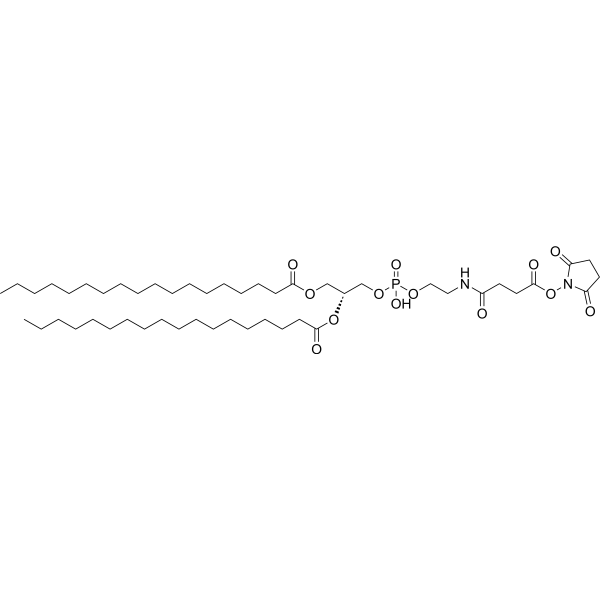
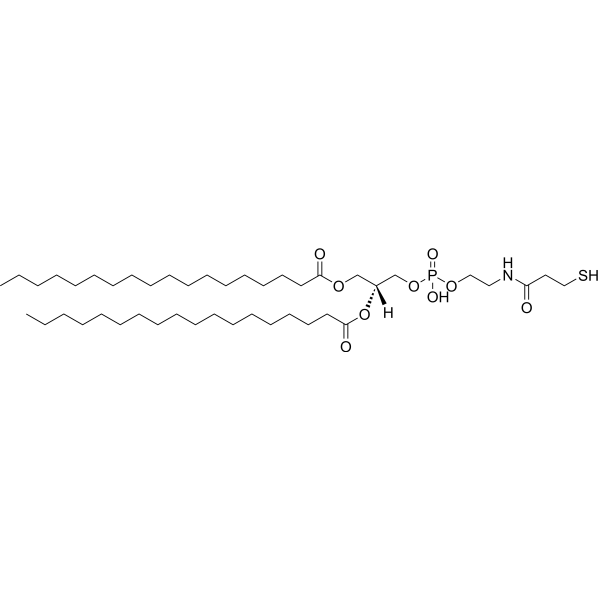
DSPE-NHS is a bioconjugation phospholipid molecule with two hydrophobic lipid tails. DSPE-NHS is a self-assembling reagent which forms lipid bilayer in aqueous solution. The NHS-ester is reactive with N-terminal of protein/peptide or other amine molecule to form a stable amide linkage. DSPE-NHS labels antibodies. DSPE-NHS can be used to prepare liposomes as agent nanocarrier .
|
-
-
- HY-174892
-
|
|
Biochemical Assay Reagents
|
Others
|
|
Biotin-PEG5-NHS ester is a heterobifunctional crosslinker as well as a polyethylene glycol-containing bioconjugation reagent. Biotin-PEG5-NHS ester is widely used in scientific research fields such as the construction of highly sensitive biosensors, the development of targeted drug delivery systems (e.g., liposome modification), immunofluorescence imaging, and protein affinity purification, and serves as an important tool for achieving precise labeling and functionalization of biomolecules .
|
-
-
- HY-151655
-
|
|
ADC Linker
|
Others
|
|
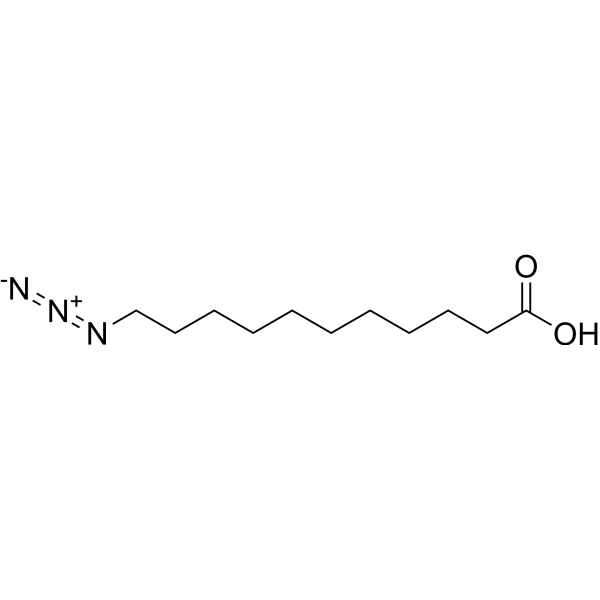
11-Azidoundecanoic acid is a click chemistry reagent containing an azide group. 11-Azidoundecanoic acid acts as a hydrophobic bioconjugation linker that can be further modified at the azido-position using Staudinger ligation or Click-chemistry. 11-Azidoundecanoic acid is substrate of lipoic acid ligase (LpIA) for labeling . 11-Azidoundecanoic acid is a click chemistry reagent, it contains an Azide group and can undergo copper-catalyzed azide-alkyne cycloaddition reaction (CuAAc) with molecules containing Alkyne groups. It can also undergo strain-promoted alkyne-azide cycloaddition (SPAAC) reactions with molecules containing DBCO or BCN groups.
|
-
-
- HY-155881
-
|
mPEG550-NH2
|
Biochemical Assay Reagents
|
Cancer
|
|
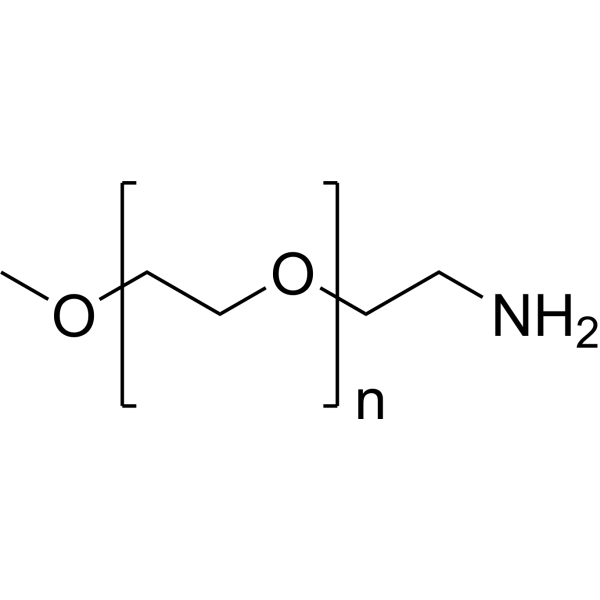
mPEG550-amine (mPEG550-NH2) is a class of functionalized polymers composed of a methoxy-terminated polyethylene glycol backbone and a terminal primary amine group. mPEG550-amine serves as an important intermediate for constructing functionalized nanocarriers, modifying proteins or polypeptides, and developing novel drug delivery systems.
|
-
-
- HY-125372
-
|
ABAO
|
Biochemical Assay Reagents
|
Others
|
|
2-Amino benzamidoxime (ABAO) acts as a bioconjugation reagent precursor and a fluorescent probe precursor. 2-Amino benzamidoxime contains an aniline group for imine activation of aldehydes, as well as a nucleophilic group (Nu:) located at the ortho position of the amine, which is responsible for intramolecular cyclization. 2-Amino benzamidoxime reacts with glyoxal at the N-terminus of phage-displayed peptide libraries. Derivatives of 2-Amino benzamidoxime can be used for protein bioconjugation. Derivatives of 2-Amino benzamidoxime serve as fluorescent probes .\n
|
-
-
- HY-160155
-
|
|
Biochemical Assay Reagents
|
Others
|
|
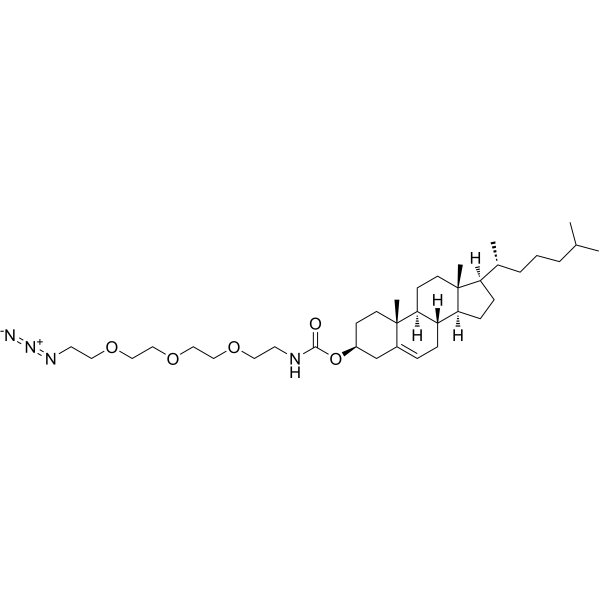
Cholesteryl-Teg azide is a cholesterol azide and can be used as a ligand for bioconjugation. Cholesteryl-Teg azide can modify RNA strands .
|
-
-
- HY-W1123936B
-
|
DBCO-PEG1000-Folate
|
Folate Receptor (FR)
|
Cancer
|
|
DBCO-PEG1000-FA (DBCO-PEG1000-Folate) is a multifunctional bioconjugation reagent, which is a copolymer of DBCO and Folic acid (FA) (HY-16637) and can target folate receptors (FR). Folate receptors are highly overexpressed on the surface of many cancer cells (such as lung cancer, nasopharyngeal cancer, ovarian cancer, etc.), but exhibit extremely low expression levels in normal tissues. DBCO-PEG-FA can be used for click chemistry conjugation via its DBCO terminal, and thus applies to various bioconjugation and drug delivery applications .
|
-
-
- HY-145485
-
|
|
PROTAC Linkers
|
Others
|
|
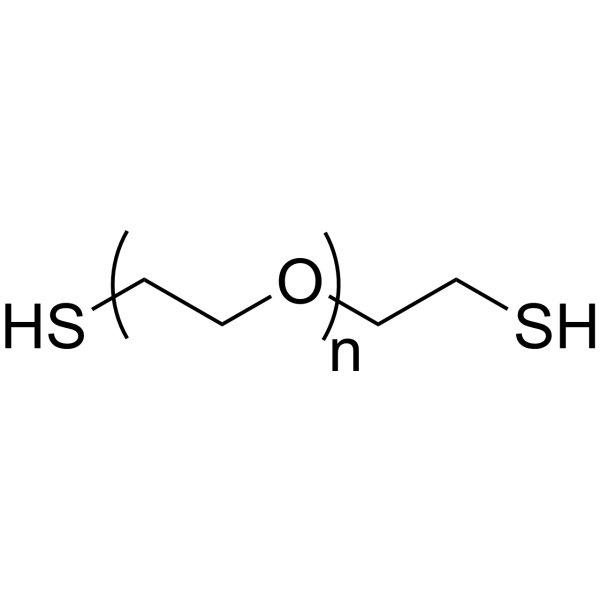
HS-PEG3400-SH, a linear homobifunctional PEG, is a cross-linker. HS-PEG-SH can be used for drug delivery and preparation of PEG hydrogels .
|
-
-
- HY-W190824
-
|
|
Biochemical Assay Reagents
|
Others
|
|
Biotin-PEG8-azide is a bioconjugation reagent. Biotin-PEG8-azide consists of biotin, PEG8 linker and azide group and serves as a modifying linker in click reactions. Biotin-PEG8-azide can be used for research related to click chemistry .
|
-
-
- HY-158072
-
|
|
Biochemical Assay Reagents
Radionuclide-Drug Conjugates (RDCs)
|
Cancer
|
|
DOTAM-NHS-ester is a bifunctional chelator and a macrocyclic DOTA derivative used for tumor pre-targeting. DOTAM-NHS-ester combines the efficient metal chelating ability of DOTAM macrocyclic ligands with the bioconjugation function of NHS ester active groups, and can be widely used in the biomedical field for metal labeling, molecular imaging and drug delivery development .
|
-
-
- HY-W588706
-
|
|
Biochemical Assay Reagents
|
Others
|
|
Tetrazine-PEG5-SS-NHS ester is a heterobifunctional crosslinking agent, a PEG derivative composed of NHS ester. NHS ester can bind to amino acids or other amino-containing molecules. Tetrazine-PEG5-SS-NHS ester is used in bioconjugation, bioorthogonal chemistry, and delivery.
|
-
-
- HY-W190766
-
|
S-Acetyl-dPEG(R)8-NHS ester
|
Biochemical Assay Reagents
|
|
|
dPEG(R)8-SATA (S-Acetyl-dPEG(R)8-NHS ester) is a bioconjugation reagent with excellent biocompatibility and high selectivity. dPEG(R)8-SATA can be used to label and cross-link biomolecules and promote the interaction between biomolecules. dPEG(R)8-SATA plays an important role in bioimaging and compound delivery systems.
|
-
-
- HY-151818
-
|
|
ADC Linker
|
Others
|
|
12-Azido-dodecanoyl-OSu is a click chemistry reagent containing an azide group. 12-Azido-dodecanoyl-OSu can be used as a hydrophobic bioconjugation linker. It contains an azide group and can undergo copper-catalyzed azide-alkyne cycloaddition (CuAAc) with molecules containing alkyne groups. It can also undergo ring strain-promoted alkyne-azide cycloaddition (SPAAC) with molecules containing DBCO or BCN groups.
|
-
-
- HY-D1406
-
|
|
Fluorescent Dye
|
Others
|
|
L-Biotin-NH-5MP-Br is a biotin-conjugated 5-Methylene pyrrolone (5MP). 5-Methylene pyrrolones (5MPs) are thiol-specific, reversible bioconjugation reagents for cysteine-specific protein modification, that are commonly used for protein bioconjugation .
|
-
-
- HY-164785
-
|
|
Drug Intermediate
|
Others
|
|
TCO-PEG5-maleimide is a PEG linker with TCO and maleimide groups, specifically enabling tetrazine click chemistry and thiol conjugation for bioconjugation, probe design, and drug delivery.
|
-
-
- HY-168939A
-
|
|
Biochemical Assay Reagents
|
Others
|
|
Poly(ethylene glycol) 2-mercaptoethyl ether acetic acid (Mn 2000) is a derivative of polyethylene glycol, which can be used for bioconjugation, drug delivery, PEG hydrogel, crosslinker and surface functionalization .
|
-
-
- HY-151752
-
|
|
ADC Linker
|
Others
|
|
Mal-AMCHC-N-Propargylamide is a click chemistry reagent containing an azide group. Mal-AMCHC-N-Propargylamide can be a bio-conjugation reagent for antibody-agent-conjugate synthesis using Click-Chemistry .
|
-
-
- HY-W1123936C
-
|
DBCO-PEG2000-Folate
|
Folate Receptor (FR)
|
Others
|
|
DBCO-PEG2000-FA (DBCO-PEG2000-Folate) is a multifunctional bioconjugation reagent, which is a copolymer of DBCO and Folic acid (FA) (HY-16637) and can target folate receptors (FR). Folate receptors are highly overexpressed on the surface of many cancer cells (such as lung cancer, nasopharyngeal cancer, ovarian cancer, etc.), but exhibit extremely low expression levels in normal tissues. DBCO-PEG-FA can be used for click chemistry conjugation via its DBCO terminal, and thus applies to various bioconjugation and drug delivery applications .
|
-
-
- HY-W190755
-
|
|
Biochemical Assay Reagents
|
Others
|
|
Mal-PEG4-Mal is a PEG derivative with maleimide groups at both ends. Maleimide is a functional group that can undergo Michael addition reactions with sulfhydryl groups (–SH) and can be used for bioconjugation .
|
-
-
- HY-151640
-
|
|
ADC Linker
|
Others
|
|
Fmoc-DAP-N3 is a click chemistry reagent containing an azide group. Fmoc-DAP-N3 is a short, linear spacer molecule with Fmoc protected amino function. Fmoc-DAP-N3 can be used in click conjugation and amid bond formation either with small molecules or for bioconjugation with proteins and antibodies . It contains an azide group and can undergo copper-catalyzed azide-alkyne cycloaddition (CuAAc) with molecules containing alkyne groups. It can also undergo ring strain-promoted alkyne-azide cycloaddition (SPAAC) with molecules containing DBCO or BCN groups.
|
-
-
- HY-W714969A
-
|
|
Phosphoramidites
|
Others
|
|
BCN-CE-phosphoramidite is an oligonucleotide modifier containing a BCN strained cyclooctyne structure. BCN-CE-phosphoramidite possesses bioorthogonal reactivity and bioconjugation capability .
|
-
-
- HY-W1123936D
-
|
DBCO-PEG3400-Folate
|
Folate Receptor (FR)
|
Others
|
|
DBCO-PEG-FA (DBCO-PEG-Folate) (MW 3400) is a multifunctional bioconjugation reagent, which is a copolymer of DBCO and Folic acid (FA) (HY-16637) and can target folate receptors (FR). Folate receptors are highly overexpressed on the surface of many cancer cells (such as lung cancer, nasopharyngeal cancer, ovarian cancer, etc.), but exhibit extremely low expression levels in normal tissues. DBCO-PEG-FA can be used for click chemistry conjugation via its DBCO terminal, and thus applies to various bioconjugation and drug delivery applications .
|
-
-
- HY-111945
-
|
|
Fluorescent Dye
|
Others
|
|
Cys modifier 1 (compound 7) is a cysteine-selective protein modifier for protein bioconjugation. A fluorescent carbonylacrylic derivative bearing nitrobenzofurazan (λex=465nm and λem539 nm)[1].
|
-
-
- HY-151636
-
|
|
ADC Linker
|
Others
|
|
10-Undecynoyl-OSu is a click chemistry reagent. 10-Undecynoyl-OSu is used as a hydrophobic bioconjugation linker that can be further modified at the alkyne using Click-chemistry .
|
-
-
- HY-D1403
-
|
|
Fluorescent Dye
|
Cancer
|
|
L-Biotin-NH-5MP is a biotin-conjugated 5-Methylene pyrrolone (5MP). 5-Methylene pyrrolones (5MPs) are thiol-specific, reversible bioconjugation reagents for cysteine-specific protein modification, that are commonly used for protein bioconjugation .
|
-
-
- HY-D1404
-
|
|
Fluorescent Dye
|
Others
|
|
5MP-Propargyl is the derivative of 5-Methylene pyrrolone (5MP). 5-Methylene pyrrolones (5MPs) are thiol-specific, reversible bioconjugation reagents for cysteine-specific protein modification, that are commonly used for protein bioconjugation . 5MP-Propargyl is a click chemistry reagent, it contains an Alkyne group and can undergo copper-catalyzed azide-alkyne cycloaddition (CuAAc) with molecules containing Azide groups.
|
-
-
- HY-D1407
-
|
|
Fluorescent Dye
|
Others
|
|
Br-5MP-Propargyl is the derivative of 5-Methylene pyrrolone (5MP). 5-Methylene pyrrolones (5MPs) are thiol-specific, reversible bioconjugation reagents for cysteine-specific protein modification, that are commonly used for protein bioconjugation . Br-5MP-Propargyl is a click chemistry reagent, it contains an Alkyne group and can undergo copper-catalyzed azide-alkyne cycloaddition (CuAAc) with molecules containing Azide groups.
|
-
-
- HY-168939
-
|
|
Biochemical Assay Reagents
|
Others
|
|
Poly(ethylene glycol) 2-mercaptoethyl ether acetic acid (Mn 1000) is a derivative of polyethylene glycol, which can be used for bioconjugation, drug delivery, PEG hydrogel, crosslinker and surface functionalization .
|
-
-
- HY-W1123936H
-
|
DBCO-PEG10000-Folate
|
Folate Receptor (FR)
|
Others
|
|
DBCO-PEG10000-FA (DBCO-PEG10000-Folate) is a multifunctional bioconjugation reagent, which is a copolymer of DBCO and Folic acid (FA) (HY-16637) and can target folate receptors (FR). Folate receptors are highly overexpressed on the surface of many cancer cells (such as lung cancer, nasopharyngeal cancer, ovarian cancer, etc.), but exhibit extremely low expression levels in normal tissues. DBCO-PEG-FA can be used for click chemistry conjugation via its DBCO terminal, and thus applies to various bioconjugation and drug delivery applications .
|
-
-
- HY-W1123936E
-
|
DBCO-PEG5000-Folate
|
Folate Receptor (FR)
|
Others
|
|
DBCO-PEG5000-FA (DBCO-PEG5000-Folate) is a multifunctional bioconjugation reagent, which is a copolymer of DBCO and Folic acid (FA) (HY-16637) and can target folate receptors (FR). Folate receptors are highly overexpressed on the surface of many cancer cells (such as lung cancer, nasopharyngeal cancer, ovarian cancer, etc.), but exhibit extremely low expression levels in normal tissues. DBCO-PEG-FA can be used for click chemistry conjugation via its DBCO terminal, and thus applies to various bioconjugation and drug delivery applications .
|
-
-
- HY-W190746
-
|
|
Biochemical Assay Reagents
|
Others
|
|
Mal-PEG1-Mal is a PEG derivative with maleimide groups at both ends. Maleimide is a functional group that can undergo Michael addition reactions with sulfhydryl groups (–SH) and can be used for bioconjugation .
|
-
-
- HY-D1402
-
|
|
Fluorescent Dye
|
Others
|
|
5MP-Fluorescein (compound 3e) is a fluorescein dye base on 5-Methylene pyrrolone (5MP).5-Methylene pyrrolones are highly thiol-specific and tracelessly removable bioconjugation tools .
|
-
-
- HY-W591965
-
|
|
Biochemical Assay Reagents
|
Others
|
|
t-Boc-Aminooxy-pentane-amine is a linker containing an aminooxy group and a primary amine. The aminooxy group can be used in bioconjugation. It reacts with an aldehyde to form an oxime bond. If a reductant is used, it will form a hydroxylamine linkage. The amino group is reactive with carboxylic acids, activated NHS esters, carbonyls (ketone, aldehyde) etc.
|
-
-
- HY-172290
-
|
|
ADC Linker
|
Cancer
|
|
Benzyl N1-[PEG1-NHS] -N6-(t-Boc)-L-lysinate is a multifunctional ADC linker consisting of a terminal benzyl group, one PEG unit, an NHS ester, and a t-Boc-protected L-lysine, often used for bioconjugation and chemical modifications in R&D.
|
-
-
- HY-W440907
-
|
|
Biochemical Assay Reagents
|
Others
|
|
DSPE-PEG5000-Vinylsulfone is a viniyl sulfone PEG lipid which can be used for bioconjugation with cysteine or other thiol molecule through thiol-ene reaction. The polymer is a self-assembling reagetn which forms lipid bilayer in water and can be used as drug carrier to delivery therapeutic agents, such as mRNA or DNA vaccine.
|
-
-
- HY-W440905
-
|
|
Biochemical Assay Reagents
|
Others
|
|
DSPE-PEG2000-Vinylsulfone is a viniyl sulfone PEG lipid which can be used for bioconjugation with cysteine or other thiol molecule through thiol-ene reaction. The polymer is a self-assembling reagetn which forms lipid bilayer in water and can be used as drug carrier to delivery therapeutic agents, such as mRNA or DNA vaccine.
|
-
-
- HY-W440904
-
|
|
Biochemical Assay Reagents
|
Others
|
|
DSPE-PEG1000-Vinylsulfone is a viniyl sulfone PEG lipid which can be used for bioconjugation with cysteine or other thiol molecule through thiol-ene reaction. The polymer is a self-assembling reagetn which forms lipid bilayer in water and can be used as drug carrier to delivery therapeutic agents, such as mRNA or DNA vaccine.
|
-
-
- HY-W800649
-
|
|
Biochemical Assay Reagents
|
Others
|
|
Aminooxy-PEG2-amine hydrochloride (compound L3) is an aqueous soluble crosslinker. The aminooxy group can be used in bioconjugation. It reacts with an aldehyde to form an oxime bond, if a reductant is used, it will form a hydroxylamine linkage. The amino group is reactive with carboxylic acids, activated NHS esters, carbonyls (ketone, aldehyde) etc. Aminooxy compounds are very reactive and sensitive; they cannot be stored for long term .
|
-
-
- HY-W354021
-
|
|
Biochemical Assay Reagents
|
Others
|
|
Bis-N-succinimidyl diglycolic acid is a multifunctional crosslinker. Bis-N-succinimidyl diglycolic acid finds application in bioconjugation and protein labeling .
|
-
-
- HY-185163
-
|
|
Biochemical Assay Reagents
|
Others
|
|
Sulfo DBCO-Gly-Gly-Gly is a crosslinker/handle installer with dibenzocyclooctyne (DBCO). Sulfo DBCO-Gly-Gly-Gly can be used in bioconjugation research .
|
-
-
- HY-W800727
-
-
-
- HY-174941
-
|
|
Biochemical Assay Reagents
|
Others
|
|
Mal-PEG18-acid is a PEG derivative modified with maleimide groups. Maleimide is a functional group that can undergo Michael addition reaction with sulfhydryl (–SH) groups and can be used for bioconjugation.
|
-
-
- HY-168939C
-
|
|
Biochemical Assay Reagents
|
Others
|
|
Poly(ethylene glycol) 2-mercaptoethyl ether acetic acid (Mn 5000) is a derivative of polyethylene glycol, which can be used for bioconjugation, drug delivery, PEG hydrogel, crosslinker and surface functionalization .
|
-
-
- HY-W800726
-
|
|
Biochemical Assay Reagents
|
Others
|
|
BB1-NHS ester is amine reactive at pH 7-9 to form a stable, irreversible amide bond. It was used in a unique chemselective "unclickable' bioconjugation strategy to site specifically modify proteins.
|
-
-
- HY-168939B
-
|
|
Biochemical Assay Reagents
|
Others
|
|
Poly(ethylene glycol) 2-mercaptoethyl ether acetic acid (Mn 3400) is a derivative of polyethylene glycol, which can be used for bioconjugation, drug delivery, PEG hydrogel, crosslinker and surface functionalization .
|
-
-
- HY-W451415
-
|
|
Biochemical Assay Reagents
|
Others
|
|
NHS-PEG-NHS is a derivative of activated polyethylene glycol (PEG) that can modify functional groups on protein surfaces via covalent binding. NHS-PEG-NHS serves as a bioconjugation modification reagent for modifying proteins, enzymes, peptides and antibodies .
|
-
-
- HY-W190925
-
|
|
Biochemical Assay Reagents
|
Others
|
|
APN-C3-biotin is a heterobifunctional linker containing an APN moiety with exquisite chemoselectivity for cysteine and Biotin. The superior stability of APN-cysteine conjugates in aqueous media, human plasma, and living cells makes this new thiol-click reaction a promising methodology for applications in bioconjugation.
|
-
-
- HY-182663A
-
|
|
Biochemical Assay Reagents
|
Others
|
|
Dextran-NH2 (MW 10 kDa) is a functional polysaccharide derivative that has been chemically modified to introduce amino (-NH2) active groups onto the molecular chain of natural dextran. Dextran-NH2 (MW 10 kDa) can be used as a drug delivery vehicle and a bioconjugation label.
|
-
-
- HY-182663E
-
|
|
Biochemical Assay Reagents
|
Others
|
|
Dextran-NH2 (MW 500 kDa) is a functional polysaccharide derivative that has been chemically modified to introduce amino (-NH2) active groups onto the molecular chain of natural dextran. Dextran-NH2 (MW 500 kDa) can be used as a drug delivery vehicle and a bioconjugation label.
|
-
-
- HY-182663B
-
|
|
Biochemical Assay Reagents
|
Others
|
|
Dextran-NH2 (MW 70 kDa) is a functional polysaccharide derivative that has been chemically modified to introduce amino (-NH2) active groups onto the molecular chain of natural dextran. Dextran-NH2 (MW 70 kDa) can be used as a drug delivery vehicle and a bioconjugation label.
|
-
- HY-182663C
-
|
|
Biochemical Assay Reagents
|
Others
|
|
Dextran-NH2 (MW 100 kDa) is a functional polysaccharide derivative that has been chemically modified to introduce amino (-NH2) active groups onto the molecular chain of natural dextran. Dextran-NH2 (MW 100 kDa) can be used as a drug delivery vehicle and a bioconjugation label.
|
-
- HY-182663D
-
|
|
Biochemical Assay Reagents
|
Others
|
|
Dextran-NH2 (MW 250 kDa) is a functional polysaccharide derivative that has been chemically modified to introduce amino (-NH2) active groups onto the molecular chain of natural dextran. Dextran-NH2 (MW 250 kDa) can be used as a drug delivery vehicle and a bioconjugation label.
|
-
- HY-W440906
-
|
|
Biochemical Assay Reagents
|
Others
|
|
DSPE-PEG3400-Vinylsulfone is a viniyl sulfone PEG lipid which can be used for bioconjugation with cysteine or other thiol molecule through thiol-ene reaction. The polymer is a self-assembling reagetn which forms lipid bilayer in water and can be used as drug carrier to delivery therapeutic agents, such as mRNA or DNA vaccine.
|
-
- HY-182841D
-
|
DMPE-PEG10000-Thiol
|
Biochemical Assay Reagents
|
Others
|
|
DMPE-PEG10000-SH (DMPE-PEG10000-Thiol) is a conjugate composed of DMPE, a PEG chain, and a terminal thiol group (-SH). The thiol group in DMPE-PEG10000-SH exhibits strong chemical reactivity and can participate in various bioconjugation reactions for targeted modification of liposomes/nanoparticles.
|
-
- HY-182882D
-
|
DPPE-PEG10000-Thiol
|
Biochemical Assay Reagents
|
Others
|
|
DPPE-PEG10000-SH (DPPE-PEG10000-Thiol) is a conjugate composed of DPPE, a PEG chain, and a terminal thiol group (-SH). The thiol group in DPPE-PEG10000-SH exhibits strong chemical reactivity and can participate in various bioconjugation reactions for targeted modification of liposomes/nanoparticles.
|
-
- HY-182841C
-
|
DMPE-PEG5000-Thiol
|
Biochemical Assay Reagents
|
Others
|
|
DMPE-PEG5000-SH (DMPE-PEG5000-Thiol) is a conjugate composed of DMPE, a PEG chain, and a terminal thiol group (-SH). The thiol group in DMPE-PEG5000-SH exhibits strong chemical reactivity and can participate in various bioconjugation reactions for targeted modification of liposomes/nanoparticles.
|
-
- HY-183055A
-
|
DSG-PEG2000-Thiol
|
Biochemical Assay Reagents
|
Others
|
|
DSE-PEG2000-SH (DSE-PEG2000-Thiol) is a conjugate composed of DSE, a PEG chain, and a terminal thiol group (-SH). The thiol group in DSE-PEG2000-SH exhibits strong chemical reactivity and can participate in various bioconjugation reactions for targeted modification of liposomes/nanoparticles.
|
-
- HY-182882A
-
|
DPPE-PEG2000-Thiol
|
Biochemical Assay Reagents
|
Others
|
|
DPPE-PEG2000-SH (DPPE-PEG2000-Thiol) is a conjugate composed of DPPE, a PEG chain, and a terminal thiol group (-SH). The thiol group in DPPE-PEG2000-SH exhibits strong chemical reactivity and can participate in various bioconjugation reactions for targeted modification of liposomes/nanoparticles.
|
-
- HY-182882C
-
|
DPPE-PEG5000-Thiol
|
Biochemical Assay Reagents
|
Others
|
|
DPPE-PEG5000-SH (DPPE-PEG5000-Thiol) is a conjugate composed of DPPE, a PEG chain, and a terminal thiol group (-SH). The thiol group in DPPE-PEG5000-SH exhibits strong chemical reactivity and can participate in various bioconjugation reactions for targeted modification of liposomes/nanoparticles.
|
-
- HY-182882
-
|
DPPE-PEG1000-Thiol
|
Biochemical Assay Reagents
|
Others
|
|
DPPE-PEG1000-SH (DPPE-PEG1000-Thiol) is a conjugate composed of DPPE, a PEG chain, and a terminal thiol group (-SH). The thiol group in DPPE-PEG1000-SH exhibits strong chemical reactivity and can participate in various bioconjugation reactions for targeted modification of liposomes/nanoparticles.
|
-
- HY-183055
-
|
DSG-PEG1000-Thiol
|
Biochemical Assay Reagents
|
Others
|
|
DSE-PEG1000-SH (DSE-PEG1000-Thiol) is a conjugate composed of DSE, a PEG chain, and a terminal thiol group (-SH). The thiol group in DSE-PEG1000-SH exhibits strong chemical reactivity and can participate in various bioconjugation reactions for targeted modification of liposomes/nanoparticles.
|
-
- HY-182841
-
|
DMPE-PEG1000-Thiol
|
Biochemical Assay Reagents
|
Others
|
|
DMPE-PEG1000-SH (DMPE-PEG1000-Thiol) is a conjugate composed of DMPE, a PEG chain, and a terminal thiol group (-SH). The thiol group in DMPE-PEG1000-SH exhibits strong chemical reactivity and can participate in various bioconjugation reactions for targeted modification of liposomes/nanoparticles.
|
-
- HY-182882B
-
|
DPPE-PEG3400-Thiol
|
Biochemical Assay Reagents
|
Others
|
|
DPPE-PEG3400-SH (DPPE-PEG3400-Thiol) is a conjugate composed of DPPE, a PEG chain, and a terminal thiol group (-SH). The thiol group in DPPE-PEG3400-SH exhibits strong chemical reactivity and can participate in various bioconjugation reactions for targeted modification of liposomes/nanoparticles.
|
-
- HY-182841A
-
|
DMPE-PEG2000-Thiol
|
Biochemical Assay Reagents
|
Others
|
|
DMPE-PEG2000-SH (DMPE-PEG2000-Thiol) is a conjugate composed of DMPE, a PEG chain, and a terminal thiol group (-SH). The thiol group in DMPE-PEG2000-SH exhibits strong chemical reactivity and can participate in various bioconjugation reactions for targeted modification of liposomes/nanoparticles.
|
-
- HY-W1052910B
-
|
|
Biochemical Assay Reagents
|
Others
|
|
8-Arm-PEG40000-Alkyne is an eight-arm PEG derivative. The core structure of 8-Arm-PEG40000-Alkyne consists of eight PEG chains, each modified at the end with an alkyne group. 8-Arm-PEG40000-Alkyne can be used for bioconjugation and drug delivery.
|
-
- HY-W1052067
-
|
|
Biochemical Assay Reagents
|
Others
|
|
8-Arm-PEG20000-DBCO is a eight-armed PEG derivative. The core structure of 8-Arm-PEG20000-DBCO consists of eight PEG chains, each modified at the end with a diphenylcyclooctyne (DBCO) group. 8-Arm-PEG20000-DBCO can be used for bioconjugation and drug delivery.
|
-
- HY-W1052921
-
|
|
Biochemical Assay Reagents
|
Others
|
|
4-Arm-PEG2000-Acrylamide is a four-armed PEG derivative. The core structure of 4-Arm-PEG2000-Acrylamide consists of four PEG chains, each modified with an acrylamide group at its end. 4-Arm-PEG2000-Acrylamide can be used for bioconjugation and drug delivery.
|
-
- HY-182838
-
|
8-Arm-PEG10000-DF
|
Biochemical Assay Reagents
|
Others
|
|
8-Arm-PEG10000-Benzaldehyde is a eight-armed PEG derivative. The core structure of 8-Arm-PEG10000-Benzaldehyde consists of eight PEG chains, each modified at the end with a benzaldehyde group. 8-Arm-PEG10000-Benzaldehyde can be used for bioconjugation and drug delivery.
|
-
- HY-W1052067A
-
|
|
Biochemical Assay Reagents
|
Others
|
|
8-Arm-PEG40000-DBCO is a eight-armed PEG derivative. The core structure of 8-Arm-PEG40000-DBCO consists of eight PEG chains, each modified at the end with a diphenylcyclooctyne (DBCO) group. 8-Arm-PEG40000-DBCO can be used for bioconjugation and drug delivery.
|
-
- HY-W1053027
-
|
|
Biochemical Assay Reagents
|
Others
|
|
4-Arm-PEG10000-DBCO is a four-armed PEG derivative. The core structure of 4-Arm-PEG10000-DBCO consists of four PEG chains, each modified at the end with a diphenylcyclooctyne (DBCO) group. 4-Arm-PEG10000-DBCO can be used for bioconjugation and drug delivery.
|
-
- HY-W1048515E
-
|
|
Biochemical Assay Reagents
|
Others
|
|
4-Arm-PEG5000-Benzaldehyde is a four-armed PEG derivative. The core structure of 4-Arm-PEG5000-Benzaldehyde consists of four PEG chains, each modified at the end with a benzaldehyde group. 4-Arm-PEG5000-Benzaldehyde can be used for bioconjugation and drug delivery.
|
-
- HY-W1052067C
-
|
|
Biochemical Assay Reagents
|
Others
|
|
8-Arm-PEG10000-DBCO is a eight-armed PEG derivative. The core structure of 8-Arm-PEG10000-DBCO consists of eight PEG chains, each modified at the end with a diphenylcyclooctyne (DBCO) group. 8-Arm-PEG10000-DBCO can be used for bioconjugation and drug delivery.
|
-
- HY-W1052921C
-
|
|
Biochemical Assay Reagents
|
Others
|
|
4-Arm-PEG5000-Acrylamide is a four-armed PEG derivative. The core structure of 4-Arm-PEG5000-Acrylamide consists of four PEG chains, each modified with an acrylamide group at its end. 4-Arm-PEG5000-Acrylamide can be used for bioconjugation and drug delivery.
|
-
- HY-W1053027B
-
|
|
Biochemical Assay Reagents
|
Others
|
|
4-Arm-PEG2000-DBCO is a four-armed PEG derivative. The core structure of 4-Arm-PEG2000-DBCO consists of four PEG chains, each modified at the end with a diphenylcyclooctyne (DBCO) group. 4-Arm-PEG2000-DBCO can be used for bioconjugation and drug delivery.
|
-
- HY-W1053027A
-
|
|
Biochemical Assay Reagents
|
Others
|
|
4-Arm-PEG20000-DBCO is a four-armed PEG derivative. The core structure of 4-Arm-PEG20000-DBCO consists of four PEG chains, each modified at the end with a diphenylcyclooctyne (DBCO) group. 4-Arm-PEG20000-DBCO can be used for bioconjugation and drug delivery.
|
-
- HY-W1048515A
-
|
|
Biochemical Assay Reagents
|
Others
|
|
4-Arm-PEG10000-Benzaldehyde is a four-armed PEG derivative. The core structure of 4-Arm-PEG10000-Benzaldehyde consists of four PEG chains, each modified at the end with a benzaldehyde group. 4-Arm-PEG10000-Benzaldehyde can be used for bioconjugation and drug delivery.
|
-
- HY-W1052910
-
|
|
Biochemical Assay Reagents
|
Others
|
|
8-Arm-PEG10000-Alkyne is an eight-arm PEG derivative. The core structure of 8-Arm-PEG10000-Alkyne consists of eight PEG chains, each modified at the end with an alkyne group. 8-Arm-PEG10000-Alkyne can be used for bioconjugation and drug delivery.
|
-
- HY-W1048695E
-
|
|
Biochemical Assay Reagents
|
Others
|
|
4-Arm-PEG2000-Norbornene is a four-armed PEG derivative. The core structure of 4-Arm-PEG2000-Norbornene consists of four PEG chains, each modified at the end with norbornene molecules. 4-Arm-PEG2000-Norbornene can be used for bioconjugation and drug delivery.
|
-
- HY-W1052910A
-
|
|
Biochemical Assay Reagents
|
Others
|
|
8-Arm-PEG20000-Alkyne is an eight-arm PEG derivative. The core structure of 8-Arm-PEG20000-Alkyne consists of eight PEG chains, each modified at the end with an alkyne group. 8-Arm-PEG20000-Alkyne can be used for bioconjugation and drug delivery.
|
-
- HY-W1048515D
-
|
|
Biochemical Assay Reagents
|
Others
|
|
4-Arm-PEG2000-Benzaldehyde is a four-armed PEG derivative. The core structure of 4-Arm-PEG2000-Benzaldehyde consists of four PEG chains, each modified at the end with a benzaldehyde group. 4-Arm-PEG2000-Benzaldehyde can be used for bioconjugation and drug delivery.
|
-
- HY-W1048695A
-
|
|
Biochemical Assay Reagents
|
Others
|
|
4-Arm-PEG5000-Norbornene is a four-armed PEG derivative. The core structure of 4-Arm-PEG5000-Norbornene consists of four PEG chains, each modified at the end with norbornene molecules. 4-Arm-PEG5000-Norbornene can be used for bioconjugation and drug delivery.
|
-
- HY-182838A
-
|
8-Arm-PEG20000-DF
|
Biochemical Assay Reagents
|
Others
|
|
8-Arm-PEG20000-Benzaldehyde is a eight-armed PEG derivative. The core structure of 8-Arm-PEG20000-Benzaldehyde consists of eight PEG chains, each modified at the end with a benzaldehyde group. 8-Arm-PEG20000-Benzaldehyde can be used for bioconjugation and drug delivery.
|
-
- HY-182835C
-
|
|
Biochemical Assay Reagents
|
Others
|
|
4-Arm-PEG20000-Isocyanate is a four-armed PEG derivative. The core structure of 4-Arm-PEG20000-Isocyanate consists of four PEG chains, each modified at the end with an isocyanate group. 4-Arm-PEG20000-Isocyanate can be used for bioconjugation and drug delivery.
|
-
- HY-182835B
-
|
|
Biochemical Assay Reagents
|
Others
|
|
4-Arm-PEG10000-Isocyanate is a four-armed PEG derivative. The core structure of 4-Arm-PEG10000-Isocyanate consists of four PEG chains, each modified at the end with an isocyanate group. 4-Arm-PEG10000-Isocyanate can be used for bioconjugation and drug delivery.
|
-
- HY-W1052921A
-
|
|
Biochemical Assay Reagents
|
Others
|
|
4-Arm-PEG10000-Acrylamide is a four-armed PEG derivative. The core structure of 4-Arm-PEG10000-Acrylamide consists of four PEG chains, each modified with an acrylamide group at its end. 4-Arm-PEG10000-Acrylamide can be used for bioconjugation and drug delivery.
|
-
- HY-W1052921B
-
|
|
Biochemical Assay Reagents
|
Others
|
|
4-Arm-PEG20000-Acrylamide is a four-armed PEG derivative. The core structure of 4-Arm-PEG20000-Acrylamide consists of four PEG chains, each modified with an acrylamide group at its end. 4-Arm-PEG20000-Acrylamide can be used for bioconjugation and drug delivery.
|
-
- HY-182838B
-
|
8-Arm-PEG40000-DF
|
Biochemical Assay Reagents
|
Others
|
|
8-Arm-PEG40000-Benzaldehyde is a eight-armed PEG derivative. The core structure of 8-Arm-PEG40000-Benzaldehyde consists of eight PEG chains, each modified at the end with a benzaldehyde group. 8-Arm-PEG40000-Benzaldehyde can be used for bioconjugation and drug delivery.
|
-
- HY-182840A
-
|
|
Biochemical Assay Reagents
|
Others
|
|
8-Arm-PEG20000-Norbornene is a eight-armed PEG derivative. The core structure of 8-Arm-PEG20000-Norbornene consists of eight PEG chains, each modified at the end with norbornene molecules. 8-Arm-PEG20000-Norbornene can be used for bioconjugation and drug delivery.
|
-
- HY-W1053027C
-
|
|
Biochemical Assay Reagents
|
Others
|
|
4-Arm-PEG5000-DBCO is a four-armed PEG derivative. The core structure of 4-Arm-PEG5000-DBCO consists of four PEG chains, each modified at the end with a diphenylcyclooctyne (DBCO) group. 4-Arm-PEG5000-DBCO can be used for bioconjugation and drug delivery.
|
-
- HY-182840
-
|
|
Biochemical Assay Reagents
|
Others
|
|
8-Arm-PEG10000-Norbornene is a eight-armed PEG derivative. The core structure of 8-Arm-PEG10000-Norbornene consists of eight PEG chains, each modified at the end with norbornene molecules. 8-Arm-PEG10000-Norbornene can be used for bioconjugation and drug delivery.
|
-
- HY-W1048515B
-
|
|
Biochemical Assay Reagents
|
Others
|
|
4-Arm-PEG20000-Benzaldehyde is a four-armed PEG derivative. The core structure of 4-Arm-PEG20000-Benzaldehyde consists of four PEG chains, each modified at the end with a benzaldehyde group. 4-Arm-PEG20000-Benzaldehyde can be used for bioconjugation and drug delivery.
|
-
- HY-W1048695C
-
|
|
Biochemical Assay Reagents
|
Others
|
|
4-Arm-PEG20000-Norbornene is a four-armed PEG derivative. The core structure of 4-Arm-PEG20000-Norbornene consists of four PEG chains, each modified at the end with norbornene molecules. 4-Arm-PEG20000-Norbornene can be used for bioconjugation and drug delivery.
|
-
- HY-182840B
-
|
|
Biochemical Assay Reagents
|
Others
|
|
8-Arm-PEG40000-Norbornene is a eight-armed PEG derivative. The core structure of 8-Arm-PEG40000-Norbornene consists of eight PEG chains, each modified at the end with norbornene molecules. 8-Arm-PEG40000-Norbornene can be used for bioconjugation and drug delivery.
|
-
- HY-W1048695B
-
|
|
Biochemical Assay Reagents
|
Others
|
|
4-Arm-PEG10000-Norbornene is a four-armed PEG derivative. The core structure of 4-Arm-PEG10000-Norbornene consists of four PEG chains, each modified at the end with norbornene molecules. 4-Arm-PEG10000-Norbornene can be used for bioconjugation and drug delivery.
|
-
- HY-W1053112B
-
|
DOPE-PEG10000-NH2
|
Biochemical Assay Reagents
|
Others
|
|
DOPE-PEG10000-Amine (DOPE-PEG1000-NH2) is a conjugate composed of dioleoylphosphatidylethanolamine (DOPE), a PEG chain, and a terminal amino group (-NH2). The amino group in DOPE-PEG10000-Amine can chemically react with carboxyl groups, activated esters, etc., participating in various bioconjugation reactions for targeted modification of liposomes/nanoparticles.
|
-
- HY-W440990
-
|
DOPE-PEG1000-NH2
|
Biochemical Assay Reagents
|
Others
|
|
DOPE-PEG1000-Amine (DOPE-PEG1000-NH2) is a conjugate composed of dioleoylphosphatidylethanolamine (DOPE), a PEG chain, and a terminal amino group (-NH2). The amino group in DOPE-PEG1000-Amine can chemically react with carboxyl groups, activated esters, etc., participating in various bioconjugation reactions for targeted modification of liposomes/nanoparticles.
|
-
- HY-177696
-
|
|
Biochemical Assay Reagents
|
Others
|
|
3-[4-(2-Propyn-1-yloxy)phenyl]-2H-azirine (Compound AZ-9) is a reactive probe based on 3-phenyl-2H-azirine, enabling chemoselective bioconjugation of carboxyl residues in proteins with excellent labeling efficiency and specificity under both in vitro and in situ conditions in live cells .
|
-
- HY-W190737
-
|
|
Biochemical Assay Reagents
|
|
|
NHS-SS-dPEG4-biotin (cleavable) is a biodegradable crosslinker with efficient bioconjugation activity. NHS-SS-dPEG4-biotin (cleavable) can effectively connect biomolecules, optimize the efficiency of biolabeling, and be used in targeted compound delivery systems. NHS-SS-dPEG4-biotin (cleavable) can also play an important role in protein engineering and fluorescence imaging.
|
-
- HY-W1052238
-
|
8-Arm-PEG10000-ACA
|
Biochemical Assay Reagents
|
Others
|
|
8-Arm-PEG10000-Acrylamide (8-Arm-PEG10000-ACA) is a eight-armed PEG derivative. The core structure of 8-Arm-PEG10000-Acrylamide consists of eight PEG chains, each modified with an acrylamide group at its end. 8-Arm-PEG10000-Acrylamide can be used for bioconjugation and drug delivery.
|
-
- HY-W1048872C
-
|
4-Arm-PEG20000-HZ
|
Biochemical Assay Reagents
|
Others
|
|
4-Arm-PEG20000-Hydrazide (4-Arm-PEG20000-HZ) is a four-arm PEG derivative. The core structure of 4-Arm-PEG20000-Hydrazide consists of four PEG chains, each modified at the end with a hydrazide group. 4-Arm-PEG20000-Hydrazide can be used for bioconjugation and drug delivery.
|
-
- HY-W1048872A
-
|
4-Arm-PEG5000-HZ
|
Biochemical Assay Reagents
|
Others
|
|
4-Arm-PEG5000-Hydrazide (4-Arm-PEG5000-HZ) is a four-arm PEG derivative. The core structure of 4-Arm-PEG5000-Hydrazide consists of four PEG chains, each modified at the end with a hydrazide group. 4-Arm-PEG5000-Hydrazide can be used for bioconjugation and drug delivery.
|
-
- HY-W1048872E
-
|
4-Arm-PEG2000-HZ
|
Biochemical Assay Reagents
|
Others
|
|
4-Arm-PEG2000-Hydrazide (4-Arm-PEG2000-HZ) is a four-arm PEG derivative. The core structure of 4-Arm-PEG2000-Hydrazide consists of four PEG chains, each modified at the end with a hydrazide group. 4-Arm-PEG2000-Hydrazide can be used for bioconjugation and drug delivery.
|
-
- HY-W1052238B
-
|
8-Arm-PEG40000-ACA
|
Biochemical Assay Reagents
|
Others
|
|
8-Arm-PEG40000-Acrylamide (8-Arm-PEG40000-ACA) is a eight-armed PEG derivative. The core structure of 8-Arm-PEG40000-Acrylamide consists of eight PEG chains, each modified with an acrylamide group at its end. 8-Arm-PEG40000-Acrylamide can be used for bioconjugation and drug delivery.
|
-
- HY-W1048872B
-
|
4-Arm-PEG10000-HZ
|
Biochemical Assay Reagents
|
Others
|
|
4-Arm-PEG10000-Hydrazide (4-Arm-PEG10000-HZ) is a four-arm PEG derivative. The core structure of 4-Arm-PEG10000-Hydrazide consists of four PEG chains, each modified at the end with a hydrazide group. 4-Arm-PEG10000-Hydrazide can be used for bioconjugation and drug delivery.
|
-
- HY-W1052238A
-
|
8-Arm-PEG20000-ACA
|
Biochemical Assay Reagents
|
Others
|
|
8-Arm-PEG20000-Acrylamide (8-Arm-PEG20000-ACA) is a eight-armed PEG derivative. The core structure of 8-Arm-PEG20000-Acrylamide consists of eight PEG chains, each modified with an acrylamide group at its end. 8-Arm-PEG20000-Acrylamide can be used for bioconjugation and drug delivery.
|
-
- HY-W1052890A
-
|
4-Arm-PEG5000-SPDP
|
Biochemical Assay Reagents
|
Others
|
|
4-Arm-PEG5000-OPSS (4-Arm-PEG5000-SPDP) is a four-armed PEG derivative. The core structure of 4-Arm-PEG5000-OPSS consists of four PEG chains, each modified at the end with an o-dithiopyridine (OPSS) group. 4-Arm-PEG5000-OPSS can be used for bioconjugation and drug delivery.
|
-
- HY-W1052890
-
|
4-Arm-PEG2000-SPDP
|
Biochemical Assay Reagents
|
Others
|
|
4-Arm-PEG2000-OPSS (4-Arm-PEG2000-SPDP) is a four-armed PEG derivative. The core structure of 4-Arm-PEG2000-OPSS consists of four PEG chains, each modified at the end with an o-dithiopyridine (OPSS) group. 4-Arm-PEG2000-OPSS can be used for bioconjugation and drug delivery.
|
-
- HY-W1052890B
-
|
4-Arm-PEG10000-SPDP
|
Biochemical Assay Reagents
|
Others
|
|
4-Arm-PEG10000-OPSS (4-Arm-PEG10000-SPDP) is a four-armed PEG derivative. The core structure of 4-Arm-PEG10000-OPSS consists of four PEG chains, each modified at the end with an o-dithiopyridine (OPSS) group. 4-Arm-PEG10000-OPSS can be used for bioconjugation and drug delivery.
|
-
- HY-W1052890C
-
|
4-Arm-PEG20000-SPDP
|
Biochemical Assay Reagents
|
Others
|
|
4-Arm-PEG20000-OPSS (4-Arm-PEG20000-SPDP) is a four-armed PEG derivative. The core structure of 4-Arm-PEG20000-OPSS consists of four PEG chains, each modified at the end with an o-dithiopyridine (OPSS) group. 4-Arm-PEG20000-OPSS can be used for bioconjugation and drug delivery.
|
-
- HY-W800833
-
|
|
Biochemical Assay Reagents
|
Others
|
|
Benzyl N-[2-(prop-2-enamido)ethyl]carbamate is a short aliphatic linker featuring a Cbz-protected amine and an acrylamide. Acrylamide is a Michael acceptor which is a good Michael acceptor which can be used in thiol-based bioconjugation or polymerization. Meanwhile, the Cbz protecting group can be removed using Pd-C hydrogenation to reveal a free amine that can participate in a wide variety of reactions such as couplings or reductive amination.
|
-
- HY-W1048867B
-
|
4-Arm-PEG10000-VS
|
Biochemical Assay Reagents
|
Others
|
|
4-Arm-PEG10000-Vinyl sulfone (4-Arm-PEG10000-VS) is a four-armed PEG derivative. The core structure of 4-Arm-PEG10000-Vinyl sulfone consists of four PEG chains, each modified at the end with a vinyl sulfone (Vinyl sulfone) group. 4-Arm-PEG10000-Vinyl sulfone can be used for bioconjugation and drug delivery.
|
-
- HY-W1048867C
-
|
4-Arm-PEG20000-VS
|
Biochemical Assay Reagents
|
Others
|
|
4-Arm-PEG20000-Vinyl sulfone (4-Arm-PEG20000-VS) is a four-armed PEG derivative. The core structure of 4-Arm-PEG20000-Vinyl sulfone consists of four PEG chains, each modified at the end with a vinyl sulfone (Vinyl sulfone) group. 4-Arm-PEG20000-Vinyl sulfone can be used for bioconjugation and drug delivery.
|
-
- HY-139014
-
|
H-L-Lys(Poc)-OH
|
Fluorescent Dye
|
Cancer
|
|
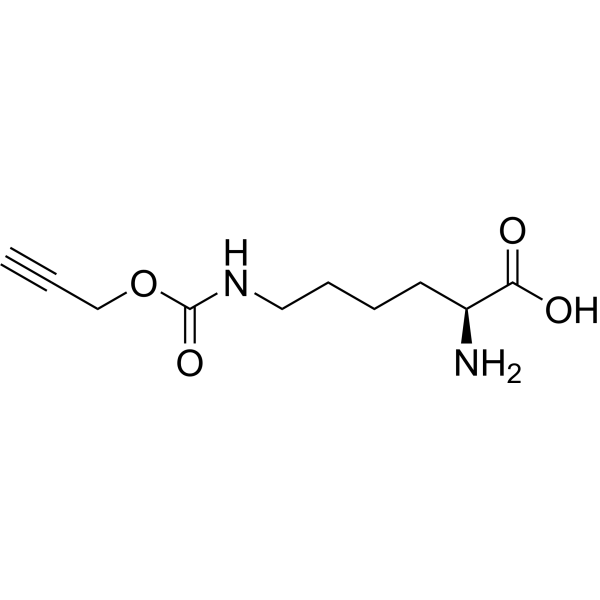
N-ε-propargyloxycarbonyl-L-lysine (H-L-Lys(Poc)-OH) is a lysine-based unnatural amino acid (UAA). N-ε-propargyloxycarbonyl-L-lysine is widely used for bio-conjugation of fluorescent probes in diverse organisms from E. coli to mammalian cells even in animals . N-ε-propargyloxycarbonyl-L-lysine is a click chemistry reagent, it contains an Alkyne group and can undergo copper-catalyzed azide-alkyne cycloaddition (CuAAc) with molecules containing Azide groups.
|
-
- HY-W1048545H
-
|
Amine-PEG1000-Thiol hydrochloride
|
Biochemical Assay Reagents
|
Others
|
|
H2N-PEG1000-SH (Amine-PEG1000-Thiol) hydrochloride is a linear heterobifunctional PEGylated product containing thiol and amine. H2N-PEG1000-SH hydrochloride is an important cross-linking or bioconjugation reagent with PEG chains. Thiol or SH, sulfhydryl or thiol selectively reacts with maleimide, OPSS, vinyl sulfone and transition metal surfaces (including gold, silver, etc.) .
|
-
- HY-W1048867A
-
|
4-Arm-PEG5000-VS
|
Biochemical Assay Reagents
|
Others
|
|
4-Arm-PEG5000-Vinyl sulfone (4-Arm-PEG5000-VS) is a four-armed PEG derivative. The core structure of 4-Arm-PEG5000-Vinyl sulfone consists of four PEG chains, each modified at the end with a vinyl sulfone (Vinyl sulfone) group. 4-Arm-PEG5000-Vinyl sulfone can be used for bioconjugation and drug delivery.
|
-
- HY-W1052829A
-
|
4-Arm-PEG10000-NPC
|
Biochemical Assay Reagents
|
Others
|
|
4-Arm-PEG10000-Nitrophenyl carbonate (4-Arm-PEG10000-NPC) is a four-arm PEG derivative. The core structure of 4-Arm-PEG10000-Nitrophenyl carbonate consists of four PEG chains, each modified at the end with a nitrophenyl carbonate group. 4-Arm-PEG10000-Nitrophenyl carbonate can be used for bioconjugation and drug delivery.
|
-
- HY-W1048545I
-
|
Amine-PEG3400-Thiol hydrochloride
|
Biochemical Assay Reagents
|
Others
|
|
H2N-PEG3400-SH (Amine-PEG3400-Thiol) hydrochloride is a linear heterobifunctional PEGylated product containing thiol and amine. H2N-PEG3400-SH hydrochloride is an important cross-linking or bioconjugation reagent with PEG chains. Thiol or SH, sulfhydryl or thiol selectively reacts with maleimide, OPSS, vinyl sulfone and transition metal surfaces (including gold, silver, etc.) .
|
-
- HY-W1048867
-
|
4-Arm-PEG2000-VS
|
Biochemical Assay Reagents
|
Others
|
|
4-Arm-PEG2000-Vinyl sulfone (4-Arm-PEG2000-VS) is a four-armed PEG derivative. The core structure of 4-Arm-PEG2000-Vinyl sulfone consists of four PEG chains, each modified at the end with a vinyl sulfone (Vinyl sulfone) group. 4-Arm-PEG2000-Vinyl sulfone can be used for bioconjugation and drug delivery.
|
-
- HY-W1048545E
-
|
Amine-PEG20000-Thiol hydrochloride
|
Biochemical Assay Reagents
|
Others
|
|
H2N-PEG20000-SH (Amine-PEG20000-Thiol) hydrochloride is a linear heterobifunctional PEGylated product containing thiol and amine. H2N-PEG20000-SH hydrochloride is an important cross-linking or bioconjugation reagent with PEG chains. Thiol or SH, sulfhydryl or thiol selectively reacts with maleimide, OPSS, vinyl sulfone and transition metal surfaces (including gold, silver, etc.) .
|
-
- HY-W1048545D
-
|
Amine-PEG10000-Thiol hydrochloride
|
Biochemical Assay Reagents
|
Others
|
|
H2N-PEG10000-SH (Amine-PEG10000-Thiol) hydrochloride is a linear heterobifunctional PEGylated product containing thiol and amine. H2N-PEG10000-SH hydrochloride is an important cross-linking or bioconjugation reagent with PEG chains. Thiol or SH, sulfhydryl or thiol selectively reacts with maleimide, OPSS, vinyl sulfone and transition metal surfaces (including gold, silver, etc.) .
|
-
- HY-118112
-
|
|
Biochemical Assay Reagents
|
Others
|
|
4-N-Maleimidobenzoicacid-NHS is a PEG linker that finds utility in bioconjugation endeavors and protein labeling ventures. Specifically designed for selective reaction with thiol groups, the maleimide group establishes covalent linkages, thereby facilitating the coupling of proteins, peptides, or diverse molecules to thiol-bearing biomolecules. The NHS ester is able to react specifically and efficiently with primary amines (e.g. the side chain of lysine residues or aminosilane-coated surfaces) at neutral or slightly basic conditions to form a covalent bond.
|
-
- HY-W1048545A
-
|
Amine-PEG2000-Thiol hydrochloride
|
Biochemical Assay Reagents
|
Others
|
|
H2N-PEG2000-SH (Amine-PEG2000-Thiol) hydrochloride is a linear heterobifunctional PEGylated product containing thiol and amine. H2N-PEG2000-SH hydrochloride is an important cross-linking or bioconjugation reagent with PEG chains. Thiol or SH, sulfhydryl or thiol selectively reacts with maleimide, OPSS, vinyl sulfone and transition metal surfaces (including gold, silver, etc.) .
|
-
- HY-W190842
-
|
|
Biochemical Assay Reagents
|
Others
|
|
m-PEG2-NHS ester is a PEG linker containing an NHS ester. The NHS ester of m-PEG2-NHS ester is used to label primary amines (-NH2) of proteins, amine-modified oligonucleotides and other amine-containing molecules. The hydrophilic PEG spacer effectively improves solubility in aqueous media. m-PEG2-NHS ester can be used in studies related to bioconjugation with ADC, proteins, peptides and other molecules .
|
-
- HY-W1052829B
-
|
4-Arm-PEG20000-NPC
|
Biochemical Assay Reagents
|
Others
|
|
4-Arm-PEG20000-Nitrophenyl carbonate (4-Arm-PEG20000-NPC) is a four-arm PEG derivative. The core structure of 4-Arm-PEG20000-Nitrophenyl carbonate consists of four PEG chains, each modified at the end with a nitrophenyl carbonate group. 4-Arm-PEG20000-Nitrophenyl carbonate can be used for bioconjugation and drug delivery.
|
-
- HY-W1052829
-
|
4-Arm-PEG2000-NPC
|
Biochemical Assay Reagents
|
Others
|
|
4-Arm-PEG2000-Nitrophenyl carbonate (4-Arm-PEG2000-NPC) is a four-arm PEG derivative. The core structure of 4-Arm-PEG2000-Nitrophenyl carbonate consists of four PEG chains, each modified at the end with a nitrophenyl carbonate group. 4-Arm-PEG2000-Nitrophenyl carbonate can be used for bioconjugation and drug delivery.
|
-
- HY-W1048545J
-
|
Amine-PEG40000-Thiol hydrochloride
|
Biochemical Assay Reagents
|
Others
|
|
H2N-PEG40000-SH (Amine-PEG40000-Thiol) hydrochloride is a linear heterobifunctional PEGylated product containing thiol and amine. H2N-PEG40000-SH hydrochloride is an important cross-linking or bioconjugation reagent with PEG chains. Thiol or SH, sulfhydryl or thiol selectively reacts with maleimide, OPSS, vinyl sulfone and transition metal surfaces (including gold, silver, etc.) .
|
-
- HY-W1052829C
-
|
4-Arm-PEG5000-NPC
|
Biochemical Assay Reagents
|
Others
|
|
4-Arm-PEG5000-Nitrophenyl carbonate (4-Arm-PEG5000-NPC) is a four-arm PEG derivative. The core structure of 4-Arm-PEG5000-Nitrophenyl carbonate consists of four PEG chains, each modified at the end with a nitrophenyl carbonate group. 4-Arm-PEG5000-Nitrophenyl carbonate can be used for bioconjugation and drug delivery.
|
-
- HY-128676
-
|
H-L-Lys(Poc)-OH hydrochloride
|
Amino Acid Derivatives
|
Cancer
|
|
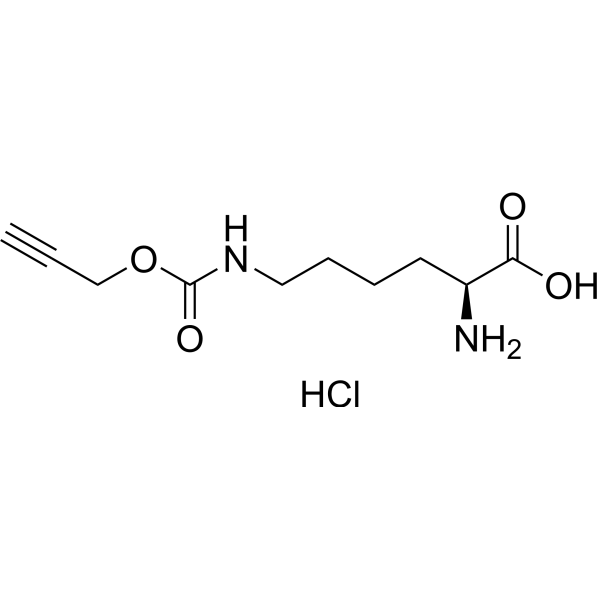
N-ε-propargyloxycarbonyl-L-lysine (H-L-Lys(Poc)-OH) hydrochloride is a lysine-based unnatural amino acid (UAA). N-ε-propargyloxycarbonyl-L-lysine is widely used for bio-conjugation of fluorescent probes in diverse organisms from E. coli to mammalian cells even in animals . N-ε-propargyloxycarbonyl-L-lysine (hydrochloride) is a click chemistry reagent, it contains an Alkyne group and can undergo copper-catalyzed azide-alkyne cycloaddition (CuAAc) with molecules containing Azide groups.
|
-
- HY-W1048545C
-
|
Amine-PEG5000-Thiol hydrochloride
|
Biochemical Assay Reagents
|
Others
|
|
H2N-PEG5000-SH (Amine-PEG5000-Thiol) hydrochloride is a linear heterobifunctional PEGylated product containing thiol and amine. H2N-PEG5000-SH hydrochloride is an important cross-linking or bioconjugation reagent with PEG chains. Thiol or SH, sulfhydryl or thiol selectively reacts with maleimide, OPSS, vinyl sulfone and transition metal surfaces (including gold, silver, etc.) .
|
-
- HY-D2954
-
|
CLIP-PEG-NH2
|
Drug Intermediate
|
Others
|
|
BC-PEG-NH2 (CLIP-PEG-NH2) is a chemical building block specifically designed for the CLIP-tag system, featuring enhanced water solubility and reactivity. BC-PEG-NH2 can be used for the synthesis of super-resolution imaging probes .
|
-
- HY-151692
-
|
|
ADC Linker
|
Others
|
|
18-Azido-stearic acid is a click chemistry reagent containing an azide group. 18-Azido-stearic acid can be used as a hydrophobic bioconjugation linker (using N-Myristoyltransferase) that can be further modified at the azido-position using Click-chemistry . It contains an azide group and can undergo copper-catalyzed azide-alkyne cycloaddition (CuAAc) with molecules containing alkyne groups. It can also undergo ring strain-promoted alkyne-azide cycloaddition (SPAAC) with molecules containing DBCO or BCN groups.
|
-
- HY-W591393
-
|
|
Biochemical Assay Reagents
|
Cancer
|
|
Biotin Azide Plus is an oxazolidine reagent that integrates azide-biotin click chemistry and a photocleavable linker arm. Biotin Azide Plus not only reacts with biotin thioether to form stable sulfinimide products, but also enables bioconjugation of proteins and DNA through biotin redox-activated chemical labeling technology. Taking advantage of the streptavidin capture and photo-release properties, Biotin Azide Plus effectively facilitates the isolation of lipid-derived electrophile-protein adducts, thus finding wide application in scientific research related to fields such as SKBR3 cancer .
|
-
- HY-Y0623
-
|
HOSu; 1-Hydroxy-2,5-pyrrolidinedione
|
Biochemical Assay Reagents
|
Others
|
|
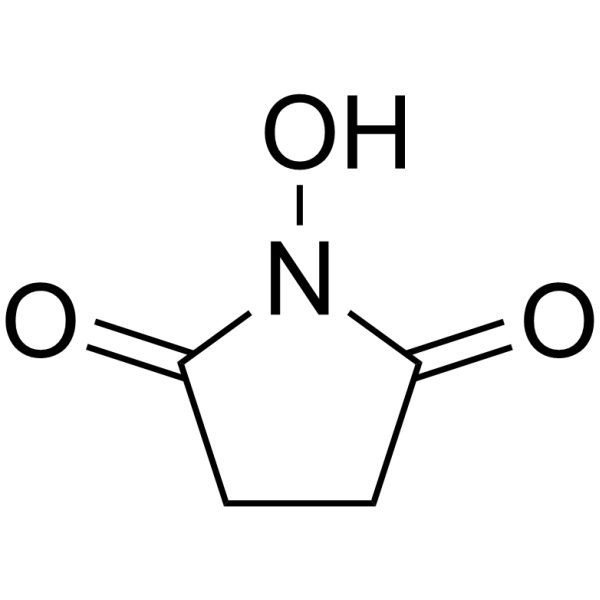
N-Hydroxysuccinimide (HOSu; 1-Hydroxy-2,5-pyrrolidinedione) is a covalent crosslinker commonly used in bioconjugation technology with a primary amine group. N-Hydroxysuccinimide reacts with amino groups (-NH2) to form a stable amide bond, which can modify amino-containing biomolecules. N-Hydroxysuccinimide can be used, for example, for protein labeling with fluorescent dyes and enzymes, surface activation of chromatography supports, microbeads, nanoparticles and microarray slides, and chemical synthesis of peptides. N-Hydroxysuccinimide has a wide range of applications in biomaterial synthesis (such as collagen, chitosan crosslinking), drug delivery systems (such as hydrogel preparation) and tissue engineering .
|
-
- HY-160841
-
|
|
DNA Stain
DNA/RNA Synthesis
|
Others
|
|
Biotin-16-dCTP is a biotinylated deoxycytidine triphosphate that serves as an important DNA labeling substrate. Biotin-16-dCTP can be enzymatically incorporated into the 3' end of DNA probes via terminal deoxynucleotidyl transferase, forming a 1-3 nucleotide-long tail to achieve biotinylation of the probes. Biotin-16-dCTP enhances chemiluminescent detection of low-abundance targets such as specific tRNA isoacceptors through Northern blotting. Biotin-16-dCTP can also replace conventional dCTP to be integrated into single-stranded DNA generated by asymmetric polymerase chain reaction, which is applicable for bioconjugation or pull-down assays. Repeated freeze-thaw cycles of Biotin-16-dCTP should be avoided to prevent degradation of its function for probe biotinylation .
|
-
| Cat. No. |
Product Name |
Type |
-
- HY-W591393
-
|
|
Fluorescent Dye
|
|
Biotin Azide Plus is an oxazolidine reagent that integrates azide-biotin click chemistry and a photocleavable linker arm. Biotin Azide Plus not only reacts with biotin thioether to form stable sulfinimide products, but also enables bioconjugation of proteins and DNA through biotin redox-activated chemical labeling technology. Taking advantage of the streptavidin capture and photo-release properties, Biotin Azide Plus effectively facilitates the isolation of lipid-derived electrophile-protein adducts, thus finding wide application in scientific research related to fields such as SKBR3 cancer .
|
-
- HY-D1406
-
|
|
Fluorescent Dye
|
|
L-Biotin-NH-5MP-Br is a biotin-conjugated 5-Methylene pyrrolone (5MP). 5-Methylene pyrrolones (5MPs) are thiol-specific, reversible bioconjugation reagents for cysteine-specific protein modification, that are commonly used for protein bioconjugation .
|
-
- HY-D1403
-
|
|
Fluorescent Dye
|
|
L-Biotin-NH-5MP is a biotin-conjugated 5-Methylene pyrrolone (5MP). 5-Methylene pyrrolones (5MPs) are thiol-specific, reversible bioconjugation reagents for cysteine-specific protein modification, that are commonly used for protein bioconjugation .
|
-
- HY-D1404
-
|
|
Fluorescent Dye
|
|
5MP-Propargyl is the derivative of 5-Methylene pyrrolone (5MP). 5-Methylene pyrrolones (5MPs) are thiol-specific, reversible bioconjugation reagents for cysteine-specific protein modification, that are commonly used for protein bioconjugation . 5MP-Propargyl is a click chemistry reagent, it contains an Alkyne group and can undergo copper-catalyzed azide-alkyne cycloaddition (CuAAc) with molecules containing Azide groups.
|
-
- HY-D1407
-
|
|
Fluorescent Dye
|
|
Br-5MP-Propargyl is the derivative of 5-Methylene pyrrolone (5MP). 5-Methylene pyrrolones (5MPs) are thiol-specific, reversible bioconjugation reagents for cysteine-specific protein modification, that are commonly used for protein bioconjugation . Br-5MP-Propargyl is a click chemistry reagent, it contains an Alkyne group and can undergo copper-catalyzed azide-alkyne cycloaddition (CuAAc) with molecules containing Azide groups.
|
-
- HY-D1402
-
|
|
Fluorescent Dye
|
|
5MP-Fluorescein (compound 3e) is a fluorescein dye base on 5-Methylene pyrrolone (5MP).5-Methylene pyrrolones are highly thiol-specific and tracelessly removable bioconjugation tools .
|
-
- HY-D2954
-
|
CLIP-PEG-NH2
|
Fluorescent Dye
|
|
BC-PEG-NH2 (CLIP-PEG-NH2) is a chemical building block specifically designed for the CLIP-tag system, featuring enhanced water solubility and reactivity. BC-PEG-NH2 can be used for the synthesis of super-resolution imaging probes .
|
| Cat. No. |
Product Name |
Type |
-
- HY-Y0623
-
|
HOSu; 1-Hydroxy-2,5-pyrrolidinedione
|
Biochemical Assay Reagents
|
|
N-Hydroxysuccinimide (HOSu; 1-Hydroxy-2,5-pyrrolidinedione) is a covalent crosslinker commonly used in bioconjugation technology with a primary amine group. N-Hydroxysuccinimide reacts with amino groups (-NH2) to form a stable amide bond, which can modify amino-containing biomolecules. N-Hydroxysuccinimide can be used, for example, for protein labeling with fluorescent dyes and enzymes, surface activation of chromatography supports, microbeads, nanoparticles and microarray slides, and chemical synthesis of peptides. N-Hydroxysuccinimide has a wide range of applications in biomaterial synthesis (such as collagen, chitosan crosslinking), drug delivery systems (such as hydrogel preparation) and tissue engineering .
|
-
- HY-W441011
-
|
|
Biochemical Assay Reagents
|
|
DSPE-NHS is a bioconjugation phospholipid molecule with two hydrophobic lipid tails. DSPE-NHS is a self-assembling reagent which forms lipid bilayer in aqueous solution. The NHS-ester is reactive with N-terminal of protein/peptide or other amine molecule to form a stable amide linkage. DSPE-NHS labels antibodies. DSPE-NHS can be used to prepare liposomes as agent nanocarrier .
|
-
- HY-174892
-
|
|
Biochemical Assay Reagents
|
|
Biotin-PEG5-NHS ester is a heterobifunctional crosslinker as well as a polyethylene glycol-containing bioconjugation reagent. Biotin-PEG5-NHS ester is widely used in scientific research fields such as the construction of highly sensitive biosensors, the development of targeted drug delivery systems (e.g., liposome modification), immunofluorescence imaging, and protein affinity purification, and serves as an important tool for achieving precise labeling and functionalization of biomolecules .
|
-
- HY-155881
-
|
mPEG550-NH2
|
Biochemical Assay Reagents
|
|
mPEG550-amine (mPEG550-NH2) is a class of functionalized polymers composed of a methoxy-terminated polyethylene glycol backbone and a terminal primary amine group. mPEG550-amine serves as an important intermediate for constructing functionalized nanocarriers, modifying proteins or polypeptides, and developing novel drug delivery systems.
|
-
- HY-W1123936B
-
|
DBCO-PEG1000-Folate
|
Biochemical Assay Reagents
|
|
DBCO-PEG1000-FA (DBCO-PEG1000-Folate) is a multifunctional bioconjugation reagent, which is a copolymer of DBCO and Folic acid (FA) (HY-16637) and can target folate receptors (FR). Folate receptors are highly overexpressed on the surface of many cancer cells (such as lung cancer, nasopharyngeal cancer, ovarian cancer, etc.), but exhibit extremely low expression levels in normal tissues. DBCO-PEG-FA can be used for click chemistry conjugation via its DBCO terminal, and thus applies to various bioconjugation and drug delivery applications .
|
-
- HY-158072
-
|
|
Biochemical Assay Reagents
|
|
DOTAM-NHS-ester is a bifunctional chelator and a macrocyclic DOTA derivative used for tumor pre-targeting. DOTAM-NHS-ester combines the efficient metal chelating ability of DOTAM macrocyclic ligands with the bioconjugation function of NHS ester active groups, and can be widely used in the biomedical field for metal labeling, molecular imaging and drug delivery development .
|
-
- HY-W588706
-
|
|
Biochemical Assay Reagents
|
|
Tetrazine-PEG5-SS-NHS ester is a heterobifunctional crosslinking agent, a PEG derivative composed of NHS ester. NHS ester can bind to amino acids or other amino-containing molecules. Tetrazine-PEG5-SS-NHS ester is used in bioconjugation, bioorthogonal chemistry, and delivery.
|
-
- HY-168939A
-
|
|
Biochemical Assay Reagents
|
|
Poly(ethylene glycol) 2-mercaptoethyl ether acetic acid (Mn 2000) is a derivative of polyethylene glycol, which can be used for bioconjugation, drug delivery, PEG hydrogel, crosslinker and surface functionalization .
|
-
- HY-W1123936C
-
|
DBCO-PEG2000-Folate
|
Biochemical Assay Reagents
|
|
DBCO-PEG2000-FA (DBCO-PEG2000-Folate) is a multifunctional bioconjugation reagent, which is a copolymer of DBCO and Folic acid (FA) (HY-16637) and can target folate receptors (FR). Folate receptors are highly overexpressed on the surface of many cancer cells (such as lung cancer, nasopharyngeal cancer, ovarian cancer, etc.), but exhibit extremely low expression levels in normal tissues. DBCO-PEG-FA can be used for click chemistry conjugation via its DBCO terminal, and thus applies to various bioconjugation and drug delivery applications .
|
-
- HY-W190755
-
|
|
Biochemical Assay Reagents
|
|
Mal-PEG4-Mal is a PEG derivative with maleimide groups at both ends. Maleimide is a functional group that can undergo Michael addition reactions with sulfhydryl groups (–SH) and can be used for bioconjugation .
|
-
- HY-W1048867B
-
|
4-Arm-PEG10000-VS
|
Biochemical Assay Reagents
|
|
4-Arm-PEG10000-Vinyl sulfone (4-Arm-PEG10000-VS) is a four-armed PEG derivative. The core structure of 4-Arm-PEG10000-Vinyl sulfone consists of four PEG chains, each modified at the end with a vinyl sulfone (Vinyl sulfone) group. 4-Arm-PEG10000-Vinyl sulfone can be used for bioconjugation and drug delivery.
|
-
- HY-W1123936D
-
|
DBCO-PEG3400-Folate
|
Biochemical Assay Reagents
|
|
DBCO-PEG-FA (DBCO-PEG-Folate) (MW 3400) is a multifunctional bioconjugation reagent, which is a copolymer of DBCO and Folic acid (FA) (HY-16637) and can target folate receptors (FR). Folate receptors are highly overexpressed on the surface of many cancer cells (such as lung cancer, nasopharyngeal cancer, ovarian cancer, etc.), but exhibit extremely low expression levels in normal tissues. DBCO-PEG-FA can be used for click chemistry conjugation via its DBCO terminal, and thus applies to various bioconjugation and drug delivery applications .
|
-
- HY-W1048545H
-
|
Amine-PEG1000-Thiol hydrochloride
|
Biochemical Assay Reagents
|
|
H2N-PEG1000-SH (Amine-PEG1000-Thiol) hydrochloride is a linear heterobifunctional PEGylated product containing thiol and amine. H2N-PEG1000-SH hydrochloride is an important cross-linking or bioconjugation reagent with PEG chains. Thiol or SH, sulfhydryl or thiol selectively reacts with maleimide, OPSS, vinyl sulfone and transition metal surfaces (including gold, silver, etc.) .
|
-
- HY-168939
-
|
|
Biochemical Assay Reagents
|
|
Poly(ethylene glycol) 2-mercaptoethyl ether acetic acid (Mn 1000) is a derivative of polyethylene glycol, which can be used for bioconjugation, drug delivery, PEG hydrogel, crosslinker and surface functionalization .
|
-
- HY-W1123936H
-
|
DBCO-PEG10000-Folate
|
Biochemical Assay Reagents
|
|
DBCO-PEG10000-FA (DBCO-PEG10000-Folate) is a multifunctional bioconjugation reagent, which is a copolymer of DBCO and Folic acid (FA) (HY-16637) and can target folate receptors (FR). Folate receptors are highly overexpressed on the surface of many cancer cells (such as lung cancer, nasopharyngeal cancer, ovarian cancer, etc.), but exhibit extremely low expression levels in normal tissues. DBCO-PEG-FA can be used for click chemistry conjugation via its DBCO terminal, and thus applies to various bioconjugation and drug delivery applications .
|
-
- HY-W1123936E
-
|
DBCO-PEG5000-Folate
|
Biochemical Assay Reagents
|
|
DBCO-PEG5000-FA (DBCO-PEG5000-Folate) is a multifunctional bioconjugation reagent, which is a copolymer of DBCO and Folic acid (FA) (HY-16637) and can target folate receptors (FR). Folate receptors are highly overexpressed on the surface of many cancer cells (such as lung cancer, nasopharyngeal cancer, ovarian cancer, etc.), but exhibit extremely low expression levels in normal tissues. DBCO-PEG-FA can be used for click chemistry conjugation via its DBCO terminal, and thus applies to various bioconjugation and drug delivery applications .
|
-
- HY-W190746
-
|
|
Biochemical Assay Reagents
|
|
Mal-PEG1-Mal is a PEG derivative with maleimide groups at both ends. Maleimide is a functional group that can undergo Michael addition reactions with sulfhydryl groups (–SH) and can be used for bioconjugation .
|
-
- HY-W440907
-
|
|
Biochemical Assay Reagents
|
|
DSPE-PEG5000-Vinylsulfone is a viniyl sulfone PEG lipid which can be used for bioconjugation with cysteine or other thiol molecule through thiol-ene reaction. The polymer is a self-assembling reagetn which forms lipid bilayer in water and can be used as drug carrier to delivery therapeutic agents, such as mRNA or DNA vaccine.
|
-
- HY-W440905
-
|
|
Biochemical Assay Reagents
|
|
DSPE-PEG2000-Vinylsulfone is a viniyl sulfone PEG lipid which can be used for bioconjugation with cysteine or other thiol molecule through thiol-ene reaction. The polymer is a self-assembling reagetn which forms lipid bilayer in water and can be used as drug carrier to delivery therapeutic agents, such as mRNA or DNA vaccine.
|
-
- HY-W440904
-
|
|
Biochemical Assay Reagents
|
|
DSPE-PEG1000-Vinylsulfone is a viniyl sulfone PEG lipid which can be used for bioconjugation with cysteine or other thiol molecule through thiol-ene reaction. The polymer is a self-assembling reagetn which forms lipid bilayer in water and can be used as drug carrier to delivery therapeutic agents, such as mRNA or DNA vaccine.
|
-
- HY-W1048545D
-
|
Amine-PEG10000-Thiol hydrochloride
|
Biochemical Assay Reagents
|
|
H2N-PEG10000-SH (Amine-PEG10000-Thiol) hydrochloride is a linear heterobifunctional PEGylated product containing thiol and amine. H2N-PEG10000-SH hydrochloride is an important cross-linking or bioconjugation reagent with PEG chains. Thiol or SH, sulfhydryl or thiol selectively reacts with maleimide, OPSS, vinyl sulfone and transition metal surfaces (including gold, silver, etc.) .
|
-
- HY-W1048545A
-
|
Amine-PEG2000-Thiol hydrochloride
|
Biochemical Assay Reagents
|
|
H2N-PEG2000-SH (Amine-PEG2000-Thiol) hydrochloride is a linear heterobifunctional PEGylated product containing thiol and amine. H2N-PEG2000-SH hydrochloride is an important cross-linking or bioconjugation reagent with PEG chains. Thiol or SH, sulfhydryl or thiol selectively reacts with maleimide, OPSS, vinyl sulfone and transition metal surfaces (including gold, silver, etc.) .
|
-
- HY-174941
-
|
|
Biochemical Assay Reagents
|
|
Mal-PEG18-acid is a PEG derivative modified with maleimide groups. Maleimide is a functional group that can undergo Michael addition reaction with sulfhydryl (–SH) groups and can be used for bioconjugation.
|
-
- HY-168939C
-
|
|
Biochemical Assay Reagents
|
|
Poly(ethylene glycol) 2-mercaptoethyl ether acetic acid (Mn 5000) is a derivative of polyethylene glycol, which can be used for bioconjugation, drug delivery, PEG hydrogel, crosslinker and surface functionalization .
|
-
- HY-168939B
-
|
|
Biochemical Assay Reagents
|
|
Poly(ethylene glycol) 2-mercaptoethyl ether acetic acid (Mn 3400) is a derivative of polyethylene glycol, which can be used for bioconjugation, drug delivery, PEG hydrogel, crosslinker and surface functionalization .
|
-
- HY-182663A
-
|
|
Biochemical Assay Reagents
|
|
Dextran-NH2 (MW 10 kDa) is a functional polysaccharide derivative that has been chemically modified to introduce amino (-NH2) active groups onto the molecular chain of natural dextran. Dextran-NH2 (MW 10 kDa) can be used as a drug delivery vehicle and a bioconjugation label.
|
-
- HY-182663E
-
|
|
Biochemical Assay Reagents
|
|
Dextran-NH2 (MW 500 kDa) is a functional polysaccharide derivative that has been chemically modified to introduce amino (-NH2) active groups onto the molecular chain of natural dextran. Dextran-NH2 (MW 500 kDa) can be used as a drug delivery vehicle and a bioconjugation label.
|
-
- HY-182663B
-
|
|
Biochemical Assay Reagents
|
|
Dextran-NH2 (MW 70 kDa) is a functional polysaccharide derivative that has been chemically modified to introduce amino (-NH2) active groups onto the molecular chain of natural dextran. Dextran-NH2 (MW 70 kDa) can be used as a drug delivery vehicle and a bioconjugation label.
|
-
- HY-182663C
-
|
|
Biochemical Assay Reagents
|
|
Dextran-NH2 (MW 100 kDa) is a functional polysaccharide derivative that has been chemically modified to introduce amino (-NH2) active groups onto the molecular chain of natural dextran. Dextran-NH2 (MW 100 kDa) can be used as a drug delivery vehicle and a bioconjugation label.
|
-
- HY-182663D
-
|
|
Biochemical Assay Reagents
|
|
Dextran-NH2 (MW 250 kDa) is a functional polysaccharide derivative that has been chemically modified to introduce amino (-NH2) active groups onto the molecular chain of natural dextran. Dextran-NH2 (MW 250 kDa) can be used as a drug delivery vehicle and a bioconjugation label.
|
-
- HY-W440906
-
|
|
Biochemical Assay Reagents
|
|
DSPE-PEG3400-Vinylsulfone is a viniyl sulfone PEG lipid which can be used for bioconjugation with cysteine or other thiol molecule through thiol-ene reaction. The polymer is a self-assembling reagetn which forms lipid bilayer in water and can be used as drug carrier to delivery therapeutic agents, such as mRNA or DNA vaccine.
|
-
- HY-182841D
-
|
DMPE-PEG10000-Thiol
|
Biochemical Assay Reagents
|
|
DMPE-PEG10000-SH (DMPE-PEG10000-Thiol) is a conjugate composed of DMPE, a PEG chain, and a terminal thiol group (-SH). The thiol group in DMPE-PEG10000-SH exhibits strong chemical reactivity and can participate in various bioconjugation reactions for targeted modification of liposomes/nanoparticles.
|
-
- HY-182882D
-
|
DPPE-PEG10000-Thiol
|
Biochemical Assay Reagents
|
|
DPPE-PEG10000-SH (DPPE-PEG10000-Thiol) is a conjugate composed of DPPE, a PEG chain, and a terminal thiol group (-SH). The thiol group in DPPE-PEG10000-SH exhibits strong chemical reactivity and can participate in various bioconjugation reactions for targeted modification of liposomes/nanoparticles.
|
-
- HY-182841C
-
|
DMPE-PEG5000-Thiol
|
Biochemical Assay Reagents
|
|
DMPE-PEG5000-SH (DMPE-PEG5000-Thiol) is a conjugate composed of DMPE, a PEG chain, and a terminal thiol group (-SH). The thiol group in DMPE-PEG5000-SH exhibits strong chemical reactivity and can participate in various bioconjugation reactions for targeted modification of liposomes/nanoparticles.
|
-
- HY-183055A
-
|
DSG-PEG2000-Thiol
|
Biochemical Assay Reagents
|
|
DSE-PEG2000-SH (DSE-PEG2000-Thiol) is a conjugate composed of DSE, a PEG chain, and a terminal thiol group (-SH). The thiol group in DSE-PEG2000-SH exhibits strong chemical reactivity and can participate in various bioconjugation reactions for targeted modification of liposomes/nanoparticles.
|
-
- HY-182882A
-
|
DPPE-PEG2000-Thiol
|
Biochemical Assay Reagents
|
|
DPPE-PEG2000-SH (DPPE-PEG2000-Thiol) is a conjugate composed of DPPE, a PEG chain, and a terminal thiol group (-SH). The thiol group in DPPE-PEG2000-SH exhibits strong chemical reactivity and can participate in various bioconjugation reactions for targeted modification of liposomes/nanoparticles.
|
-
- HY-182882C
-
|
DPPE-PEG5000-Thiol
|
Biochemical Assay Reagents
|
|
DPPE-PEG5000-SH (DPPE-PEG5000-Thiol) is a conjugate composed of DPPE, a PEG chain, and a terminal thiol group (-SH). The thiol group in DPPE-PEG5000-SH exhibits strong chemical reactivity and can participate in various bioconjugation reactions for targeted modification of liposomes/nanoparticles.
|
-
- HY-182882
-
|
DPPE-PEG1000-Thiol
|
Biochemical Assay Reagents
|
|
DPPE-PEG1000-SH (DPPE-PEG1000-Thiol) is a conjugate composed of DPPE, a PEG chain, and a terminal thiol group (-SH). The thiol group in DPPE-PEG1000-SH exhibits strong chemical reactivity and can participate in various bioconjugation reactions for targeted modification of liposomes/nanoparticles.
|
-
- HY-183055
-
|
DSG-PEG1000-Thiol
|
Biochemical Assay Reagents
|
|
DSE-PEG1000-SH (DSE-PEG1000-Thiol) is a conjugate composed of DSE, a PEG chain, and a terminal thiol group (-SH). The thiol group in DSE-PEG1000-SH exhibits strong chemical reactivity and can participate in various bioconjugation reactions for targeted modification of liposomes/nanoparticles.
|
-
- HY-182841
-
|
DMPE-PEG1000-Thiol
|
Biochemical Assay Reagents
|
|
DMPE-PEG1000-SH (DMPE-PEG1000-Thiol) is a conjugate composed of DMPE, a PEG chain, and a terminal thiol group (-SH). The thiol group in DMPE-PEG1000-SH exhibits strong chemical reactivity and can participate in various bioconjugation reactions for targeted modification of liposomes/nanoparticles.
|
-
- HY-182882B
-
|
DPPE-PEG3400-Thiol
|
Biochemical Assay Reagents
|
|
DPPE-PEG3400-SH (DPPE-PEG3400-Thiol) is a conjugate composed of DPPE, a PEG chain, and a terminal thiol group (-SH). The thiol group in DPPE-PEG3400-SH exhibits strong chemical reactivity and can participate in various bioconjugation reactions for targeted modification of liposomes/nanoparticles.
|
-
- HY-182841A
-
|
DMPE-PEG2000-Thiol
|
Biochemical Assay Reagents
|
|
DMPE-PEG2000-SH (DMPE-PEG2000-Thiol) is a conjugate composed of DMPE, a PEG chain, and a terminal thiol group (-SH). The thiol group in DMPE-PEG2000-SH exhibits strong chemical reactivity and can participate in various bioconjugation reactions for targeted modification of liposomes/nanoparticles.
|
-
- HY-W1052910B
-
|
|
Biochemical Assay Reagents
|
|
8-Arm-PEG40000-Alkyne is an eight-arm PEG derivative. The core structure of 8-Arm-PEG40000-Alkyne consists of eight PEG chains, each modified at the end with an alkyne group. 8-Arm-PEG40000-Alkyne can be used for bioconjugation and drug delivery.
|
-
- HY-W1052067
-
|
|
Biochemical Assay Reagents
|
|
8-Arm-PEG20000-DBCO is a eight-armed PEG derivative. The core structure of 8-Arm-PEG20000-DBCO consists of eight PEG chains, each modified at the end with a diphenylcyclooctyne (DBCO) group. 8-Arm-PEG20000-DBCO can be used for bioconjugation and drug delivery.
|
-
- HY-W1052921
-
|
|
Biochemical Assay Reagents
|
|
4-Arm-PEG2000-Acrylamide is a four-armed PEG derivative. The core structure of 4-Arm-PEG2000-Acrylamide consists of four PEG chains, each modified with an acrylamide group at its end. 4-Arm-PEG2000-Acrylamide can be used for bioconjugation and drug delivery.
|
-
- HY-182838
-
|
8-Arm-PEG10000-DF
|
Biochemical Assay Reagents
|
|
8-Arm-PEG10000-Benzaldehyde is a eight-armed PEG derivative. The core structure of 8-Arm-PEG10000-Benzaldehyde consists of eight PEG chains, each modified at the end with a benzaldehyde group. 8-Arm-PEG10000-Benzaldehyde can be used for bioconjugation and drug delivery.
|
-
- HY-W1052067A
-
|
|
Biochemical Assay Reagents
|
|
8-Arm-PEG40000-DBCO is a eight-armed PEG derivative. The core structure of 8-Arm-PEG40000-DBCO consists of eight PEG chains, each modified at the end with a diphenylcyclooctyne (DBCO) group. 8-Arm-PEG40000-DBCO can be used for bioconjugation and drug delivery.
|
-
- HY-W1053027
-
|
|
Biochemical Assay Reagents
|
|
4-Arm-PEG10000-DBCO is a four-armed PEG derivative. The core structure of 4-Arm-PEG10000-DBCO consists of four PEG chains, each modified at the end with a diphenylcyclooctyne (DBCO) group. 4-Arm-PEG10000-DBCO can be used for bioconjugation and drug delivery.
|
-
- HY-W1048515E
-
|
|
Biochemical Assay Reagents
|
|
4-Arm-PEG5000-Benzaldehyde is a four-armed PEG derivative. The core structure of 4-Arm-PEG5000-Benzaldehyde consists of four PEG chains, each modified at the end with a benzaldehyde group. 4-Arm-PEG5000-Benzaldehyde can be used for bioconjugation and drug delivery.
|
-
- HY-W1052067C
-
|
|
Biochemical Assay Reagents
|
|
8-Arm-PEG10000-DBCO is a eight-armed PEG derivative. The core structure of 8-Arm-PEG10000-DBCO consists of eight PEG chains, each modified at the end with a diphenylcyclooctyne (DBCO) group. 8-Arm-PEG10000-DBCO can be used for bioconjugation and drug delivery.
|
- HY-W1052921C
-
|
|
Biochemical Assay Reagents
|
|
4-Arm-PEG5000-Acrylamide is a four-armed PEG derivative. The core structure of 4-Arm-PEG5000-Acrylamide consists of four PEG chains, each modified with an acrylamide group at its end. 4-Arm-PEG5000-Acrylamide can be used for bioconjugation and drug delivery.
|
- HY-W1053027B
-
|
|
Biochemical Assay Reagents
|
|
4-Arm-PEG2000-DBCO is a four-armed PEG derivative. The core structure of 4-Arm-PEG2000-DBCO consists of four PEG chains, each modified at the end with a diphenylcyclooctyne (DBCO) group. 4-Arm-PEG2000-DBCO can be used for bioconjugation and drug delivery.
|
- HY-W1053027A
-
|
|
Biochemical Assay Reagents
|
|
4-Arm-PEG20000-DBCO is a four-armed PEG derivative. The core structure of 4-Arm-PEG20000-DBCO consists of four PEG chains, each modified at the end with a diphenylcyclooctyne (DBCO) group. 4-Arm-PEG20000-DBCO can be used for bioconjugation and drug delivery.
|
- HY-W1048515A
-
|
|
Biochemical Assay Reagents
|
|
4-Arm-PEG10000-Benzaldehyde is a four-armed PEG derivative. The core structure of 4-Arm-PEG10000-Benzaldehyde consists of four PEG chains, each modified at the end with a benzaldehyde group. 4-Arm-PEG10000-Benzaldehyde can be used for bioconjugation and drug delivery.
|
- HY-W1052910
-
|
|
Biochemical Assay Reagents
|
|
8-Arm-PEG10000-Alkyne is an eight-arm PEG derivative. The core structure of 8-Arm-PEG10000-Alkyne consists of eight PEG chains, each modified at the end with an alkyne group. 8-Arm-PEG10000-Alkyne can be used for bioconjugation and drug delivery.
|
- HY-W1048695E
-
|
|
Biochemical Assay Reagents
|
|
4-Arm-PEG2000-Norbornene is a four-armed PEG derivative. The core structure of 4-Arm-PEG2000-Norbornene consists of four PEG chains, each modified at the end with norbornene molecules. 4-Arm-PEG2000-Norbornene can be used for bioconjugation and drug delivery.
|
- HY-W1052910A
-
|
|
Biochemical Assay Reagents
|
|
8-Arm-PEG20000-Alkyne is an eight-arm PEG derivative. The core structure of 8-Arm-PEG20000-Alkyne consists of eight PEG chains, each modified at the end with an alkyne group. 8-Arm-PEG20000-Alkyne can be used for bioconjugation and drug delivery.
|
- HY-W1048515D
-
|
|
Biochemical Assay Reagents
|
|
4-Arm-PEG2000-Benzaldehyde is a four-armed PEG derivative. The core structure of 4-Arm-PEG2000-Benzaldehyde consists of four PEG chains, each modified at the end with a benzaldehyde group. 4-Arm-PEG2000-Benzaldehyde can be used for bioconjugation and drug delivery.
|
- HY-W1048695A
-
|
|
Biochemical Assay Reagents
|
|
4-Arm-PEG5000-Norbornene is a four-armed PEG derivative. The core structure of 4-Arm-PEG5000-Norbornene consists of four PEG chains, each modified at the end with norbornene molecules. 4-Arm-PEG5000-Norbornene can be used for bioconjugation and drug delivery.
|
- HY-182838A
-
|
8-Arm-PEG20000-DF
|
Biochemical Assay Reagents
|
|
8-Arm-PEG20000-Benzaldehyde is a eight-armed PEG derivative. The core structure of 8-Arm-PEG20000-Benzaldehyde consists of eight PEG chains, each modified at the end with a benzaldehyde group. 8-Arm-PEG20000-Benzaldehyde can be used for bioconjugation and drug delivery.
|
- HY-182835C
-
|
|
Biochemical Assay Reagents
|
|
4-Arm-PEG20000-Isocyanate is a four-armed PEG derivative. The core structure of 4-Arm-PEG20000-Isocyanate consists of four PEG chains, each modified at the end with an isocyanate group. 4-Arm-PEG20000-Isocyanate can be used for bioconjugation and drug delivery.
|
- HY-182835B
-
|
|
Biochemical Assay Reagents
|
|
4-Arm-PEG10000-Isocyanate is a four-armed PEG derivative. The core structure of 4-Arm-PEG10000-Isocyanate consists of four PEG chains, each modified at the end with an isocyanate group. 4-Arm-PEG10000-Isocyanate can be used for bioconjugation and drug delivery.
|
- HY-W1052921A
-
|
|
Biochemical Assay Reagents
|
|
4-Arm-PEG10000-Acrylamide is a four-armed PEG derivative. The core structure of 4-Arm-PEG10000-Acrylamide consists of four PEG chains, each modified with an acrylamide group at its end. 4-Arm-PEG10000-Acrylamide can be used for bioconjugation and drug delivery.
|
- HY-W1052921B
-
|
|
Biochemical Assay Reagents
|
|
4-Arm-PEG20000-Acrylamide is a four-armed PEG derivative. The core structure of 4-Arm-PEG20000-Acrylamide consists of four PEG chains, each modified with an acrylamide group at its end. 4-Arm-PEG20000-Acrylamide can be used for bioconjugation and drug delivery.
|
- HY-182838B
-
|
8-Arm-PEG40000-DF
|
Biochemical Assay Reagents
|
|
8-Arm-PEG40000-Benzaldehyde is a eight-armed PEG derivative. The core structure of 8-Arm-PEG40000-Benzaldehyde consists of eight PEG chains, each modified at the end with a benzaldehyde group. 8-Arm-PEG40000-Benzaldehyde can be used for bioconjugation and drug delivery.
|
- HY-182840A
-
|
|
Biochemical Assay Reagents
|
|
8-Arm-PEG20000-Norbornene is a eight-armed PEG derivative. The core structure of 8-Arm-PEG20000-Norbornene consists of eight PEG chains, each modified at the end with norbornene molecules. 8-Arm-PEG20000-Norbornene can be used for bioconjugation and drug delivery.
|
- HY-W1053027C
-
|
|
Biochemical Assay Reagents
|
|
4-Arm-PEG5000-DBCO is a four-armed PEG derivative. The core structure of 4-Arm-PEG5000-DBCO consists of four PEG chains, each modified at the end with a diphenylcyclooctyne (DBCO) group. 4-Arm-PEG5000-DBCO can be used for bioconjugation and drug delivery.
|
- HY-182840
-
|
|
Biochemical Assay Reagents
|
|
8-Arm-PEG10000-Norbornene is a eight-armed PEG derivative. The core structure of 8-Arm-PEG10000-Norbornene consists of eight PEG chains, each modified at the end with norbornene molecules. 8-Arm-PEG10000-Norbornene can be used for bioconjugation and drug delivery.
|
- HY-W1048515B
-
|
|
Biochemical Assay Reagents
|
|
4-Arm-PEG20000-Benzaldehyde is a four-armed PEG derivative. The core structure of 4-Arm-PEG20000-Benzaldehyde consists of four PEG chains, each modified at the end with a benzaldehyde group. 4-Arm-PEG20000-Benzaldehyde can be used for bioconjugation and drug delivery.
|
- HY-W1048695C
-
|
|
Biochemical Assay Reagents
|
|
4-Arm-PEG20000-Norbornene is a four-armed PEG derivative. The core structure of 4-Arm-PEG20000-Norbornene consists of four PEG chains, each modified at the end with norbornene molecules. 4-Arm-PEG20000-Norbornene can be used for bioconjugation and drug delivery.
|
- HY-182840B
-
|
|
Biochemical Assay Reagents
|
|
8-Arm-PEG40000-Norbornene is a eight-armed PEG derivative. The core structure of 8-Arm-PEG40000-Norbornene consists of eight PEG chains, each modified at the end with norbornene molecules. 8-Arm-PEG40000-Norbornene can be used for bioconjugation and drug delivery.
|
- HY-W1048695B
-
|
|
Biochemical Assay Reagents
|
|
4-Arm-PEG10000-Norbornene is a four-armed PEG derivative. The core structure of 4-Arm-PEG10000-Norbornene consists of four PEG chains, each modified at the end with norbornene molecules. 4-Arm-PEG10000-Norbornene can be used for bioconjugation and drug delivery.
|
- HY-W1053112B
-
|
DOPE-PEG10000-NH2
|
Biochemical Assay Reagents
|
|
DOPE-PEG10000-Amine (DOPE-PEG1000-NH2) is a conjugate composed of dioleoylphosphatidylethanolamine (DOPE), a PEG chain, and a terminal amino group (-NH2). The amino group in DOPE-PEG10000-Amine can chemically react with carboxyl groups, activated esters, etc., participating in various bioconjugation reactions for targeted modification of liposomes/nanoparticles.
|
- HY-W440990
-
|
DOPE-PEG1000-NH2
|
Biochemical Assay Reagents
|
|
DOPE-PEG1000-Amine (DOPE-PEG1000-NH2) is a conjugate composed of dioleoylphosphatidylethanolamine (DOPE), a PEG chain, and a terminal amino group (-NH2). The amino group in DOPE-PEG1000-Amine can chemically react with carboxyl groups, activated esters, etc., participating in various bioconjugation reactions for targeted modification of liposomes/nanoparticles.
|
- HY-W1052238
-
|
8-Arm-PEG10000-ACA
|
Biochemical Assay Reagents
|
|
8-Arm-PEG10000-Acrylamide (8-Arm-PEG10000-ACA) is a eight-armed PEG derivative. The core structure of 8-Arm-PEG10000-Acrylamide consists of eight PEG chains, each modified with an acrylamide group at its end. 8-Arm-PEG10000-Acrylamide can be used for bioconjugation and drug delivery.
|
- HY-W1048872C
-
|
4-Arm-PEG20000-HZ
|
Biochemical Assay Reagents
|
|
4-Arm-PEG20000-Hydrazide (4-Arm-PEG20000-HZ) is a four-arm PEG derivative. The core structure of 4-Arm-PEG20000-Hydrazide consists of four PEG chains, each modified at the end with a hydrazide group. 4-Arm-PEG20000-Hydrazide can be used for bioconjugation and drug delivery.
|
- HY-W1048872A
-
|
4-Arm-PEG5000-HZ
|
Biochemical Assay Reagents
|
|
4-Arm-PEG5000-Hydrazide (4-Arm-PEG5000-HZ) is a four-arm PEG derivative. The core structure of 4-Arm-PEG5000-Hydrazide consists of four PEG chains, each modified at the end with a hydrazide group. 4-Arm-PEG5000-Hydrazide can be used for bioconjugation and drug delivery.
|
- HY-W1048872E
-
|
4-Arm-PEG2000-HZ
|
Biochemical Assay Reagents
|
|
4-Arm-PEG2000-Hydrazide (4-Arm-PEG2000-HZ) is a four-arm PEG derivative. The core structure of 4-Arm-PEG2000-Hydrazide consists of four PEG chains, each modified at the end with a hydrazide group. 4-Arm-PEG2000-Hydrazide can be used for bioconjugation and drug delivery.
|
- HY-W1052238B
-
|
8-Arm-PEG40000-ACA
|
Biochemical Assay Reagents
|
|
8-Arm-PEG40000-Acrylamide (8-Arm-PEG40000-ACA) is a eight-armed PEG derivative. The core structure of 8-Arm-PEG40000-Acrylamide consists of eight PEG chains, each modified with an acrylamide group at its end. 8-Arm-PEG40000-Acrylamide can be used for bioconjugation and drug delivery.
|
- HY-W1048872B
-
|
4-Arm-PEG10000-HZ
|
Biochemical Assay Reagents
|
|
4-Arm-PEG10000-Hydrazide (4-Arm-PEG10000-HZ) is a four-arm PEG derivative. The core structure of 4-Arm-PEG10000-Hydrazide consists of four PEG chains, each modified at the end with a hydrazide group. 4-Arm-PEG10000-Hydrazide can be used for bioconjugation and drug delivery.
|
- HY-W1052238A
-
|
8-Arm-PEG20000-ACA
|
Biochemical Assay Reagents
|
|
8-Arm-PEG20000-Acrylamide (8-Arm-PEG20000-ACA) is a eight-armed PEG derivative. The core structure of 8-Arm-PEG20000-Acrylamide consists of eight PEG chains, each modified with an acrylamide group at its end. 8-Arm-PEG20000-Acrylamide can be used for bioconjugation and drug delivery.
|
- HY-W1052890A
-
|
4-Arm-PEG5000-SPDP
|
Biochemical Assay Reagents
|
|
4-Arm-PEG5000-OPSS (4-Arm-PEG5000-SPDP) is a four-armed PEG derivative. The core structure of 4-Arm-PEG5000-OPSS consists of four PEG chains, each modified at the end with an o-dithiopyridine (OPSS) group. 4-Arm-PEG5000-OPSS can be used for bioconjugation and drug delivery.
|
- HY-W1052890
-
|
4-Arm-PEG2000-SPDP
|
Biochemical Assay Reagents
|
|
4-Arm-PEG2000-OPSS (4-Arm-PEG2000-SPDP) is a four-armed PEG derivative. The core structure of 4-Arm-PEG2000-OPSS consists of four PEG chains, each modified at the end with an o-dithiopyridine (OPSS) group. 4-Arm-PEG2000-OPSS can be used for bioconjugation and drug delivery.
|
- HY-W1052890B
-
|
4-Arm-PEG10000-SPDP
|
Biochemical Assay Reagents
|
|
4-Arm-PEG10000-OPSS (4-Arm-PEG10000-SPDP) is a four-armed PEG derivative. The core structure of 4-Arm-PEG10000-OPSS consists of four PEG chains, each modified at the end with an o-dithiopyridine (OPSS) group. 4-Arm-PEG10000-OPSS can be used for bioconjugation and drug delivery.
|
- HY-W1052890C
-
|
4-Arm-PEG20000-SPDP
|
Biochemical Assay Reagents
|
|
4-Arm-PEG20000-OPSS (4-Arm-PEG20000-SPDP) is a four-armed PEG derivative. The core structure of 4-Arm-PEG20000-OPSS consists of four PEG chains, each modified at the end with an o-dithiopyridine (OPSS) group. 4-Arm-PEG20000-OPSS can be used for bioconjugation and drug delivery.
|
- HY-W1048867C
-
|
4-Arm-PEG20000-VS
|
Biochemical Assay Reagents
|
|
4-Arm-PEG20000-Vinyl sulfone (4-Arm-PEG20000-VS) is a four-armed PEG derivative. The core structure of 4-Arm-PEG20000-Vinyl sulfone consists of four PEG chains, each modified at the end with a vinyl sulfone (Vinyl sulfone) group. 4-Arm-PEG20000-Vinyl sulfone can be used for bioconjugation and drug delivery.
|
- HY-W1048867A
-
|
4-Arm-PEG5000-VS
|
Biochemical Assay Reagents
|
|
4-Arm-PEG5000-Vinyl sulfone (4-Arm-PEG5000-VS) is a four-armed PEG derivative. The core structure of 4-Arm-PEG5000-Vinyl sulfone consists of four PEG chains, each modified at the end with a vinyl sulfone (Vinyl sulfone) group. 4-Arm-PEG5000-Vinyl sulfone can be used for bioconjugation and drug delivery.
|
- HY-W1052829A
-
|
4-Arm-PEG10000-NPC
|
Biochemical Assay Reagents
|
|
4-Arm-PEG10000-Nitrophenyl carbonate (4-Arm-PEG10000-NPC) is a four-arm PEG derivative. The core structure of 4-Arm-PEG10000-Nitrophenyl carbonate consists of four PEG chains, each modified at the end with a nitrophenyl carbonate group. 4-Arm-PEG10000-Nitrophenyl carbonate can be used for bioconjugation and drug delivery.
|
- HY-W1048545I
-
|
Amine-PEG3400-Thiol hydrochloride
|
Biochemical Assay Reagents
|
|
H2N-PEG3400-SH (Amine-PEG3400-Thiol) hydrochloride is a linear heterobifunctional PEGylated product containing thiol and amine. H2N-PEG3400-SH hydrochloride is an important cross-linking or bioconjugation reagent with PEG chains. Thiol or SH, sulfhydryl or thiol selectively reacts with maleimide, OPSS, vinyl sulfone and transition metal surfaces (including gold, silver, etc.) .
|
- HY-W1048867
-
|
4-Arm-PEG2000-VS
|
Biochemical Assay Reagents
|
|
4-Arm-PEG2000-Vinyl sulfone (4-Arm-PEG2000-VS) is a four-armed PEG derivative. The core structure of 4-Arm-PEG2000-Vinyl sulfone consists of four PEG chains, each modified at the end with a vinyl sulfone (Vinyl sulfone) group. 4-Arm-PEG2000-Vinyl sulfone can be used for bioconjugation and drug delivery.
|
- HY-W1048545E
-
|
Amine-PEG20000-Thiol hydrochloride
|
Biochemical Assay Reagents
|
|
H2N-PEG20000-SH (Amine-PEG20000-Thiol) hydrochloride is a linear heterobifunctional PEGylated product containing thiol and amine. H2N-PEG20000-SH hydrochloride is an important cross-linking or bioconjugation reagent with PEG chains. Thiol or SH, sulfhydryl or thiol selectively reacts with maleimide, OPSS, vinyl sulfone and transition metal surfaces (including gold, silver, etc.) .
|
- HY-W1052829B
-
|
4-Arm-PEG20000-NPC
|
Biochemical Assay Reagents
|
|
4-Arm-PEG20000-Nitrophenyl carbonate (4-Arm-PEG20000-NPC) is a four-arm PEG derivative. The core structure of 4-Arm-PEG20000-Nitrophenyl carbonate consists of four PEG chains, each modified at the end with a nitrophenyl carbonate group. 4-Arm-PEG20000-Nitrophenyl carbonate can be used for bioconjugation and drug delivery.
|
- HY-W1052829
-
|
4-Arm-PEG2000-NPC
|
Biochemical Assay Reagents
|
|
4-Arm-PEG2000-Nitrophenyl carbonate (4-Arm-PEG2000-NPC) is a four-arm PEG derivative. The core structure of 4-Arm-PEG2000-Nitrophenyl carbonate consists of four PEG chains, each modified at the end with a nitrophenyl carbonate group. 4-Arm-PEG2000-Nitrophenyl carbonate can be used for bioconjugation and drug delivery.
|
- HY-W1048545J
-
|
Amine-PEG40000-Thiol hydrochloride
|
Biochemical Assay Reagents
|
|
H2N-PEG40000-SH (Amine-PEG40000-Thiol) hydrochloride is a linear heterobifunctional PEGylated product containing thiol and amine. H2N-PEG40000-SH hydrochloride is an important cross-linking or bioconjugation reagent with PEG chains. Thiol or SH, sulfhydryl or thiol selectively reacts with maleimide, OPSS, vinyl sulfone and transition metal surfaces (including gold, silver, etc.) .
|
- HY-W1052829C
-
|
4-Arm-PEG5000-NPC
|
Biochemical Assay Reagents
|
|
4-Arm-PEG5000-Nitrophenyl carbonate (4-Arm-PEG5000-NPC) is a four-arm PEG derivative. The core structure of 4-Arm-PEG5000-Nitrophenyl carbonate consists of four PEG chains, each modified at the end with a nitrophenyl carbonate group. 4-Arm-PEG5000-Nitrophenyl carbonate can be used for bioconjugation and drug delivery.
|
- HY-W1048545C
-
|
Amine-PEG5000-Thiol hydrochloride
|
Biochemical Assay Reagents
|
|
H2N-PEG5000-SH (Amine-PEG5000-Thiol) hydrochloride is a linear heterobifunctional PEGylated product containing thiol and amine. H2N-PEG5000-SH hydrochloride is an important cross-linking or bioconjugation reagent with PEG chains. Thiol or SH, sulfhydryl or thiol selectively reacts with maleimide, OPSS, vinyl sulfone and transition metal surfaces (including gold, silver, etc.) .
|
| Cat. No. |
Product Name |
|
Classification |
-
- HY-128676
-
|
H-L-Lys(Poc)-OH hydrochloride
|
|
Alkynes
Labeling and Fluorescence Imaging
|
|
N-ε-propargyloxycarbonyl-L-lysine (H-L-Lys(Poc)-OH) hydrochloride is a lysine-based unnatural amino acid (UAA). N-ε-propargyloxycarbonyl-L-lysine is widely used for bio-conjugation of fluorescent probes in diverse organisms from E. coli to mammalian cells even in animals . N-ε-propargyloxycarbonyl-L-lysine (hydrochloride) is a click chemistry reagent, it contains an Alkyne group and can undergo copper-catalyzed azide-alkyne cycloaddition (CuAAc) with molecules containing Azide groups.
|
-
- HY-151655
-
|
|
|
Azide
|
|
11-Azidoundecanoic acid is a click chemistry reagent containing an azide group. 11-Azidoundecanoic acid acts as a hydrophobic bioconjugation linker that can be further modified at the azido-position using Staudinger ligation or Click-chemistry. 11-Azidoundecanoic acid is substrate of lipoic acid ligase (LpIA) for labeling . 11-Azidoundecanoic acid is a click chemistry reagent, it contains an Azide group and can undergo copper-catalyzed azide-alkyne cycloaddition reaction (CuAAc) with molecules containing Alkyne groups. It can also undergo strain-promoted alkyne-azide cycloaddition (SPAAC) reactions with molecules containing DBCO or BCN groups.
|
-
- HY-151692
-
|
|
|
Azide
|
|
18-Azido-stearic acid is a click chemistry reagent containing an azide group. 18-Azido-stearic acid can be used as a hydrophobic bioconjugation linker (using N-Myristoyltransferase) that can be further modified at the azido-position using Click-chemistry . It contains an azide group and can undergo copper-catalyzed azide-alkyne cycloaddition (CuAAc) with molecules containing alkyne groups. It can also undergo ring strain-promoted alkyne-azide cycloaddition (SPAAC) with molecules containing DBCO or BCN groups.
|
-
- HY-W1123936B
-
|
DBCO-PEG1000-Folate
|
|
DBCO
|
|
DBCO-PEG1000-FA (DBCO-PEG1000-Folate) is a multifunctional bioconjugation reagent, which is a copolymer of DBCO and Folic acid (FA) (HY-16637) and can target folate receptors (FR). Folate receptors are highly overexpressed on the surface of many cancer cells (such as lung cancer, nasopharyngeal cancer, ovarian cancer, etc.), but exhibit extremely low expression levels in normal tissues. DBCO-PEG-FA can be used for click chemistry conjugation via its DBCO terminal, and thus applies to various bioconjugation and drug delivery applications .
|
-
- HY-139014
-
|
H-L-Lys(Poc)-OH
|
|
Labeling and Fluorescence Imaging
Alkynes
|
|
N-ε-propargyloxycarbonyl-L-lysine (H-L-Lys(Poc)-OH) is a lysine-based unnatural amino acid (UAA). N-ε-propargyloxycarbonyl-L-lysine is widely used for bio-conjugation of fluorescent probes in diverse organisms from E. coli to mammalian cells even in animals . N-ε-propargyloxycarbonyl-L-lysine is a click chemistry reagent, it contains an Alkyne group and can undergo copper-catalyzed azide-alkyne cycloaddition (CuAAc) with molecules containing Azide groups.
|
-
- HY-151818
-
|
|
|
Azide
|
|
12-Azido-dodecanoyl-OSu is a click chemistry reagent containing an azide group. 12-Azido-dodecanoyl-OSu can be used as a hydrophobic bioconjugation linker. It contains an azide group and can undergo copper-catalyzed azide-alkyne cycloaddition (CuAAc) with molecules containing alkyne groups. It can also undergo ring strain-promoted alkyne-azide cycloaddition (SPAAC) with molecules containing DBCO or BCN groups.
|
-
- HY-151752
-
|
|
|
Alkynes
|
|
Mal-AMCHC-N-Propargylamide is a click chemistry reagent containing an azide group. Mal-AMCHC-N-Propargylamide can be a bio-conjugation reagent for antibody-agent-conjugate synthesis using Click-Chemistry .
|
-
- HY-W1123936C
-
|
DBCO-PEG2000-Folate
|
|
DBCO
|
|
DBCO-PEG2000-FA (DBCO-PEG2000-Folate) is a multifunctional bioconjugation reagent, which is a copolymer of DBCO and Folic acid (FA) (HY-16637) and can target folate receptors (FR). Folate receptors are highly overexpressed on the surface of many cancer cells (such as lung cancer, nasopharyngeal cancer, ovarian cancer, etc.), but exhibit extremely low expression levels in normal tissues. DBCO-PEG-FA can be used for click chemistry conjugation via its DBCO terminal, and thus applies to various bioconjugation and drug delivery applications .
|
-
- HY-151640
-
|
|
|
Azide
|
|
Fmoc-DAP-N3 is a click chemistry reagent containing an azide group. Fmoc-DAP-N3 is a short, linear spacer molecule with Fmoc protected amino function. Fmoc-DAP-N3 can be used in click conjugation and amid bond formation either with small molecules or for bioconjugation with proteins and antibodies . It contains an azide group and can undergo copper-catalyzed azide-alkyne cycloaddition (CuAAc) with molecules containing alkyne groups. It can also undergo ring strain-promoted alkyne-azide cycloaddition (SPAAC) with molecules containing DBCO or BCN groups.
|
-
- HY-W714969A
-
|
|
|
BCN
|
|
BCN-CE-phosphoramidite is an oligonucleotide modifier containing a BCN strained cyclooctyne structure. BCN-CE-phosphoramidite possesses bioorthogonal reactivity and bioconjugation capability .
|
-
- HY-W1123936D
-
|
DBCO-PEG3400-Folate
|
|
DBCO
|
|
DBCO-PEG-FA (DBCO-PEG-Folate) (MW 3400) is a multifunctional bioconjugation reagent, which is a copolymer of DBCO and Folic acid (FA) (HY-16637) and can target folate receptors (FR). Folate receptors are highly overexpressed on the surface of many cancer cells (such as lung cancer, nasopharyngeal cancer, ovarian cancer, etc.), but exhibit extremely low expression levels in normal tissues. DBCO-PEG-FA can be used for click chemistry conjugation via its DBCO terminal, and thus applies to various bioconjugation and drug delivery applications .
|
-
- HY-151636
-
|
|
|
Alkynes
|
|
10-Undecynoyl-OSu is a click chemistry reagent. 10-Undecynoyl-OSu is used as a hydrophobic bioconjugation linker that can be further modified at the alkyne using Click-chemistry .
|
-
- HY-D1404
-
|
|
|
Alkynes
|
|
5MP-Propargyl is the derivative of 5-Methylene pyrrolone (5MP). 5-Methylene pyrrolones (5MPs) are thiol-specific, reversible bioconjugation reagents for cysteine-specific protein modification, that are commonly used for protein bioconjugation . 5MP-Propargyl is a click chemistry reagent, it contains an Alkyne group and can undergo copper-catalyzed azide-alkyne cycloaddition (CuAAc) with molecules containing Azide groups.
|
-
- HY-D1407
-
|
|
|
Alkynes
|
|
Br-5MP-Propargyl is the derivative of 5-Methylene pyrrolone (5MP). 5-Methylene pyrrolones (5MPs) are thiol-specific, reversible bioconjugation reagents for cysteine-specific protein modification, that are commonly used for protein bioconjugation . Br-5MP-Propargyl is a click chemistry reagent, it contains an Alkyne group and can undergo copper-catalyzed azide-alkyne cycloaddition (CuAAc) with molecules containing Azide groups.
|
-
- HY-W1123936H
-
|
DBCO-PEG10000-Folate
|
|
DBCO
|
|
DBCO-PEG10000-FA (DBCO-PEG10000-Folate) is a multifunctional bioconjugation reagent, which is a copolymer of DBCO and Folic acid (FA) (HY-16637) and can target folate receptors (FR). Folate receptors are highly overexpressed on the surface of many cancer cells (such as lung cancer, nasopharyngeal cancer, ovarian cancer, etc.), but exhibit extremely low expression levels in normal tissues. DBCO-PEG-FA can be used for click chemistry conjugation via its DBCO terminal, and thus applies to various bioconjugation and drug delivery applications .
|
-
- HY-W1123936E
-
|
DBCO-PEG5000-Folate
|
|
DBCO
|
|
DBCO-PEG5000-FA (DBCO-PEG5000-Folate) is a multifunctional bioconjugation reagent, which is a copolymer of DBCO and Folic acid (FA) (HY-16637) and can target folate receptors (FR). Folate receptors are highly overexpressed on the surface of many cancer cells (such as lung cancer, nasopharyngeal cancer, ovarian cancer, etc.), but exhibit extremely low expression levels in normal tissues. DBCO-PEG-FA can be used for click chemistry conjugation via its DBCO terminal, and thus applies to various bioconjugation and drug delivery applications .
|
-
- HY-W1052910B
-
|
|
|
Alkynes
|
|
8-Arm-PEG40000-Alkyne is an eight-arm PEG derivative. The core structure of 8-Arm-PEG40000-Alkyne consists of eight PEG chains, each modified at the end with an alkyne group. 8-Arm-PEG40000-Alkyne can be used for bioconjugation and drug delivery.
|
-
- HY-W1053027
-
|
|
|
DBCO
|
|
4-Arm-PEG10000-DBCO is a four-armed PEG derivative. The core structure of 4-Arm-PEG10000-DBCO consists of four PEG chains, each modified at the end with a diphenylcyclooctyne (DBCO) group. 4-Arm-PEG10000-DBCO can be used for bioconjugation and drug delivery.
|
-
- HY-W1053027B
-
|
|
|
DBCO
|
|
4-Arm-PEG2000-DBCO is a four-armed PEG derivative. The core structure of 4-Arm-PEG2000-DBCO consists of four PEG chains, each modified at the end with a diphenylcyclooctyne (DBCO) group. 4-Arm-PEG2000-DBCO can be used for bioconjugation and drug delivery.
|
-
- HY-W1053027A
-
|
|
|
DBCO
|
|
4-Arm-PEG20000-DBCO is a four-armed PEG derivative. The core structure of 4-Arm-PEG20000-DBCO consists of four PEG chains, each modified at the end with a diphenylcyclooctyne (DBCO) group. 4-Arm-PEG20000-DBCO can be used for bioconjugation and drug delivery.
|
-
- HY-W1052910
-
|
|
|
Alkynes
|
|
8-Arm-PEG10000-Alkyne is an eight-arm PEG derivative. The core structure of 8-Arm-PEG10000-Alkyne consists of eight PEG chains, each modified at the end with an alkyne group. 8-Arm-PEG10000-Alkyne can be used for bioconjugation and drug delivery.
|
-
- HY-W1052910A
-
|
|
|
Alkynes
|
|
8-Arm-PEG20000-Alkyne is an eight-arm PEG derivative. The core structure of 8-Arm-PEG20000-Alkyne consists of eight PEG chains, each modified at the end with an alkyne group. 8-Arm-PEG20000-Alkyne can be used for bioconjugation and drug delivery.
|
-
- HY-W1053027C
-
|
|
|
DBCO
|
|
4-Arm-PEG5000-DBCO is a four-armed PEG derivative. The core structure of 4-Arm-PEG5000-DBCO consists of four PEG chains, each modified at the end with a diphenylcyclooctyne (DBCO) group. 4-Arm-PEG5000-DBCO can be used for bioconjugation and drug delivery.
|
-
- HY-177696
-
|
|
|
Alkynes
|
|
3-[4-(2-Propyn-1-yloxy)phenyl]-2H-azirine (Compound AZ-9) is a reactive probe based on 3-phenyl-2H-azirine, enabling chemoselective bioconjugation of carboxyl residues in proteins with excellent labeling efficiency and specificity under both in vitro and in situ conditions in live cells .
|
| Cat. No. |
Product Name |
|
Classification |
-
- HY-W441011
-
|
|
|
Phospholipids
|
|
DSPE-NHS is a bioconjugation phospholipid molecule with two hydrophobic lipid tails. DSPE-NHS is a self-assembling reagent which forms lipid bilayer in aqueous solution. The NHS-ester is reactive with N-terminal of protein/peptide or other amine molecule to form a stable amide linkage. DSPE-NHS labels antibodies. DSPE-NHS can be used to prepare liposomes as agent nanocarrier .
|
-
- HY-155881
-
|
mPEG550-NH2
|
|
Polymers
|
|
mPEG550-amine (mPEG550-NH2) is a class of functionalized polymers composed of a methoxy-terminated polyethylene glycol backbone and a terminal primary amine group. mPEG550-amine serves as an important intermediate for constructing functionalized nanocarriers, modifying proteins or polypeptides, and developing novel drug delivery systems.
|
-
- HY-W714969A
-
|
|
|
Phosphoramidites
Other Phosphoramidite
|
|
BCN-CE-phosphoramidite is an oligonucleotide modifier containing a BCN strained cyclooctyne structure. BCN-CE-phosphoramidite possesses bioorthogonal reactivity and bioconjugation capability .
|
-
- HY-W440905
-
|
|
|
Pegylated Lipids
|
|
DSPE-PEG2000-Vinylsulfone is a viniyl sulfone PEG lipid which can be used for bioconjugation with cysteine or other thiol molecule through thiol-ene reaction. The polymer is a self-assembling reagetn which forms lipid bilayer in water and can be used as drug carrier to delivery therapeutic agents, such as mRNA or DNA vaccine.
|
-
- HY-W440904
-
|
|
|
Pegylated Lipids
|
|
DSPE-PEG1000-Vinylsulfone is a viniyl sulfone PEG lipid which can be used for bioconjugation with cysteine or other thiol molecule through thiol-ene reaction. The polymer is a self-assembling reagetn which forms lipid bilayer in water and can be used as drug carrier to delivery therapeutic agents, such as mRNA or DNA vaccine.
|
-
- HY-W440906
-
|
|
|
Pegylated Lipids
|
|
DSPE-PEG3400-Vinylsulfone is a viniyl sulfone PEG lipid which can be used for bioconjugation with cysteine or other thiol molecule through thiol-ene reaction. The polymer is a self-assembling reagetn which forms lipid bilayer in water and can be used as drug carrier to delivery therapeutic agents, such as mRNA or DNA vaccine.
|
Your information is safe with us. * Required Fields.
Inquiry Information
- Product Name:
- Cat. No.:
- Quantity:
- MCE Japan Authorized Agent: