1. Search Result
Search Result
Results for "

heterogeneous

" in MedChemExpress (MCE) Product Catalog:

17

Inhibitors & Agonists

1

Screening Libraries

3

Fluorescent Dyes

2

Biochemical Assay Reagents

9

Recombinant Proteins

17

Antibodies

Targets Recommended:
Cat. No. Product Name Target Research Areas Chemical Structure
  • HY-W088065

    Environmental Pollutants DNA/RNA Synthesis Others
    Sodium formate acts as a key promoter for heterogeneous nucleation of ZIF crystals and thin film synthesis. It is also recognized as a GRAS substance by the FDA, and serves as a cosmetic preservative and food additive. Sodium formate has low acute oral toxicity (acute oral LD50=7410 mg/kg and acute intravenous LD50=807 mg/kg in mice), with no heritable or carcinogenic effects, but exhibits embryonic developmental toxicity and teratogenicity at high concentrations. Sodium formate may cause moderate irritation to rabbit eyes, is relatively safe to the skin, and does not induce tumor formation in rats in vivo. Sodium formate is rapidly absorbed and oxidized to carbon dioxide in vivo, and forms DNA adducts in specific metabolic deficiency models or upon high-dose exposure .
    Sodium formate
  • HY-W034344

    Biochemical Assay Reagents Others
    Sodium methanesulfonate is a hygroscopic atmospheric aerosol, which typically forms from the reaction of methanesulfonic acid with sodium chloride or sea salt particles. Sodium methanesulfonate can serve as a substrate for oxidation reactions, undergoing heterogeneous oxidation by hydroxyl radicals at the air-aerosol interface, thereby initiating subsequent aerosol-phase chain reactions. Sodium methanesulfonate exhibits significant temperature-dependent deliquescence and efflorescence properties; particularly at lower temperatures relevant to the troposphere, its deliquescence and efflorescence relative humidity increase accordingly .
    Sodium methanesulfonate
  • HY-137265

    Flavivirus Infection
    Aminomethyltrioxsalen hydrochloride is a psoralen derivative and nucleic acid intercalator. Aminomethyltrioxsalen hydrochloride can penetrate intact cells and react with nucleic acid secondary structures in vivo without disrupting the tissue structure of natural nucleoproteins. Aminomethyltrioxsalen hydrochloride inactivates viruses by crosslinking nucleic acid pyrimidine residues after exposure to UV-A radiation. Aminomethyltrioxsalen hydrochloride can be used in research related to dengue virus infection .
    Aminomethyltrioxsalen hydrochloride
  • HY-W998680

    5-FITC-Maleimide

    Fluorescent Dye Others
    Fluorescein-maleimide (5-FITC-Maleimide) is a thiol-reactive fluorescent derivatization reagent and non-specific protein labeling reagent. Fluorescein-maleimide covalently binds to protein thiol groups for protein labeling. Fluorescein-maleimide covalently binds to protein amino and imidazole groups under neutral pH conditions. Fluorescein-maleimide is used for fluorescent labeling of proteins, nucleic acids or other molecules containing one or more thiol groups (Ex/Em = 494/519 nm) .
    Fluorescein-maleimide
  • HY-135691

    c-Myc Apoptosis Cancer
    hnRNPK-IN-1 is a heterogeneous nuclear ribonucleoprotein K (hnRNPK) binding ligand with Kd values of 4.6 μM and 2.6 μM measured with SPR and MST, respectively. hnRNPK-IN-1 inhibits c-myc transcription by disrupting the binding of hnRNPK and c-myc promoter. hnRNPK-IN-1 induces Hela cells apoptosis and has strongly anti-tumor activities .
    hnRNPK-IN-1
  • HY-124811

    c-Myc Cancer
    IRES-C11 is a spectfic c-MYC internal ribosome entry site (IRES) translation inhibitor. IRES-C11 blocks the interaction of a requisite c-MYC IRES trans-acting factor, heterogeneous nuclear ribonucleoprotein A1, with its IRES. IRES-C11 does not inhibits BAG-1, XIAP and p53 IRESes .
    IRES-C11
  • HY-131768

    Cholinesterase (ChE) Others
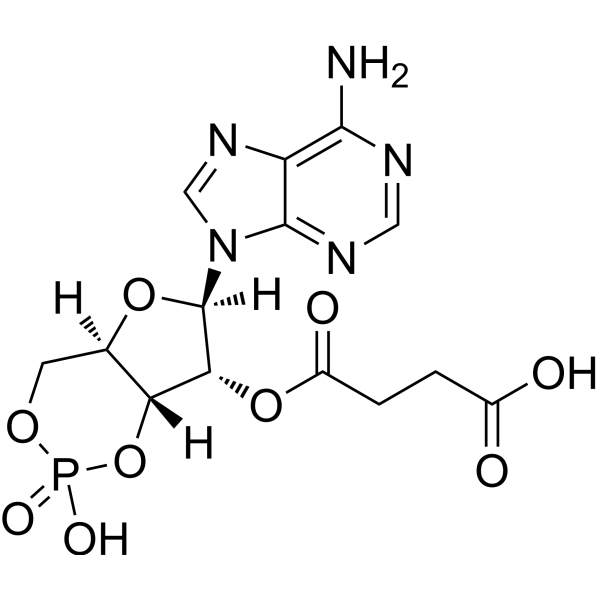
    2'-O-Succinyl-cAMP is a cAMP analog that can be covalently coupled to acetylcholinesterase. 2'-O-Succinyl-cAMP conjugate has been used as tracers in a classical heterogeneous competitive enzyme immunoassay allowing the determination of cAMP .
    2'-O-Succinyl-cAMP
  • HY-W206987

    Drug Intermediate Others
    2-(Aminomethyl)benzoic acid is an amino acid derivative and also a building block for heterogeneously synthetic folded oligomers with repeating γ/α 2-Amb-Pro motifs. 2-(Aminomethyl)benzoic acid can be used to construct synthetic oligomers .
    2-(Aminomethyl)benzoic acid
  • HY-177414

    Antibody-Drug Conjugates (ADCs) EGFR Inflammation/Immunology Cancer
    BB-1701 is an anti-HER2 antibody-drug conjugate (ADC). BB-1701 is composed of a humanized anti-HER2 antibody (Trastuzumab) (HY-P9907), a linker (Mal-PEG2-VCP), a microtubule inhibitor (Eribulin) (HY-13442), and the drug-linker conjugate for ADC is Mal-PEG2-VCP-Eribulin (HY-128870). BB-1701 has a potent cytotoxicity and bystander effects on tumors with heterogeneous target expression. BB-1701 significantly induces immunogenic cell death and the activation of the immune .
    BB-1701
  • HY-161910

    Anaplastic lymphoma kinase (ALK) Cancer
    SH-E4A-66 is a C 2-COUPLr (COvalent Protein Ligator) with carbazole scaffold barring heterogeneous cysteine reactive warheads (acrylamide and chloroacetamide). SH-E4A-66 is capable of coupling with EML4-ALK (EC50=1.5 μM) and inhibiting the activity of EML4-ALK kinase (IC50=2.3 μM) .
    SH-E4A-66
  • HY-13325

    Drug Derivative Amyloid-β Neurological Disease
    Aβ aggregation modulator-1 is a stimulator of amyloid-β () fibrillogenesis. Aβ aggregation modulator-1 binds hydrophobic residues in peptides and stabilizes β-sheet-rich protofibrils and fibrils. Aβ aggregation modulator-1 accelerates polymerization and reduces concentrations of small, toxic oligomers in heterogeneous aggregation reactions. Aβ aggregation modulator-1 suppresses long-term potentiation (LTP) inhibition by oligomers in hippocampal brain slices. Aβ aggregation modulator-1 can be used for the study of Alzheimer's disease (AD) .
    Aβ aggregation modulator-1
  • HY-W111403

    Environmental Pollutants Biochemical Assay Reagents Others
    Calcium oxide (CaO) acts as a heterogeneous base catalyst. Calcium oxide can be extracted not only from waste materials such as oyster shells, eggshells and crab shells, but also exhibits tolerance to low to moderate oil quality, free fatty acid and water content in raw materials. Calcium oxide can be used in biodiesel production, where it effectively catalyzes the transesterification of vegetable oils or animal fats to produce alkyl esters .
    Calcium oxide
  • HY-185564

    Biochemical Assay Reagents Others
    F6OM, a nonionic fluorinated octyl maltoside derivative, is a surfactant. F6OM readily interacts with and completely solubilizes phospholipid vesicles via a heterogeneous solubilization mechanism, without compromising membrane order at subsolubilizing concentrations. F6OM promotes bilayer insertion of an integral membrane enzyme in the absence of micelles to support functional refolding of integral membrane proteins. F6OM can be used for membrane-protein applications .
    F6OM
  • HY-182546

    DNA/RNA Synthesis Cancer
    Anticancer agent 312 is a heterogeneous nuclear ribonucleoprotein A18 (hnRNP A18) inhibitor with an IC50 of 2.9 μM. Anticancer agent 312 binds to the RNA recognition motif of hnRNP A18 and blocks its binding to homologous RNA transcripts. Anticancer agent 312 acts as a protein synthesis inhibitor by blocking hnRNP A18-mediated mRNA translation. Anticancer agent 312 is applicable to research on cancers such as melanoma .
    Anticancer agent 312
  • HY-D3179

    Fluorescent Dye BCRP Neurological Disease
    CDg13 is a fluorescent probe that specifically detects living neural stem/progenitor cells. CDg13 localizes to the endoplasmic reticulum via its dihexyl moiety, with no interaction with endoplasmic reticulum biomolecules. CDg13 undergoes selective efflux by active ABCG2 transporters, with increased intracellular accumulation following ABCG2 inhibition or knockdown. CDg13 isolates and enriches self-renewable neural stem/progenitor cells from embryonic mouse brain tissue, stains neural stem/progenitor cells brightly, and sorts ABCG2low cell populations from heterogeneous populations . (Ex/Em = 520/553 nm)
    CDg13
  • HY-108010

    Amyloid-β Neurological Disease
    Aftobetin is a non-invasive molecular probe used for the early diagnosis of Alzheimer's disease (AD). Aftobetin can specifically bind to the aggregated β-amyloid peptide () in the lens of the eye, enabling the early diagnosis of AD through a rapid and painless detection method .
    Aftobetin
  • HY-W075708

    Cu(II) Meso-Tetra(4-carboxyphenyl)porphyrin

    MOFs Others
    Cu (II) MTCPP (Cu (II) Meso-Tetra (4-carboxyphenyl) porphyrin) is a copper coordination complex. Cu (II) MTCPP-sensitized TiO2 nanotubes are a type of visible-light photocatalyst. Cu (II) MTCPP-sensitized TiO2 nanotubes can expand the wavelength response range, transfer excited electrons more efficiently, and separate photogenerated electron-hole pairs .
    Cu(II) MTCPP

Inquiry Online

Your information is safe with us. * Required Fields.

Salutation


Country or Region *

Applicant Name *


Organization Name *

Department *


Email Address *


Product Name *

Cat. No.


Requested quantity *

Phone Number *


Remarks

Inquiry Online

Inquiry Information

Product Name:
Cat. No.:
Quantity:
MCE Japan Authorized Agent:

