



PRMT1 Antibody (YA686)
(Synonyms: ANM 1; ANM1; ANM1_HUMAN; complete cds; HCP 1; HCP1; Heterogeneous nuclear ribonucleoprotein methyltransferase 1 like 2; Heterogeneous nuclear ribonucleoproteins methyltransferase like 2; Heterogeneous nuclear ribonucleoproteins methyltransferase like2; Hi)Based on 1 Customer Validation
PRMT1 Antibody (YA686) is a Mouse-derived and non-conjugated IgG2b monoclonal antibody, targeting to PRMT1.
-
Host:
Mouse
-
Isotype:
IgG
-
Application:
WB
-
Reactivity :
Human
-
Formulation:
Supplied in 1*PBS (pH 7.3), 50% glycerol and 0.5% BSA. Preservative: 0.02% sodium azide.
-
Conjugation:
Non-conjugated


To place orders, for customer services and technical support, please contact: MedChemExpress USA
Tel: 609-228-6898 E-mail: [email protected] [email protected]





Applications
| Application |
WB

WB: Western Blot
|
|---|---|
| Dilution Ratio | 1:500-1:1000 |


Product Details
PRMT1 Antibody (YA686) is a Mouse-derived and non-conjugated IgG2b monoclonal antibody, targeting to PRMT1.
-
Host Mouse

-
Clonality Monoclonal

-
Species ReactivityHuman
-
Observed Molecular WeightObserved band size: 42 kDa
Note: Due to possible protein modifications or aggregation, the molecular weight should be confirmed by actual measurement, and the predicted value is for reference only.

-
Calculated Molecular Weight Predicted band size: 42 kDa

Synthetic peptide corresponding to Human PRMT1.The exact sequence is proprietary to MCE.
Endogenous
affinity purified
Non-conjugated
Unmodified
IgG


Product Properties
-
Appearance
Solution
-
Formulation
Supplied in 1*PBS (pH 7.3), 50% glycerol and 0.5% BSA. Preservative: 0.02% sodium azide.
-
Concentration
Batch-dependent, Please check the COA for the concentration of each lot. Check Lot Concentration
-
Storage & Stability
Stored at -20°C for 1 year. Avoid repeated freeze / thaw cycles.
-
Shipping
Shipping with blue ice.


Verification Images
-
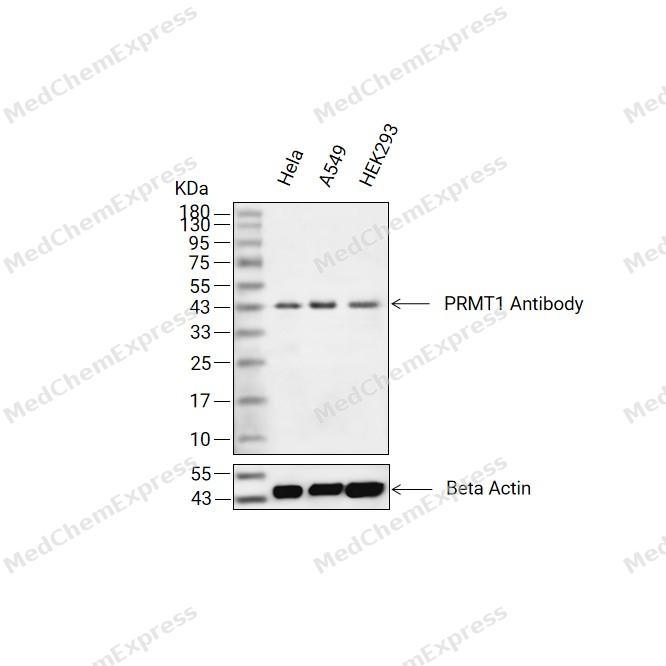 Western blot analysis of extracts from Hela(lane 2(20ug) , A549(lane 3(20ug) and HEK293(lane 4(20ug) using PRMT1 Antibody (HY-P80874) Rabbit mAb. Proteins were transferred to a PVDF membrane and blocked with 5% non-fat milk in TBST for 2 hour at room temperature. The primary antibody (1/1000) and Loading control antibody (Beta Actin, HY-P83730, 1/10000) was used in 5% non-fat milk in TBST at 4°C overnight. Goat Anti-Mouse/Rabbit IgG-HRP Secondary Antibody (1/10000) was used for 1 hour at room temperature.


Background
-
Function
Protein arginine methyltransferase 1 (PRMT1) is the primary type I PRMT responsible for asymmetric dimethylation of arginine residues on histone and non-histone proteins[1][2]. Mechanistically, PRMT1 regulates gene transcription, RNA processing, DNA replication, and signal transduction pathways critical for cell proliferation and survival[3][2]. PRMT1 activity influences type I interferon signaling and modulates anti-tumor immunity, particularly in lung adenocarcinoma, affecting proliferation, migration, and invasion[4]. In disease models, PRMT1 dysregulation contributes to persistence of cancer cells under EGFR- and KRAS-targeted therapies, with knockdown enhancing drug efficacy and prolonging tumor regression in xenografts[5]. Compared with related isoforms, PRMT1 exhibits distinct substrate specificity and nuclear localization, unlike PRMT3 which is primarily cytoplasmic, or PRMT8 which has brain-specific expression[6][7]. Functionally, PRMT1 shows sensitivity to ionic strength, temperature, and pH, allowing regulation under cellular stress conditions[2]. Experimental applications have demonstrated that inhibition of PRMT1, alone or combined with PRMT5 blockade, sensitizes cancer cells to DNA damage and PARP inhibitors, highlighting its therapeutic potential[8][9]. Collectively, PRMT1 is a key epigenetic regulator, distinct from other PRMT isoforms, and serves as a critical target in cancer biology and therapeutic design[10][5].
-
Subcellular Localization
Nucleus; Nucleus, nucleoplasm; Cytoplasm; Cytoplasm, cytosol; Lysosome membrane
-
Expression
Tissue_specificity:Widely expressed (PubMed:11097842) . Highly expressed in colorectal cancer cells (protein level) (PubMed:28040436) . Highly expressed in colorectal cancer tissues compared to wild-type colon tissue (protein level) (PubMed:28040436) . Highly expressed in colorectal cancer tissues compared to wild-type colon tissue (PubMed:28040436) . -
Isoforms & Post-Translational Modification
Q99873 has 4 isomers: Q99873-1: 42462 Da (predicted); Q99873-2: 39929 Da (predicted); Q99873-3: 40548 Da (predicted); Q99873-5: 32693 Da (predicted).
Polyubiquitinated at Lys-145 by the SCF(FBXL17) complex, leading to its subsequent degradation (By similarity). Ubiquitination is regulated by acetylation at Lys-228 and Lys-233 (By similarity). Polyubiquitinated by E3 ubiquitin-protein ligase TRIM48, leading to suppression of MAP3K5/ASK1 methylation and subsequent MAP3K5 activation (PubMed:29186683);Acetylation at Lys-228 and Lys-233 regulates ubiquitination by the SCF(FBXL17) complex. Acetylated at Lys-233 by p300/EP300. Deacetylated at Lys-228 and Lys-233 by SIRT1 -
Subunit
Homodimer (PubMed:16879614, PubMed:26876602). Homooctamer; individual homodimers associates to form a homooctamer (PubMed:26876602).
-
SwissProt ID
-
Synonyms
ANM 1; ANM1; ANM1_HUMAN; complete cds; HCP 1; HCP1; Heterogeneous nuclear ribonucleoprotein methyltransferase 1 like 2; Heterogeneous nuclear ribonucleoproteins methyltransferase like 2; Heterogeneous nuclear ribonucleoproteins methyltransferase like2; Hi
-
Research Field
Cell Biology


Documentation
-
Data Sheet (263 KB)
-
SDS (252 KB)
- English - EN (252 KB)
- Français - FR (252 KB)
- Deutsch - DE (252 KB)
- Norwegian - NO (252 KB)
- Español - ES (252 KB)
- Swedish - SV (252 KB)
- Italian - IT (252 KB)
- Korean - KR (252 KB)
- Portuguese - PT (252 KB)
-
User Guide for Antibodies (1077 KB)
References
[1]. Wang YC, et al. Identification, chromosomal arrangements and expression analyses of the evolutionarily conserved prmt1 gene in chicken in comparison with its vertebrate paralogue prmt8. PLoS One. 2017 Sep 21;12(9):e0185042. [Content Brief]
[2]. Lowe TL, et al. Human protein arginine methyltransferases (PRMTs) can be optimally active under nonphysiological conditions. J Biol Chem. 2022 Sep;298(9):102290. [Content Brief]
[3]. Yoshimatsu M, et al. Dysregulation of PRMT1 and PRMT6, Type I arginine methyltransferases, is involved in various types of human cancers. Int J Cancer. 2011 Feb 1;128(3):562-73. [Content Brief]
[4]. Wang J, et al. Pan-cancer analysis identifies protein arginine methyltransferases PRMT1 and PRMT5 and their related signatures as markers associated with prognosis, immune profile, and therapeutic response in lung adenocarcinoma. Heliyon. 2023 Nov 27;9(12):e22088. [Content Brief]
[5]. Sun X, et al. Targeting PRMT1 Reduces Cancer Persistence and Tumor Relapse in EGFR- and KRAS-Mutant Lung Cancer. Cancer Res Commun. 2025 Jan 1;5(1):119-127. [Content Brief]
[6]. Tang J, et al. PRMT 3, a type I protein arginine N-methyltransferase that differs from PRMT1 in its oligomerization, subcellular localization, substrate specificity, and regulation. J Biol Chem. 1998 Jul 3;273(27):16935-45. [Content Brief]
[7]. Lin YL, et al. The critical role of protein arginine methyltransferase prmt8 in zebrafish embryonic and neural development is non-redundant with its paralogue prmt1. PLoS One. 2013;8(3):e55221. [Content Brief]
[8]. Zhang Y, et al. Repression of PRMT activities sensitize human homologous recombination-proficient ovarian and breast cancer cells to PARP inhibitor treatment. Elife. 2026 Feb 3;13:RP99225. [Content Brief]
[9]. Gao G, et al. PRMT1 loss sensitizes cells to PRMT5 inhibition. Nucleic Acids Res. 2019 Jun 4;47(10):5038-5048. [Content Brief]
[10]. Li M, et al. The arginine methyltransferase PRMT5 and PRMT1 distinctly regulate the degradation of anti-apoptotic protein CFLARL in human lung cancer cells. J Exp Clin Cancer Res. 2019 Feb 8;38(1):64. [Content Brief]

 Powered by Bioz
