
13 Results for "

human tPA

" in MedChemExpress (MCE) Product Catalog:
Products (13)

13 Results for "human tPA" in MCE Product Catalog:

5
5 Cited Publications
Cat. No.: HY-P71051
Purity:  ≥ 95%, as determined by reducing SDS-PAGE.
Synonyms: PLAT; T-PA; Plasminogen Activator, Tissue Type; tPA; Tissue-Type Plasminogen Activator; Plasminogen Activator, Tissue; T-Plasminogen Activator; Plasminogen/Activator Kringle; Alteplase; Plasminogen Activator; Reteplase
Species:  
Source:  
loading...
    loading...
Cat. No.: HY-108845
CAS No.: 191588-94-0
Synonyms: TNK-tPA
Tenecteplase (TNK-tPA) is a modified tissue plasminogen activator. Tenecteplase is a recombinant human tissue plasminogen activator (rt-PA) that has been bioengineered to produce mutations in three gene loci. Tenecteplase (TNK-tPA) can be used in the study of acute ischemic stroke .
loading...
    loading...
Cat. No.: HY-114330A
CAS No.: 2436760-76-6
Purity:  99.03%
Target:  

PAI-1 Ser/Thr Protease

Research Areas:  

Inflammation/Immunology

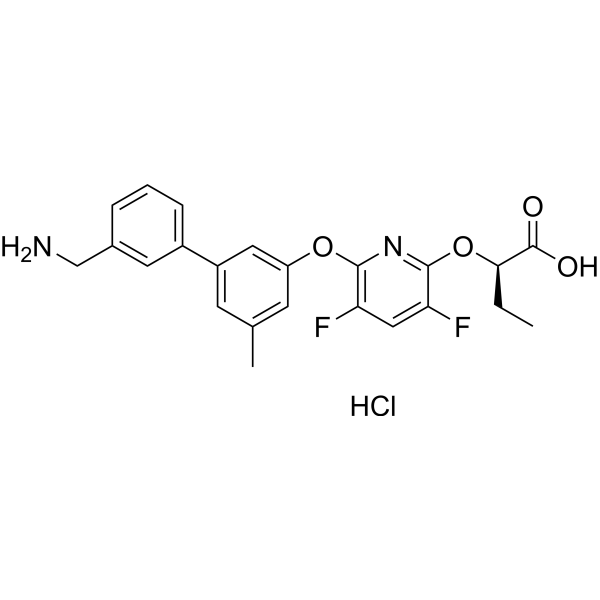
ZK824859 hydrochloride is an oral available and selective urokinase plasminogen activator (uPA) inhibitor with IC50s of 79 nM, 1580 nM and 1330 nM for human uPA, tPA, and plasmin, respectively .
loading...
    loading...
Cat. No.: HY-114330
CAS No.: 2271122-53-1
Target:  

PAI-1 Ser/Thr Protease

Research Areas:  

Inflammation/Immunology

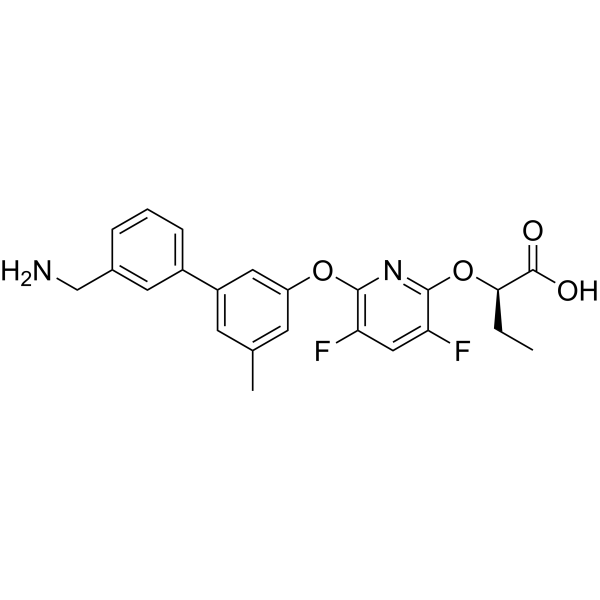
ZK824859 is an oral available and selective urokinase plasminogen activator (uPA) inhibitor with IC50s of 79 nM, 1580 nM and 1330 nM for human uPA, tPA, and plasmin, respectively .
loading...
    loading...
Cat. No.: HY-P11413
CAS No.: 139446-70-1
PAI-1 is a serine protease inhibitor (SERPIN). PAI-1 binds to and irreversibly inhibits uPA, tPA and furin; it also interacts with vitronectin, α1-acid glycoprotein, CRT, TLR4, proteasome α-3 subunit, uPAR, LRP1, Integrin αvβ3 and thrombin. PAI-1 regulates fibrinolysis, extracellular matrix turnover, cell migration, angiogenesis, inflammatory response and tissue remodeling; it mediates epithelial-mesenchymal transition (EMT)/endothelial-mesenchymal transition (EndMT), apoptosis and thrombus stabilization. PAI-1 can be used in research related to sepsis, acute lung injury, cardiovascular diseases, tissue fibrosis, diabetic nephropathy, obstructive nephropathy and non-insulin-dependent diabetes mellitus .
loading...
    loading...
Cat. No.: HY-19205A
CAS No.: 193739-23-0
Synonyms: LDP-392
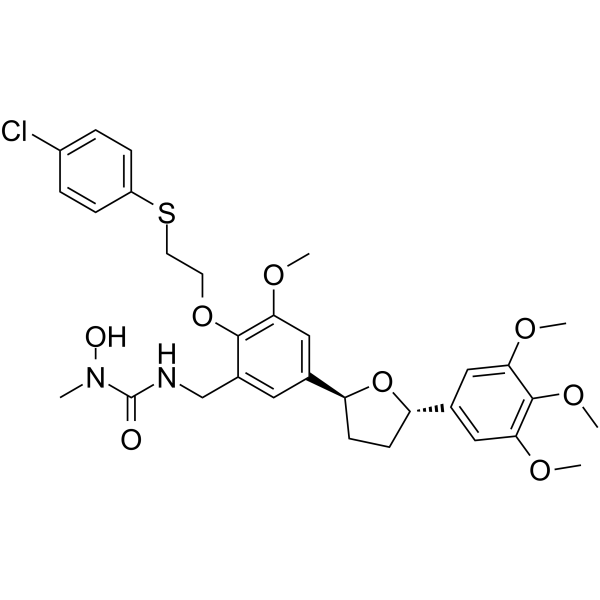
CMI-392 (LDP-392) is an orally active dual 5-lipoxygenase inhibitor and platelet-activating factor receptor (PAFR) antagonist, with an IC50 of 10 nM for human PAF receptor and an IC50 of 100 nM for rat 5-lipoxygenase. CMI-392 blocks PAF receptor binding, inhibits leukotriene synthesis, attenuates PAF-induced hemoconcentration, and suppresses arachidonic acid- and TPA-induced ear swelling in mice. CMI-392 reduces inflammatory cell infiltration, decreases MPO levels, alleviates ocular inflammation, and improves dextran sulfate sodium-induced colitis. CMI-392 can be used in the research of inflammatory and immune-related diseases such as colitis and atopic dermatitis .
loading...
    loading...
Cat. No.: HY-114015
CAS No.: 154628-42-9
Target:  

Ser/Thr Protease

Research Areas:  

Cancer

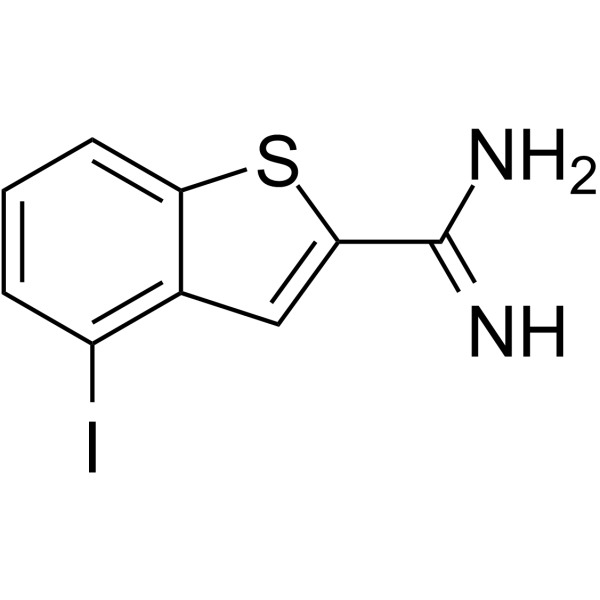
APC-6860 is a competitive, selective arylamidine Serine protease inhibitor, with a Ki of 0.44 μM for trypsin, 0.10 μM for h-uPA, and 0.082 μM for mouse uPA. APC-6860 inhibits urokinase-activated plasminogen-mediated degradation of Fibronectin in cancer cells. APC-6860 is applicable to research related to breast cancer and prostate cancer .
loading...
    loading...
Cat. No.: HY-19205B
CAS No.: 205654-37-1
(2S,5S)-CMI-392 is the absolute configuration of CMI-392 (HY-19205A). CMI-392 is an orally active dual 5-lipoxygenase inhibitor and platelet-activating factor receptor (PAFR) antagonist, with an IC50 of 10 nM for human PAF receptor and an IC50 of 100 nM for rat 5-lipoxygenase. CMI-392 blocks PAF receptor binding, inhibits leukotriene synthesis, attenuates PAF-induced hemoconcentration, and suppresses arachidonic acid- and TPA-induced ear swelling in mice. CMI-392 reduces inflammatory cell infiltration, decreases MPO levels, alleviates ocular inflammation, and improves dextran sulfate sodium-induced colitis. CMI-392 can be used in the research of inflammatory and immune-related diseases such as colitis and atopic dermatitis .
loading...
    loading...
Cat. No.: HY-P73451
Purity:  ≥ 80%, as determined by reducing SDS-PAGE.
Synonyms: PLAT; T-PA; Plasminogen Activator, Tissue Type; tPA; Tissue-Type Plasminogen Activator; Plasminogen Activator, Tissue; T-Plasminogen Activator; Plasminogen/Activator Kringle; Alteplase; Plasminogen Activator; Reteplase
Species:  
Source:  
loading...
    loading...
Cat. No.: HY-W794573
CAS No.: 149732-36-5
Target:  

Ser/Thr Protease

Research Areas:  

Cancer

APC-6860 hydrochloride is a competitive, selective arylamidine Serine protease inhibitor, with a Ki of 0.44 μM for trypsin, 0.10 μM for h-uPA, and 0.082 μM for mouse uPA. APC-6860 hydrochloride inhibits urokinase-activated plasminogen-mediated degradation of Fibronectin in cancer cells. APC-6860 hydrochloride is applicable to research related to breast cancer and prostate cancer .
loading...
    loading...
Cat. No.: HY-P77508
Purity:  ≥ 95%, as determined by reducing SDS-PAGE.
Synonyms: DCTPP1; XTP3-Transactivated Gene A Protein; DCTP Pyrophosphatase 1; Deoxycytidine-Triphosphatase 1; XTP3tPA; XTP3-Transactivated Protein A; RS21C6; DCtPAse 1; CDA03; MGC5627
Species:  
Source:  
loading...
    loading...
Cat. No.: HY-N18117A
CAS No.: 1429747-10-3
23-Hydroxyohchininolide is a limonoid found in the leaves of Melia azedarach L.. 23-Hydroxyohchininolide inhibits LPS (HY-D1056)-induced NO production and exerts cytotoxic activity against human leukemia and stomach cancer cells. 23-Hydroxyohchininolide inhibits TPA (HY-18739)-induced Epstein-Barr virus early antigen activation. 23-Hydroxyohchininolide can be used for the research of cancer, infection and inflammatory disease .
loading...
    loading...
Cat. No.: HY-165553
CAS No.: 873541-45-8
ASB16165 is a selective and potent PDE7A inhibitor with an IC50 of 15 nM against human PDE7A. ASB16165 inhibits IL-12-induced IFN-γ production via a cAMP/PKA-dependent mechanism, reduces cutaneous TNF-α production, and suppresses keratinocyte proliferation. ASB16165 can be used in research on skin diseases such as psoriasis .
loading...
    loading...
  • 1

