

12 Results for "

long-term depression

" in MedChemExpress (MCE) Product Catalog:
Products (12)

12 Results for "long-term depression" in MCE Product Catalog:

2
2 Cited Publications
Cat. No.: HY-P2259
CAS No.: 1404188-93-7
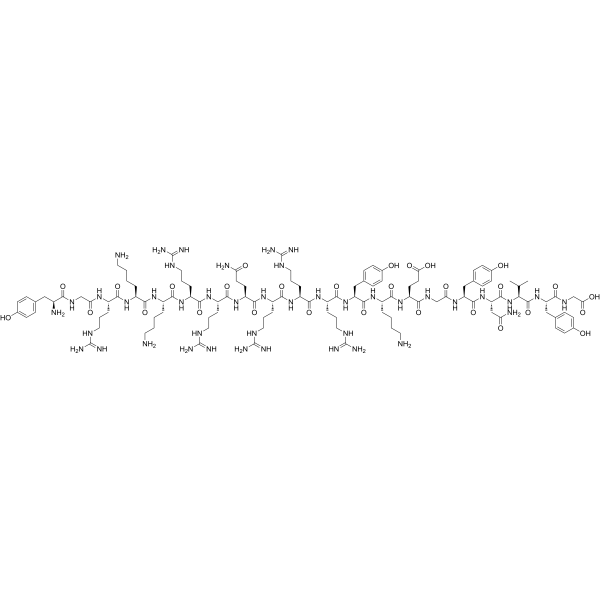
TAT-GluA2 3Y is a blood-brain barrier-permeable AMPA receptor inhibitory peptide that crosses cell membranes via the HIV-1 TAT protein domain. TAT-GluA2 3Y blocks the endocytosis of AMPA receptors, including the internalization of GluA1/GluA2 subunits, by disrupting interactions with the AP2, Brag2 and Syt3-GluA2 complexes, while also inhibiting long-term depression. TAT-GluA2 3Y blocks hypoxia-mediated AMPAR internalization, alleviates A1R-induced persistent synaptic inhibition, and reduces cerebral ischemic volume, neurological deficits and spatial memory deficits. TAT-GluA2 3Y blocks the effect of NLRP3 deficiency on fear generalization, inhibits amphetamine-induced behavioral/neurochemical sensitization, weakens the unconditioned stimulus-conditioned stimulus association of morphine, and promotes the extinction of morphine CPP. TAT-GluA2 3Y can be used in studies related to fear generalization, ischemic stroke, hypoxia, drug addiction and opioid addiction .
loading...
    loading...
1
1 Cited Publications
Cat. No.: HY-P4106A
Research Areas:  

Neurological Disease

Tat-GluR23Y, scrambled TFA is the scrambled peptide of Tat-GluR23Y (HY-P2259). Tat-GluR23Y is a synthetic peptide containing tyrosine residues that inhibit AMPAR endocytosis and is effective in the research of long-term depression (LTD) .
loading...
    loading...
Cat. No.: HY-101955A
CAS No.: 1430202-69-9
Purity:  99.61%
Synonyms: (2R,6R)-HNK hydrochloride
Target:  

Drug Metabolite

Research Areas:  

Neurological Disease

(2R,6R)-Hydroxynorketamine ((2R,6R)-HNK) hydrochloride is an active ketamine metabolite with no NMDAR binding activity. (2R,6R)-Hydroxynorketamine hydrochloride rescues impaired dorsal hippocampal long-term potentiation and restores robust long-term potentiation in the hippocampal SC-CA1 pathway. (2R,6R)-Hydroxynorketamine hydrochloride can be used for research on depression .
loading...
    loading...
Cat. No.: HY-171844
CAS No.: 1086377-48-1
Target:  

iGluR

CX1739 is an orally active, blood-brain barrier permeable, low-efficacy AMPA-glutamate receptor (AMPAR) potentiator. CX1739 enhances excitatory neurotransmission by potentiating glutamate-induced excitatory currents and promoting in vivo long-term potentiation. CX1739 eliminates amphetamine-induced locomotor activity, reverses opioid-, pentobarbital- and ethanol-induced respiratory depression, and exerts pro-cognitive effects in animals. CX1739 impairs motor function recovery and increases the risk of post-injury complications. CX1739 can be used in research related to attention-deficit/hyperactivity disorder, dementia, respiratory depression and spinal cord injury .
loading...
    loading...
Cat. No.: HY-135741
CAS No.: 2012536-16-0
Purity:  98.77%
NYX-2925 is an orally active, blood-brain barrier-permeable NMDAR modulator, with EC50 values of 55 pM, 28 fM, 11 pM and 55 pM against NR2A, NR2B, NR2C and NR2D, respectively . NYX-2925 enhances synaptic plasticity, long-term potentiation, metaplasticity, structural plasticity, learning ability, memory capacity and circadian rhythm amplitude. NYX-2925 regulates the signaling pathways of Src kinase, EIF2, mTOR, CDK5 and protein kinase A (PKA). NYX-2925 increases the levels of PSD-95, GluA1, activated Src and synaptic GluN2B . NYX-2925 is used in the research of neuropathic pain, fibromyalgia, painful diabetic peripheral neuropathy, post-traumatic stress disorder, cognitive impairment, depression, age-related cognitive decline and NMDAR-mediated central nervous system diseases .
loading...
    loading...
Cat. No.: HY-176036
CAS No.: 3070323-06-4
MS1262 is a blood-brain barrier-permeable, selective inhibitor of histone methyltransferases G9a (EHMT2) and GLP (EHMT1), with an IC50 of 19 nM and a Kd of 74 nM against G9a, and an IC50 of 6 nM and a Kd of 19 nM against GLP. MS1262 reduces the dimethylation level of histone H3 lysine 9 and decreases the size of plaques. MS1262 restores hippocampal long-term potentiation (LTP) and miniature excitatory postsynaptic current (sEPSC) frequency, ameliorates spatial memory deficits, and reverses anxiety-like and depression-like behaviors in AD model mice. MS1262 reverses the expression/phosphorylation levels of early AD biomarkers, providing support for stage-specific diagnosis of AD. MS1262 reduces the risk of thrombus rupture. MS1262 can be used in research related to Alzheimer's disease, colorectal cancer, and triple-negative breast cancer .
loading...
    loading...
Cat. No.: HY-P4106
CAS No.: 1404188-94-8
Research Areas:  

Neurological Disease

Tat-GluR23Y, scrambled is the scrambled peptide of Tat-GluR23Y (HY-P2259). Tat-GluR23Y is a synthetic peptide containing tyrosine residues that inhibit AMPAR endocytosis and is effective in the research of long-term depression (LTD) .
loading...
    loading...
Cat. No.: HY-P1058
CAS No.: 243843-42-7
Target:  

iGluR

Research Areas:  

Neurological Disease

Pep2m is a peptide receptor inhibitor. Pep2m inhibits the interaction between the C-terminus of the AMPA-type glutamate receptor (GluA2) subunit and N-ethylmaleimide-sensitive fusion protein (NSF). Pep2m prevents synaptic long-term depression (LTD). Pep2m can reduce postsynaptic currents in neurons, AMPA-mediated currents in cultured hippocampal neurons, and AMPA receptor surface expression [1] [2] [3] [4] [5].
loading...
    loading...
Cat. No.: HY-P1056
CAS No.: 328944-75-8
Target:  

iGluR

Research Areas:  

Neurological Disease

pep2-SVKI is a selective peptide inhibitor. pep2-SVKI inhibits the binding of AMPA-type glutamate receptor (GluA2) (C-terminal PDZ site) to glutamate receptor interacting protein (GRIP), AMPA receptor binding protein (ABP), and C-kinase interacting protein (PICK1). pep2-SVKI increases the amplitude of AMPA receptor-mediated currents and blocks long-term depression (LTD). pep2-SVKI can be used to study neurological diseases .
loading...
    loading...
Cat. No.: HY-183404
CAS No.: 72807-01-3
Target:  

Serotonin Transporter

Research Areas:  

Neurological Disease

Wy 25093 is a selective serotonin (5-HT) uptake transporter inhibitor. Wy 25093 regulates the turnover and metabolism of central 5-HT, enhances postsynaptic 5-HT actions and 5-hydroxytryptophan-induced behavioral syndrome. Wy 25093 induces ipsilateral and contralateral circling behavior in rats, reduces the turnover rate of striatal dopamine, decreases the level of 5-hydroxyindole-3-acetic acid in the brain, and long-term administration reduces brain 5-HT levels. Wy 25093 can be used in research related to depression .
loading...
    loading...
Cat. No.: HY-181127
CAS No.: 2419700-58-4
Target:  

iGluR

Research Areas:  

Neurological Disease

GluN2B-NMDAR Allosteric modulator 1 is a selective GluN2B-NMDAR positive allosteric modulator. GluN2B-NMDAR Allosteric modulator 1 can increase glutamate- and aspartate-evoked GluN2B-NMDAR-gated currents with EC50 values of 43.7 and 18 nM. GluN2B-NMDAR Allosteric modulator 1 can reverse anxiety-like behavior and social cognition deficits in mice. GluN2B-NMDAR Allosteric modulator 1 can be used for the research of neurological disease, such as anxiety .
loading...
    loading...
Cat. No.: HY-176036A
MS1262 TFA is a blood-brain barrier-permeable, selective inhibitor of histone methyltransferases G9a (EHMT2) and GLP (EHMT1), with an IC50 of 19 nM and a Kd of 74 nM against G9a, and an IC50 of 6 nM and a Kd of 19 nM against GLP. MS1262 TFA reduces the dimethylation level of histone H3 lysine 9 and decreases the size of plaques. MS1262 TFA restores hippocampal long-term potentiation (LTP) and miniature excitatory postsynaptic current (sEPSC) frequency, ameliorates spatial memory deficits, and reverses anxiety-like and depression-like behaviors in AD model mice. MS1262 TFA reverses the expression/phosphorylation levels of early AD biomarkers, providing support for stage-specific diagnosis of AD. MS1262 TFA reduces the risk of thrombus rupture. MS1262 TFA can be used in research related to Alzheimer's disease, colorectal cancer, and triple-negative breast cancer .
loading...
    loading...
  • 1

