1. Search Result
Search Result
Results for "

neural disorders

" in MedChemExpress (MCE) Product Catalog:

16

Inhibitors & Agonists

2

Screening Libraries

1

Peptides

2

Natural
Products

2

Isotope-Labeled Compounds

1

Click Chemistry

Cat. No. Product Name Target Research Areas Chemical Structure
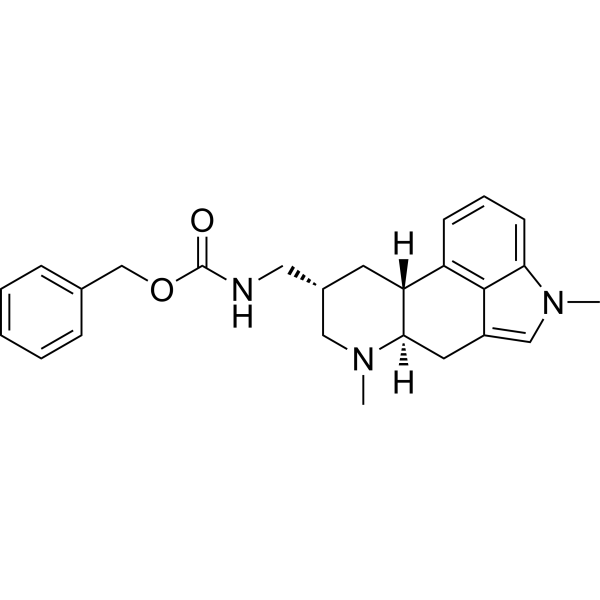
  • HY-B1033
    Metergoline
    2 Publications Verification

    5-HT Receptor Dopamine Receptor Sodium Channel Neurological Disease
    Metergoline is a serotonin (5-HT) receptor and dopamine receptors antagonist, with pKis of 8.64, 8.75 and 8.75 for 5-HT2A, 5-HT2B and 5-HT2C, respectively. Metergoline is a high-affinity ligand for the h5-HT7 receptor, with a Ki of 16 nM. Metergoline is also a reversible neural Na + channels inhibitor. Metergoline is commonly used for the research of seasonal affective disorder, prolactin hormone regulation .
    Metergoline
  • HY-B1277
    Trihexyphenidyl hydrochloride
    3 Publications Verification

    mAChR Cholinesterase (ChE) Neurological Disease
    Trihexyphenidyl hydrochloride is a selective and orally active M1 muscarinic receptor antagonist with an IC50 of 3.7 nM for rat cerebral cortex M1 muscarinic receptors. Trihexyphenidyl hydrochloride modulates cholinergic activity, countering acetylcholine supersensitivity in neural pathways. Trihexyphenidyl hydrochloride improves movement disorder, inhibits McN-A-343 (HY-107648)-induced pressor responses, vagally-induced bradycardia and vasodilatation. Trihexyphenidyl hydrochloride can be used for the research of Parkinson's disease. .
    Trihexyphenidyl hydrochloride
  • HY-B2167R

    DHA (Standard); Cervonic acid (Standard)

    Reference Standards Endogenous Metabolite Neurological Disease Cancer
    Docosahexaenoic acid (Standard) is the analytical standard of Docosahexaenoic acid. This product is intended for research and analytical applications. Docosahexaenoic Acid (DHA) is an omega-3 fatty acid abundantly present brain and retina. It can be obtained directly from fish oil and maternal milk. In Vitro: Docosahexaenoic acid (DHA) is essential for the growth and functional development of the brain in infants. DHA is also required for maintenance of normal brain function in adults. The inclusion of plentiful DHA in the diet improves learning ability and memory . DHA is an essential requirement in every step of brain development like neural cell proliferation, migration, differentiation, synaptogenesis. The multiple double bonds and unique structure allow DHA to impart special membrane characteristics for effective cell signaling. Many development disorders like dyslexia, autism spectrum disorder, attention deficit hyperactivity disorder, schizophrenia etc. are causally related to decreased level of DHA . DHA is a potent RXR ligand inducing robust RXR activation already at low micro molar concentrations. The EC50 for RXRα activation by DHA is about 5-10 μM fatty acid . In Vivo: Docosahexaenoic acid administration over 10 weeks significantly reduces the number of reference memory errors, without affecting the number of working memory errors, and significantly increases the docosahexaenoic acid content and the docosahexaenoic acid/arachidonic acid ratio in both the hippocampus and the cerebral cortex . DHA treatment exerts neuroprotective actions on an experimental mouse model of PD. There is a decrease tendency in brain lipid oxidation of MPTP mice but it does not significantly .
    Docosahexaenoic acid (Standard)
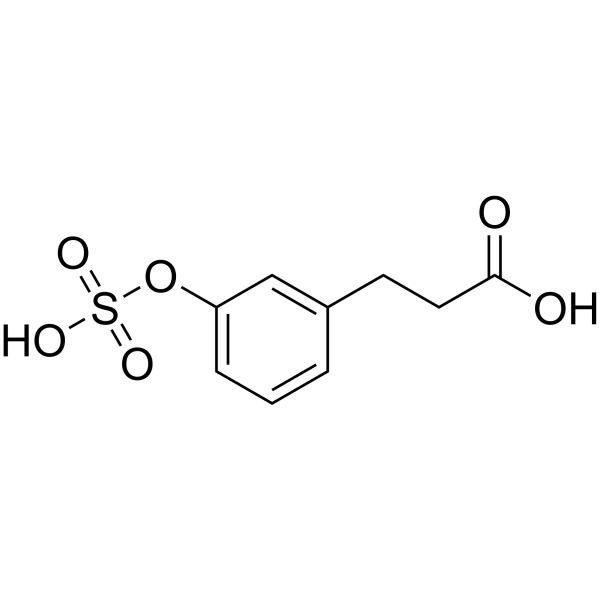
  • HY-160236

    Drug Metabolite Neurological Disease
    3-(3-Sulfooxyphenyl) propanoic acid is a metabolite of Echinacoside (HY-N0020). It promotes neural, psychological and brain health, enhances the proliferation, function and activity of brain cells, and facilitates extinction learning. 3-(3-Sulfooxyphenyl) propanoic acid can be used in research related to anxiety disorders, post-traumatic stress disorder, extinction learning deficits, autism, as well as neurodegenerative diseases including Parkinson's disease and Alzheimer's disease .
    3-(3-Sulfooxyphenyl)propanoic acid
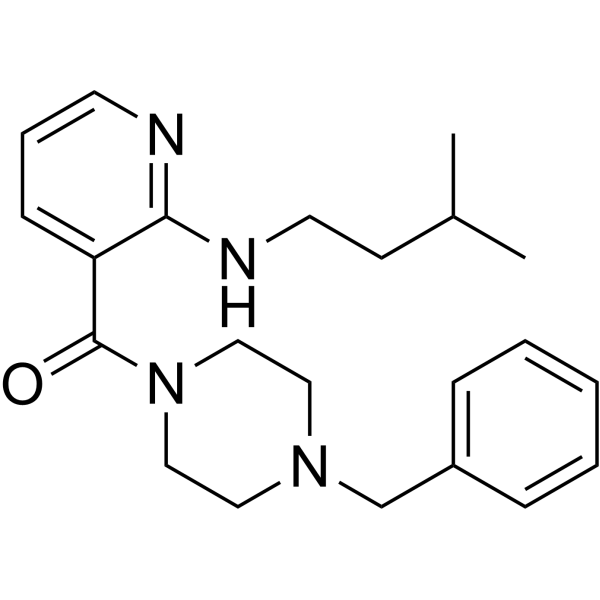
  • HY-13999

    NSI-189

    Trk Receptor Neurological Disease
    Amdiglurax (NSI-189) is an orally active chemical entity with enhanced neurogenic activity. Amdiglurax up-regulates neurogenic factors such as BDNF (brain derived-neurotrophic factor) and SCF. Amdiglurax exhibits anti-depressant effect. Amdiglurax enhances synaptic plasticity and reduces cognitive dysfunction. Amdiglurax holds potential for psychiatric disorder research .
    Amdiglurax
  • HY-142035
    N-Propargylglycine
    1 Publications Verification

    Mitochondrial Metabolism Neurological Disease Metabolic Disease Inflammation/Immunology Cancer
    N-Propargylglycine is a brain-penetrant and orally active PRODH inhibitor. N-Propargylglycine covalently modifies enzyme-bound FAD and active site lysine, causing enzyme structural distortion, protein decay, and irreversible inhibition of proline and 4-hydroxyproline catabolism. N-Propargylglycine induces UPRmt, upregulates mitochondrial chaperones and YME1L1, enhances mitochondrial proteostasis, blocks astrocytic L-proline consumption, and abolishes L-proline’s ATP-maintaining and viability-protective effects. N-Propargylglycine stimulates neural processes, increases brain proline, hydroxyproline, and sarcosine levels, partially normalizes Huntington’s disease whole brain transcriptomes. N-Propargylglycine reduces hyperoxaluria, prevents calcium oxalate stone formation, reduces kidney tubular damage, and restores weight and survival in Grhpr knockout mice. N-Propargylglycine can be used for the research of breast cancer, neurodegenerative disorders, Huntington’s disease, and primary hyperoxaluria type 2 .
    N-Propargylglycine
  • HY-13999A1

    NSI-189 phosphate

    Trk Receptor Neurological Disease
    Amdiglurax (NSI-189) phosphate is an orally active chemical entity with enhanced neurogenic activity. Amdiglurax phosphate up-regulates neurogenic factors such as BDNF (brain derived-neurotrophic factor) and SCF. Amdiglurax phosphate exhibits anti-depressant effect. Amdiglurax enhances synaptic plasticity and reduces cognitive dysfunction. Amdiglurax phosphate holds potential for psychiatric disorder research .
    Amdiglurax phosphate
  • HY-B1277A

    mAChR Cholinesterase (ChE) Cardiovascular Disease Neurological Disease
    Trihexyphenidyl is a selective and orally active M1 muscarinic receptor antagonist with an IC50 of 3.7 nM for rat cerebral cortex M1 muscarinic receptors. Trihexyphenidyl modulates cholinergic activity, countering acetylcholine supersensitivity in neural pathways. Trihexyphenidyl improves movement disorder, inhibits McN-A-343 (HY-107648)-induced pressor responses, vagally-induced bradycardia and vasodilatation. Trihexyphenidyl can be used for the research of Parkinson's disease. .
    Trihexyphenidyl
  • HY-P11322

    Amino Acid Derivatives Neurological Disease
    NHIP peptide is a peptide segment containing 20 amino acids located in the nucleus of the cell. NHIP is highly expressed in neuronal derived cells such as LUHMES cells. NHIP peptide can promote the proliferation of 293T cells. NHIP peptide regulates gene networks related to neural development and autism spectrum disorder (ASD) .
    NHIP peptide
  • HY-105161

    5-HT Receptor Neurological Disease
    AP-521 (free base) is a benzothienopyridine derivative that exhibits potent anxiolytic effects by acting as a postsynaptic 5-HT1A receptor agonist and by enhancing serotonergic neural transmission in the medial prefrontal cortex (mPFC). AP-521 (free base) is promising for research of anxiety disorders .
    AP-521 free base
  • HY-N2439R

    Reference Standards Others Neurological Disease
    Methyl isoeugenol (Standard) is the analytical standard of Methyl isoeugenol. This product is intended for research and analytical applications. Methyl isoeugenol (MIE) is a natural food flavour that can be isolated from Pimenta pseudocaryophyllus leaf. Methyl isoeugenol shows anxiolytic and antidepressant like effects. Methyl isoeugenol is orally active .
    Methyl isoeugenol (Standard)
  • HY-B1277AS

    Isotope-Labeled Compounds mAChR Cholinesterase (ChE) Neurological Disease
    Trihexyphenidyl-d5 is deuterium labeled Trihexyphenidyl (HY-B1277A). Trihexyphenidyl is a selective and orally active M1 muscarinic receptor antagonist with an IC50 of 3.7 nM for rat cerebral cortex M1 muscarinic receptors. Trihexyphenidyl modulates cholinergic activity, countering acetylcholine supersensitivity in neural pathways. Trihexyphenidyl improves movement disorder, inhibits McN-A-343 (HY-107648)-induced pressor responses, vagally-induced bradycardia and vasodilatation. Trihexyphenidyl can be used for the research of Parkinson's disease. .
    Trihexyphenidyl-d5
  • HY-B1277S

    Isotope-Labeled Compounds mAChR Cholinesterase (ChE) Neurological Disease
    Trihexyphenidyl-d5 hydrochloride is deuterium labeled Trihexyphenidyl hydrochloride (HY-B1277). Trihexyphenidyl hydrochloride is a selective and orally active M1 muscarinic receptor antagonist with an IC50 of 3.7 nM for rat cerebral cortex M1 muscarinic receptors. Trihexyphenidyl hydrochloride modulates cholinergic activity, countering acetylcholine supersensitivity in neural pathways. Trihexyphenidyl hydrochloride improves movement disorder, inhibits McN-A-343 (HY-107648)-induced pressor responses, vagally-induced bradycardia and vasodilatation. Trihexyphenidyl hydrochloride can be used for the research of Parkinson's disease. .
    Trihexyphenidyl-d5 hydrochloride
  • HY-B1277R

    Reference Standards mAChR Cholinesterase (ChE) Neurological Disease
    Trihexyphenidyl hydrochloride (Standard) is the analytical standard of Trihexyphenidyl hydrochloride (HY-B1277). This product is intended for research and analytical applications. Trihexyphenidyl is a selective and orally active M1 muscarinic receptor antagonist with an IC50 of 3.7 nM for rat cerebral cortex M1 muscarinic receptors. Trihexyphenidyl modulates cholinergic activity, countering acetylcholine supersensitivity in neural pathways. Trihexyphenidyl improves movement disorder, inhibits McN-A-343 (HY-107648)-induced pressor responses, vagally-induced bradycardia and vasodilatation. Trihexyphenidyl can be used for the research of Parkinson's disease. .
    Trihexyphenidyl hydrochloride (Standard)
  • HY-B1033R

    5-HT Receptor Dopamine Receptor Sodium Channel Reference Standards Neurological Disease
    Metergoline (Standard) is the analytical standard of Metergoline. This product is intended for research and analytical applications. Metergoline is a serotonin (5-HT) receptor and dopamine receptors antagonist, with pKis of 8.64, 8.75 and 8.75 for 5-HT2A, 5-HT2B and 5-HT2C, respectively. Metergoline is a high-affinity ligand for the h5-HT7 receptor, with a Ki of 16 nM. Metergoline is also a reversible neural Na+ channels inhibitor. Metergoline is commonly used for the research of seasonal affective disorder, prolactin hormone regulation .
    Metergoline (Standard)
  • HY-160236B

    Drug Metabolite Neurological Disease
    3-(3-Sulfooxyphenyl) propanoic acid disodium is a metabolite of Echinacoside (HY-N0020). 3-(3-Sulfooxyphenyl) propanoic acid disodium promotes neural, psychological and brain health, enhances the proliferation, function and activity of brain cells, and facilitates extinction learning. 3-(3-Sulfooxyphenyl) propanoic acid disodiumis can be used in research related to anxiety disorders, post-traumatic stress disorder, extinction learning deficits, autism, as well as neurodegenerative diseases including Parkinson's disease and Alzheimer's disease .
    3-(3-Sulfooxyphenyl)propanoic acid disodium

Inquiry Online

Your information is safe with us. * Required Fields.

Salutation


Country or Region *

Applicant Name *


Organization Name *

Department *


Email Address *


Product Name *

Cat. No.


Requested quantity *

Phone Number *


Remarks

Inquiry Online

Inquiry Information

Product Name:
Cat. No.:
Quantity:
MCE Japan Authorized Agent:

