1. Search Result
Search Result
Pathways Recommended: Stem Cell/Wnt Cell Cycle/DNA Damage
Results for "

normal breast epithelial cells

" in MedChemExpress (MCE) Product Catalog:

12

Inhibitors & Agonists

2

Natural
Products

Cat. No. Product Name Target Research Areas Chemical Structure
  • HY-N3009
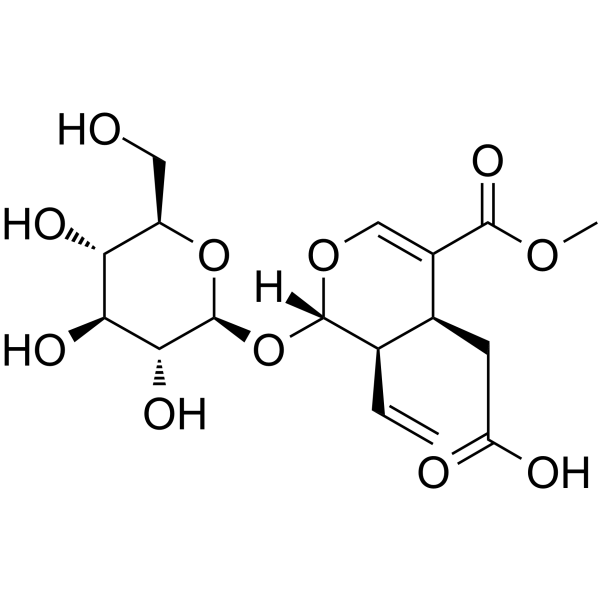
    Secoxyloganin
    1 Publications Verification

    Drug Derivative Apoptosis Bcl-2 Family Cardiovascular Disease Inflammation/Immunology Cancer
    Secoxyloganin is an orally effective iridoid derivative. Secoxyloganin can be isolated from the flower buds of L. japonica. Secoxyloganin induces Apoptosis by inhibiting the expression of Bcl-2. Secoxyloganin potently inhibits the proliferation of breast cancer cells, while exerting weak activity against normal mammary epithelial cells. Secoxyloganin inhibits the decrease in tail vein blood flow associated with allergic reactions .
    Secoxyloganin
  • HY-138071

    8αTGH

    STAT Pyroptosis Apoptosis Reactive Oxygen Species (ROS) c-Myc Bcl-2 Family TrxR Cancer
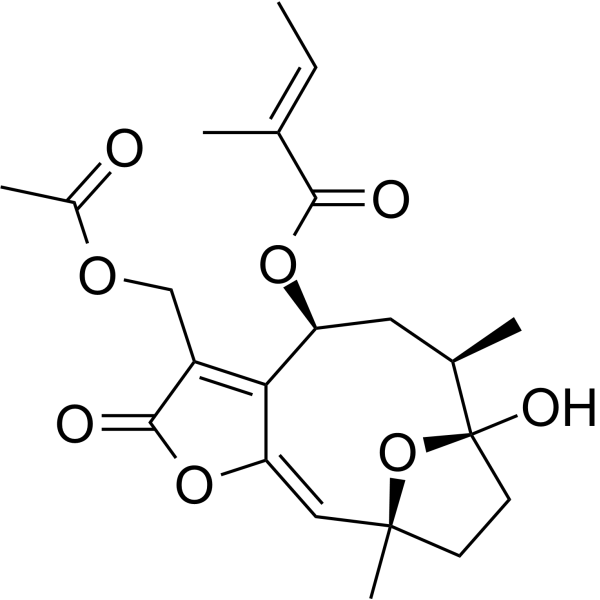
    8α-Tigloyloxyhirsutinolide 13-O-acetate (8αTGH) is a potent and orally active STAT3 inhibitor. 8α-Tigloyloxyhirsutinolide 13-O-acetate induces early oxidative stress and pyroptosis, and late DNA damage, cell cycle arrest, apoptosis in the TNBC cells. 8α-Tigloyloxyhirsutinolide 13-O-acetate suppresses tumor cell growth in vitro and tumor growth in vivo .
    8α-Tigloyloxyhirsutinolide 13-O-acetate
  • HY-144724

    HSP Apoptosis Cancer
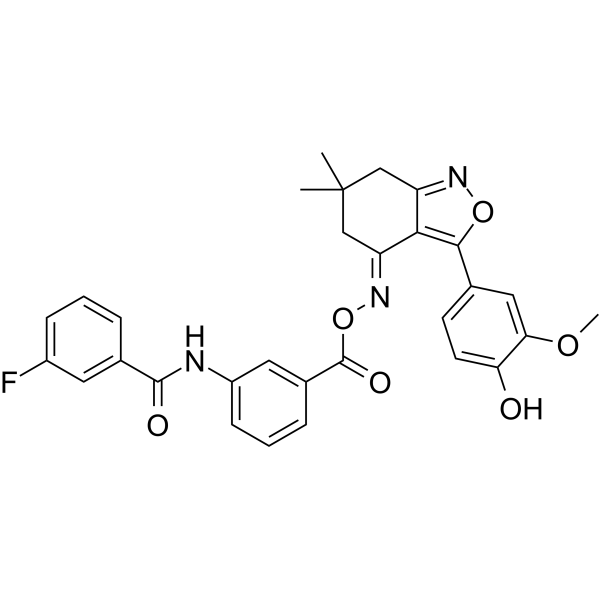
    HSP90-IN-10 (Compound 16s) is a potent inhibitor of HSP90. HSP90-IN-10 exhibits high antiproliferative potency against HCC1954 breast cancer cells with the IC50 value of 6 µM. HSP90-IN-10 does not inhibit the growth of normal epithelial cells. HSP90-IN-10 also induces apoptosis .
    HSP90-IN-10
  • HY-W010713

    Fimaporfin free base

    Photosensitizer Cancer
    Meso-tetraphenylchlorin (TPCS2a) is a photosensitizer with poor water solubility, which limits its use in the blood circulation. However, TPCS2a@NPs nanoparticles can be prepared based on polylactic-co-polyethylene glycol acid (PLGA) polymer core loaded with TPCS2. Such nanoparticles can be coated with mesenchymal stem cell-derived plasma membranes (mMSCs) to form mMSC-TPCS2a@NPs, which prolongs blood circulation time and improves tumor targeting ability. Compared with uncoated TPCS2a@NPs, mMSC-TPCS2a@NPs can reduce macrophage uptake by 54% to 70% under different conditions. Both nanoparticle forms are effectively accumulated in MCF7 and MDA-MB-231 breast cancer cells, while uptake in normal breast epithelial cells MCF10A is significantly lower .
    Meso-tetraphenylchlorin
  • HY-182054

    Topoisomerase Beclin1 Autophagy Apoptosis Cancer
    Topoisomerase ll/ME-1-IN-1 (Compound 7a) is a Topoisomerase ll and ME-1 inhibitor with an IC50 of 5.03 μM against Topoisomerase ll. Topoisomerase ll/ME-1-IN-1 functionally inhibits the activity of Topoisomerase II and functionally blocks the activity of ME-1. Topoisomerase ll/ME-1-IN-1 induces Autophagy by upregulating the expression of Beclin-1 and LC3-II. Topoisomerase ll/ME-1-IN-1 promotes Apoptosis. Topoisomerase ll/ME-1-IN-1 exhibits antiproliferative activity against breast cancer cells and shows no toxicity to normal mammary epithelial cells. Topoisomerase ll/ME-1-IN-1 can be used in studies related to breast cancer (including triple-negative breast cancer) .
    Topoisomerase ll/ME-1-IN-1
  • HY-181392

    PROTACs Histone Methyltransferase Cancer
    PROTAC EZH2 Degrader-35 (compound U3i (44)) is a PROTAC protein degrader targeting EZH2 with a human EZH2 Ka of 16.19 nM. PROTAC EZH2 Degrader-35 exhibits antiproliferative activity in triple-negative breast cancer cells and minimal cytotoxicity in normal human epithelial, hepatic, renal cells.PROTAC EZH2 Degrader-35 can be used for the research of triple-negative breast cancer .
    PROTAC EZH2 Degrader-35
  • HY-181060

    Apoptosis DNA/RNA Synthesis Caspase Bcl-2 Family MDM-2/p53 Cancer
    Apoptosis inducer 56 is an apoptosis inducer. Apoptosis inducer 56 induces DNA damage (upregulation of γH2AX and p-ATM expression) by minor groove binding. Apoptosis inducer 56 induces intrinsic apoptosis (upregulation of p53 and Bax/Bcl-2 ratio, cleaved caspase-7) via S-phase cell cycle arrest. Apoptosis inducer 56 shows selectivity for cancer cells over normal breast epithelial cells. Apoptosis inducer 56 can be used for the research of breast cancer .
    Apoptosis inducer 56
  • HY-182614

    Src Cathepsin PI3K Akt Ras Raf ERK MMP Cancer
    BJ-2302 is a Src kinase inhibitor with an IC50 of 3.23 μM, and inhibits cathepsin S (CTSS) activity .BJ-2302 binds to Src, suppresses PI3K/AKT and Ras/Raf/ERK pathways, and reduces CTSS and MMP-9 expression .BJ-2302 inhibits cancer cell invasion, metastasis, proliferation, and tumor growth .BJ-2302 does not induce cytotoxicity in normal breast epithelial cells .BJ-2302 can be used for the research of breast cancer and triple-negative breast cancer .
    BJ-2302
  • HY-182032

    VEGFR Apoptosis Reactive Oxygen Species (ROS) Cancer
    VEGFR-2-IN-83 is a VEGFR-2 kinase inhibitor with an IC50 of 0.037 μM. VEGFR-2-IN-83 induces G0/G1 cell cycle arrest and apoptosis in breast cancer cells, and increases the production of reactive oxygen species (ROS). VEGFR-2-IN-83 is applicable to relevant research on breast cancer .
    VEGFR-2-IN-83
  • HY-183294

    Glutathione Peroxidase Ferroptosis Reactive Oxygen Species (ROS) Cancer
    GPX4-IN-24 is an orally active glutathione peroxidase 4 (GPX4) inhibitor with a human IC50 of 10.90 μM, human Kd of 10.04 μM. GPX4-IN-24 suppresses GPX4 enzymatic activity, disrupts redox homeostasis, drives lipid peroxidation, promotes lipid peroxidation, and induces ferroptosis. GPX4-IN-24 can be used for the research of triple-negative breast cancer .
    GPX4-IN-24
  • HY-182003

    Akt Cancer
    Anticancer agent 308 (compound 3s) is an AKT inhibitor with antitumor activity. Anticancer agent 308 reduces total AKT protein levels, thereby inhibiting the pro-survival PI3K/AKT signaling pathway. Anticancer agent 308 induces apoptosis, disrupts mitochondrial membrane potential, promotes reactive oxygen species (ROS) accumulation in mitochondria, and induces cell cycle arrest. Anticancer agent 308 inhibits cancer cell migration. Anticancer agent 308 is applicable to research related to breast cancer, lung adenocarcinoma, cervical cancer, prostate cancer, and hepatocellular carcinoma .
    Anticancer agent 308
  • HY-181413

    PROTACs Histone Methyltransferase Bcl-2 Family Caspase PARP Cancer
    PROTAC EZH2 Degrader-44 (compound 60) is a highly efficient PROTAC degrader targeting the EZH2-PRC2 complex. By recruiting the CRBN E3 ligase and relying on the proteasome system, PROTAC EZH2 Degrader-44 simultaneously induces the degradation of core components EZH2, SUZ12 and EED, thereby significantly reducing the levels of H3K27me3 and CARM1. PROTAC EZH2 Degrader-44 exerts antiproliferative effects through a dual mechanism: on the one hand, it triggers mitochondrial dysfunction leading to decreased membrane potential; on the other hand, it strongly promotes apoptosis by regulating Bcl-2 family proteins (upregulating Bax, Caspase-3 and PARP, and downregulating Bcl-2). PROTAC EZH2 Degrader-44 exhibits only extremely low cytotoxicity in human normal mammary epithelial, liver and kidney cells, showing a favorable safety window. PROTAC EZH2 Degrader-44 is an ideal tool molecule for exploring the mechanisms of targeted therapy for triple-negative breast cancer .
    PROTAC EZH2 Degrader-44

Inquiry Online

Your information is safe with us. * Required Fields.

Salutation


Country or Region *

Applicant Name *


Organization Name *

Department *


Email Address *


Product Name *

Cat. No.


Requested quantity *

Phone Number *


Remarks

Inquiry Online

Inquiry Information

Product Name:
Cat. No.:
Quantity:
MCE Japan Authorized Agent:

