



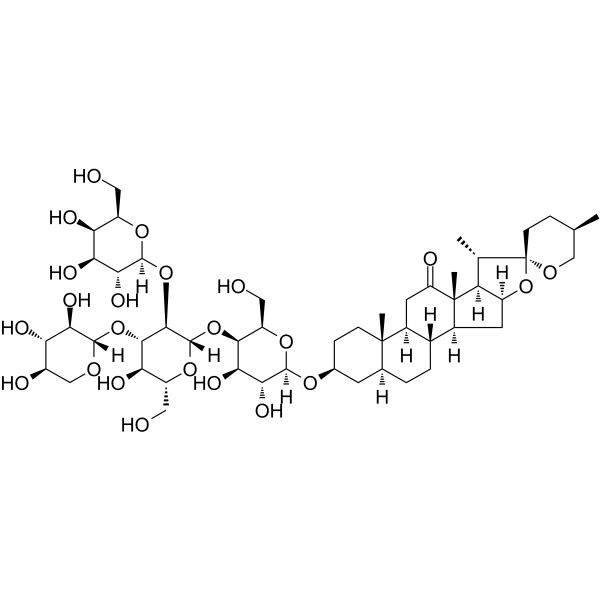
Terrestrosin D

Based on 1 Customer Validation
Terrestrosin D is an orally active apoptosis inducer. Terrestrosin D induces cell cycle arrest at the G1 and S phases, reduces mitochondrial membrane potential, and inhibits the growth of cancer cells and endothelial cells. Terrestrosin D is studied in castration-resistant prostate cancer and pulmonary fibrosis.
For research use only. We do not sell to patients.
- Purity : 99.30%
- CAS No.: 179464-23-4
- Formula: C50H80O23
- Molecular Weight:1049.16
-
Storage:
4°C, protect from light
* In solvent : -80°C, 6 months; -20°C, 1 month (protect from light)

To place orders, for customer services and technical support, please contact: MedChemExpress USA
Tel: 609-228-6898 E-mail: [email protected] [email protected]


-
 Biological Activity
-
Chemical Information
-
Solvent & Solubility
- Protocols
- Purity & Documentation
- References
-
 Help & FAQs



All VEGFR Isoforms
More

Biological Activity
Description
In Vitro
Terrestrosin D (2.6-41.3 μM; 24 h) exerts significant cytotoxicity in human normal liver LO2 cells (IC50 = 16.88 μM) and human embryonic kidney 293T cells (IC50 = 21.80 μM) following 24 h of treatment[1].
Terrestrosin D (1-5 μM; 24 h) potently inhibits the growth of PC-3, PC-3M, DU145, LNCaP, and 22RV1 human prostate cancer cells with an IC50 below 5 μM after 24 h of treatment[2].
Terrestrosin D (2-5 μM; 24 h) induces G1 phase cell cycle arrest in PC-3 human prostate cancer cells after 24 h of treatment with 2 or 5 μM[2].
Terrestrosin D (1-5 μM; 24 h) potently inhibits the growth of HUVECs and bladder-derived normal human microvascular endothelial cells with an IC50 below 3 μM after 24 h of treatment[2].
Terrestrosin D (2-3 μM; 24 h) induces S phase cell cycle arrest in HUVEC human endothelial cells after 24 h of treatment with 2 or 3 μM[2].
Terrestrosin D (2-5 μM; 24 h) induces dose-dependent, caspase-independent apoptosis in PC-3 human prostate cancer cells, with 60.5% of cells undergoing apoptosis after 24 h of treatment with 5 μM[2].
Terrestrosin D (5 μM; 24 h) does not activate caspase-3 and instead reduces its activity in PC-3 human prostate cancer cells after 24 h of treatment with 5 μM, confirming a caspase-independent apoptotic mechanism[2].
Terrestrosin D (2-3 μM; 24 h) induces dose-dependent, caspase-independent apoptosis in HUVEC human endothelial cells, with 34.3% of cells undergoing apoptosis after 24 h of treatment with 3 μM[2].
Terrestrosin D (3 μM; 24 h) does not activate caspase-3 and instead reduces its activity in HUVEC human endothelial cells after 24 h of treatment with 3 μM, confirming a caspase-independent apoptotic mechanism[2].
Terrestrosin D (2-5 μM; 24 h) induces mitochondrial membrane potential depolarization in 53.8% of PC-3 human prostate cancer cells[2].
Terrestrosin D (2-3 μM; 24 h) induces dose-dependent mitochondrial membrane potential depolarization in HUVEC human endothelial cells[2].
Terrestrosin D (1-5 μM; 24 h) dose-dependently increases VEGF secretion in PC-3 human prostate cancer cells, causing a 1.86-fold increase after 24 h of treatment with 5 μM[2].
Terrestrosin D (1-3 μM; 24 h) dose-dependently increases VEGF secretion in HUVEC human endothelial cells, causing an 11.21-fold increase after 24 h of treatment with 3 μM[2].
MedChemExpress (MCE) has not independently confirmed the accuracy of these methods. They are for reference only.
-
Cell Line:PC-3 human prostate cancer cells
-
Concentration:2, 5 μM
-
Incubation Time:24 h
-
Result:Caused significant increases in G1 phase populations and concomitant decreases in S phase populations at 5 μM.
Altered cell cycle phase distribution relative to control at 2 μM.
-
Cell Line:PC-3 human prostate cancer cells
-
Concentration:2, 5 μM; 5 μM (with 1 h pre-incubation with z-VAD (HY-164388))
-
Incubation Time:24 h; 24 h (with 1 h pre-incubation with z-VAD)
-
Result:Induced apoptosis in 6.1% of PC-3 cells at 2 μM for 24 h.
Induced apoptosis in 60.5% of PC-3 cells at 5 μM for 24 h.
Did not reduce the number of apoptotic cells induced by 5 μM TED when pre-treated with z-VAD.
-
Cell Line:PC-3 human prostate cancer cells
-
Concentration:1, 2, 3, 4, 5 μM
-
Incubation Time:24 h
-
Result:Induced a dose-dependent increase in VEGF secretion.
Caused a 1.86-fold increase in VEGF levels relative to control at 5 μM.
Parmacokinetics
In Vivo
Terrestrosin D (50 mg/kg; i.p.; 3 times weekly; 4 weeks) significantly suppresses PC-3 xenograft tumor growth in BALB/c nude mice, increases tumor cell apoptosis, and reduces tumor angiogenesis, without causing significant body weight loss[2].
Terrestrosin D (10 mg/kg; i.p.; daily for
6 weeks) significantly attenuates Bleomycin (HY-108345)-induced pulmonary inflammation and fibrosis in male KM mice[3].
MedChemExpress (MCE) has not independently confirmed the accuracy of these methods. They are for reference only.
-
Animal Model:Sprague-Dawley (male, 200 g)[1]
-
Dosage:5 mg/kg; 15 mg/kg
-
Administration:p.o.; daily; 28 days
-
Result:Increased serum alanine aminotransferase to 42.8 U/L, alkaline phosphatase to 264.3 U/L, serum creatinine to 25.4 μmol/L, urinary β-N-Acetylglucosaminidase to 32.0 U/L, and Kidney Injury Molecule 1 to 321.3 ng/L at 5 mg/kg after 28 days of treatment.
Increased serum alanine aminotransferase to 48.8 U/L, aspartate aminotransferase to 151.5 U/L, alkaline phosphatase to 313.5 U/L, blood urea nitrogen to 8.3 mmol/L, serum creatinine to 28.7 μmol/L, urinary β-N-Acetylglucosaminidase to 43.2 U/L, and Kidney Injury Molecule 1 to 332.7 ng/L at 15 mg/kg after 28 days of treatment.
Reduced body weight on Day 8 and food consumption at Week 2 for both doses after 28 days of treatment.
Restored body weight and food consumption to control levels for both doses after 14-day recovery period.
-
Animal Model:BALB/c nude (male, 5 weeks of age, subcutaneous PC-3 cell implantation)[2]
-
Dosage:25 mg/kg; 50 mg/kg
-
Administration:i.p.; 3 times weekly; 4 weeks
-
Result:Suppressed tumor growth to an average volume of 127.41 mm3 after 28 days at 50 mg/kg.
Increased tumor apoptosis index to 58.5 at 50 mg/kg.
Reduced microvessel density to 17.6 per 400× field at 50 mg/kg.
Did not significantly affect mouse body weight at 50 mg/kg.
Showed little effect on tumor growth at 25 mg/kg.
-
Animal Model:KM mice (male, 30 g, bleomycin-induced pulmonary fibrosis model)[3]
-
Dosage:10 mg/kg
-
Administration:i.p.; daily; 2 weeks or 6 weeks
-
Result:Reduced bronchoalveolar lavage fluid (BALF) cell density by ~50% at 2 weeks.
Returned BALF macrophage, neutrophil, and lymphocyte percentages to control levels by 6 weeks.
Significantly reduced BALF levels of TNF-α, IL-6, and IL-8 to near-control levels at 2 and 6 weeks.
Preserved alveolar structure, reducing bleomycin-induced alveolar space reduction and fibrotic focal area formation.
- Collagen: Sirius Red Staining
- Mitochondrial membrane-potential fluorescent assay
- Annexin V plus membrane-impermeant dye apoptosis staining
- BrdU Incorporation Assay
- Connective Tissue: Masson's Trichrome/Collagen Trichrome Staining
- Protocol for Cell Cycle
- Fibrosis/Collagen Morphometry
- Detection of Apoptosis
- TUNEL staining for apoptotic DNA fragmentation
- Flow cytometric DNA-content cell-cycle staining
- Fluorescent plasma-membrane potential dye assay
- Mitochondrial membrane-potential and mitochondrial mass staining
- Endothelial Tube Formation Assay
- Apoptosis Solutions


Chemical Information
-
CAS No. 179464-23-4
-
Appearance Solid
-
Molecular Weight 1049.16
-
Formula C50H80O23
-
Color White to off-white
-
SMILES
C[C@@]12[C@]3([H])[C@](O[C@]4(CC[C@@H](C)CO4)[C@H]3C)([H])C[C@@]1([H])[C@@]5([H])[C@]([C@@]6([C@@](C[C@@H](O[C@]7([H])O[C@@H]([C@H](O[C@@]8([H])[C@@H]([C@H]([C@H](O)[C@@H](CO)O8)O[C@@]9([H])[C@@H]([C@H]([C@H](O)CO9)O)O)O[C@]%10([H])O[C@@H]([C@H](O)[C@H](O)[C@H]%10O)CO)[C@H](O)[C@H]7O)CO)CC6)([H])CC5)C)([H])CC2=O
-
Structure Classification
-
Initial Source
-
Shipping
Room temperature in continental US; may vary elsewhere.
-
Storage
4°C, protect from light
* In solvent : -80°C, 6 months; -20°C, 1 month (protect from light)


Solvent & Solubility
In Vitro:
DMSO : 100 mg/mL (95.31 mM; Need ultrasonic; Hygroscopic DMSO has a significant impact on the solubility of product, please use newly opened DMSO)
Please refer to the solubility information to select the appropriate solvent. Once prepared, please aliquot and store the solution to prevent product inactivation from repeated freeze-thaw cycles.
Storage method and period of stock solution: -80°C, 6 months; -20°C, 1 month (protect from light). When stored at -80°C, please use it within 6 months. When stored at -20°C, please use it within 1 month.
Please refer to the solubility information to select the appropriate solvent. Once prepared, please aliquot and store the solution to prevent product inactivation from repeated freeze-thaw cycles.
Storage method and period of stock solution: -80°C, 6 months; -20°C, 1 month (protect from light). When stored at -80°C, please use it within 6 months. When stored at -20°C, please use it within 1 month.
Concentration (start) × Volume (start) = Concentration (final) × Volume (final)
In Vivo:
Select the appropriate dissolution method based on your experimental animal and administration route.
- For the following dissolution methods, please ensure to first prepare a clear stock solution using an In Vitro approach and then sequentially add co-solvents:
- To ensure reliable experimental results, the clarified stock solution can be appropriately stored based on storage conditions. As for the working solution for In Vivo experiments, it is recommended to prepare freshly and use it on the same day.
- The percentages shown for the solvents indicate their volumetric ratio in the final prepared solution. If precipitation or phase separation occurs during preparation, heat and/or sonication can be used to aid dissolution.
Add each solvent one by one: 10% DMSO 40% PEG300 5% Tween-80 45% Saline
Solubility: ≥ 2.5 mg/mL (2.38 mM); Clear solution
This protocol yields a clear solution of ≥ 2.5 mg/mL (saturation unknown).
Taking 1 mL working solution as an example, add 100 μL DMSO stock solution (25.0 mg/mL) to 400 μL PEG300, and mix evenly; then add 50 μL Tween-80 and mix evenly; then add 450 μL Saline to adjust the volume to 1 mL.
Preparation of Saline: Dissolve 0.9 g sodium chloride in ddH₂O and dilute to 100 mL to obtain a clear Saline solution.
Add each solvent one by one: 10% DMSO 90% (20% SBE-β-CD in Saline)
Solubility: ≥ 2.5 mg/mL (2.38 mM); Clear solution
This protocol yields a clear solution of ≥ 2.5 mg/mL (saturation unknown).
Taking 1 mL working solution as an example, add 100 μL DMSO stock solution (25.0 mg/mL) to 900 μL 20% SBE-β-CD in Saline, and mix evenly.
Preparation of 20% SBE-β-CD in Saline (4°C, storage for one week): 2 g SBE-β-CD powder is dissolved in 10 mL Saline, completely dissolve until clear.
In Vivo Dissolution Calculator
Please enter the basic information of animal experiments:
-
-
-
-
Recommended: Prepare an additional quantity of animals to account for potential losses during experiments.
Please enter your animal formula composition:
-
%DMSO +
Recommended: Keep the proportion of DMSO in working solution below 2% if your animal is weak.
-
%+
-
+%Tween-80 + +
-
%Saline +
The co-solvents required include: DMSO, . All of co-solvents are available by MedChemExpress (MCE). , Tween 80. All of co-solvents are available by MedChemExpress (MCE).
Working solution concentration: 0.22 mg/mL
Method for preparing stock solution: mg drug dissolved in μL DMSO. Stock solution concentration: mg/mL. * In solvent : -80°C, 6 months; -20°C, 1 month (protect from light)
1. Take μL DMSO stock solution;
2. Add μL .
μL , mix evenly;
3. Then add μL Tween 80, mix evenly;
4. Then add μL
Please ensure that the stock solution in the first step is dissolved to a clear state, and add co-solvents in sequence. You can use ultrasonic heating (ultrasonic cleaner, recommended frequency 20-40 kHz), vortexing, etc. to assist dissolution.


Purity & Documentation
-
Data Sheet (287 KB)
-
SDS (252 KB)
- English - EN (252 KB)
- Français - FR (252 KB)
- Deutsch - DE (252 KB)
- Norwegian - NO (252 KB)
- Español - ES (252 KB)
- Swedish - SV (252 KB)
- Italian - IT (252 KB)
- Korean - KR (252 KB)
- Portuguese - PT (252 KB)
-
Handling Instructions (2659 KB)
References
[1]. Sun XC, et al. Terrestrosin D, a spirostanol saponin from Tribulus terrestris L. with potential hepatorenal toxicity. J Ethnopharmacol. 2022;283:114716. [Content Brief]
[2]. Wei S, et al. Terrestrosin D, a steroidal saponin from Tribulus terrestris L., inhibits growth and angiogenesis of human prostate cancer in vitro and in vivo. Pathobiology. 2014;81(3):123-132. [Content Brief]
[3]. Qiu M, et al. Terrestrosin D from Tribulus terrestris attenuates bleomycin-induced inflammation and suppresses fibrotic changes in the lungs of mice. Pharm Biol. 2019 Dec;57(1):694-700. [Content Brief]


Complete Stock Solution Preparation Table
Please refer to the solubility information to select the appropriate solvent. Once prepared, please aliquot and store the solution to prevent product inactivation from repeated freeze-thaw cycles.
Storage method and period of stock solution: -80°C, 6 months; -20°C, 1 month (protect from light). When stored at -80°C, please use it within 6 months. When stored at -20°C, please use it within 1 month.
| Optional Solvent | Concentration Solvent Mass | 1 mg | 5 mg | 10 mg | 25 mg |
|---|---|---|---|---|---|
| DMSO | 1 mM | 0.9531 mL | 4.7657 mL | 9.5314 mL | 23.8286 mL |
| 5 mM | 0.1906 mL | 0.9531 mL | 1.9063 mL | 4.7657 mL | |
| 10 mM | 0.0953 mL | 0.4766 mL | 0.9531 mL | 2.3829 mL | |
| 15 mM | 0.0635 mL | 0.3177 mL | 0.6354 mL | 1.5886 mL | |
| 20 mM | 0.0477 mL | 0.2383 mL | 0.4766 mL | 1.1914 mL | |
| 25 mM | 0.0381 mL | 0.1906 mL | 0.3813 mL | 0.9531 mL | |
| 30 mM | 0.0318 mL | 0.1589 mL | 0.3177 mL | 0.7943 mL | |
| 40 mM | 0.0238 mL | 0.1191 mL | 0.2383 mL | 0.5957 mL | |
| 50 mM | 0.0191 mL | 0.0953 mL | 0.1906 mL | 0.4766 mL | |
| 60 mM | 0.0159 mL | 0.0794 mL | 0.1589 mL | 0.3971 mL | |
| 80 mM | 0.0119 mL | 0.0596 mL | 0.1191 mL | 0.2979 mL |


Terrestrosin D Related Classifications
HY-N5074 Related Classifications
 Powered by Bioz