



ABT-546
Based on 1 publication(s) in Google Scholar
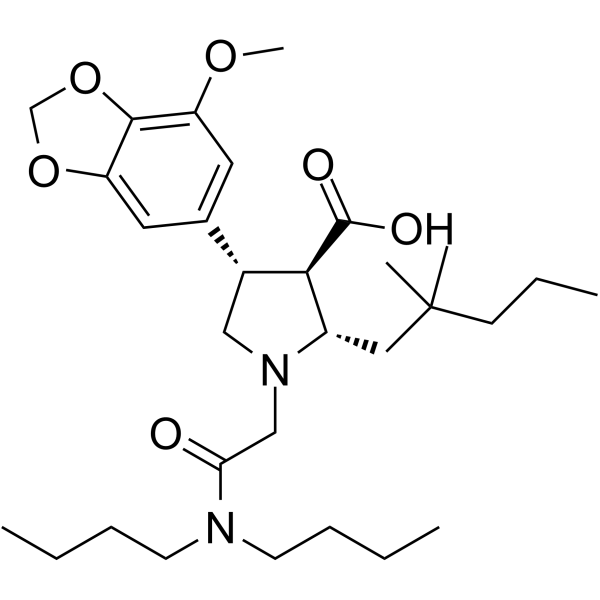
ABT-546 (A-216546) is an orally active ETA receptor antagonist, with Ki values of 0.46 nM and 13000 nM for human ETA and ETB receptors, respectively, and exhibits >25000-fold selectivity over the ETB receptor. ABT-546 effectively inhibits ET-1 (HY-P0202)-induced phosphoinositide hydrolysis (IC50 = 0.59 nM) and arachidonic acid release (IC50 = 3.03 nM), and antagonizes ET-1-induced contraction in isolated vascular rings. ABT-546 crosses the placental barrier but shows extremely low fetal exposure, with a favorable safety profile. ABT-546 inhibits ET-1-induced pressor response and downregulates the NLRP3/ROS/GSDMD-mediated pyroptosis pathway. ABT-546 can be used for research on abdominal aortic aneurysm.
For research use only. We do not sell to patients.
- CAS No.: 212481-66-8
- Formula: C30H48N2O6
- Molecular Weight:532.71
-
Storage:
Please store the product under the recommended conditions in the Certificate of Analysis.

To place orders, for customer services and technical support, please contact: MedChemExpress USA
Tel: 609-228-6898 E-mail: [email protected] [email protected]


-
 Biological Activity
-
Chemical Information
- Purity & Documentation
- References
-
 Help & FAQs


Publications Citing Use of MedChemExpress (MCE) ABT-546
More

Biological Activity
|
ETA 0.46 nM (Ki) |
ETB 13000 nM (Ki) |
NLRP3 |
IL-1β |
IL-18 |
ABT-546 exhibits an IC50 of 0.17-0.49 nM for the human ETA receptor and 0.22-0.56 nM for the rat ETA receptor in competitive binding assays; for the human ETB receptor, its IC50 is > 15000 nM, and for the porcine ETB receptor, > 16000 nM, showing a selectivity of over 25000-fold[1][2].
ABT-546 shows a Ki of 0.46 nM for the human ETA receptor and a Ki of 13000 nM for the human ETB receptor[1][2].
ABT-546 (15-30 min) effectively inhibits ET-1-stimulated phosphoinositide (PI) hydrolysis in rat MMQ cells (IC50 = 0.59 nM) and ET-1-stimulated arachidonic acid (AA) release in human pericardial smooth muscle cells (IC50 = 3.03 nM), and it displays no agonist activity by itself[1][2].
ABT-546 (10 μM) shows 98% inhibition of the ETA receptor, 56% inhibition of the ETB receptor, 62% inhibition of the δ-opioid receptor, and 61% inhibition of the Cl- ion carrier in a receptor binding profile screening against 73 targets; no significant activity is observed for the remaining targets in the assay[2].
ABT-546 antagonizes ET-1-induced vasoconstriction (ETA-mediated) in isolated rat aortic rings with a pA₂ of 8.29, and it antagonizes Sarafotoxin 6c-induced vasoconstriction (ETB-mediated) in isolated rabbit pulmonary artery rings with a pA₂ of 4.57, demonstrating its ETA selectivity[4].
ABT-546 (0.1-10 μM; 20-30 min) concentration-dependently and completely blocks ET-1-stimulated 2-deoxyglucose uptake in 3T3-L1 adipocytes and simultaneously inhibits ET-1-induced GLUT4 translocation[5].
MedChemExpress (MCE) has not independently confirmed the accuracy of these methods. They are for reference only.
-
Cell Line:3T3‑L1 adipocytes
-
Concentration:10 μM
-
Incubation Time:20 min
-
Result:Blocked ET‑1‑induced GLUT4 translocation.
ABT-546 (20 mg/kg/day; subcutaneous osmotic pump administration; on gestation days 14-21, for 7 days) crosses the placental barrier in pregnant rats but shows extremely low fetal exposure, produces no adverse effects on pregnancy outcomes or on offspring survival and growth, and improves offspring blood oxygen saturation on postnatal day 7[3].
ABT-546 (20 mg/kg; intragastric administration; once daily) significantly reduces abdominal aortic diameter in the Ang II (HY-13948)/Bap (HY-107377)-induced abdominal aortic aneurysm model in C57BL/6 mice, downregulates NLRP3 inflammasome and ROS levels, and significantly decreases the release of activated GSDMD and the inflammatory cytokines IL-1β and IL-18[6].
MedChemExpress (MCE) has not independently confirmed the accuracy of these methods. They are for reference only.
-
Animal Model:
-
Dosage:0.1, 1, 10, 30, 100 mg/kg
-
Administration:Oral gavage (p.o.), single dose, at a volume of 2 mL/kg
-
Result:Dose-dependently inhibited ET-1-induced pressor response, with statistically significant inhibition observed at doses of 3 mg/kg and above at both 1 h and 4 h post-dosing , and an ED50 of 10 mg/kg.
At 30 mg/kg, significant suppression of the pressor response was maintained at 4 h and 8 h post-dosing, but no significant suppression was observed at 24 h.
Showed no effect on ET-1-induced transient depressor response at 10 and 30 mg/kg; modest inhibition was observed only at 100 mg/kg.
At 30 mg/kg, significant suppression of the pressor response was evident at 4 h and 8 h post-dosing, but no significant suppression was observed at 24 h .
Plasma drug concentration at 25 h after a single 30 mg/kg oral dose was 0.051 μg/mL.
-
Animal Model:Pregnant Sprague-Dawley rats were administered with an ETA antagonist via subcutaneous osmotic pump from gestation day 14 to day 21 to evaluate maternal/fetal plasma drug concentrations, pregnancy outcomes, and neonatal survival and growth[3].
-
Dosage:20 mg/kg/day
-
Administration:Subcutaneous osmotic pump (s.c.), continuous infusion, gestation days 14-21 (for 7 days)
-
Result:On gestation day 21, maternal plasma concentrations ranged from 0.45 to 1.30 μg/mL, and fetal plasma concentrations ranged from 0.012 to 0.023 μg/mL, with fetal levels reaching only 2% of maternal levels (p < 0.01); the maternal/fetal plasma concentration ratio ranged from 23.2 to 103.4.
No significant effects were observed on gestational length (21.5-22.5 days), litter size, number of stillbirths, or number of live pups at birth.
Postnatal day 7 pup survival did not differ significantly from that at birth, and postnatal deaths were extremely rare. Birth weights and pup weights at postnatal day 7 were similar to those of the control group. Oxygen saturation (SpO₂) on postnatal day 1 was not significantly different from that of the control group, but was significantly higher on postnatal day 7 compared with the control group.
-
Animal Model:Male C57BL/6 mice (8-10 months old, 30-35 g) received Ang II infusion (0.90 mg/kg/day) via subcutaneous osmotic minipump and weekly intraperitoneal injection of Bap (10 mg/kg, dissolved in medium-chain triglycerides) for AAA induction[6].
-
Dosage:20 mg/kg (co-administered with Ang II and Bap)
-
Administration:Oral gavage (i.g.)
-
Result:Significantly reduced the maximal external diameter of the suprarenal aorta compared to the Bap/Ang II grou.
Decreased the expression of pyroptosis core protein GSDMD in vascular smooth muscle cells, as evidenced by immunohistochemistry and immunofluorescence staining.
ELISA results showed that, compared with the Bap/Ang II group, the ABT-546 combination group exhibited significantly decreased serum levels of IL-1β and IL-18 (P < 0.01), while serum ET-1 levels remained unchanged.
Did not significantly alter blood pressure or heart rate in mice.


Chemical Information
-
CAS No. 212481-66-8
-
Molecular Weight 532.71
-
Formula C30H48N2O6
-
SMILES
O=C([C@H]1[C@H](CC(C)(C)CCC)N(CC(N(CCCC)CCCC)=O)C[C@@H]1C2=CC(OC)=C(OCO3)C3=C2)O
-
Synonyms
A-216546
-
Shipping
Room temperature in continental US; may vary elsewhere.
-
Storage
Please store the product under the recommended conditions in the Certificate of Analysis.


Publications (1)
-
Journal Impact Factor
-
Most Recent
-
Int Immunopharmacol
3, 4-Benzopyrene (Bap) aggravated abdominal aortic aneurysm formation by targeting pyroptosis in smooth muscle cells through ET-1 mediated NLRP3-inflammasome activation. [Abstract]2023 Aug 29;124(Pt A):110851. PMID: 37651853


Purity & Documentation
References
[1]. Liu G, et al. Pyrrolidine-3-carboxylic acids as endothelin antagonists. 3. Discovery of a potent, 2-nonaryl, highly selective ETA antagonist (ABT-546). J Med Chem. 1998 Aug 13;41(17):3261-75. [Content Brief]
[2]. Wu-Wong JR, et al. Pharmacology of ABT-546: a highly selective antagonist for endothelin ET(A) receptor. Eur J Pharmacol. 1999 Feb 5;366(2-3):189-201. [Content Brief]
[3]. Thaete LG, et al. Endothelin receptor antagonist has limited access to the fetal compartment during chronic maternal administration late in pregnancy. Life Sci. 2012 Oct 15;91(13-14):583-6. [Content Brief]
[4]. Wessale JL, et al. Pharmacology of endothelin receptor antagonists ABT-627, ABT-546, A-182086 and A-192621: ex vivo and in vivo studies. Clin Sci (Lond). 2002 Aug;103 Suppl 48:112S-117S. [Content Brief]
[5]. Wu-Wong JR, et al. Endothelin stimulates glucose uptake and GLUT4 translocation via activation of endothelin ETA receptor in 3T3-L1 adipocytes. J Biol Chem. 1999 Mar 19;274(12):8103-10. [Content Brief]
[6]. Liu S, et al. 3, 4-Benzopyrene (Bap) aggravated abdominal aortic aneurysm formation by targeting pyroptosis in smooth muscle cells through ET-1 mediated NLRP3-inflammasome activation. Int Immunopharmacol. 2023 Nov;124(Pt A):110851. [Content Brief]

Calculators
Concentration (start) × Volume (start) = Concentration (final) × Volume (final)


ABT-546 Related Classifications
HY-135283 Related Classifications
 Powered by Bioz
- ABT-546
- 212481-66-8
- A-216546
- ABT546
- ABT 546
- A216546
- A 216546
- Endothelin Receptor
- NOD-like Receptor (NLR)
- Reactive Oxygen Species (ROS)
- Pyroptosis
- Interleukin Related
- ETA receptor
- endothelin receptor A
- selective ETA antagonist
- non-peptide antagonist
- functional antagonist
- competitive antagonist
- radioligand binding assay
- phosphoinositol (PI) hydrolysis assay
- arachidonic acid release assay
- pA?
- isolated rat aorta
- rabbit pulmonary artery
- sarafotoxin 6c
- MMQ cells (rat pituitary tumor cells)
- CHO cells (Chinese hamster ovary cells
- hETA/hETB)
- porcine cerebellar tissue (pETB)
- human pericardial smooth muscle cells
- receptor specificity panel (73 assays)
- δ-opioid receptor
- Cl- ionophore
- Sprague-Dawley rats
- conscious rat model
- in vivo pressor response
- oral bioavailability
- pharmacokinetics
- IC50
- ABT-627 clinical backup
- NLRP3/ROS/GSDMD
- Inhibitor
- inhibitor
- inhibit