



9-PAHSA

Based on 1 Customer Validation
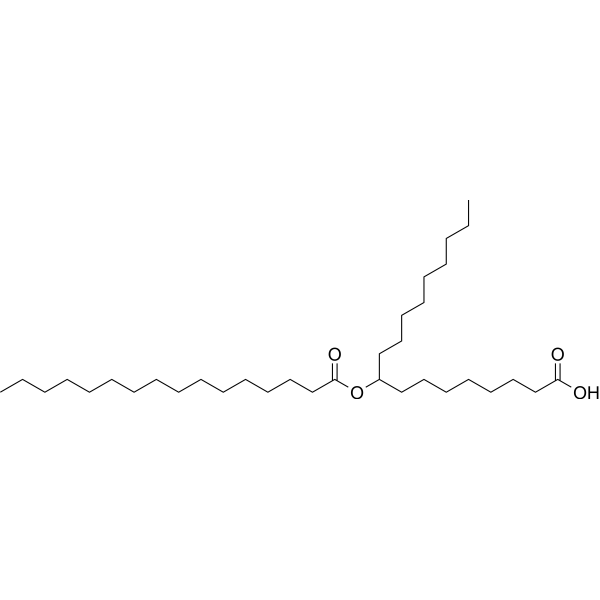
9-PAHSA is an orally active endogenous GPR120 agonist (EC50=18 μM). 9-PAHSA significantly inhibits LPS-induced inflammatory responses by blocking the NF-κB pathway. 9-PAHSA induces adipocyte browning, enhances glucose uptake and reduces lipid accumulation, while improving mitochondrial function and the survival rate of steatotic hepatocytes. In terms of neuroprotection, 9-PAHSA regulates the expression of REST and BDNF in the prefrontal cortex of diabetic mice, and effectively prevents spatial working memory deficits and abnormal social behaviors. 9-PAHSA does not directly regulate insulin secretion or improve systemic insulin sensitivity, and possesses specific anti-inflammatory, metabolic regulatory and neuroprotective properties. 9-PAHSA can be used in the research of diabetes-related cognitive impairment, obesity and non-alcoholic fatty liver disease.
For research use only. We do not sell to patients.
- Purity : 99.88%
- CAS No.: 1481636-31-0
- Formula: C34H66O4
- Molecular Weight:538.89
-
Storage:Powder -20°C, 3 years , 4°C, 2 years ; In solvent -80°C, 6 months , -20°C, 1 month

To place orders, for customer services and technical support, please contact: MedChemExpress USA
Tel: 609-228-6898 E-mail: [email protected] [email protected]


-
 Biological Activity
-
Chemical Information
-
Solvent & Solubility
- Protocols
- Purity & Documentation
- References
-
 Help & FAQs


-
HY-N1481
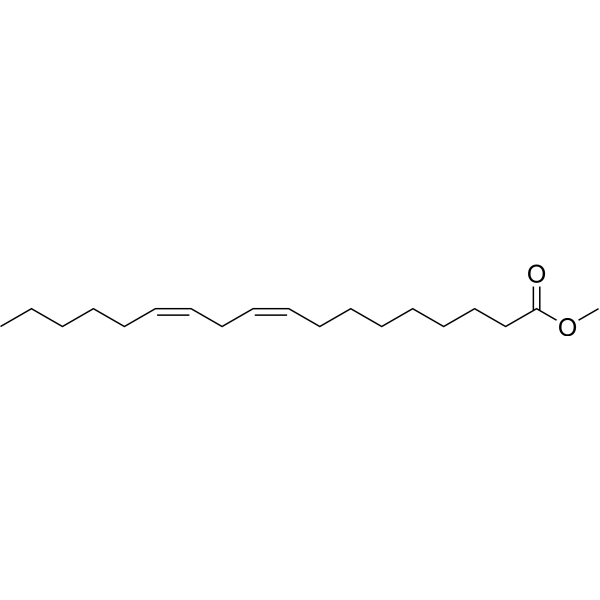
Methyl linoleateMITF Inhibitor -

HY-124177
C14 CeramideEster Product -
HY-116215
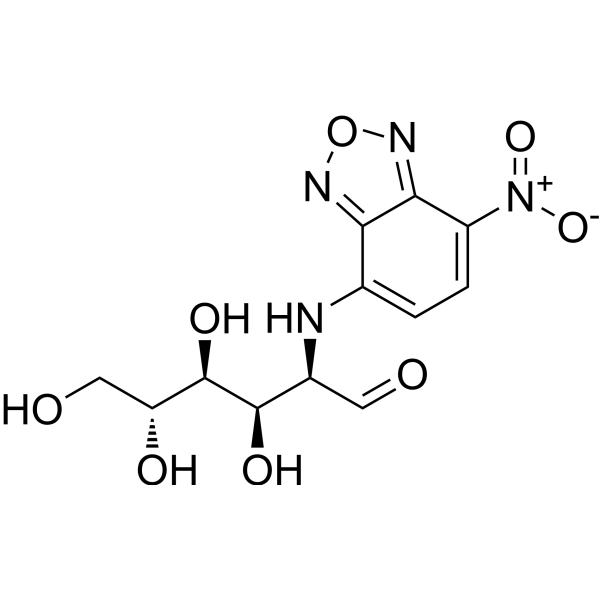
2-NBDGFluorescent Indicator -

HY-120657R
9-PAHSA (Standard)Anti-Inflammatory Lipid -

HY-W717504
Glucosylceramide, plantAnti-inflammatory Agent -

HY-165035
Glucosylceramide (gaucher's spleen)Sphingolipid/Gaucher Disease Biomarker -

HY-DY1019
2-NBDG (solution)Fluorescent Indicator -

HY-N1481R
Methyl linoleate (Standard)MITF Inhibitor -

HY-153830
LacCer (d18:1/16:0)Sphingolipid -
HY-115403
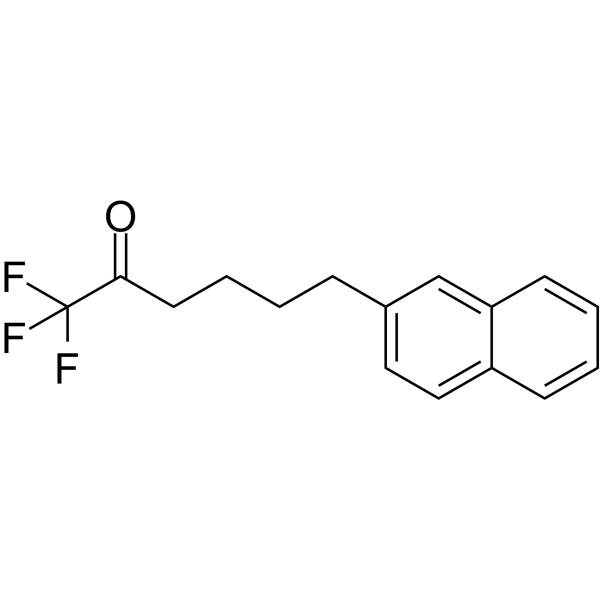
FKGK18GVIA iPLA2 Inhibitor -

HY-141635
cis-11,14-Eicosadienoic acid methyl esterPUFA -

HY-156206
C24 Dihydro ceramide (d18:0/24:0)Ester Product


Biological Activity
Description
In Vitro
(R)-9-PAHSA and (S)-9-PAHSA (20 μM; 30 min pre-incubation) do not significantly increase basal or insulin-stimulated glucose uptake in human in vitro differentiated adipocytes[1].
Racemic 9-PAHSA (1-20 μM; 2 h) does not stimulate glucose-dependent insulin secretion in dispersed mouse pancreatic islets[1].
9-PAHSA (5-30 μM; 72 h) exhibits no significant cytotoxicity toward 3T3-L1 pre-adipocytes following 72 h of treatment[3].
9-PAHSA (5-10 μM; 6 h) increases the viability of HepG2 cells with steatosis, with up to 140% relative viability observed in 500 μM oleic acid-treated cells, while higher 9-PAHSA concentrations reduce viability[4].
9-PAHSA (10-40 μM; 6 h) reduces intracellular lipid accumulation in oleic acid-induced steatotic HepG2 cells[4].
MedChemExpress (MCE) has not independently confirmed the accuracy of these methods. They are for reference only.
-
Cell Line:HepG2
-
Concentration:5 μM, 10 μM, 20 μM, 40 μM; tested in cells pre-treated with 250 μM, 500 μM, or 1000 μM oleic acid
-
Incubation Time:6 h
-
Result:Increased relative cell viability to up to 120% in HepG2 cells treated with 250 μM oleic acid at 5 μM, while reduced viability at 10 μM, 20 μM, and 40 μM.
Increased relative cell viability to up to 140% in HepG2 cells treated with 500 μM oleic acid at 5 μM and 10 μM, while reduced viability at 20 μM and 40 μM.
Increased relative cell viability slightly in HepG2 cells treated with 1000 μM oleic acid at 5 μM and 10 μM, while reduced viability at 20 μM and 40 μM.
In Vivo
9-PAHSA (45 mg/kg; oral gavage; single acute dose) does not improve glucose tolerance or stimulate insulin or GLP-1 secretion in male C57BL/6J mice fed BT-HFD for 18 weeks[1].
9-PAHSA (15 mg/kg; oral gavage; single acute dose) does not improve glucose tolerance or stimulate glucose-stimulated insulin secretion in male C57BL/6J mice fed LARD-HFD for 20 weeks[1].
9-PAHSA (50 mg/kg; i.g.; daily; 28 days) improves type 2 diabetes-associated cognitive impairment in db/db mice by reducing cortical REST expression and upregulating cortical BDNF expression, while also restoring spatial working memory and social novelty preference[2].
9-PAHSA (50 mg/kg; p.o.; once daily; 28 days) promotes browning of subcutaneous inguinal white adipose tissue in both wild-type and ob/ob mice via upregulation of brown fat-specific genes and proteins, with more pronounced effects in ob/ob mice[3].
MedChemExpress (MCE) has not independently confirmed the accuracy of these methods. They are for reference only.
-
Animal Model:C57BL/6J mice with Type 2 diabetes (male; 18-week diet-induced obesity via BT-HFD feeding)[1]
-
Dosage:45 mg/kg
-
Administration:oral gavage; single acute dose
-
Result:Increased plasma levels significantly to around 145 nM.
Detected no significant differences in glucose excursion during oGTT, baseline insulin secretion, glucose-stimulated insulin secretion, or active GLP-1 release compared to vehicle-treated mice.
-
Animal Model:C57 mice with Obesity (20-week-old male, wild-type); C57BL ob/ob (20-week-old male, transgenic obesity model)[3]
-
Dosage:50 mg/kg
-
Administration:p.o.; once daily; 28 days
-
Result:Did not significantly alter body weight or food intake in either WT or ob/ob mice.
Reduced triglyceride levels (no specific numerical value provided).
Significantly increased mRNA expression of brown fat-specific markers UCP1, PGC1α, Cidea, and PRDM16 in sWAT, with greater increases observed in ob/ob mice compared to WT mice.
Significantly elevated protein levels of UCP1 and PGC1α in both mouse strains.
Induced smaller, multilocular fat cells in sWAT of treated mice via H&E staining.
Increased UCP1 and PGC1α staining in sWAT via immunohistochemistry.
- 3T3-L1 preadipocyte-to-adipocyte differentiation
- RNA extraction experimental
- Mitochondrial membrane-potential fluorescent assay
- Large-size fat particle sorting
- Research Protocol for Endocrine Diseases
- Mitochondrial membrane-potential and mitochondrial mass staining
- Human Islet Cell Culture
- Research Protocol for Inflammation-related Diseases
- Research Protocol for Metabolic Diseases
- Lipid Droplets: Oil Red O/Sudan Dye Lipid Staining
- Alzheimer’s Disease Modeling


Chemical Information
-
CAS No. 1481636-31-0
-
Appearance Solid
-
Molecular Weight 538.89
-
Formula C34H66O4
-
Color White to off-white
-
SMILES
OC(CCCCCCCC(CCCCCCCCC)OC(CCCCCCCCCCCCCCC)=O)=O
-
Structure Classification
-
Initial Source
-
Shipping
Room temperature in continental US; may vary elsewhere.
-
Storage
Powder -20°C 3 years 4°C 2 years In solvent -80°C 6 months -20°C 1 month


Solvent & Solubility
In Vitro:
DMSO : 5 mg/mL (9.28 mM; ultrasonic and warming and heat to 80°C; Hygroscopic DMSO has a significant impact on the solubility of product, please use newly opened DMSO)
Please refer to the solubility information to select the appropriate solvent. Once prepared, please aliquot and store the solution to prevent product inactivation from repeated freeze-thaw cycles.
Storage method and period of stock solution: -80°C, 6 months; -20°C, 1 month. When stored at -80°C, please use it within 6 months. When stored at -20°C, please use it within 1 month.
Please refer to the solubility information to select the appropriate solvent. Once prepared, please aliquot and store the solution to prevent product inactivation from repeated freeze-thaw cycles.
Storage method and period of stock solution: -80°C, 6 months; -20°C, 1 month. When stored at -80°C, please use it within 6 months. When stored at -20°C, please use it within 1 month.
Concentration (start) × Volume (start) = Concentration (final) × Volume (final)
In Vivo:
Select the appropriate dissolution method based on your experimental animal and administration route.
- For the following dissolution methods, please ensure to first prepare a clear stock solution using an In Vitro approach and then sequentially add co-solvents:
- To ensure reliable experimental results, the clarified stock solution can be appropriately stored based on storage conditions. As for the working solution for In Vivo experiments, it is recommended to prepare freshly and use it on the same day.
- The percentages shown for the solvents indicate their volumetric ratio in the final prepared solution. If precipitation or phase separation occurs during preparation, heat and/or sonication can be used to aid dissolution.
Add each solvent one by one: 10% DMSO 40% PEG300 5% Tween-80 45% Saline
Solubility: 0.5 mg/mL (0.93 mM); Clear solution; Need ultrasonic
This protocol yields a clear solution of 0.5 mg/mL.
Taking 1 mL working solution as an example, add 100 μL DMSO stock solution (5.0 mg/mL) to 400 μL PEG300, and mix evenly; then add 50 μL Tween-80 and mix evenly; then add 450 μL Saline to adjust the volume to 1 mL.
Preparation of Saline: Dissolve 0.9 g sodium chloride in ddH₂O and dilute to 100 mL to obtain a clear Saline solution.
Add each solvent one by one: 10% DMSO 90% (20% SBE-β-CD in Saline)
Solubility: 0.5 mg/mL (0.93 mM); Clear solution; Need ultrasonic
This protocol yields a clear solution of 0.5 mg/mL.
Taking 1 mL working solution as an example, add 100 μL DMSO stock solution (5.0 mg/mL) to 900 μL 20% SBE-β-CD in Saline, and mix evenly.
Preparation of 20% SBE-β-CD in Saline (4°C, storage for one week): 2 g SBE-β-CD powder is dissolved in 10 mL Saline, completely dissolve until clear.
In Vivo Dissolution Calculator
Please enter the basic information of animal experiments:
-
-
-
-
Recommended: Prepare an additional quantity of animals to account for potential losses during experiments.
Please enter your animal formula composition:
-
%DMSO +
Recommended: Keep the proportion of DMSO in working solution below 2% if your animal is weak.
-
%+
-
+%Tween-80 + +
-
%Saline +
The co-solvents required include: DMSO, . All of co-solvents are available by MedChemExpress (MCE). , Tween 80. All of co-solvents are available by MedChemExpress (MCE).
Working solution concentration: 0.22 mg/mL
Method for preparing stock solution: mg drug dissolved in μL DMSO. Stock solution concentration: mg/mL.
1. Take μL DMSO stock solution;
2. Add μL .
μL , mix evenly;
3. Then add μL Tween 80, mix evenly;
4. Then add μL
Please ensure that the stock solution in the first step is dissolved to a clear state, and add co-solvents in sequence. You can use ultrasonic heating (ultrasonic cleaner, recommended frequency 20-40 kHz), vortexing, etc. to assist dissolution.


Purity & Documentation
-
Data Sheet (278 KB)
-
SDS (647 KB)
- English - EN (647 KB)
- Français - FR (647 KB)
- Deutsch - DE (647 KB)
- Norwegian - NO (647 KB)
- Español - ES (647 KB)
- Swedish - SV (647 KB)
- Italian - IT (647 KB)
- Korean - KR (647 KB)
- Portuguese - PT (647 KB)
-
Handling Instructions (2659 KB)
References
[1]. Pflimlin E, et al. Acute and Repeated Treatment with 5-PAHSA or 9-PAHSA Isomers Does Not Improve Glucose Control in Mice. Cell Metab. 2018;28(2):217-227.e13. [Content Brief]
[2]. Wen XH, et al. Effect of 9 - PAHSA on cognitive dysfunction in diabetic mice and its possible mechanism. Biochem Biophys Res Commun. 2020;524(3):525-532. [Content Brief]
[4]. Schultz Moreira AR, et al. 9-PAHSA Prevents Mitochondrial Dysfunction and Increases the Viability of Steatotic Hepatocytes. Int J Mol Sci. 2020;21(21):8279. Published 2020 Nov 5. [Content Brief]


Complete Stock Solution Preparation Table
Please refer to the solubility information to select the appropriate solvent. Once prepared, please aliquot and store the solution to prevent product inactivation from repeated freeze-thaw cycles.
Storage method and period of stock solution: -80°C, 6 months; -20°C, 1 month. When stored at -80°C, please use it within 6 months. When stored at -20°C, please use it within 1 month.
| Optional Solvent | Concentration Solvent Mass | 1 mg | 5 mg | 10 mg | 25 mg |
|---|---|---|---|---|---|
| DMSO | 1 mM | 1.8557 mL | 9.2783 mL | 18.5567 mL | 46.3917 mL |
| 5 mM | 0.3711 mL | 1.8557 mL | 3.7113 mL | 9.2783 mL |


9-PAHSA Related Classifications
HY-120657 Related Classifications
 Powered by Bioz